Skip to content
Booking projects for next month. Free website audit with every quote.Claim yours →

Home services and tradesBooking projects for November

HVAC Website Development Company for More Booked Service Calls

A dead furnace at 9 p.m. and a 17-year-old AC due for replacement need different pages, a number that dials on the first tap and booking straight into your dispatch board. We build HVAC sites that switch with the season, sell your maintenance plan online and show which source booked each job.

  • Built for HVAC contractors
  • Fixed quote in 1 business day
  • You own everything
yourhvac.com/no-heat-repair24/7 furnace repairin ColumbusBook a techTap to callNew booking: no heat upstairsFrom /no-heat-repair · 9:14 pmTracked as a leadSource: GoogleAI ASSISTANTWho can fix my furnace tonight near me?Your Company: licensed, 24/7 no-heatservice, book online tonight.Source: your website
Illustration: a visit becomes a tracked lead

The short answer

What does an HVAC website development company do?

An HVAC website development company builds websites for heating and cooling contractors that turn local searches for AC repair, furnace repair, heat pump installation and tune-ups into answered calls, online bookings and replacement estimate requests. The site has to reach a homeowner with no heat on a January night, prove you are licensed and real, explain your maintenance plan and financing in plain terms, and record which page and channel produced each booked job.

For a residential service and replacement company that means one page per job (a ductless mini-split install is a different search from a furnace that short cycles), emergency no-heat and no-cool pages, a homepage that leads with cooling in spring and summer and heating in fall and winter, a replacement estimate flow, a membership page with online sign-up and a short list of real town pages. For light commercial work it adds rooftop unit service and preventive maintenance agreement pages with a request path for property managers.

Billion Web Studio is an HVAC website development company that delivers this as one fixed-scope project: design, service and town pages, HVACBusiness schema, call and form tracking in GA4, and online booking through ServiceTitan Scheduling Pro, Housecall Pro or the field-service software you already run. You own the site, the domain and every account from day one, with no per-lead fees and no lock-in.

The market

What the numbers say about HVAC contractors online

HVAC is two businesses in one year: emergency repairs when the weather turns, and planned replacements and tune-ups in between. IBISWorld counts well over a hundred thousand heating and air-conditioning contractors in the US, so a homeowner with a dead system has plenty of numbers to call. The figures below show how much reviews weigh in that choice, what happens to a call nobody answers, how fast the choice is made and why homeowners walk away.

How they choose

How customers find and choose an HVAC company

HVAC jobs start two ways: a breakdown (no heat on the first cold night, warm air from the vents in August, a heat pump stuck in defrost) or a planned decision (a 15-year-old AC, a high summer bill, a rebate letter from the utility). Both end with a call or a booking made fast. Here is how a US homeowner picks an HVAC company and what your site has to do at each step.

  1. 1

    The trigger: the house is too hot or too cold

    The search uses plain words: "AC not cooling", "furnace repair near me", "heat pump blowing cold air". Your site needs a page for each of those problems, written the way homeowners say it, with the phone number and a Book Online button above the fold on a phone.

  2. 2

    The shortlist: map pack, AI answer, two or three sites

    Most start on Google, and many now ask an AI assistant too. BrightLocal found 72% look at three or fewer businesses. Your site and Google Business Profile must match exactly on name, phone, hours and service area, so every source tells the same story.

  3. 3

    The check: reviews, license, price signals

    BrightLocal found star rating and review count weigh more for trades and home services than for any other industry. The site has to show your rating with a link to the profile, license numbers, real technician and truck photos, your diagnostic or service call terms, and whether nights and weekends cost extra.

  4. 4

    The contact: call, text or book at 9 p.m.

    A breakdown call goes to whoever answers or books first. The site gives three paths: tap to call, tap to text, and a 24/7 scheduler from your dispatch board, so a no-cool repair booked after hours lands on tomorrow's board instead of in a competitor's.

  5. 5

    The bigger decision: repair or replace

    When the tech recommends a new system, the homeowner goes back online to check you. Replacement pages, a free estimate or second opinion request, financing with the terms the law requires, a dated rebates page and your maintenance plan close the job and keep the customer for the next 15 years.

The problem

Why most HVAC websites lose booked jobs

What we find again and again when we audit sites in this trade. None of it is about how the site looks.

Leak 01

The phone number hides on a phone

When the AC dies in a heat wave, the homeowner is on a phone in a hot kitchen. A number shown only as an icon, or tucked in the footer, sends them back to the map pack. Keep the full number as text in the header on every page, with tap to call and tap to text.

Leak 02

No path for no-heat calls after hours

One HVAC owner in r/HVAC says leads that come in after 7 p.m. are booked with someone else by 8 a.m. CallRail reports up to 85% of callers who reach no one do not call back. A site with no emergency page and no online booking loses those jobs every winter night.

Leak 03

The site is out of season and out of date

An AC tune-up banner in December, expired fall coupons, low-monthly-payment banners with a payment figure but no APR or term, and pages still promising the federal heat pump tax credit, which the IRS limits to property placed in service before December 31, 2025. Heating and cooling searches swing with the weather, and a site that does not swing with them tells the homeowner who checks that nobody is minding the store.

Leak 04

The Book Online button never reaches dispatch

Some booking buttons are script placeholders with no fallback link, or forms that land in an inbox nobody checks on Saturday. If the scheduler is not embedded from ServiceTitan, Housecall Pro or your own software, and tested with a real booking, the job is lost without anyone noticing.

Leak 05

Thirty town pages with the same text

An HVAC owner on r/SEO built about 30 location pages with identical copy and only one ranked. Google's spam policies name city pages that funnel users to one page as doorway abuse. Stock photos and copy-paste pages also do little to prove a real business when a Google profile is questioned.

Leak 06

Your site and your Google profile tell different stories

A different phone number after a developer handover, old hours, a P.O. box or a license number that does not match state records. On Local Search Forum, replies to HVAC owners say Google runs suspension sweeps on heavily abused categories, and in one r/GoogleMyBusiness thread a new HVAC company whose two appeals were denied found its site's Call Now number had changed at handover. AI answers repeat the mismatch too.

Generic vs built for you

Why a generic website fails HVAC contractors

A template is built to fit every business, so it fits yours badly. Here is what changes when the site is planned around how customers actually buy.

Generic website compared with a website built for HVAC contractors
What you needGeneric template siteBuilt for HVAC contractors
Heating and cooling seasonsOne static homepage all yearA seasonal hero, offers and tune-up booking that switch from cooling to heating without changing URLs
No-heat and no-cool emergenciesA contact form and a phone iconEmergency pages with what to check first (breaker, thermostat, filter), the after-hours number, your night and weekend terms and a booking path
Online bookingA generic appointment widget that writes to an email inboxServiceTitan Scheduling Pro, Housecall Pro or your own software embedded, with booking source captured and a real test booking before launch
Replacement estimatesOne "Get a quote" form asking for name and emailA two-step estimate flow: system type, fuel, home size and system age first, contact details second, plus a free second opinion request
Maintenance plan salesA paragraph that says "ask about our plans"A plan page with visits per year, priority scheduling, repair discounts, price, billing, renewal and cancel terms next to an online sign-up
Financing"Low monthly payments" with a made-up exampleA financing page and pre-qualification link, with payment examples only when the APR and repayment terms sit beside them
Licenses and trust"Licensed, bonded and insured" in a stock badgeEvery state license number in the footer, EPA 608 and NATE only where true, real techs and trucks, and no "bonded" claim on California sites, which CSLB does not allow
Town pagesDozens of city-swap pages with the same textFewer town pages, each with local jobs, photos, permit notes and reviews from that area

Free self-check · 2 minutes

What your current HVAC website is missing

Tick everything your site does today. Each box you cannot tick is a place where a ready-to-buy visitor leaves.

What you need

What every HVAC website needs

The features that turn an HVAC website from a brochure into the best salesperson you have. We build all of them.

  1. Must-have · 01

    Full phone number in the header, tap to call and tap to text

    The number as text, not just an icon, on every page, with a sticky call and text bar on mobile. It matches the number on your Google Business Profile and in your schema.

  2. Must-have · 02

    No-heat and no-cool emergency pages

    Separate pages for furnace and AC breakdowns with a short safety and self-check list, your after-hours number, whether nights and weekends cost extra, and a booking button for the next open slot.

  3. Must-have · 03

    One page per real job

    AC repair, AC replacement, heat pump repair and installation, furnace repair and replacement, boiler service, ductless mini-split installation, indoor air quality, duct sealing, thermostats and, if you do it, geothermal and rooftop units. Each answers the questions that job raises.

  4. Must-have · 04

    A homepage that follows the season

    Cooling first in spring and summer, heating first in fall and winter, with the matching tune-up offer. ENERGY STAR tells homeowners to check cooling in spring and heating in fall, and your homepage should say the same thing at the same time.

  5. Must-have · 05

    24/7 online booking from your dispatch board

    ServiceTitan Scheduling Pro, Housecall Pro Online Booking or your current software embedded on the site, with arrival windows, both www and non-www domains allowed, and source data passed through for attribution.

  6. Must-have · 06

    A replacement estimate flow

    Two steps: system type, fuel, square footage and age of the current unit first, then contact details and preferred time. Your comfort advisor shows up knowing whether it is a heat pump conversion or a like-for-like furnace swap.

  7. Must-have · 07

    A maintenance plan page that sells

    What the plan includes (two tune-ups a year, priority scheduling, repair discounts, no overtime fees if you offer that), the price, billing frequency, renewal and how to cancel, next to an online sign-up button. Linked from every repair page.

  8. Must-have · 08

    Financing and rebates done by the rules

    Your lender's pre-qualification link on every replacement page, and a monthly payment figure only with the disclosures Regulation Z requires. A rebates page lists utility and state programs with a last-reviewed date and an owner who updates it, so you never promise a federal credit that has ended or a rebate the utility has closed.

  9. Must-have · 09

    License numbers and certifications

    Every license number you hold, by state, in the footer and on About and Contact. EPA Section 608 technician certification, NATE and manufacturer dealer status shown only where true.

  10. Must-have · 10

    Reviews, guarantees and real photos near the top

    Your Google rating and review count near the top of the homepage with a link to the profile, a review request link sent to every customer the same way, a guarantees page (workmanship, comfort, property protection) and real photos of your techs, trucks and installs. Over 90% of homeowners check reviews before they pick an HVAC contractor (ACCA).

  11. Must-have · 11

    Town pages backed by real jobs

    A service area hub and a page per real market, each with installs and repairs done there, photos, local permit notes and reviews from customers in that town.

  12. Must-have · 12

    HVACBusiness schema and fast mobile pages

    schema.org HVACBusiness markup with service area, hours, services and phone, plus Core Web Vitals targets of LCP 2.5 seconds or less, INP 200 ms or less and CLS 0.1 or less.

What we build

The HVAC website we would build for you

Here is the sitemap we would start from for a residential HVAC company. We cut or add pages to match the jobs you actually want, the brands you install and the towns you actually serve.

yourcompany.comHome · every section links here

Cooling

  • AC repair
  • AC replacement and installation
  • Heat pump repair
  • Heat pump installation
  • Ductless mini-split installation
  • AC tune-up
  • Emergency no-cool service

Heating

  • Furnace repair
  • Furnace replacement
  • Boiler service
  • Heat pump heating and defrost problems
  • Furnace tune-up
  • Emergency no-heat service

Air quality and commercial

  • Air purifiers and UV lights
  • Humidifiers and dehumidifiers
  • Duct cleaning and duct sealing
  • Smart thermostats
  • Commercial HVAC and rooftop units
  • Preventive maintenance agreements

Offers and help

  • Maintenance plan with online sign-up
  • Financing
  • Rebates and incentives
  • Seasonal specials and coupons
  • Free replacement estimate
  • Free second opinion
  • Repair or replace guide
  • Help guides: filters, system sizing (Manual J), R-410A and newer refrigerants

Service areas

  • Service area hub
  • Town pages backed by local jobs
  • Location page for each real office
  • Job stories by town

Trust and company

  • Reviews
  • Licenses and certifications
  • Guarantees and warranties
  • Brands we install and dealer pages
  • Technicians and team
  • Careers for HVAC techs
  • FAQ
  • Contact

Calls, bookings, leads

How we turn visitors into booked jobs

Good website design for HVAC contractors is judged in booked jobs: a visitor becomes a booked call, a scheduled tune-up, a replacement estimate or a plan member, and you can see where each one came from. This is how we build that path and track every lead.

  • 01Sticky call and text bar on mobileCall and Text buttons stay at the bottom of the screen on every page. Each tap is a GA4 conversion event tagged with the page, so you know whether the AC repair page or the furnace page rings the phone.
  • 0224/7 booking from your field-service softwareWe embed ServiceTitan Scheduling Pro, Housecall Pro Online Booking or your current scheduler, add a plain link fallback, and make a real test booking before launch. UTM values and click IDs pass through so the job in your software shows where it came from.
  • 03A request form that asks what dispatch needsRepair, replacement estimate or maintenance; furnace, heat pump, AC, boiler or mini-split; is the system down now; ZIP code; best time. The office stops calling back just to ask what the problem is.
  • 04Two-step replacement estimate flowSystem and home details first, contact second, with a financing pre-qualification link on the thank-you page. It sorts high-ticket replacement leads from repair calls before anyone picks up the phone.
  • 05Membership sign-up and renewal onlinePlan benefits, price, billing, renewal and cancel terms beside the sign-up, with a confirmation sent after sign-up. Every repair page links to the plan, so a repair customer can become a plan member.
  • 06Call tracking that keeps your real number intactDynamic number insertion swaps the shown number for ad and campaign visitors only. Your main number stays in the schema, the footer and the Google profile, so your business details stay consistent everywhere.
  • 07A monthly lead report you can readCalls, texts, bookings, estimate requests and plan sign-ups by source and page, in plain numbers. You see which channel books replacements and can stop paying for the ones that do not.

AI search

Homeowners now ask ChatGPT, Google AI Mode and Perplexity which HVAC company to call. BrightLocal found 45% of consumers used generative AI for local recommendations. In its 2026 study of local AI answers, business websites were about 93% of cited domains, and service-area businesses, which is how most HVAC companies run, were named less often than storefronts (29.4% against 33.6%). AI assistants lean on your Google profile, your reviews and your own site, so the site has to state plainly what you do, where, when and with what proof.

Questions your customers ask AI assistants

  • Who is the best-rated HVAC company near me that can come out today?
  • Which HVAC companies in Plano offer 24/7 emergency furnace repair?
  • Should I repair or replace my 15-year-old AC?
  • Is a heat pump worth it in a cold climate, and who installs them near me?
  • Which local HVAC companies offer a maintenance plan, and what does it include?
  • Is this HVAC company licensed in Texas?
  • Facts written as text, not hidden in images

    Services, brands you install, towns served, hours, after-hours terms, license numbers and guarantees as plain text on the page. An AI assistant cannot quote a license number that only appears inside a badge image.

  • One identity across site and profile

    The same business name, phone, hours and service area on your site, Google Business Profile and directory listings. AI answers have been seen pulling old hours from out-of-date pages, so we fix the inconsistencies before launch.

  • Pages that answer the questions people ask

    Repair or replace, heat pump in cold weather, what size system you need (Manual J), what a tune-up includes, whether the old tax credit still applies. Each answered on the page in the first lines, in words a homeowner uses.

  • Proof AI can cite

    Real job stories by town and system type, your Google rating linked to the profile, technician certifications and dated rebate content. Specific, checkable facts are what an assistant can repeat about you.

  • HVACBusiness schema

    Structured data with your service area, opening hours, services and phone number, so search engines and AI systems read the same facts the visitor sees.

  • An AI information page

    A plain fact page about your company: services, towns, hours, licenses, brands and plans. At least one large HVAC company already publishes one, and it gives assistants a single clean source.

Compliance and trust

The rules an HVAC website has to get right

An HVAC site makes claims that state boards, federal agencies and Google all have rules about: license numbers, financing payments, membership renewals, texts, reviews and tax credits. We build pages and forms that support these rules. We do not certify legal compliance; you confirm your state rules with your licensing board and your financing terms with your lender.

License numbers in every place they are required

Texas rules require air conditioning and refrigeration contractors to include the licensee's number in advertising. Florida statute requires the certification or registration number in advertisements regardless of medium. California's CSLB says license numbers belong on websites, contractors may not advertise outside their classification, and may not advertise that they are bonded. We place every license you hold in the footer, About and Contact pages.

Financing and membership wording

Under Regulation Z (12 CFR 1026.24, for installment loans), a monthly payment in an ad requires the down payment, repayment terms and APR; revolving card plans follow 1026.16, so we use your lender's approved wording. Membership plans billed monthly need price, billing frequency, renewal and cancel terms beside the sign-up button; federal negative option rules are in flux and many states have automatic renewal laws.

Consent for tune-up reminders and promotional texts

The TCPA requires prior express written consent for autodialed or prerecorded marketing texts and calls to cell phones, and consent cannot be a condition of purchase. Our forms carry separate, clear consent text and a STOP path, so a service request does not quietly sign someone up for promotions.

Honest reviews

The FTC Consumer Reviews and Testimonials Rule bans fake reviews, rewards tied to positive sentiment, undisclosed reviews from employees and buying fake social media followers or views. We build review requests that go to every customer the same way. Google does not show star rich results for reviews a business controls about itself, so we link to your profile instead.

Tax credit, refrigerant and certification claims kept current

The IRS limits the 25C heat pump credit to property placed in service before December 31, 2025. In May 2026 EPA lifted the 1 Jan 2026 installation deadline for residential and light commercial R-410A AC and heat pump equipment made or imported before 2025, while New York kept its own deadline. EPA 608 certification is a federal requirement for technicians who handle refrigerant. Pages that mention these carry a last-reviewed date.

Accessibility and privacy

The Justice Department says the ADA applies to the websites of businesses open to the public. We build to WCAG: alt text, color contrast, labeled forms with clear errors and keyboard navigation. Forms collect only what dispatch needs, and a privacy policy explains what you do with it.

We build with tools and patterns that support these rules and document what we set up. For legal advice on your own obligations, talk to your attorney.

From the forums

What HVAC contractors ask about websites, answered

We read what HVAC owners ask each other on r/HVAC, r/sweatystartup, r/GoogleMyBusiness, r/smallbusiness, r/SEO and Local Search Forum. The same worries come up: long marketing contracts with reports nobody can read, shared leads, suspended Google profiles, reviews and night calls lost by morning. These are their questions, paraphrased, with our straight answers.

Where owners talkr/HVACr/sweatystartupr/GoogleMyBusinessr/smallbusinessr/SEOLocal Search Forum

Asked on r/SEO

“My two-year contract with a home services marketing company is nearly up and I cannot see what it did for me. What should I ask the next one?”

Our answer: Before you sign with any HVAC website design company, ask who will own the site, domain and tracking numbers, how long the contract runs, and how you will see calls and booked jobs by source without their help. Check that your domain, Google profile and the words you target all match one brand. We work on a fixed scope with no lock-in, you own everything from day one, and the report is plain numbers you can read yourself.

Asked on r/SEO

“I built about 30 town pages with the same text. Why does only one of them rank?”

Our answer: Google treats near-identical pages as duplicates and may ignore most of them, and its spam policies name city pages that funnel to one page as doorway abuse. Build fewer town pages, each with installs and repairs done there, local photos, permit notes and reviews from that area. Mention the other towns on your main service pages.

Asked on r/HVAC

“A lead marketplace keeps calling me. Are shared leads worth it for a one-man HVAC shop?”

Our answer: Owners in the thread found the same lead goes to several companies and becomes a race on price. Your own site, profile and reviews send the call to you alone, and call tracking shows your real cost per booked job. We charge no per-lead fees.

Asked on r/HVAC

“Will my equipment manufacturer's dealer program send me leads?”

Our answer: Owners report a handful a year at most, mostly from the brand's dealer locator. A dealer page on your own site (for example ductless installation for the brand you carry, in your town) and a current rebates page help, but your own site and reviews have to carry the load. If a distributor offers co-op money, check their rules for outside web builders first.

Asked on r/sweatystartup

“We have never run ads. Will Google Ads pay off for a small heating and plumbing company?”

Our answer: An owner in the thread says yes, but only because they track cost per lead, hit rate, average job size and margin. Replies say start with search ads rather than social, partly because Facebook and Instagram carry many HVAC scam ads that have made homeowners wary. Each ad needs a matching page (furnace replacement ads go to the furnace replacement page, not the homepage). We set up call and form tracking by source so you can run that math.

Asked on r/GoogleMyBusiness

“Our new HVAC Google profile was suspended and two appeals were denied. Can the website be part of the problem?”

Our answer: It can be. In one thread the Call Now number on the site had changed when it moved from the previous developer, and other details did not match, though replies named a P.O. box address as the likely main trigger. Before and after launch we check that the name, phone, address handling, license number and service area on the site match your profile and state records. We do not promise reinstatement.

Asked on r/HVAC

“How do I get more Google reviews without it being awkward or breaking the rules?”

Our answer: Owners say ask every customer at the end of the job and text the direct link the same day; QR codes and tap cards on the tech's tablet help. Do not offer discounts or bonuses tied to five-star reviews, and that includes paying techs only for five-star reviews that name them: Google prohibits paying for reviews and the FTC rule bans rewards tied to positive sentiment. We put a review link on the site and in follow-ups, sent the same way to everyone.

Asked on r/smallbusiness

“I show near the top for AC repair near me, but nobody calls. Why?”

Our answer: Ranking is not trust. Next to competitors with hundreds of real reviews, a new company needs to show its license number, real truck and tech photos, guarantees and reviews from actual customers, not friends and family. The site's job is to turn that visit into a call, and to show you how many visits did not.

Asked on Local Search Forum

“Should we switch our Google primary category with the seasons, furnace repair in winter and AC repair in summer?”

Our answer: SEOs on the forum are split: some swap categories twice a year with no trouble, others have seen a category change trigger re-verification or a suspension. The safer move is on your own site: a homepage, offers and tune-up booking that switch with the season, and separate pages for furnace repair, AC repair and the brands you service. Check which category the map pack winners in your town use before you change anything.

Asked on r/sweatystartup

“We already have hundreds of reviews and get found on the map. What would a better website even add?”

Our answer: Fair point: with strong reviews, much of your work starts on the Google profile, and referrals still matter most. The site's job is to turn the profile visit into a booked call, sell plans and replacements between rush seasons, and show which source produced each job. If yours does that today, keep it.

Questions are paraphrased from public threads. We never quote members by name.

Others vs us

HVAC website design options: Billion Web Studio vs a website builder template vs a typical HVAC marketing agency

The three ways HVAC contractors usually get a website, side by side.

HVAC website design options: Billion Web Studio vs a website builder template vs a typical HVAC marketing agency
Billion Web StudioWebsite builder templateTypical industry agency
Who owns the site, domain and contentYou do, from day one, in your own accountsYou own the content; the site lives on the builder's platformOften the agency, on a rented site you lose if you leave
Contract and pricingFixed quote in 1 business day, agreed before work starts, no lock-inMonthly subscription, you build it yourselfMonthly retainer, often on a 12-month or longer contract
Heating and cooling season switchSeasonal hero, offers and tune-up booking built in and editableManual edits if you rememberVaries; often the same homepage for every client
No-heat and no-cool emergency pathsEmergency pages, sticky call and text bar, 24/7 bookingA contact page and a phone iconUsually a call button, sometimes their call center
ServiceTitan or Housecall Pro bookingEmbedded, source data passed through, tested with a real bookingEmbed code if the builder allows itSometimes, often their own form instead
Maintenance plan and financing pagesPlan sign-up with terms, financing with required disclosuresWhatever you writeUsually present; disclosures vary
License numbers, texting consent, review rulesBuilt into the footer, forms and review flowUp to youVaries by agency
Call and booking tracking by sourceGA4 events plus call tracking, report in plain numbersBasic form countsTheir dashboard, which may stay with them if you leave
Town pagesFewer pages, each backed by local jobsOne page per town you copy and editOften many templated city pages

Why Billion Web Studio

What we do better, and why it matters to you

  • A fixed quote in 1 business day, with a free audit

    We review your current HVAC site, profile match, booking and tracking, then send a written scope and a fixed price based on pages, features, integrations and content. No hourly billing, no surprises.

  • You own everything from day one

    Code, design, content, domain, hosting, analytics and call tracking accounts in your name. No lock-in, and no site that disappears if you stop paying a retainer.

  • Built around how HVAC actually runs

    Most HVAC contractor website design starts from a generic home services template. Ours starts from how your year runs: seasonal switching, emergency paths, replacement estimates, membership sales, financing, rebates and license display are in the plan from the first week, not bolted on later.

  • A site move that does not break your Google profile

    Before and after launch we check that the phone number, name, hours, service area and license numbers on the new site match your Google Business Profile and state records. We keep the URLs that rank and redirect the rest. A number changed at handover is a known trigger for profile trouble.

  • Every call and booking traced to its source

    GA4 conversion events, call tracking and source data in your field-service software, so you can see which channel books furnace replacements and which only rings the phone.

  • A dated plan and a guarantee on it

    A week-by-week plan, weekly written updates and 30 days of free support after launch. If we slip a date because of us, the next month of support is free.

In writing, before we start

  • Fixed quote in 1 business day

    Scope, deliverables and price agreed in writing, with a free audit of your current site. No hourly billing.

  • Launch date in writing

    A dated week-by-week plan and a written update every week. If we slip because of us, the next month of support is free.

  • You own everything

    Code, design, content, domain and accounts are yours from day one. No 12-month contract, no rented site.

  • 30 days of support included

    We watch rankings, forms and call tracking after launch and fix anything that needs it.

Proof, not promises

Results from websites we have built

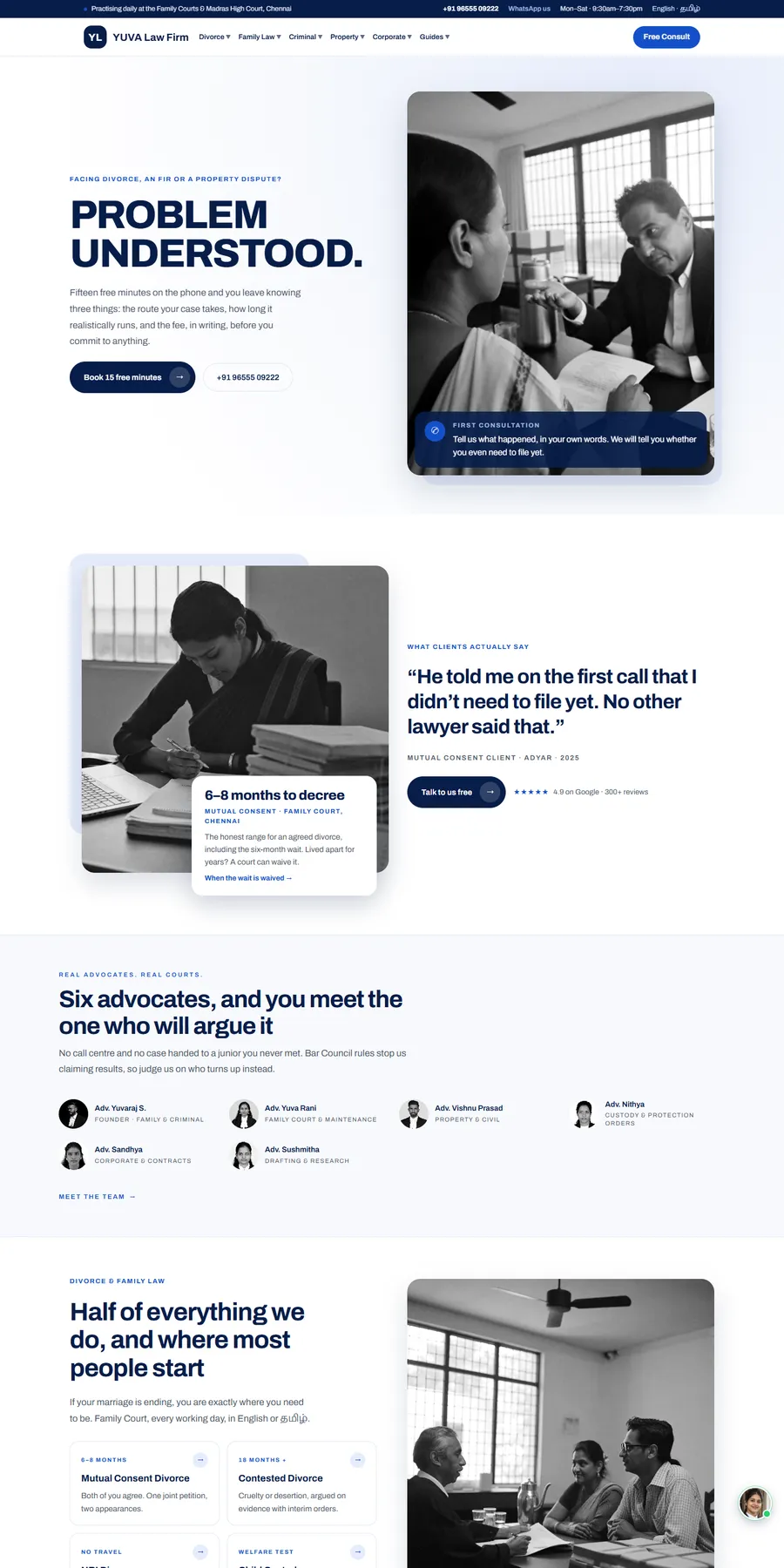
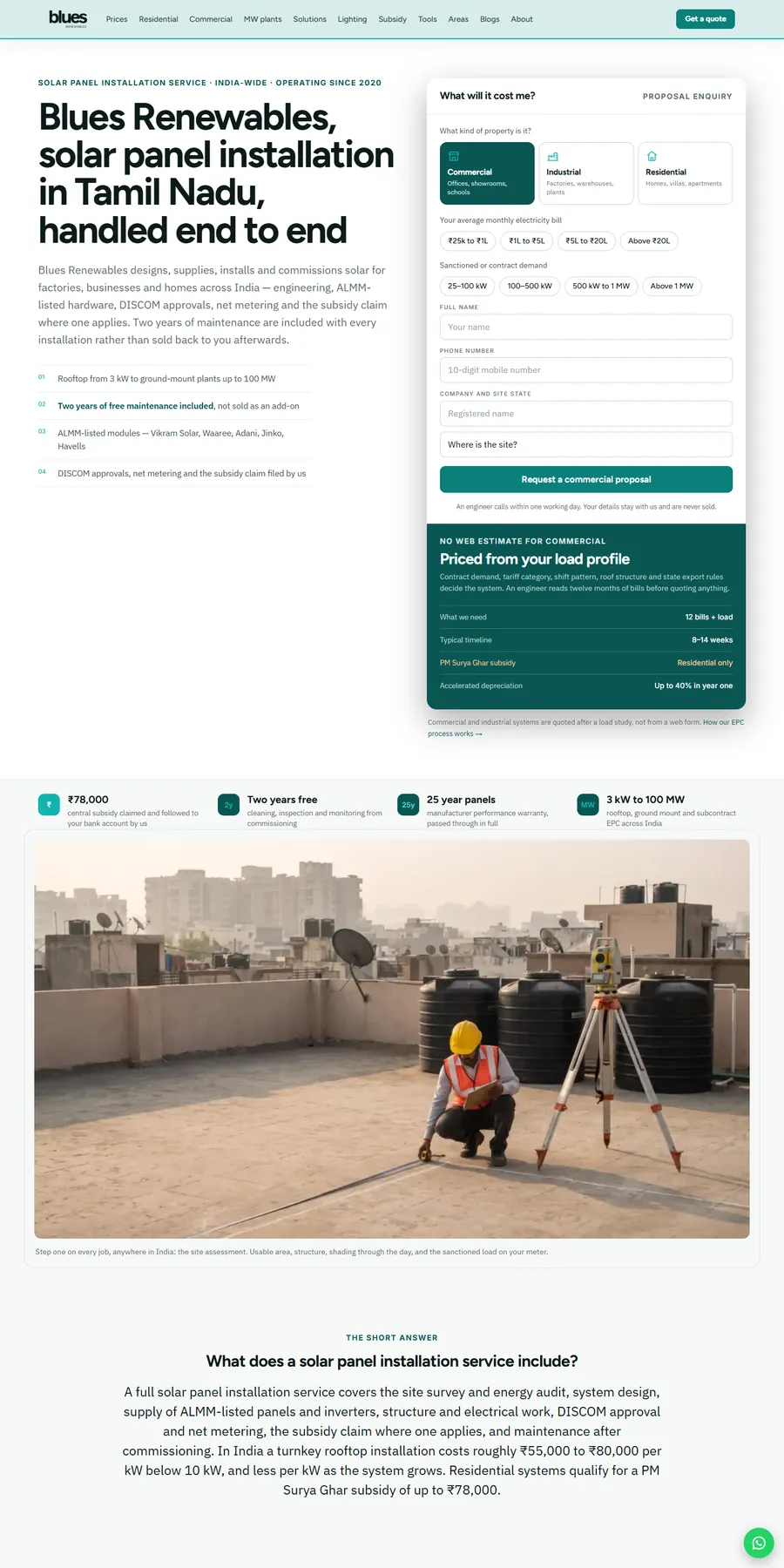
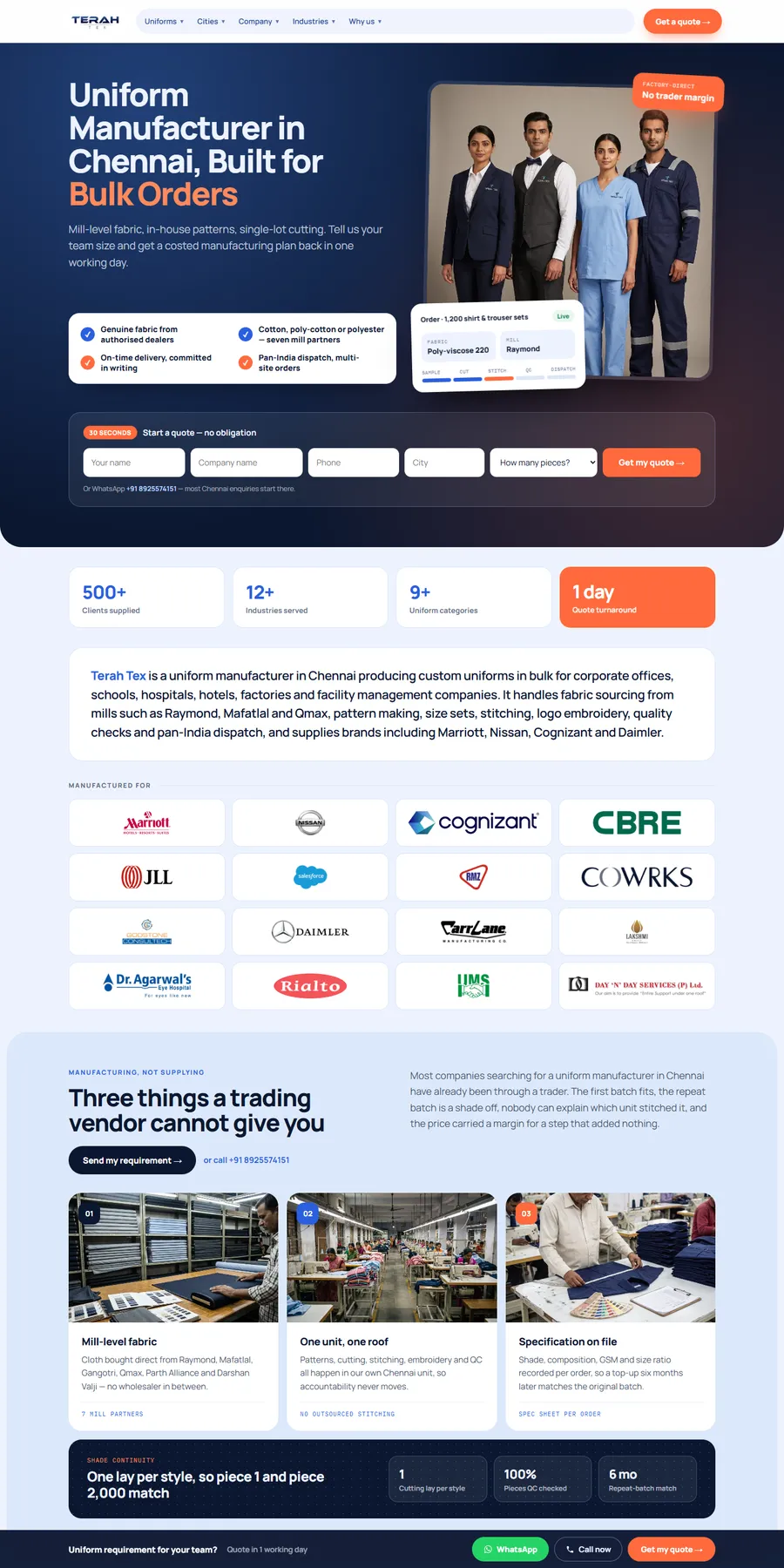
We have not built an HVAC company website yet, and we will not pretend otherwise. The closest proof is Blues Renewables, a rooftop solar installer that sells high-ticket home energy equipment through price pages by system size, subsidy guides and local area pages, the same buying pattern as a heat pump or furnace replacement. Its site went from no tracked leads to 7 to 10 enquiries a week, and Google clicks rose from 14 to 560 a fortnight in two months, with every call and form tracked as a GA4 lead event. For an HVAC company, its system-size pages become heat pump and AC replacement pages by system type and tonnage (with price ranges only if you choose to publish them), its subsidy guides become a dated rebates page, and its local area guides become a smaller set of town pages backed by real jobs. Its mobile pages score in the mid 80s to mid 90s on Lighthouse. Terah Tex shows the two-step quote form we would use for replacement estimates: it went from no website enquiries to about 5 bulk-order leads a week.

More websites we have designed and built

Process

How your HVAC website project runs

Typical timeline: 4 to 8 weeks for most HVAC sites; 8 to 12 weeks with many service area or location pages. You see progress every week.

  1. Step 01 · Week 1

    Discovery and audit

    We audit your current site, competitors, and how you show up on Google and in AI answers, then agree on goals and a fixed quote.

  2. Step 02 · Weeks 2 to 3

    Strategy and design

    Sitemap, wireframes and full designs for your review. You approve everything before we build.

  3. Step 03 · Weeks 3 to 6

    Build and test

    Development, SEO setup, speed tuning, and testing across devices and browsers.

  4. Step 04 · Launch and beyond

    Launch and grow

    We launch, monitor, and improve based on real data. 30 days of free support included.

What shapes your quote

Scope, not hourly billing

Every project gets a fixed quote within 1 business day, agreed before work starts.

Get my fixed quote →
  • How many service pages and real town or location pages you need
  • Which field-service software we connect for booking, and how membership billing works in it
  • Replacement estimate, maintenance plan sign-up and financing flows
  • Whether we write the content and organize photos of your techs, trucks and installs
  • Moving from your current site: redirects, keeping pages that rank and setting up tracking first
  • Multi-trade or multi-location setups, such as HVAC plus plumbing or a second metro

HVAC website questions, answered

Straight answers to what owners ask us, and what they ask Google and AI assistants. Ask us anything else.

How much does an HVAC website cost?

Our HVAC web development services are quoted as one fixed price, agreed before work starts, based on the number of pages, features, integrations and content. You get it within 1 business day of a free audit of your current site. There is no hourly billing and no per-lead fee.

How long does it take to build an HVAC website?

Most HVAC sites take 4 to 8 weeks. Sites with many service area or location pages take 8 to 12 weeks. You get a dated week-by-week plan before we start, and we try to launch before your busy season rather than in the middle of it.

Will the site work with ServiceTitan or Housecall Pro?

Yes. We embed ServiceTitan Scheduling Pro, Housecall Pro Online Booking or the scheduler from your current field-service software, pass source data through for attribution, and test it with a real booking before launch.

Do I own the website, domain and content?

Yes, from day one. Code, design, content, domain, hosting and analytics accounts are in your name. There is no lock-in, so you can take the site to another developer at any time.

We have a site from a marketing company on a monthly contract. Can you move it?

Yes. We audit what you own and what the agency owns, plan the move, keep the URLs that rank and redirect the rest, and set up call tracking before launch. We check that the phone number, name and service area still match your Google profile after the switch.

Should my homepage change between heating and cooling season, and can I update offers myself?

Yes to both. We build a seasonal hero, offers and tune-up booking that you can switch from cooling to heating in the CMS without changing any URLs, and we train you to use it. Coupons carry an expiry date and come down on schedule, and the rebates page shows a last-reviewed date.

How many town pages should an HVAC company have?

Fewer than most agencies build. One page per market where you have real jobs, photos and reviews, plus a service area hub. Google's spam policies name copy-paste city pages as doorway abuse, and they rarely bring calls.

Can you show financing payments on my replacement pages?

Yes, with the disclosures Regulation Z requires once a payment figure appears: for an installment loan, the down payment, repayment terms and APR. Otherwise we use a "see financing options" link to your lender's pre-qualification page without numbers.

Do I need my license number on my HVAC website?

In many states, yes. Texas and Florida require license numbers in advertising, and California's CSLB says that includes websites. We add every license number you hold, by state, to the footer and the About and Contact pages.

Will a new website get me more calls?

We do not guarantee rankings or lead numbers, and anyone who does is guessing. What a new site changes is how many visitors call or book: a number that dials from the header, a 24/7 scheduler for night breakdowns, replacement and plan pages for the shoulder seasons, and tracking that shows which source produced each job. On a rooftop solar installer's site (not HVAC), the same system took tracked enquiries from none to 7 to 10 a week.

How does my HVAC company show up in ChatGPT and Google AI answers?

AI assistants lean on your Google profile, your reviews and your own website. We write your services, towns, hours, licenses and proof as plain text, add HVACBusiness schema and make the site match your profile. No one can guarantee an AI mention, but a consistent, specific site gives assistants something accurate to cite.

Can I put the Google Guaranteed or Google Verified badge on my website?

We do not copy Google's badges onto the site, since that likely conflicts with Google's brand rules. We link to your Google profile and Local Services Ads listing instead, where the badge and your reviews show in Google's own interface.

Will the content sound like it was written by AI?

No. We write from your real jobs, equipment brands, towns and photos of your own techs and trucks. Owners in contractor forums say obvious AI copy and AI images read as fake, and we agree.

What makes you different from another HVAC web design company?

We put the terms in writing first: a fixed quote in 1 business day, a dated plan, your ownership of everything and no lock-in. The build covers seasonal switching, emergency paths, tested booking, membership and financing pages and call tracking by source.
Get your free HVAC website proposal

Four quick questions. You'll get a fixed quote and a free audit of your current site within 1 business day.

  • ✓ No obligation, no sales pressure
  • ✓ Fixed price, never hourly
  • ✓ Your details stay private

Prefer email? info@billionwebstudio.com

Step 1 of 4~60 seconds
What do you need?