Skip to content
Booking projects for next month. Free website audit with every quote.Claim yours →

Health and wellnessBooking projects for November

Home Care Website Development Company for More Care Inquiries and Hires

A daughter two states away searching "does Medicare pay for home care" at 11 p.m. and a CNA looking for weekend shifts both land on your site. We build home care agency sites that send each one down the right path, answer the payment question in plain words, show your license number and tell you which source brought each assessment and each applicant.

  • Built for home care agencies
  • Fixed quote in 1 business day
  • You own everything
yourhomecare.com/dementia-careIn-home dementiacare in TampaFree assessmentTap to callNew request: dementia careFrom /dementia-care · 10:42 pmTracked as a leadSource: GoogleAI ASSISTANTWho offers dementia care at home nearme?Your Agency: licensed in Florida,dementia-trained, free assessment.Source: your website
Illustration: a visit becomes a tracked lead

The short answer

What does a home care website development company do?

A home care website development company builds websites for non-medical home care and home health agencies that turn searches for companion care, personal care, dementia care, respite and 24-hour care into calls and free in-home assessment requests, and turn caregiver job searches into qualified applicants. The site has to reassure an adult child who is often searching at night for a parent, explain what Medicare, Medicaid waivers, VA benefits and long-term care insurance will and will not pay, show your state license, and keep family inquiries and job seekers apart so neither gets lost.

For a private-pay non-medical agency that means one page per care type, a paying-for-care page, a cost page that explains minimum shifts and what sets the hourly rate, real service-area pages for the counties you are licensed to serve, a referral partners page for discharge planners and case managers, and a careers hub with pay, schedules and a short mobile application. A Medicare-certified home health agency adds skilled nursing and therapy pages written to the homebound and plan-of-care rules.

Billion Web Studio delivers this as one fixed-scope project: design, care-type and area pages, schema markup, short forms that keep health details out of email, call and form tracking in GA4 split into care leads and applicant leads, and hand-off to WellSky Personal Care, AxisCare, AlayaCare or your intake team. You own the site, the domain and every account from day one, with no per-lead fees and no lock-in.

The market

What the numbers say about home care agencies online

Demand for care at home is growing on both sides of your business at once: more older adults who want to stay put, more family members doing the searching, and a caregiver workforce every agency in your county is trying to hire from. These figures show who is looking for you, how they choose and why your careers page matters as much as your care pages.

How they choose

How families find and choose a home care agency

Home care is rarely a planned purchase. It starts with a fall, a hospital discharge date, a missed medication or a neighbor's phone call, and it is usually decided by a son or daughter, sometimes from another state, within days. AARP found 75% of adults 50 and older want to stay in their current home as long as possible. Here is how a US family picks a home care agency and what your site has to do at each step.

  1. 1

    The trigger: Mom fell, or Dad is coming home Friday

    The search is in plain words: "home care near me", "someone to stay with dad at night", "dementia care at home". Your site needs a page for each care type written the way families say it, with your phone number and a free assessment button visible on a phone without scrolling. Pew found 78% of adults 65 and older and 90% of adults 50 to 64 own a smartphone.

  2. 2

    The payment question

    Before calling anyone, families ask Google or an AI tool whether Medicare pays. Medicare home health covers skilled care for a homebound person under a plan of care, not ongoing companion or personal care. A paying-for-care page that explains private pay, long-term care insurance, VA benefits and your state's Medicaid waiver by name keeps the family on your site instead of a lead seller's.

  3. 3

    The shortlist: map pack, AI answer, discharge planner list

    BrightLocal found 97% of consumers read reviews for local businesses and 68% need at least four stars. A hospital social worker may hand over a printed list of agencies, and the family checks each one online. Your site and Google Business Profile must use the same name, phone and service areas.

  4. 4

    The check: license, screening, consistency, cost

    Families on r/CaregiverSupport and r/AgingParents describe no-call no-shows and seven different caregivers in a week. Your site has to show your license number, how caregivers are screened and trained, what happens when a caregiver calls out, minimum hours and what drives the hourly rate. CareScout puts the 2025 US median for a non-medical caregiver at $35 an hour, so families arrive with a number in mind.

  5. 5

    The contact: a call, then an in-home assessment

    The family calls or requests an assessment, often after hours. A short form (who needs care, care type, ZIP, start date) goes straight to your intake coordinator by SMS and email, and the thank-you page tells them exactly when you will call back and what the assessment visit covers.

The problem

Why most home care websites lose clients and caregivers

What we find again and again when we audit sites in this trade. None of it is about how the site looks.

Leak 01

Families and job seekers share one form

Many home care sites have one contact form, so caregiver applicants and families land in the same inbox. Ad managers on r/PPC report job seekers filling care forms even with negative keywords for jobs, careers and CNA, and agencies running lead ads describe as many as half their "care" leads being people looking for work. Your intake coordinator wastes calls, and you cannot tell what your ads really produce.

Leak 02

"Does Medicare pay?" goes unanswered, or answered wrong

Some sites say nothing about payment; others imply "insurance covers it". Medicare pays for home health only when the person is homebound and needs skilled care from a participating agency (42 CFR 409.42). A family that learns this on a call feels misled, and a family that never finds the answer calls a referral service instead.

Leak 03

No license number, or one that does not match the services

Florida law requires home health agencies to put their license number in any advertisement and companion and homemaker registrants to show their AHCA registration number. Even where it is not required, families and discharge planners look for it. Several franchise location sites we reviewed show none.

Leak 04

Stock photos and a line that says "we vet our caregivers"

Families are letting a stranger into a parent's home. Smiling stock seniors and a vague screening claim do not answer what they fear most: no-shows, revolving caregivers and tasks logged but not done. Real caregiver photos, concrete screening steps, backup coverage and how you supervise do.

Leak 05

A careers page that loses the applicants you need

An agency owner of three years wrote on Reddit that a CNA post on Indeed brings about 80 applications, only a handful certified, and fewer show up to interview. A careers page that links straight to a long third-party form, with no pay, shift or training details, loses the certified aides who have plenty of other agencies to choose from.

Leak 06

A new site that knocks you off the map

One agency owner on r/GoogleMyBusiness ranked top three to five for "home care in [city]" with 30 reviews, then dropped right after a vendor launched a new site. Missing redirects, a changed phone number or a home office address on the site can also feed Google profile suspensions, a common problem for service-area agencies.

Generic vs built for you

Why a generic website fails home care agencies

A template is built to fit every business, so it fits yours badly. Here is what changes when the site is planned around how families actually buy.

Generic website compared with a website built for home care agencies
What you needGeneric template siteBuilt for home care agencies
Two audiences on one siteOne contact form for everyone"Find care" and "Join our team" on the first screen, with separate forms, thank-you pages and conversion events
Payment questions"Call us to discuss options"A paying-for-care page covering private pay, long-term care insurance, VA benefits, your state's Medicaid waiver by name and what Medicare does not cover
Cost and minimum hoursNothing, or a price that is out of dateA cost page with starting rates if you choose to publish them, or the factors that set the rate, minimum shift length and how the free assessment works
Licensing"Licensed and insured" in a badgeLicense type and number for every state served in the footer, About and careers pages, with service pages limited to what your license covers
Older readersSmall grey text and tiny buttonsLarge type, strong contrast, big tap targets and keyboard-friendly forms built to WCAG 2.1 AA
Health details on formsA message box that emails "Mom has dementia and fell" to a shared inboxA short first form with no medical fields, health detail only on BAA-backed tools where HIPAA applies, and no ad pixels on those pages
Discharge planners and case managersNo page for themA referral partners page with a fast referral form, accepted payers, counties served and a stated response time
Service areasCity-swap pages with the same text, or noneA page per county or city you actually serve, with local hospitals, programs and travel radius

Free self-check · 2 minutes

What your current home care website is missing

Tick everything your site does today. Each box you cannot tick is a place where a ready-to-buy visitor leaves.

What you need

What every home care website needs

The features that turn a home care website from a brochure into the best salesperson you have. We build all of them.

  1. Must-have · 01

    Two doors on the first screen

    "Find care" and "Join our team" as separate buttons, with a small "Referral partners" link in the header. Each path has its own form and thank-you page, so a care lead and an applicant are counted separately in GA4.

  2. Must-have · 02

    A page for each care type

    Companion care, personal care (bathing, dressing, toileting), dementia and Alzheimer's care, respite care, 24-hour and live-in care, overnight care, post-hospital and transitional care, and transportation and errands. Each states what caregivers do, what they do not do (for example medication reminders, not administration) and the minimum visit.

  3. Must-have · 03

    A paying-for-care page

    Private pay, long-term care insurance and whether you help with claims, VA Aid and Attendance and VA-authorized care, your state's Medicaid waiver programs by name if you are an approved provider, and a plain sentence that traditional Medicare does not pay for ongoing non-medical care.

  4. Must-have · 04

    A cost of care page

    Starting hourly rates by care level if you publish them, or the factors that set the rate (hours, nights, live-in, dementia, two-person transfers), the minimum shift, and what the free in-home assessment includes.

  5. Must-have · 05

    "How it works" and "Our caregivers"

    First call, assessment, care plan, caregiver match, start date, supervisory visits, how families see visit notes or the family portal, and how to change caregivers. Then screening steps, training hours, CNA and HHA credentials, dementia training, whether caregivers are your employees, how you keep the same caregiver on a schedule and what happens when one calls out.

  6. Must-have · 06

    License, ownership and leadership shown plainly

    License type and number for each state, the owner and any RN or clinical director named with credentials, years in business, and accreditation or association memberships only where true. Home health agencies add Medicare certification and a link to their Care Compare listing.

  7. Must-have · 07

    Service-area pages that prove you serve the area

    One page per county or city you are licensed to serve, with the hospitals you take discharges from, local programs, travel radius and reviews from families there. No thin pages with the town name swapped.

  8. Must-have · 08

    A referral partners page

    A short referral form for discharge planners, case managers and social workers, accepted payers, counties covered, how fast you can start care and a direct contact who answers.

  9. Must-have · 09

    A careers hub that hires

    Open roles with pay or a starting rate, weekly or biweekly pay, shift types, paid training, help getting your state's aide certification where it applies, benefits, requirements, how long hiring takes, and a mobile first step that takes under five minutes, with separate SMS consent. Each role carries JobPosting schema so it can show in Google's job results.

  10. Must-have · 10

    Reviews and family stories with consent

    Your Google rating and review count near the top with a link to the profile, a review request link sent to every family the same way, and stories published only with written consent from the client or their legal representative.

  11. Must-have · 11

    Tap-to-call phone and a 24/7 path

    The full number as text in the header of every page, a sticky call bar on mobile and an after-hours message that says who answers and when you will call back.

  12. Must-have · 12

    Schema, speed and accessibility

    LocalBusiness, Service, FAQPage and JobPosting markup that matches the visible text, Core Web Vitals targets of LCP 2.5 seconds or less, INP 200 ms or less and CLS 0.1 or less, and WCAG 2.1 AA for older readers.

What we build

The home care website we would build for you

Here is the sitemap we would start from for an independent non-medical home care agency. We cut or add pages to match the care you actually provide, the payers you accept and the counties your license covers. For home health agency website design, we add a skilled services section: skilled nursing, physical, occupational and speech therapy, and home health aide visits.

yourcompany.comHome · every section links here

Care services

  • Companion care, errands and transportation
  • Personal care
  • Dementia and Alzheimer's care
  • Respite care
  • 24-hour, live-in and overnight care
  • Post-hospital and transitional care
  • Fall prevention and home safety
  • End-of-life support alongside hospice

Paying and getting started

  • Paying for care
  • Cost of care
  • VA benefits
  • Long-term care insurance
  • How it works
  • Free in-home assessment

Trust

  • Our caregivers and screening
  • License and accreditation
  • Leadership and nurse oversight
  • Reviews and family stories
  • FAQ
  • Privacy policy and notice of privacy practices (if HIPAA applies)
  • Accessibility statement

Service areas and partners

  • Service area hub
  • County and city pages
  • Office page for each licensed location
  • Referral partners

Careers

  • Careers hub
  • Caregiver and CNA openings
  • Pay, training and benefits
  • Short application
  • Applicant FAQ

Family resources

  • Signs a parent needs help at home
  • Hospital discharge checklist
  • Home care vs home health
  • Long-distance caregiving guide
  • Questions to ask a home care agency

Calls, bookings, leads

How we turn visitors into clients and caregivers

Good website design for home care agencies is judged in two numbers: assessments booked and qualified caregivers hired. This is how we build both paths and track every inquiry to its source.

  • 01A qualifying first question"Are you looking for care for yourself or a loved one, or looking for work?" sits at the top of every form. Job seekers go to the careers page; families continue. Each answer fires its own GA4 event.
  • 02A two-step care requestCare type and start timing first (companion, personal, dementia, respite, 24-hour), then name, phone, ZIP and who needs care. No diagnoses. The coordinator gets an SMS and email alert with enough to call back prepared.
  • 03Tap-to-call that is trackedA sticky call bar on mobile, with each tap recorded by page. Call tracking swaps numbers only for ad visitors, so your main number stays the same on the site, schema and Google profile.
  • 04A short caregiver applicationName, phone, ZIP, certifications (CNA, HHA, CPR), availability and whether they drive, in under five minutes on a phone, then a hand-off to WellSky, Hireology, ADP or your own hiring process for the background check steps.
  • 05A referral partner formReferrer name and facility, patient first name and ZIP, start date, payer and a callback number, routed to whoever handles referrals, with response time stated on the page.
  • 06Hand-off to your home care softwareWe connect forms to WellSky Personal Care, AxisCare, AlayaCare or other software where it accepts web leads, or route them by email and SMS to your intake team, with source data kept so you can see which channel produced each client.
  • 07A monthly report in plain numbersCalls, assessment requests, referrals and applications by source and page. You see whether the Google profile, organic search, ads or a referral partner page brings paying clients, and what you are paying lead services for.

AI search

Families now ask ChatGPT, Google AI Mode and Perplexity what home care costs, whether Medicare pays and which agency near them handles dementia. BrightLocal found 45% of consumers use AI tools for local recommendations, up from 6% in 2025. AI assistants quote sites that answer these questions in plain text, name the city and show checkable facts like a license number.

Questions your families ask AI assistants

  • How much does in-home care cost per hour in Sarasota?
  • Does Medicare pay for a caregiver to help my mom at home?
  • Which home care agencies near me provide dementia care overnight?
  • What is the difference between home care and home health care?
  • Is this home care agency licensed in Florida?
  • How fast can a home care agency start after a hospital discharge?
  • Answers to the payment and cost questions, in text

    Medicare, Medicaid waiver, VA and long-term care insurance answers on your paying-for-care page, and rate factors and minimum hours on your cost page, written in the first lines with your city or county named.

  • License and leadership as plain facts

    License type and number, the owner and RN oversight, and years in business written as text on the page, not inside a badge image, so an assistant can quote and check them.

  • One identity everywhere

    The same business name, phone and service areas on your site, Google Business Profile and directories. A mismatch confuses AI answers and can trigger profile trouble.

  • Separate pages per care type and area

    Dementia care in one county, respite care in another, each on a crawlable page that loads fast on mobile. One long services page gives an assistant nothing specific to cite.

  • Schema that matches the page

    LocalBusiness with your real service area, Service for each care type, FAQPage on answer blocks and JobPosting on caregiver roles, all matching the visible text.

Compliance and trust

The rules a home care website has to get right

A home care site makes claims that state licensing agencies, federal regulators and Google all have rules about: license numbers, Medicare coverage, health information, accessibility, caregiver hiring, texts and reviews. We build pages and forms that support these rules. We do not certify compliance; confirm your obligations with your licensing agency and counsel.

State license numbers and licensed services

Licensing differs by state: home care organization in California, home and community support services agency in Texas, which licenses each place of business separately (26 TAC 558.11), and home health agency or companion and homemaker registration in Florida, where Florida Statutes 400.464 and 400.509 require the license or AHCA registration number in advertisements. We show your license type and number for every state and write service pages so they only describe services your license covers.

Medicare and payment wording

Medicare home health requires that the person is homebound, needs skilled care under a plan of care and is served by a participating agency (42 CFR 409.42). Non-medical agency pages never imply Medicare pays for companion or personal care, and Medicaid waiver and VA programs are named only if you are an approved provider.

Health information on forms

Medicare-certified home health agencies and agencies that bill Medicaid electronically are usually HIPAA covered entities; a private-pay agency should confirm with counsel. Either way, the first form skips medical detail, health information goes only to tools whose vendors sign a Business Associate Agreement where HIPAA applies, notifications leave it out, and ad pixels stay off those pages.

Accessibility for older visitors

The Justice Department says the ADA applies to websites of businesses open to the public. An HHS Section 504 rule requires recipients of HHS financial assistance to meet WCAG 2.1 A and AA from May 11, 2027 (15 or more employees) or May 10, 2028 (fewer), and agencies paid through Medicaid or Medicare may be recipients. We build to WCAG 2.1 AA.

Caregiver hiring pages

If you use a background screening company, the FCRA requires a stand-alone written disclosure and written permission before the report, so consent is not buried inside the job form. JobPosting schema must match the visible post, and pay and schedule details must match what you offer. Check whether your state requires pay ranges in postings.

Texts and reviews

Marketing texts sent with an autodialer need prior express written consent that is not a condition of buying your services, and a STOP reply ends them (47 CFR 64.1200); we use a separate, unchecked consent box and log the wording and time. The FTC rule on reviews (16 CFR Part 465) bans fake reviews and rewards that depend on a positive or negative review, and requires staff and caregiver relationships to be disclosed. Never answer a review with care details.

We build with tools and patterns that support these rules and document what we set up. For legal advice on your own obligations, talk to your attorney.

From the forums

What home care agencies ask about websites, answered

We read what home care owners ask each other on r/RunAHomeCareAgency, r/seniorcarebusiness, r/techforlife, r/smallbusiness, r/PPC, r/GoogleMyBusiness, the Google Business Profile Help Community and r/hospitalsocialwork. The same worries come up: no clients six months in, job seekers in the lead forms, certified caregivers who never show up, suspended profiles, lead services that auto-bill, and rankings lost after a redesign. These are their questions, paraphrased, with our straight answers.

Where owners talkr/RunAHomeCareAgencyr/seniorcarebusinessr/techforlifer/smallbusinessr/PPCr/GoogleMyBusinessGoogle Business Profile Help Communityr/hospitalsocialwork

Asked on r/RunAHomeCareAgency

“We have been open six months and still have no clients. What actually works?”

Our answer: Replies were clear: home care runs on relationships with hospitals, doctors and discharge planners, and online alone is not enough. The site supports those relationships. A planner who hears your name checks you online, so you need a license number, real caregivers, a referral form and counties served. Local groups help too: one owner's first client came from a neighborhood Facebook group.

Asked on r/PPC

“My lead ads bring in job seekers even with negative keywords for jobs and CNA. How do I stop it?”

Our answer: A reply suggested a first question on the form asking whether the person is seeking care or work, with the work answer sent elsewhere. We build that into every form, give the careers page its own visible button so applicants do not need the care form, and count care and job leads as separate conversions.

Asked on r/GoogleMyBusiness

“A home care SEO agency built us a new site and our ranking for "home care in [city]" dropped right after. Is that normal?”

Our answer: A drop after a launch usually traces to changed URLs without redirects, a different name or phone than the Google profile, or service pages that disappeared. We map every ranking URL to its new page, keep the phone and name identical and check rankings and Search Console after launch.

Asked on Google Business Profile Help Community

“Our licensed agency's Google profile keeps getting suspended for misrepresentation. What triggers it?”

Our answer: Replies pointed to a shown home address and "LLC" in the profile name. Google asks service-area businesses to hide the address and bars legal terms in the name. Your website should use the same real-world name, phone and service areas, with no home address published. We check this before and after launch; we do not promise reinstatement.

Asked on r/smallbusiness

“We show up for our own name but not for "home care" in our area. Can I fix it myself?”

Our answer: Replies said fix the Google profile categories and make the address match the website, and get on hospital discharge short lists. On the site, a page per care type and per county you serve gives Google something to rank for each search, which a single services page cannot.

Asked on r/smallbusiness

“Can I just build my agency site myself on a website builder template?”

Our answer: Replies warned that some recommendations push a platform for affiliate fees, and one suggested self-hosted WordPress. A template can get you online. What it will not give you is the home care parts: separate care and careers paths, a paying-for-care page for your state's programs, real county pages and tracking that splits families from applicants. If you build it yourself, copy that structure. If you hire it out, make sure you own the domain and files.

Asked on r/seniorcarebusiness

“I prepaid a referral service and the balance auto-refills from my bank account every month. Is that normal?”

Our answer: Owners in this trade often resent paying lead sellers, and families on other forums say those services keep calling once they share a number. Your own site and Google profile send the inquiry to you alone. We charge no per-lead fees, and you can say on your site that you do not sell a family's information.

Asked on r/PPC

“My older, plainer landing page converted better than the polished new one. Why?”

Our answer: In home care, trust beats polish: a clear headline, the phone number, reviews and license near the top, and a short form. Keep what converts, test changes one at a time and judge by tracked assessment requests, not looks.

Asked on r/techforlife

“I have tried Indeed, Care.com, staffing agencies and Facebook for caregivers. Indeed brings volume, but most applicants are not certified and many ghost the interview. What works?”

Our answer: Keep posting where the volume is, but send every post to your own careers page. Show pay or a starting rate, shifts, the certifications you require and your training up front, so uncertified applicants filter themselves out. Then use a five-minute first step on a phone that asks for certifications and availability. Each role gets JobPosting schema so it can show in Google's job results, and applicants are counted by source so you can see which channel brings people who actually show up.

Asked on r/hospitalsocialwork

“Discharge planners and case managers: what makes you pick an agency, and what makes referrals hard?”

Our answer: An RN agency director asked planners this directly. Elsewhere a hospital social worker said planners keep a short list of agencies they trust. Make your site easy to put on that list: a referral form that takes under a minute, accepted payers, counties served, how fast you can start care after discharge and a named contact who picks up.

Questions are paraphrased from public threads. We never quote members by name.

Others vs us

Home care website design options: Billion Web Studio vs a website builder template vs a typical home care marketing agency

The three ways home care agencies usually get a website, side by side.

Home care website design options: Billion Web Studio vs a website builder template vs a typical home care marketing agency
Billion Web StudioWebsite builder templateTypical industry agency
Who owns the site, domain and contentYou do, from day one, in your own accountsYou own the content; the site lives on the builder's platformOften rented; some vendors never transfer the site or hold the domain
Contract and pricingFixed quote in 1 business day, no lock-in, no countdown offersMonthly subscription, you build it yourselfMonthly retainer, sometimes with launch deadlines and contracts
Timeline and accountabilityDated week-by-week plan, weekly written updates; if we slip a date because of us, the next month of support is freeDo it yourselfVaries
Families and caregiver applicantsSeparate care and careers paths, forms and conversion trackingOne contact formOften only in higher tiers
Paying for care and cost pagesWritten for your state programs, payers and minimum shiftsWhatever you writeUsually generic
Service-area pagesA real page per county or city you serve, with local hospitals and programsThin or noneSometimes capped at a few pages, often city-swapped
License displayLicense type and number per state, pages match licensed servicesUp to youRarely mentioned
Health privacy on formsShort first forms, BAA-backed tools where HIPAA applies, no pixels on health formsPlain email forms"HIPAA-aware" claims that vary
Tracking by sourceGA4 and call tracking you own, care and applicant leads splitBasic form countsTheir dashboard, which may stay with them if you leave

Why Billion Web Studio

What we do better, and why it matters to you

  • A fixed quote in 1 business day, with a free audit

    We review your current site, forms, license display, Google profile match and tracking, then send a written scope and a fixed price based on pages, features, integrations and content. No hourly billing and no deadline games.

  • You own everything from day one

    Code, design, content, domain, hosting, analytics and call tracking accounts in your name. No rented site that disappears when a retainer ends.

  • Built around how a home care agency runs

    A template built for clinics or senior living has one audience. Your agency has three: families, discharge planners and caregiver applicants. We plan around both funnels from week one, with paying-for-care, license and caregiver screening content that general builds skip, and a careers path that sells the job before the application.

  • A site move that keeps your Google standing

    We keep the URLs that rank, redirect the rest and check that your name, phone and service areas match your Google Business Profile before and after launch, so a redesign does not knock you off the map.

  • Tracked numbers, and honesty about where they come from

    We have not built for a home care agency yet, and we say so. What we show is a local lead system with tracked results: a rooftop solar installer went from no tracked leads to 7 to 10 enquiries a week. You get the same tracking, split into care leads, referrals and applicants, so you judge us on your own numbers.

  • A dated plan and a guarantee on it

    A week-by-week plan, weekly written updates and 30 days of free support after launch. If we slip a date because of us, the next month of support is free.

In writing, before we start

  • Fixed quote in 1 business day

    Scope, deliverables and price agreed in writing, with a free audit of your current site. No hourly billing.

  • Launch date in writing

    A dated week-by-week plan and a written update every week. If we slip because of us, the next month of support is free.

  • You own everything

    Code, design, content, domain and accounts are yours from day one. No 12-month contract, no rented site.

  • 30 days of support included

    We watch rankings, forms and call tracking after launch and fix anything that needs it.

Proof, not promises

Results from websites we have built

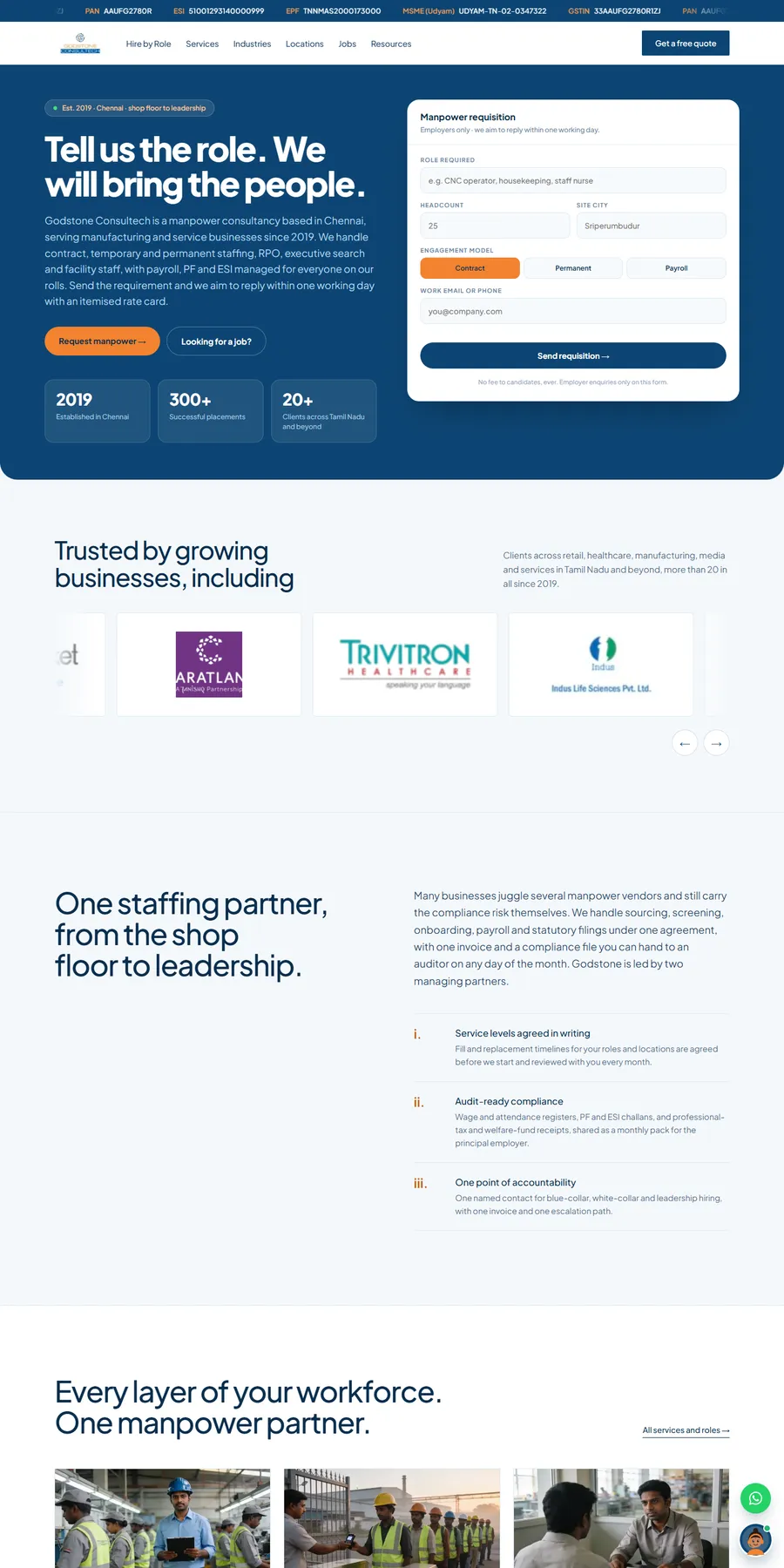
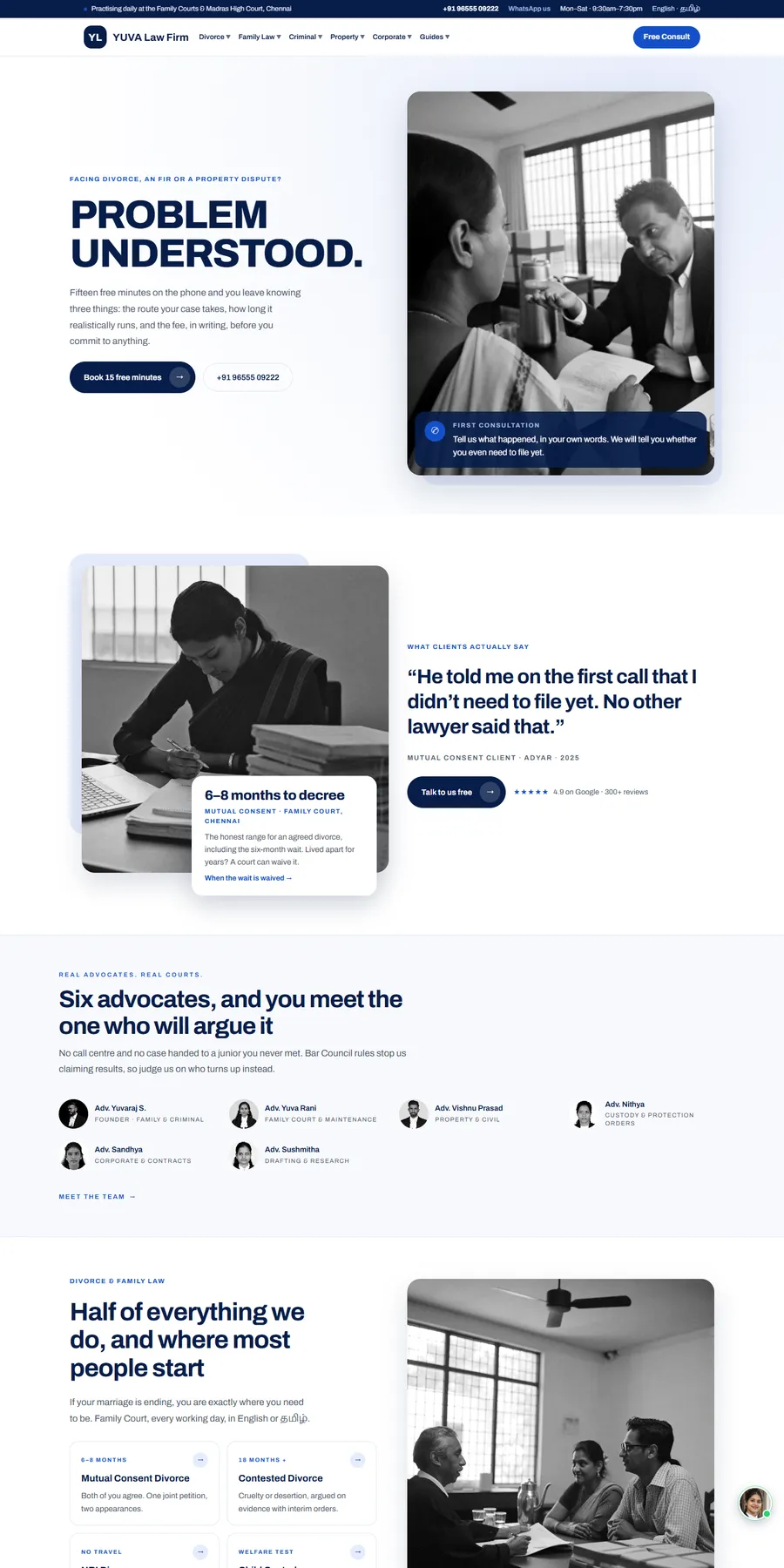
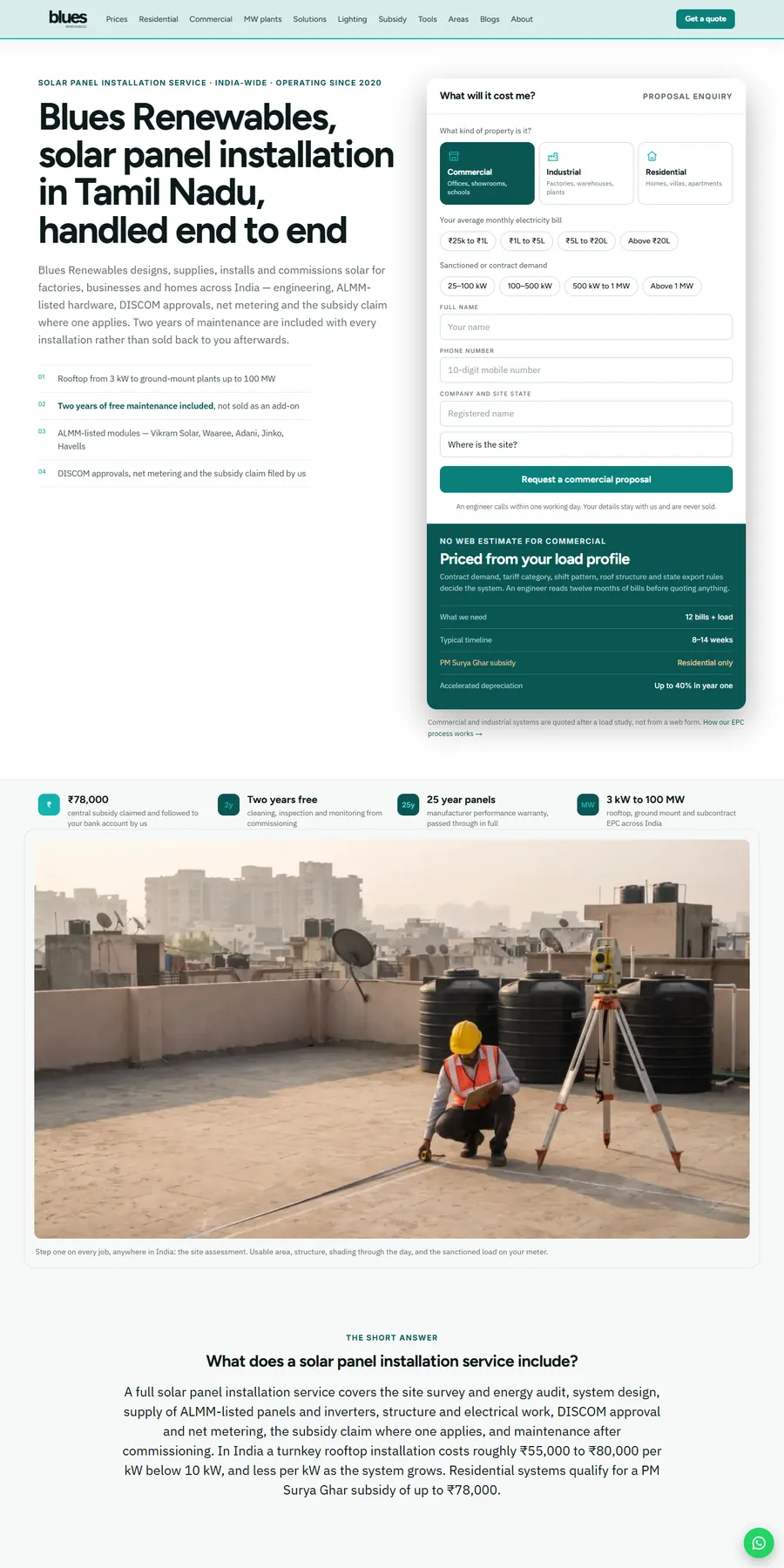
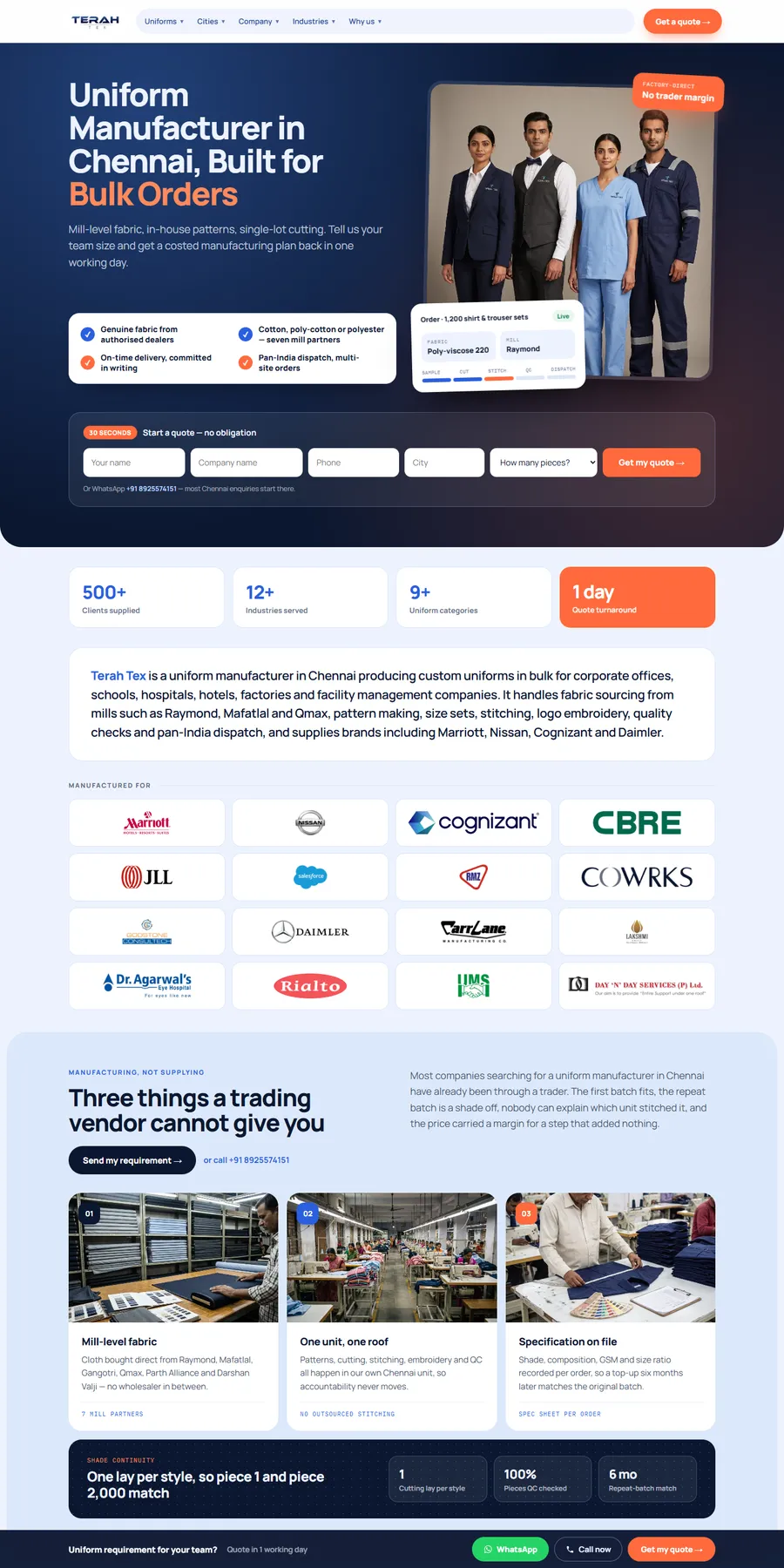
Proof from a real local lead system, not a home care site. We have not built for a home care or home health agency yet, and we will not pretend otherwise. For Blues Renewables, a rooftop solar installer, we built service and price pages, 129 local area guides and tracking on every form and call. Tracked enquiries went from none to 7 to 10 a week, and Google clicks rose from 14 to 560 a fortnight in two months. For your agency, the area guides become county pages, the price and subsidy pages become cost and paying-for-care pages, and the same tracking splits care inquiries from applicants. Terah Tex shows the two-step form we would use for care requests (about 5 leads a week from none). Our Godstone Consultech staffing site and the consultation forms on the YUVA Law Firm site are in the portfolio, with no published numbers.

More websites we have designed and built

Process

How your home care website project runs

Typical timeline: 4 to 8 weeks for most home care sites; 8 to 12 weeks with many county, city or office pages. You see progress every week.

  1. Step 01 · Week 1

    Discovery and audit

    We audit your current site, competitors, and how you show up on Google and in AI answers, then agree on goals and a fixed quote.

  2. Step 02 · Weeks 2 to 3

    Strategy and design

    Sitemap, wireframes and full designs for your review. You approve everything before we build.

  3. Step 03 · Weeks 3 to 6

    Build and test

    Development, SEO setup, speed tuning, and testing across devices and browsers.

  4. Step 04 · Launch and beyond

    Launch and grow

    We launch, monitor, and improve based on real data. 30 days of free support included.

What shapes your quote

Scope, not hourly billing

Every project gets a fixed quote within 1 business day, agreed before work starts.

Get my fixed quote →
  • How many care-type pages and real county, city or office pages you need
  • Whether forms hand off to WellSky, AxisCare, AlayaCare or your hiring software, or route by email and SMS
  • The careers hub: number of roles, application steps and JobPosting setup
  • Whether we write the paying-for-care, cost and caregiver content and organize photos of your real team
  • Moving from your current site: redirects, keeping pages that rank and setting up tracking first
  • Multi-state licensing, a home health section or Spanish pages

Home care website questions, answered

Straight answers to what owners ask us, and what they ask Google and AI assistants. Ask us anything else.

How much does a home care agency website cost?

We quote one fixed price, agreed before work starts, based on the number of pages, features, integrations and content. You get it within 1 business day of a free audit of your current site. There is no hourly billing and no per-lead fee.

How long does it take to build a home care website?

Most home care sites take 4 to 8 weeks. Sites with many county, city or office pages take 8 to 12 weeks. You get a dated week-by-week plan before we start.

Can I post client testimonials and caregiver reviews on my site?

Yes, with care. Publish a family's story only with written consent from the client or their legal representative, and HIPAA marketing rules apply if you are a covered entity. The FTC rule on reviews bans fake reviews, including AI-written ones posing as real clients, and rewards that depend on a positive or negative review. Caregivers or staff reviewing you must disclose that they work for you. Never reply to an online review with care details.

Can the site connect to WellSky, AxisCare or AlayaCare?

We connect forms to the home care software you already use where it accepts web leads, or route them by email and SMS to your intake team with source data kept. We do not claim official partnerships with any software vendor.

Is my contact form HIPAA compliant, and does it need to be?

If you are a HIPAA covered entity, such as a Medicare-certified home health agency or an agency billing Medicaid electronically, health information on your forms needs HIPAA safeguards. A private-pay agency should confirm its status with counsel. We keep the first form free of medical detail and use providers that sign a BAA where HIPAA applies.

Do I need my license number on my website?

In Florida, home health agencies and companion and homemaker registrants must include the license or registration number in advertisements. Elsewhere it is still what families and discharge planners look for. We show license type and number for every state you serve.

Should I publish my hourly rates?

Some independent agencies publish starting rates by care level with a note that the final quote follows an assessment; many prefer to explain what sets the rate. Either works if the page is honest about minimum shifts and what changes the price. We build whichever you choose.

What should my site say about Medicare?

Put one plain sentence on your paying-for-care page: traditional Medicare does not pay for ongoing non-medical home care. If you are a Medicare-certified home health agency, say who qualifies (homebound, skilled care, under a plan of care). Then list only the options you actually accept: private pay, long-term care insurance, VA benefits or your state's Medicaid waiver by name.

I own a franchise location. Can I have my own website?

Check your franchise agreement first; many control domains and branding. Where it allows a local site or local pages, we build them to the brand rules with your real caregivers, counties and reviews.

Does my home care website need to be ADA accessible?

The Justice Department says the ADA applies to the websites of businesses open to the public, and an HHS rule may require WCAG 2.1 AA from 2027 or 2028 if you receive HHS funding through Medicaid or Medicare. Ask counsel about your case. Many of your visitors are older adults, so we build to WCAG 2.1 AA regardless.

How does my agency show up in ChatGPT and Google AI answers?

AI assistants lean on your Google profile, reviews and website. We write your care types, counties, payment answers, license and leadership as plain text, add matching schema and align the site with your profile. No one can guarantee an AI mention, but a specific, consistent site gives assistants accurate facts to cite.

Will a new website get me more clients?

We do not guarantee rankings or client numbers. What a new site changes is how many visitors call or request an assessment, how many applicants finish the application and whether you can see which source produced each one. On a rooftop solar installer's site (not home care), the same lead system took tracked enquiries from none to 7 to 10 a week.

Do I need Spanish pages?

It depends on the families and caregivers in your service area. If many speak Spanish, translated care, paying-for-care and careers pages with their own forms can help on both sides. We plan it in the scope.

What makes you different from another home care web design company?

We put the terms in writing first: a fixed quote in 1 business day, a dated plan, ownership of everything and no lock-in. The build covers separate care and careers funnels, paying-for-care and license content, referral partner forms and tracking by source.
Get your free home care website proposal

Four quick questions. You'll get a fixed quote and a free audit of your current site within 1 business day.

  • ✓ No obligation, no sales pressure
  • ✓ Fixed price, never hourly
  • ✓ Your details stay private

Prefer email? info@billionwebstudio.com

Step 1 of 4~60 seconds
What do you need?