Skip to content
Booking projects for next month. Free website audit with every quote.Claim yours →

Construction and manufacturingBooking projects for November

Construction Website Development Company That Gets You Shortlisted

An owner's rep hears your name from an architect, then opens your site to see if you have built a clinic like theirs, at their size, under their delivery method. We build commercial construction sites with project pages that read like a qualifications package, a prequal path for your subs and a careers section for the superintendents you cannot find.

  • Built for commercial construction companies
  • Fixed quote in 1 business day
  • You own everything
yourgc.com/healthcareMedical office andclinic buildsRequest our qualsTap to callSOQ request: 42k sq ft clinicFrom /healthcare · owner's repTracked as a leadSource: GoogleAI ASSISTANTWho builds medical office buildings inPhoenix?Your Company: healthcare GC, CM at riskand design-build, Phoenix.Source: your website
Illustration: a visit becomes a tracked lead

The short answer

What does a construction website development company do?

A construction website development company builds websites for commercial general contractors, construction managers and design-build firms, so owners, owner's reps and architects can shortlist you, prequalify you and invite you to bid. For commercial work the site rarely starts the deal: a referral, a bid invitation or a broker's call does. The site decides whether you stay on the list once someone checks you, so it has to show projects like theirs, in their sector and at their scale, with the safety, bonding and license facts their procurement team will ask for anyway.

For a regional GC that means sector pages (healthcare, K-12 and higher education, industrial, warehouse, data centers, municipal, office and tenant improvement), delivery method pages for hard bid, negotiated work, CM at risk and design-build, a filterable project library with square footage, owner, architect and schedule on every project, a safety page with your EMR and its rating year, a subcontractor prequalification form with secure document upload, and a careers section for superintendents, project managers, estimators and crafts.

Billion Web Studio is a construction website development company that delivers this as one fixed-scope project: design, sector and project pages, GeneralContractor schema, tracking for project inquiries, qualification downloads, prequal submissions and job applications in GA4, and links into your bid platform and CRM. You own the site, the domain and every account from day one, with no lock-in.

The market

What the numbers say about commercial construction companies online

Commercial construction is busy, and busy firms still lose the jobs they want most. Owners are spending heavily on private nonresidential and public work, ABC members are carrying long backlogs led by data center projects, and almost every firm is short of people. That mix changes what your website is for: picking the next right job, keeping you on the shortlists that lead to it, and hiring the crews to build it. The figures below come from the Census Bureau, ABC, AGC and NCCER, and DBIA.

How they choose

How owners and developers find and choose a construction company

A commercial project does not start with a search for "contractor near me". It starts with a board vote, a signed lease or a bond measure, and it moves through people who check each other: owners, developers, owner's reps, architects, brokers and procurement officers. Here is how a commercial owner picks a builder and what your site has to do at each step.

  1. 1

    The trigger: a project gets approved

    A health system approves a clinic, a tenant signs for 12,000 square feet that needs a buildout, a school district passes a bond, a manufacturer needs a warehouse expansion. The owner or their rep starts a long list from past builders, the architect's suggestions and a broker's names.

  2. 2

    The long list: names from referrals, then a search

    Each name gets looked up. Some owners also search by sector and city or ask an AI assistant who builds medical office buildings or tilt-up warehouses in their region. Your site needs a page for each sector you want, stating what you build, where and at what size in the first lines.

  3. 3

    The screen: your site as a scorecard

    Have you built projects like this one, at this size, under this delivery method, in occupied buildings if that matters? Are you big enough, safe enough and bondable? The project library, safety page, license table and bonding facts answer those questions before anyone calls you.

  4. 4

    The RFQ and the interview

    Shortlisted firms get an RFQ or RFP. Your current statement of qualifications, team bios, references and a clear request path make the response faster and consistent with what the owner already read online. Numbers on the site that differ from the proposal raise doubts.

  5. 5

    After the award: subs, hires and the next job

    Trade partners check how to get on your bid list, superintendents and estimators check whether you are worth joining, and the owner checks you again before the next phase. The same site serves all three, with separate paths for each.

The problem

Why most construction websites lose bid invites and RFQs

What we find again and again when we audit sites in this trade. None of it is about how the site looks.

Leak 01

The portfolio is a photo slideshow with no facts

Beautiful drone shots with no sector, square footage, delivery method, owner, architect, schedule or completion date. An owner's rep comparing three GCs for a medical office cannot tell if you built anything like it, so the firm that lists those facts looks more qualified, even when it is not.

Leak 02

Your best numbers are trapped inside images

Counters for projects completed and safe work hours, award years and client logos baked into graphics. Search engines and AI assistants cannot read them, so the facts that set you apart never show up when someone asks which builders in your region do this work.

Leak 03

A homeowner template on a commercial firm

"Free estimate" buttons, star-rating widgets and copy about dream kitchens tell a facility director you are a residential remodeler. Commercial buyers want sectors, delivery methods, preconstruction services and references from owners and public agencies, and a template built for homeowners has no place to put them.

Leak 04

Subs hit a PDF and a mismatched email

Many GC sites offer subcontractors a downloadable prequal PDF and an email address, sometimes on a different domain from the one shown on the page. Prequal packages ask for W-9s, certificates of insurance, EMR letters, OSHA 300 and 300A logs and bonding letters, and email is a poor place to collect them.

Leak 05

Careers is one paragraph while you cannot hire

Superintendents, estimators and project managers are the hardest salaried roles to fill (named by 81%, 77% and 76% of firms hiring for them in AGC's 2025 survey), and fewer than half of firms at $50 million in revenue or less had added online recruiting, against 77% of firms over $500 million. A careers page with no open roles, offices or mobile apply hands those candidates to the bigger GC across town.

Leak 06

Claims that do not match the paperwork

"Licensed, bonded and insured" on a California site, which CSLB says contractors may not advertise. No license numbers. An EMR with no rating year. A lapsed small business badge. Years in business stated two ways on one page. Procurement reviewers compare the site with your prequal forms, and every mismatch costs credibility.

Generic vs built for you

Why a generic website fails commercial construction companies

A template is built to fit every business, so it fits yours badly. Here is what changes when the site is planned around how owners and developers actually buy.

Generic website compared with a website built for commercial construction companies
What you needGeneric template siteBuilt for commercial construction companies
Project portfolioA photo gallery with project namesA project library filterable by sector, delivery method and region, each project with size, owner, architect, schedule, challenge and photos
Who the site speaks toHomeowners, with reviews and a free estimate buttonThree paths: owners and their reps, subcontractors and trade partners, and job candidates
SectorsOne services page listing everything you buildA page per sector you want to grow, such as healthcare, K-12, industrial or data centers, with the sector's concerns and matching projects
Delivery methodsNot mentionedPages for hard bid general contracting, negotiated work, CM at risk, agency CM, design-build and preconstruction, explained in plain terms
Safety"Safety is our top priority" with a stock hard hatA safety page with your EMR, its rating year and source, programs, training and real jobsite photos with proper PPE
Licenses and bonding"Licensed, bonded and insured" badgeA license table by state, bonding capacity only as your surety letter confirms it with a date, and no "bonded" claim where a state forbids it
Subcontractor intakeA PDF form and an email addressAn online prequal form with secure document upload, trades and regions, bid list sign-up and a link to your bid platform
Recruiting"We are always hiring, send your resume"Roles by craft and salaried position, office and region, benefits, internships and a mobile apply path from your applicant tracking system

Free self-check · 2 minutes

What your current construction website is missing

Tick everything your site does today. Each box you cannot tick is a place where a ready-to-buy visitor leaves.

What you need

What every construction website needs

The features that turn a construction website from a brochure into the best salesperson you have. We build all of them.

  1. Must-have · 01

    One line that says who you build for, where and at what scale

    "Commercial and industrial builder for healthcare, education and manufacturing clients across the Carolinas, projects from tenant improvements to 200,000 square feet." An owner's rep should know in five seconds whether you belong on the list.

  2. Must-have · 02

    Sector pages for the work you want more of

    Healthcare, K-12 and higher education, industrial and manufacturing, warehouse and logistics, data centers, municipal and public safety, office and tenant improvement. Each covers what that owner worries about, such as infection control risk assessments in occupied hospitals or summer-only schedules for schools, with the projects that prove it.

  3. Must-have · 03

    Delivery method and preconstruction pages

    Hard bid general contracting, negotiated work, CM at risk, agency CM, design-build and preconstruction (estimating, value engineering, constructability reviews). If design-build is your main delivery method, it needs its own page, not a line on the services page.

  4. Must-have · 04

    A project library built like a qualifications package

    One page per project with sector, location, delivery method, square footage, value range if you allow it, schedule, owner, architect, engineer, the hard part you solved, photos and awards. Filterable by sector, delivery method and region, and easy for your marketing coordinator to add to after each closeout.

  5. Must-have · 05

    Two owner calls to action: start a project and request qualifications

    A project discovery form asking building type, size, location, delivery method, schedule and stage, and a current statement of qualifications as a download. Both tracked as conversions and routed to business development.

  6. Must-have · 06

    A safety page owners' reviewers can trust

    Your safety program, training, recognition and EMR, written the way an owner's safety reviewer reads them, with jobsite photos that show proper PPE and fall protection. How we present EMR is covered in the compliance section below.

  7. Must-have · 07

    Licenses, bonding and insurance on one page

    License numbers and classifications for every state you hold one in, an insurance summary and, if you choose, bonding capacity from your surety's current letter, laid out as a table your marketing coordinator updates in minutes.

  8. Must-have · 08

    Proof owners recognize: repeat clients, prequal networks and a capability statement

    Named repeat clients and a logo wall from owners who agreed to it, owner and architect testimonials with real names and titles, the prequalification networks you belong to (such as ISNetworld or Avetta, which many industrial owners use to screen contractors), MBE, WBE, DBE, SDVOSB, HUBZone or 8(a) status only while it is current, and a public-sector capability statement with your NAICS codes and SAM.gov registration for agencies that buy that way.

  9. Must-have · 09

    A subcontractor and trade partner portal

    An online prequalification form with secure upload for the W-9, certificate of insurance, EMR letter, OSHA 300 and 300A summary, bonding letter and safety manual, the trades and regions you buy, bid list sign-up and a link to where you post bids.

  10. Must-have · 10

    A careers section for the roles you cannot fill

    Superintendents, project managers, estimators, field engineers and crafts by office and region, benefits, internships and co-ops, and a mobile apply path. Your HR team can add the job posting notices your states require.

  11. Must-have · 11

    Leadership, offices and news with real dates

    Leadership bios, office pages for each staffed location, ownership story (family-owned or employee-owned), and a news feed for groundbreakings, ribbon cuttings and awards. No nav links that point to a social media admin page.

  12. Must-have · 12

    GeneralContractor schema, facts in text and fast pages

    Organization and GeneralContractor markup, project counts, years and license numbers as plain text, and Core Web Vitals targets of LCP 2.5 seconds or less, INP 200 ms or less and CLS 0.1 or less, even on photo-heavy project pages.

What we build

The construction website we would build for you

Here is the sitemap we start from for commercial construction website design, for a regional GC or design-build firm. We cut or add sectors and offices to match the work you actually want and the regions you actually cover.

yourcompany.comHome · every section links here

Markets

  • Healthcare and medical office
  • K-12 and higher education
  • Industrial and manufacturing
  • Warehouse and logistics
  • Data centers and mission critical
  • Municipal and public safety
  • Office and tenant improvement
  • Retail, hospitality and worship

Services and delivery

  • Preconstruction
  • General contracting
  • Construction management at risk
  • Agency construction management
  • Design-build
  • Self-perform scopes
  • Small projects and service agreements

Projects

  • Project library with filters
  • Project pages with specs
  • Featured case studies
  • Awards and recognition

Qualifications

  • Safety and EMR
  • Licenses, bonding and insurance
  • Certifications and inclusion
  • Statement of qualifications download
  • Request for qualifications
  • Capability statement (public sector)
  • Clients and testimonials

Trade partners and careers

  • Subcontractor prequalification
  • Bid opportunities
  • Bid list sign-up
  • Careers by role and office
  • Internships and co-ops

Company

  • About and history
  • How we work: preconstruction to closeout
  • Leadership
  • Office pages
  • News
  • Contact by department

Calls, bookings, leads

How we turn visitors into bid invites and RFQs

Website design for construction companies is judged by what happens after the referral: an inquiry from an owner's rep, a qualifications download before an RFQ, a prequal from a strong trade partner, an application from a superintendent. This is how we build each path and track it so you can tell them apart.

  • 01A project discovery form that asks what estimating needsBuilding type, approximate square footage, location, delivery method, target schedule and project stage (site selection, design, permitting, ready to bid). It routes to business development and into HubSpot or Salesforce, so the first call is about the project, not about what the project is.
  • 02Statement of qualifications download, trackedYour current SOQ as a tagged, accessible PDF, with each download logged as a GA4 event by page. When a healthcare owner downloads it from the healthcare page, your business development lead knows which sector is in play.
  • 03Separate routes for owners, estimating and bidsOwners reach business development, subs reach estimating or purchasing, and bid questions go to the bid inbox on your own domain. Each phone number and email is tracked as its own conversion, so purchasing calls never count as new business.
  • 04Prequal submissions counted and routed to purchasingEach prequal arrives dated, tagged by trade and region and sent to the person who maintains your bid list, with a reminder when its insurance certificate or EMR letter expires. You see how many qualified subs the site added this quarter, by trade.
  • 05Mobile apply for field and office rolesJob posts pulled from your applicant tracking system, filterable by role and office, with an apply button that works on a phone. Applications are tracked by role and source, so you know whether the site helps fill superintendent seats.
  • 06A fast path for small projects and service workFacility managers with a roof leak, a small renovation or a task order need a short form and a direct number, not your SOQ. A small projects page with its own form and tracked line keeps that steady work from getting lost in the business development inbox, and it often leads to the next capital project.
  • 07A monthly report in plain numbersProject inquiries, SOQ downloads, prequal submissions, applications and calls by source and page. Your marketing coordinator can read it without us and share it at the business development meeting.

AI search

More buyers now start research by asking ChatGPT, Google AI Mode or Perplexity questions like who builds medical office buildings in their region, or what CM at risk means. BrightLocal found 45% of US consumers used AI tools for local business recommendations in 2026, up from 6% in 2025; that survey is of consumers, so read it as the direction for smaller tenant improvement and service buyers, not proof of how a health system picks a GC. Pew found Google users clicked a regular result on 8% of visits when an AI summary appeared, against 15% without one. The aim is to be the source the summary names and the site that wins the click. Assistants can only repeat facts they can read, so your sectors, regions, projects and qualifications need to be on your own site as plain text.

Questions your owners and developers ask AI assistants

  • Which general contractors in Denver have built medical office buildings?
  • Who builds tilt-up warehouses in the Inland Empire?
  • What is the difference between design-build, CM at risk and design-bid-build?
  • Which commercial contractors near Charlotte are WBE certified?
  • What is a good EMR for a general contractor, and how do I check it?
  • How long does a 5,000 square foot office tenant improvement take?
  • Facts written as text, not inside graphics

    Sectors, regions, delivery methods, years in business, project counts, license numbers and certifications as plain text on the page. An assistant cannot quote a safe work hours figure that only exists inside an image.

  • One page per sector and per project

    A healthcare page that opens with who you build for and where, and project pages with location, size, owner and date. Specific, checkable pages are what an assistant can cite when someone asks who builds clinics in their city.

  • Answers to the questions owners ask

    Delivery methods compared, what preconstruction includes, how long a tenant improvement takes, how to read an EMR, what bonding capacity means. Each answered in the first lines of its page, with a short FAQ on every sector page.

  • Organization and GeneralContractor schema

    Structured data for your company, offices, service region and contact points, plus FAQ markup on sector pages and consistent project page fields, so search engines and AI systems read the same facts a visitor sees.

  • One identity everywhere

    The same company name, offices, phone numbers and sectors on your site, your Google Business Profile for each staffed office, LinkedIn and association directories. Mismatches give assistants conflicting facts to repeat.

Compliance and trust

The rules a construction website has to get right

A commercial construction site makes claims that state license boards, federal agencies and procurement officers check: license numbers, bonding, safety records, small business status and testimonials. We build pages that show this information accurately and make it easy to update. We do not certify compliance; you confirm every license, certification, bonding and safety figure, and your attorney confirms your state rules.

License numbers where the law requires them

California requires the license number on all advertising, including websites, and contractors may only advertise within their license classification; CSLB lists civil penalties of $100 to $5,000 for advertising violations. Florida Statutes 489.119 require the registration or certification number in every advertisement regardless of medium. For multi-state firms we build a license table by state and never show a state you are not licensed in.

"Bonded" is not the same as bonding capacity

CSLB says California contractors may not advertise that they are bonded, because it suggests more protection than the license bond gives. Project bonding capacity is different: the Miller Act (FAR 28.102-1) requires performance and payment bonds on federal construction contracts over $150,000. If you show capacity, it comes from your surety's current letter and carries the letter's date.

Safety numbers you can back up

EMR compares your workers' compensation claims with similar firms, where 1.0 is average, on a three-year window set by NCCI or your state's rating bureau. We show it with the rating year and source, show safe work hours only if you track them, never publish details about named injured workers, and pick jobsite photos with proper PPE. False or outdated claims are advertising claims under the FTC Act.

Small business and diversity certifications

Under 13 CFR 121.108, a firm bidding a set-aside or registering for small business awards is deemed to certify its size and status, and willful misrepresentation can bring suspension, debarment and civil and criminal penalties. We list only current certifications, name the certifying body and set reminders so a badge comes down the day it lapses.

Owner and architect testimonials

The FTC's rule on consumer reviews and testimonials, announced in August 2024, bans fake and AI-generated reviews and testimonials, incentives conditioned on a positive or negative review, and insider reviews by officers or managers that do not disclose the connection. Testimonials on your site carry the person's real name and title, with their permission and without edits that change the meaning.

Accessibility for public owners

The Justice Department says the ADA applies to websites of businesses open to the public, and state and local governments have their own Title II rule from April 2024. Public owners often ask vendors about accessibility, so we build to WCAG 2.2 AA: captions, alt text on project photos, labeled forms and tagged PDFs. We do not label any site "ADA compliant".

We build with tools and patterns that support these rules and document what we set up. For legal advice on your own obligations, talk to your attorney.

From the forums

What commercial construction companies ask about websites, answered

We read what construction owners, GCs and project managers ask each other on r/Construction, r/GeneralContractor, r/ConstructionManagers, r/Contractor, r/smallbusiness, r/SEO and r/Architects. The same doubts come up: whether a website matters when work comes from relationships and bids, how to break into bigger commercial jobs, and why monthly marketing spend is so hard to see. These are their questions, paraphrased, with our straight answers.

Where owners talkr/Constructionr/GeneralContractorr/ConstructionManagersr/Contractorr/smallbusinessr/SEOr/Architects

Asked on r/Contractor

“We have eight years of referrals and steady work. Does a good website even matter for us?”

Our answer: The top reply in that thread put it well: referrals look you up before they call, and a dated site makes them doubt the person who referred you. A portfolio of your best projects also helps you win larger jobs than the ones referrals usually bring. That is the job we build for: backing up the referral, not replacing it.

Asked on r/ConstructionManagers

“Why do so many GCs neglect their websites and social media?”

Our answer: The top reply said one firm rebuilt its site three times and never traced a contract to it, and that the site still has to look professional, with contact details, history, clients and project stories. For commercial GCs that is often true: the site rarely starts the deal. Tracing a contract to a website is hard when it is not set up to be traced, so we track qualification downloads and project inquiries by sector page, and you can see when the site played a part.

Asked on r/ConstructionManagers

“Has anyone actually lost work because their online presence was weak?”

Our answer: The top reply said yes: senior people on their own team had disqualified subcontractors. Owners, procurement teams and GCs screen firms before they invite them. Project pages with real facts, a current safety page and license numbers are what keep you in when they check you online.

Asked on r/GeneralContractor

“How are GCs finding commercial tenant improvement and buildout work?”

Our answer: The best reply said commercial is relationship-driven: get on property managers' preferred vendor lists, work with commercial brokers who need fast ballpark numbers, and with architects doing interiors. Each of those people checks your site after the introduction, so we build an office and tenant improvement page with typical sizes, schedules and recent buildouts they can forward.

Asked on r/GeneralContractor

“We do small office remodels. How do we get hired as the prime on bigger commercial jobs?”

Our answer: Replies pointed to bid platforms and to marketing your firm to commercial real estate agents and architects. Both groups look you up before they put your name forward, so your site has to show your largest relevant jobs as project pages with size, owner, architect and schedule, a sector page for the work you want next, and a current statement of qualifications they can forward.

Asked on r/Construction

“Do you actually win work from bid platforms like BuildingConnected or ConstructConnect?”

Our answer: Replies reported few direct wins from hundreds of bids. The real value was learning which GCs bid locally and getting onto their direct lists, where relationships decide. When an estimator looks you up after an invite, your site should show the trades, sizes and sectors that make you worth inviting again.

Asked on r/ConstructionManagers

“A GC asked for three years of P&Ls to get on its vendor list. Is that normal?”

Our answer: Replies said yes for large GCs, along with OSHA 300 logs: it proves a firm can cash-flow the work. It also shows how document-heavy prequal is on both sides. If you prequalify your own subs, an online form with secure upload into your storage makes it faster and keeps those files off email and off the public site.

Asked on r/smallbusiness

“I have paid an SEO retainer for eight months and get leads, but I cannot tell what they actually do. Is that normal?”

Our answer: It is a common complaint. Whoever you hire, ask for a written scope and a report you can read yourself. We build on a fixed quote with a dated plan and weekly written updates, you own every account, and the monthly report shows inquiries, downloads and calls by source in plain numbers.

Asked on r/Construction

“Does digital marketing actually work for general contractors?”

Our answer: The best reply said only if someone picks up the phone fast and the process from lead to contract is solid. We agree. We route each inquiry to the right person (business development, estimating or HR) and track it, but a project inquiry that waits three days for a callback is lost either way.

Asked on r/Architects

“Is a portfolio website still worth it, or is it just a credibility stamp?”

Our answer: Architects in that thread said mostly a credibility stamp and contact point, and more useful for being found by larger private clients than for public work. Architects refer GCs and judge your site the same way, so it has to look credible and make your project experience easy to check.

Questions are paraphrased from public threads. We never quote members by name.

Others vs us

Construction company web design options: Billion Web Studio vs a website builder template vs a typical construction marketing agency

The three ways commercial construction companies usually get a website, side by side.

Construction company web design options: Billion Web Studio vs a website builder template vs a typical construction marketing agency
Billion Web StudioWebsite builder templateTypical industry agency
Who owns the site, domain and contentYou do, from day one, in your own accountsYou own the content; the site lives on the builder's platformOften the agency, on a rented site you lose if you leave
Contract and pricingFixed quote in 1 business day, agreed before work starts, no lock-inMonthly subscription, you build it yourselfMonthly retainer, often on a 12-month or longer contract
Project libraryFilterable by sector, delivery method and region, with specs on every projectA gallery block with photos and captionsVaries; often a gallery reused across clients
Sector and delivery method pagesA page per sector you want and per delivery method you offerWhatever pages you writeOften generic service pages written for homeowners
Safety, licensing, bonding and certificationsEMR with year, license table by state, dated bonding facts, current badges onlyUp to youOften a "licensed, bonded and insured" badge
Subcontractor prequalOnline form with secure upload, bid list sign-up, link to your bid platformA contact formRarely built
CareersRoles by office from your applicant tracking system, mobile applyA text pageVaries
TrackingInquiries, SOQ downloads, prequals, applications and calls as separate GA4 eventsBasic form countsTheir dashboard, which may stay with them if you leave

Why Billion Web Studio

What we do better, and why it matters to you

  • A fixed quote in 1 business day, with a free audit

    We review your current site, project pages, prequal path, careers section and tracking, then send a written scope and a fixed price based on pages, features, integrations and content. No hourly billing.

  • Built for commercial buyers, not homeowners

    Most pages selling construction company web design talk about homeowners, reviews and free estimates. Ours starts from how commercial work is won: sectors, delivery methods, project facts, safety, bonding, licenses and certifications are in the plan from week one.

  • Three audiences, three paths

    Owners and their reps, subcontractors and candidates each get their own route, their own forms and their own conversion events, so one site serves business development, purchasing and HR without getting in each other's way.

  • A project template your team can keep filling

    We set the fields (sector, size, delivery method, owner, architect, schedule, challenge) and train your marketing coordinator, so project pages get added after each closeout instead of once every five years.

  • You own everything from day one

    Code, design, content, domain, hosting and analytics accounts in your name. No lock-in, and no site that disappears if you stop paying a retainer.

  • A dated plan and a guarantee on it

    A week-by-week plan, weekly written updates and 30 days of free support after launch. If we slip a date because of us, the next month of support is free.

In writing, before we start

  • Fixed quote in 1 business day

    Scope, deliverables and price agreed in writing, with a free audit of your current site. No hourly billing.

  • Launch date in writing

    A dated week-by-week plan and a written update every week. If we slip because of us, the next month of support is free.

  • You own everything

    Code, design, content, domain and accounts are yours from day one. No 12-month contract, no rented site.

  • 30 days of support included

    We watch rankings, forms and call tracking after launch and fix anything that needs it.

Proof, not promises

Results from websites we have built

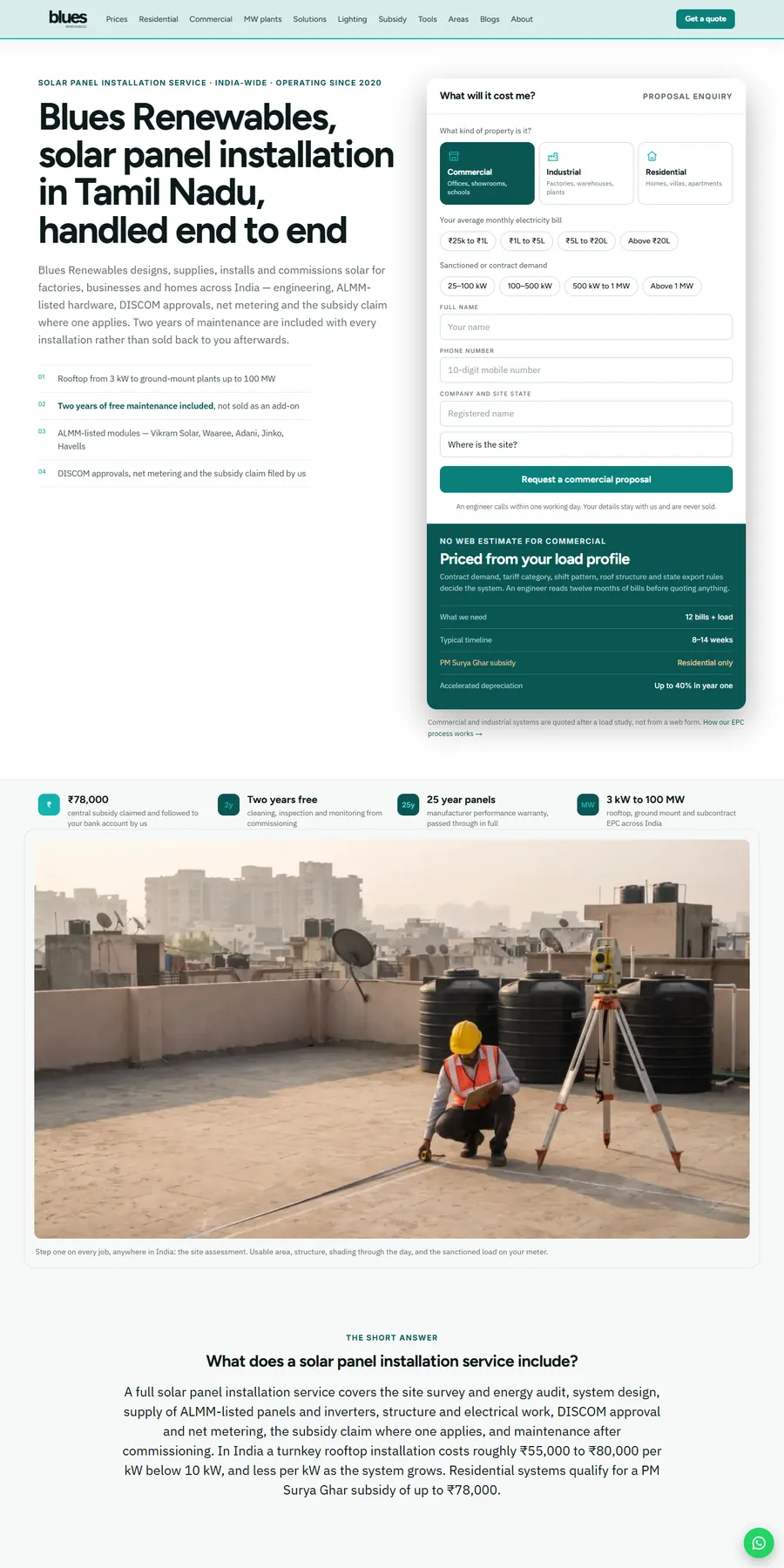
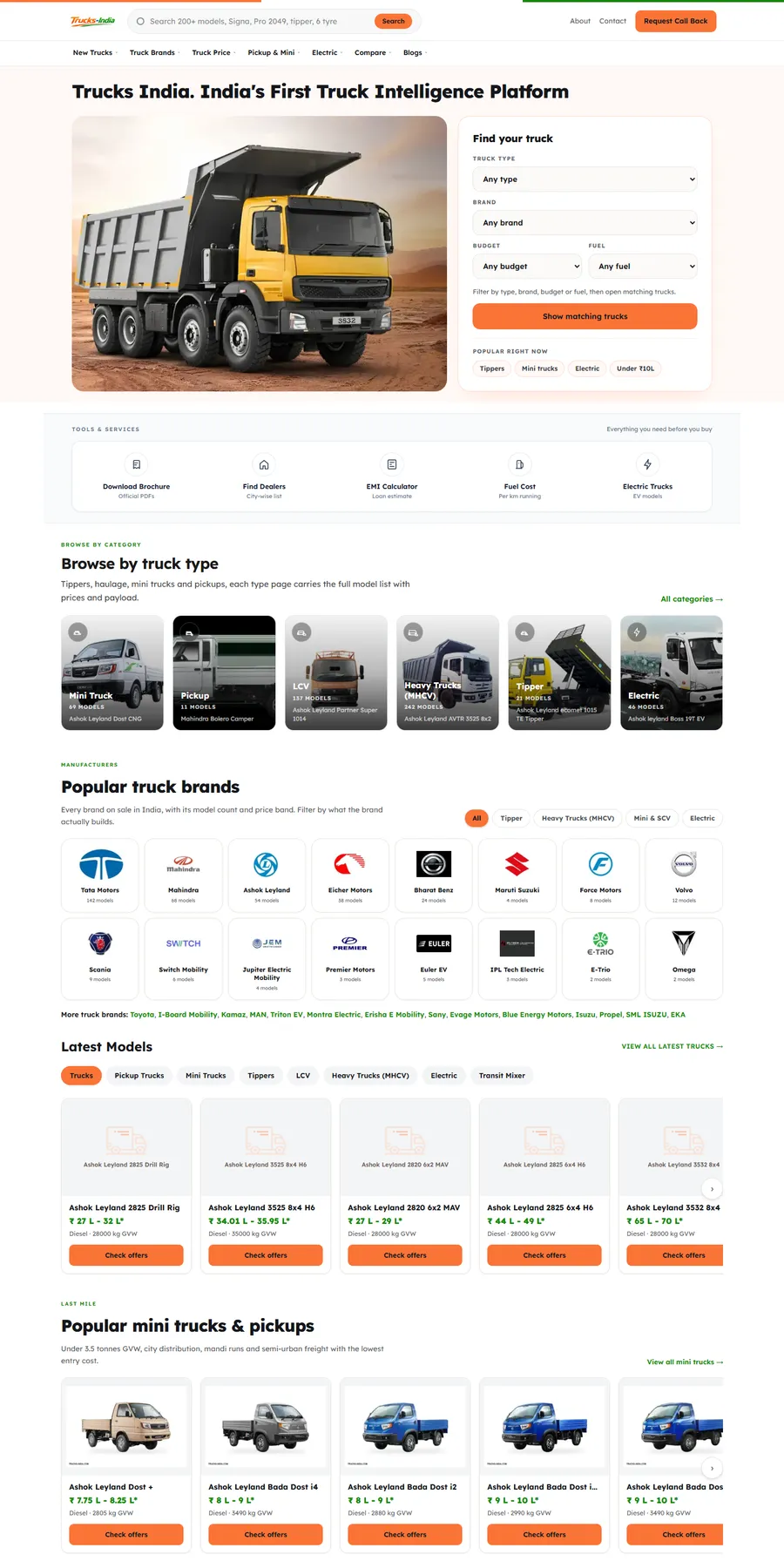
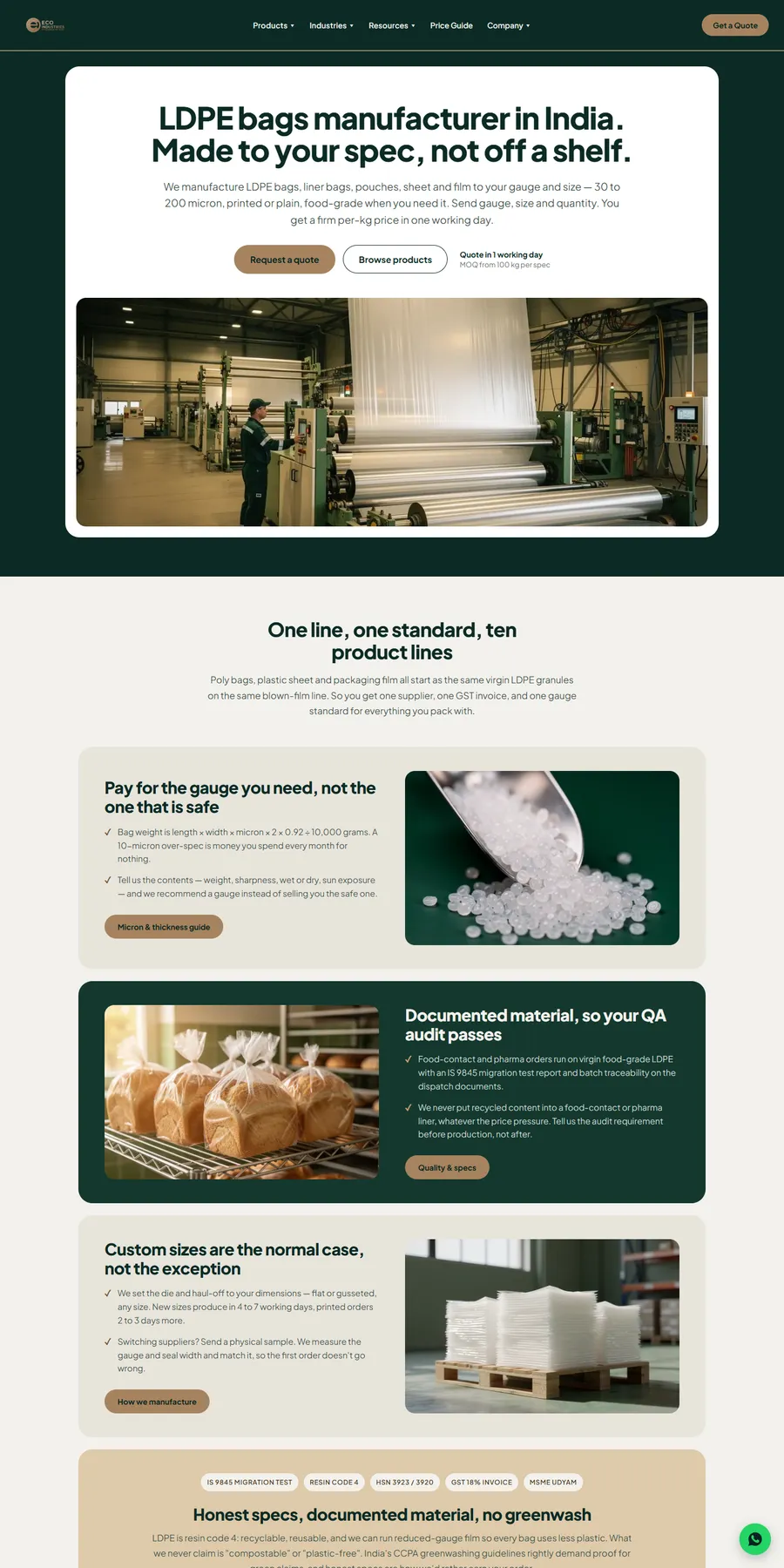
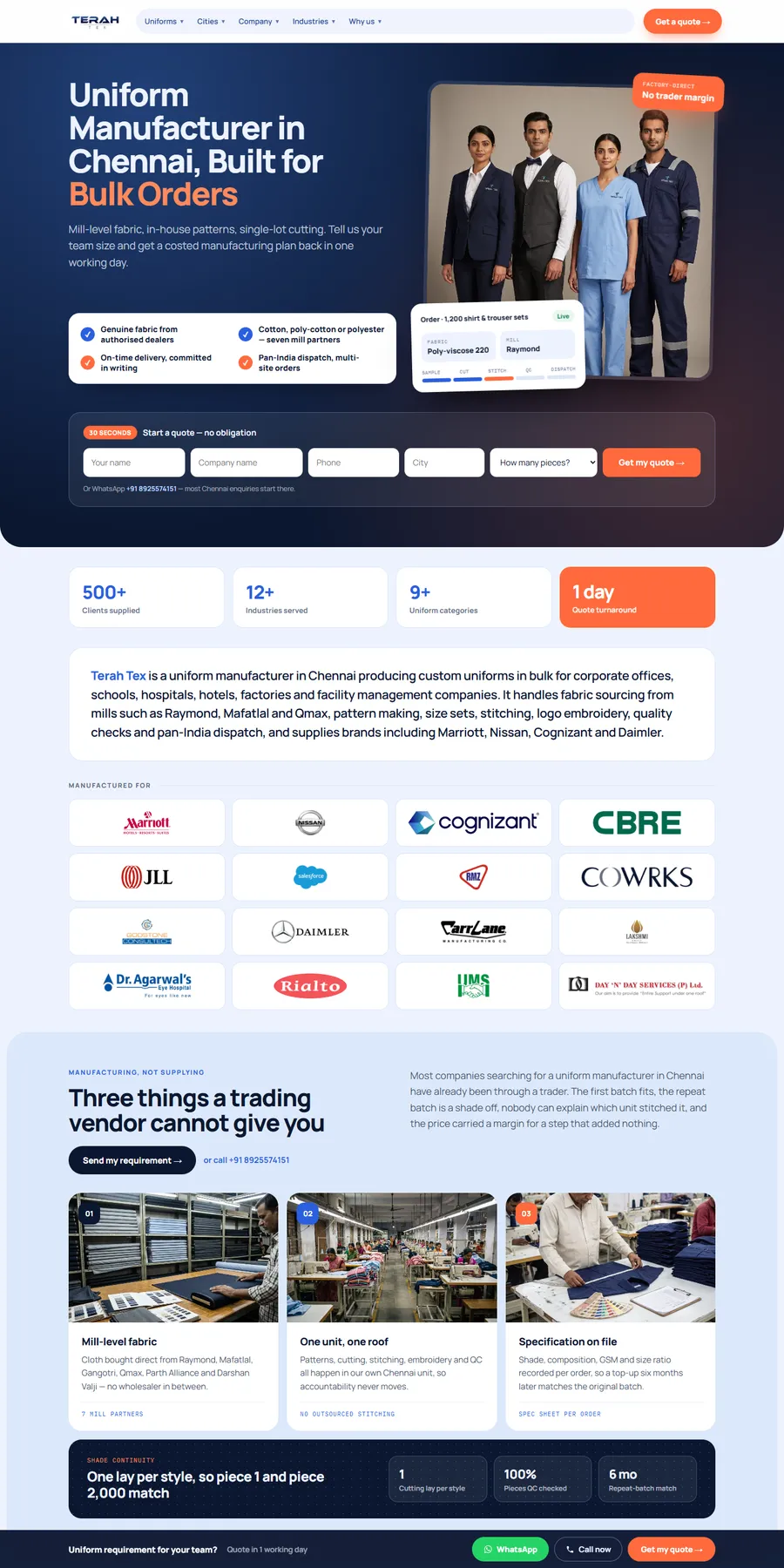
We have not built a website for a construction company yet, and we will not pretend otherwise. What transfers is B2B work where buyers research before they ask for a quote. Eco Industries, an LDPE packaging manufacturer, went from no enquiries to about 10 leads a week on a 44-page catalogue with industry pages and technical buyer guides: the same job your sector pages do for an owner's rep. Terah Tex, a bulk uniform manufacturer, went from no website enquiries to about 5 bulk-order leads a week with city pages across six metros and a two-step quote form: the pattern for your project inquiry form and regional pages. Trucks India's 1,299 filterable variant pages show we can build and run a large, structured library like your project database. Blues Renewables, a rooftop solar installer, shows every form and call tracked as a lead: from no tracked leads to 7 to 10 enquiries a week.

More websites we have designed and built

Process

How your construction website project runs

Typical timeline: 4 to 8 weeks for most commercial GC sites; 8 to 12 weeks with a large project library, many sector pages or several offices. You see progress every week.

  1. Step 01 · Week 1

    Discovery and audit

    We audit your current site, competitors, and how you show up on Google and in AI answers, then agree on goals and a fixed quote.

  2. Step 02 · Weeks 2 to 3

    Strategy and design

    Sitemap, wireframes and full designs for your review. You approve everything before we build.

  3. Step 03 · Weeks 3 to 6

    Build and test

    Development, SEO setup, speed tuning, and testing across devices and browsers.

  4. Step 04 · Launch and beyond

    Launch and grow

    We launch, monitor, and improve based on real data. 30 days of free support included.

What shapes your quote

Scope, not hourly billing

Every project gets a fixed quote within 1 business day, agreed before work starts.

Get my fixed quote →
  • How many sector, delivery method and office pages you need
  • The size of your project library and whether we write the project pages from your closeout records
  • Subcontractor prequal form, document upload and bid list setup
  • Careers integration with your applicant tracking system
  • Moving from your current site: redirects, keeping pages that rank and setting up tracking first
  • Multi-state license tables, several offices or more than one operating company

Construction website questions, answered

Straight answers to what owners ask us, and what they ask Google and AI assistants. Ask us anything else.

How much does a construction company website cost?

We quote each construction company website design project as one fixed price, agreed before work starts, based on the number of pages, features, integrations and content. You get it within 1 business day of a free audit of your current site. There is no hourly billing.

How long does it take to build a commercial construction website?

Most take 4 to 8 weeks. Sites with a large project library, many sector pages or several offices take 8 to 12 weeks. You get a dated week-by-week plan before we start and a written update every week.

Do we need a website if our work comes from relationships and bid invitations?

Yes. Owners, architects, brokers and other GCs look you up after a referral or before an RFQ. The same site also takes your subs' prequals and your job applications, so it works for business development, purchasing and HR at once.

What should a commercial GC website include?

Sector pages, delivery method pages, a project library with specs, a safety page with your EMR, licenses and bonding, certifications, a subcontractor prequal form, careers and a request for qualifications path. We cut or add to fit the work you want.

Will you write our project pages?

We set the template and fields: sector, size, delivery method, owner, architect, schedule and the challenge you solved. Your team or ours fills them from closeout records, and we train your marketing coordinator to add new ones.

Can subcontractors prequalify and upload documents on our site?

Yes, through a secure form provider. Files such as the W-9, certificate of insurance, EMR letter, OSHA logs and bonding letter go to your inbox or storage, not to the public site.

Can the site connect to BuildingConnected, Procore, our CRM and our job board?

Yes. We link to where you post bids, send project inquiries into HubSpot or Salesforce, pull job posts from your applicant tracking system and can use project photos exported from Procore or Autodesk Construction Cloud.

Should we publish our EMR and bonding capacity?

That is your call. If you do, the EMR carries its rating year and comes from your carrier or rating bureau letter, and bonding capacity comes from your surety's current letter with its date. In California, the site should not say you are "bonded".

Can you turn our statement of qualifications into web pages?

Yes. We turn its sections into sector, project and team pages and keep a current, accessible PDF version as a tracked download for RFQ responses.

Do we own the website, domain and content?

Yes, from day one. Code, design, content, domain, hosting and analytics accounts are in your name. There is no lock-in, so you can take the site to another developer at any time.

Will a new website win us more projects?

We do not guarantee rankings, leads or awards, and anyone who does is guessing. What a new site changes is how you look when someone checks you, and what you can measure: inquiries, qualification downloads, prequals and applications by source. On a rooftop solar installer's site (not construction), the same tracked system went from no tracked leads to 7 to 10 enquiries a week.

How does our firm show up in ChatGPT and Google AI answers?

AI assistants repeat facts they can read. We put sectors, regions, delivery methods, project facts and licenses on the page as plain text, add GeneralContractor schema and keep your details consistent across your profiles. No one can guarantee an AI mention.

Have you built a website for a construction company before?

No, and we say so up front. Our closest proof is B2B manufacturers whose buyers research before requesting a quote, a large structured library on a truck research platform, and a solar installer's site with every lead tracked. The case studies above show the numbers.

What makes you different from another construction company web design firm?

We put the terms in writing first: a fixed quote in 1 business day, a dated plan, weekly updates, your ownership of everything and no lock-in. The build covers project facts, sectors, delivery methods, safety and bonding, sub prequal, careers and tracking by audience.
Get your free construction website proposal

Four quick questions. You'll get a fixed quote and a free audit of your current site within 1 business day.

  • ✓ No obligation, no sales pressure
  • ✓ Fixed price, never hourly
  • ✓ Your details stay private

Prefer email? info@billionwebstudio.com

Step 1 of 4~60 seconds
What do you need?