Skip to content
Booking projects for next month. Free website audit with every quote.Claim yours →

Professional servicesBooking projects for November

Financial Advisor Website Development Company for More Booked Intro Calls

A retiree referred by her CPA, a tech employee with an RSU vest and a business owner six months from a sale all check your site before they book, and many ask an AI assistant about you first. We build financial advisor websites that say who you serve and how you are paid, put Form CRS and your IAPD or BrokerCheck record where careful prospects look, book intro calls with fit questions and go through your compliance review before anything is published.

  • Built for financial advisors and RIAs
  • Fixed quote in 1 business day
  • You own everything
yourfirm.com/retirement-incomeFee-only planningfor retireesBook an intro callTap to callNew intro call: retiring 2027From /retirement-income · 7:48 pmTracked as a leadSource: GoogleAI ASSISTANTWho is a fee-only advisor for retireesnear me?Your Firm: fee-only planners forretirees, book an intro call online.Source: your website
Illustration: a visit becomes a tracked lead

The short answer

What does a financial advisor website development company do?

A financial advisor website development company builds websites for independent advisors, fee-only planners, RIAs and wealth managers that turn referrals and searches into booked intro calls with people who fit your minimums. The site has to confirm a referral in a minute, say plainly who you serve and how you are paid, answer searches such as retirement income, equity compensation or fee-only fiduciary advice, put Form CRS, your ADV Part 2A brochure and your IAPD or BrokerCheck record where a careful prospect looks, and pass your compliance review before anything goes live.

For a solo planner or an 8-person RIA that means one page per niche you actually serve (a retiree drawing income is a different search from a tech employee with RSUs), service pages, a fees and minimums page that matches your Form ADV, a how-we-work page, advisor bios with credentials and new-client status, a client center with your custodian and portal logins, and a short intake that never asks for account numbers or a Social Security number.

Billion Web Studio is a financial advisor website development company that delivers this as one fixed-scope project: design, niche and service pages, FinancialService and Person schema, intro call tracking in GA4, scheduling through Calendly or HubSpot, links to Schwab, Fidelity, Altruist, eMoney or Advyzon, and a draft, approve and publish workflow with revision history your CCO can work with. You own the site, the domain and every account from day one, with no monthly site rental and no lock-in.

The market

What the numbers say about financial advisors and RIAs online

The BLS counts 299,400 personal financial advisors and projects only 1% growth from 2025 to 2035: a mature, crowded field where a prospect compares several firms before booking one. Most of those firms are small businesses. The median SEC registered adviser employs 8 people, and another 16,046 firms register with their states. The figures below show how many people still have no advisor, how much trust weighs in the choice, and where the search now starts.

How they choose

How clients find and choose an advisory firm

Few people hire an advisor on a whim. Something changes: a retirement date, an RSU vest or a liquidity event, an inheritance, a divorce, or a CPA who says it is time to get help. Then they check you carefully, often for weeks, before they book a first call. Here is how a US household chooses an advisor and what your site has to do at each step.

  1. 1

    The trigger: a life event or a referral

    "Retiring next year, how do I turn my 401(k) into income?" or "My CPA said to call you." A referred prospect types your name; a cold one searches for a fee-only advisor for retirees or business owners near them. Your site needs a page for that exact situation, not only a homepage about holistic wealth management.

  2. 2

    The research: Google, AI assistants and directories

    Many now ask ChatGPT or Gemini what kind of advisor they need and who serves people like them, and some find you in the NAPFA or CFP Board directories. Advisors on r/CFP report those directories send about one client a year at most, so your own site has to explain who you serve, where and how you are paid.

  3. 3

    The check: registration, documents and fees

    Buyers are told to look you up on BrokerCheck and the SEC's IAPD and to read your Form ADV brochure for fees and conflicts. The CFP Board tells consumers to ask how you are paid, what it will likely cost and about disciplinary history. A site that links those records and publishes fees and minimums answers that checklist before the call.

  4. 4

    The booking: an intro call with fit questions

    A ready prospect wants to see your calendar, not send a message and wait. A scheduler with a few fit questions (assets range, main goal, state), your phone number beside it for people who would rather call, and a note that the first meeting is not advice moves them into your week.

  5. 5

    The first meeting and the decision

    Prospects now arrive having run your ideas past an AI tool, and one r/CFP thread describes a prospect checking an advisor's recommendations with ChatGPT during the meeting. Afterward they reread your process page, sample deliverables and fees before they sign the advisory agreement. Those pages close the household; the client center keeps it.

The problem

Why most financial advisor websites lose new clients

What we find again and again when we audit sites in this trade. None of it is about how the site looks.

Leak 01

Your site looks like every other advisor's

Owners on r/CFP say you can spot a template platform site at a glance, even with a different theme. Prospects compare three or four sites that all say fiduciary, holistic and personalized over the same stock photo of a couple at a kitchen table, and nothing tells them you specialize in physicians, federal employees or owners selling a business.

Leak 02

You stay on a platform only for the compliance hookup

The main reason advisors give for keeping a rented site is that edits flow straight into compliance review. The cost: canned content, landing pages that do not convert, a monthly contract, and in one r/CFP thread billing that continued after the owner thought they had canceled. Stop paying and the site goes with it.

Leak 03

No fees, no minimums, no niche

A referred prospect checks your site before calling and leaves with no idea whether you take someone with their assets, or what it costs. Firms that publish a fee schedule or minimum filter out poor fits before the intro call. A pricing link that opens a page with no figures does the opposite.

Leak 04

Marketing Rule risks sitting in plain sight

In 2023 the SEC settled with nine advisers over hypothetical performance on public websites ($850,000 in combined penalties). In 2024 it settled with nine more over conflict-free claims, testimonials that did not come from clients, endorsements that hid a paid endorser and ratings with no date or period ($1,240,000). A model portfolio chart, an undated award badge or an embedded review feed can carry the same problem.

Leak 05

You cannot tell whether the site brings anyone in

Advisors keep asking on r/CFP whether their website has ever produced a prospect, and none of the DIY or platform threads mention measuring it. Without tracked bookings, calls and forms, you cannot tell a referral who checked the site from a search visitor, or know whether a paid lead service beats your own pages.

Leak 06

Your site disagrees with your filings

One retirement-focused firm's FAQ and footer name different headquarters cities. A domain missing from Schedule D of Form ADV, a credential an advisor no longer holds or a phone number that differs from your Google profile confuses prospects, examiners and the AI assistants that try to describe your firm.

Generic vs built for you

Why a generic website fails financial advisors and RIAs

A template is built to fit every business, so it fits yours badly. Here is what changes when the site is planned around how clients actually buy.

Generic website compared with a website built for financial advisors and RIAs
What you needGeneric template siteBuilt for financial advisors and RIAs
PositioningFiduciary, holistic, personalized, for everyoneWho-we-serve pages for your real niches: retirees, business owners, equity compensation, physicians, widows, sudden wealth
Fees and minimumsContact us for pricingA fees page consistent with Form ADV Part 2A and Form CRS: fee type, minimums, what is included and how you are paid
Required documentsA Form ADV link in the footer that breaks after the next amendmentForm CRS on the home page, footer and booking page, beside ADV Part 2A and the privacy notice, swapped in one place when amended
Advisor biosA photo, a paragraph and a row of lettersCredentials shown the way each body allows, states, new-client status and a BrokerCheck link on each FINRA registered rep's profile
Testimonials and ratingsQuotes and award badges dropped in anywhereBlocks with client status, compensation, date and period disclosures built in, used only when your CCO approves
BookingA contact form that lands in a shared inboxCalendly or HubSpot meetings with fit questions, your phone number beside it, each booking tracked as a conversion
Compliance reviewEdits go live the moment you saveDraft, approve and publish steps, revision history and dated archives your compliance consultant can review
Client loginsThree login links scattered across the headerOne client center with custodian, portal and planning logins, each behind a short you-are-leaving-our-site notice

Free self-check · 2 minutes

What your current financial advisor website is missing

Tick everything your site does today. Each box you cannot tick is a place where a ready-to-buy visitor leaves.

What you need

What every financial advisor website needs

The features that turn a financial advisor website from a brochure into the best salesperson you have. We build all of them.

  1. Must-have · 01

    Who-we-serve pages for each real niche

    Retirees and pre-retirees, business owners planning an exit, tech employees with RSUs, ISOs and ESPP, physicians, divorce, widows and inheritances. Each page names the problems you solve for that group, what working together looks like and one next step. NAPFA's advisor search filters by 18 client markets, which is how buyers think.

  2. Must-have · 02

    A fees and minimums page

    Flat fee, hourly, subscription or a percentage of assets under management, stated plainly with the minimum, what is included and how you are paid. The figures stay consistent with Form ADV Part 2A and Form CRS, so the site never says something your brochure does not.

  3. Must-have · 03

    Form CRS where prospects look

    If you are SEC registered and serve retail investors, the current Form CRS must be posted prominently on your site. We link it from the home page, the footer and the booking page, beside Form ADV Part 2A and your privacy notice, with one place in the CMS to swap in an amended version.

  4. Must-have · 04

    Advisor bios that prove who you are

    Photo, role, the credentials each person currently holds shown the way the credentialing body requires, states served, years in practice and a taking-new-clients label. The profile of each FINRA registered rep who works with retail investors carries a readily apparent BrokerCheck link, as FINRA Rule 2210(d)(8) requires.

  5. Must-have · 05

    A how-we-work page with sample deliverables

    Intro call, discovery, plan delivery and the meeting calendar for a typical year, with a sample plan summary or performance report layout. It answers the question every prospect has before signing: what will I actually get?

  6. Must-have · 06

    A start-here page for undecided prospects

    Do I need an advisor? How are you different from a robo-advisor or a big brokerage? Where are you in your wealth journey? One page answers the questions the CFP Board tells buyers to ask, routes each visitor to the right who-we-serve page and ends in one booking link. It is also the page an AI assistant quotes when someone asks whether they need an advisor at all.

  7. Must-have · 07

    A client center in one place

    Schwab, Fidelity or Altruist logins, your reporting portal, eMoney or other planning software and the document vault, grouped under one menu, each behind a short you-are-leaving-our-site notice, so clients stop emailing to ask where to log in.

  8. Must-have · 08

    Disclosure blocks built into the templates

    Testimonial, third-party rating, award and media blocks that cannot be published until their disclosure fields are filled, plus a footer registration line stating that registration does not imply a certain level of skill or training.

  9. Must-have · 09

    An approval workflow and an archive

    Draft, compliance approval and publish as separate steps, CMS revision history and dated copies of every published version, so you can show an examiner what any page said on any date.

  10. Must-have · 10

    Resources compliance can approve

    Guides, checklists and tools such as an RSU tax estimator or a Social Security timing explainer, each routed through review as advertising. Anything that projects returns stays off public pages unless your policies cover hypothetical performance.

  11. Must-have · 11

    Careers for advisors and staff

    A join-us page for lead advisors, associate planners and client service staff, with your culture, career path and how you pay where you choose to show it, and its own form so recruiting enquiries never mix with prospects.

  12. Must-have · 12

    FinancialService schema and fast pages

    schema.org FinancialService and Person markup with address, service area, credentials and contact details that match Form ADV, plus Core Web Vitals targets of LCP 2.5 seconds or less, INP 200 ms or less and CLS 0.1 or less.

What we build

The financial advisor website we would build for you

Here is the sitemap we would start from for an independent RIA or planning firm. We cut or add pages to match the niches you serve, how you charge, and whether you run one office or several.

yourcompany.comHome · every section links here

Who we serve

  • Retirees and pre-retirees
  • Business owners and exits
  • Equity compensation (RSUs, ISOs, ESPP)
  • Physicians and dentists
  • Divorce and widowhood
  • Inheritance and sudden wealth
  • Young families

Services

  • Financial planning
  • Investment management
  • Retirement income planning
  • Tax-aware planning
  • Estate and charitable coordination
  • Insurance review
  • Business retirement plans
  • Employers and workplace financial education

How we work

  • Start here: do I need an advisor?
  • Our process
  • A year working with us
  • Sample deliverables
  • Fees and minimums
  • Fiduciary standard and conflicts
  • How we are different
  • Compared with robo-advisors and big brokerages

People and firm

  • Advisor bios with new-client status
  • Team
  • Office and service-area pages (one per town you serve)
  • Media and press
  • Careers for advisors and staff
  • Contact

Resources

  • Articles and guides
  • Tools approved by compliance
  • Retirement readiness assessment
  • Newsletter
  • Podcast or video
  • FAQ

Clients and disclosures

  • Client center and logins
  • Document vault link
  • Form CRS
  • Form ADV Part 2A
  • Privacy notice
  • Legal and disclosures
  • Accessibility statement

Calls, bookings, leads

How we turn visitors into new clients

Good website design for financial advisors is judged in booked intro calls with people who fit: the right assets, the right goals, in a state where you can work with them. This is how we build that path and track each one.

  • 01A scheduler on every pageCalendly or HubSpot meetings embedded, with a plain link fallback. Each booking fires a GA4 conversion tagged with the page, so you can see whether the equity compensation page or the retirement income page fills your calendar.
  • 02Fit questions before the time slotInvestable assets range, main goal, state and how they heard of you. Prospects below your minimum see that stated plainly and get your next step for them instead of a slot: a flat-fee or hourly plan if you offer one, a junior advisor's calendar or your newsletter, so the relationship stays with your firm. One advisor on r/CFP also asks for an acknowledgment that the intro call is not advice.
  • 03A phone number beside the schedulerSome older prospects and clients will not self-schedule and call instead, as a staff member noted on r/CFP. Calls from the site are tracked with the page they came from, so phone bookings still count.
  • 04Referral landing pagesA page for CPA and estate attorney referrals and one for clients who introduce friends, each with the scheduler, so you can see how many referred prospects checked the site before booking. Any referral reward or paid promoter arrangement is a Marketing Rule question for your CCO first.
  • 05Assessments and guides as a first stepA retirement readiness assessment, an RSU decision guide or a fee comparison that ends in a booking offer. Each is reviewed as advertising, and none projects returns unless your policies cover hypothetical performance.
  • 06Intake that stays out of Reg S-P troubleName, email, phone, assets range and a short question only. Statements and documents go to your secure portal after the first meeting, never through a web form, and ad pixels and session recording stay off intake and client pages.
  • 07A lead report you can readIntro calls, phone calls, forms and assessment completions by source and page each month, set beside what you pay any lead service, so you can compare cost per booked meeting.

AI search

Prospects now ask ChatGPT, Gemini and Google AI Mode what kind of advisor they need and who serves people like them nearby. Pew found 44% of US adults say they use ChatGPT, yet Northwestern Mutual found 56% trust a human more than AI to build a retirement plan, against 13% who trust AI more. The assistant builds the shortlist and the human makes the choice. To be on that shortlist, your site has to state plainly who you serve, where, how you are paid and how you are registered, in facts that match Form ADV, IAPD, BrokerCheck and your Google profile.

Questions your clients ask AI assistants

  • How do I find a fee-only financial advisor who specializes in retirement income?
  • Who are some financial advisors near me who work with business owners?
  • Which fee-only fiduciary in Denver helps tech employees with RSUs?
  • What is the difference between a fee-only and a fee-based advisor?
  • Can I pay a flat fee for a one-time financial plan near me?
  • Is this advisor registered, and do they have any disciplinary history?
  • Facts that match your filings

    Firm name, headquarters, states, registration type, fee structure and credentials on the site match Form ADV, IAPD, BrokerCheck, your Google profile and your NAPFA or CFP Board listing, so an assistant gets one consistent answer about your firm.

  • Niche and fee facts as plain text

    Who you serve, minimums, fee type and how a first meeting works, written as text on the page rather than inside images or PDFs, so an assistant asked which fee-only advisor works with physicians in Raleigh can answer from your site.

  • Answers to the questions buyers ask

    Fee-only or fee-based, flat fee or a percentage of assets, do I need an advisor, how you differ from a robo-advisor, whether you take new clients and where to check your registration. Each is answered in the first lines of a page, in words your compliance team has approved.

  • Named, credentialed authors

    Money decisions are a topic where search engines weigh trust heavily. Articles carry the advisor's name, credentials and bio, and cite official sources such as the IRS, the Social Security Administration and the SEC.

  • FinancialService and Person schema

    Structured data for the firm and each advisor, with the same address, phone, service area and credentials the page shows, so search engines and AI systems read the facts your compliance team approved.

  • An AI information page

    A short fact page about the firm: who you serve, fee structure, registration, states, team and links to Form CRS and Form ADV. At least one multi-office RIA already publishes one, and it gives assistants a single approved source.

Compliance and trust

The rules a financial advisor website has to get right

An advisor's website is a regulated advertisement. The SEC's adopting release for the Marketing Rule says content on your own site that promotes your services would likely count as one, state regulators apply their own rules to state registered firms, and FINRA rules apply to broker-dealer reps. We build pages and workflows that support these rules. We are not lawyers and we do not certify compliance: your CCO, compliance consultant or broker-dealer review desk approves every page before it goes live.

Claims and performance under the Marketing Rule

Rule 206(4)-1 bars untrue or unsubstantiated claims and requires fair and balanced treatment of risks. We avoid words like conflict-free, best or top-rated unless you hold the proof, place risk language next to the benefit it qualifies, and keep performance charts, model portfolios and projection tools off public pages unless your policies cover hypothetical performance and net figures sit beside gross.

Testimonials, ratings and reviews

Testimonials must disclose whether the person is a client, whether they were paid and any material conflicts. Third-party ratings need the date, the period covered, who gave it and whether you paid. The SEC's release says an adviser that curates or edits comments adopts them and cannot remove only negative ones, so embedding Google reviews is your CCO's decision, not a design default.

Form CRS, Form ADV and BrokerCheck

SEC registered firms serving retail investors must post the current Form CRS prominently, with working links to the documents it references. FINRA Rule 2210(d)(8) requires a BrokerCheck link on the retail home page and the profile of each registered person who works with retail investors. Section 208 of the Advisers Act bars implying government approval, so the footer says registration does not imply a certain level of skill or training.

Approval, archiving and your Form ADV listing

Rule 204-2 requires copies of every advertisement, and FINRA Rule 2210 requires principal approval of retail communications and records with dates of first and last use. We set up draft, approve and publish steps with revision history and dated archives, and flag that every firm website belongs on Schedule D of Form ADV, so a new domain needs an amendment.

Privacy and intake under Regulation S-P

The SEC's 2024 amendments require a written incident response program and notice to affected individuals within 30 days of becoming aware of unauthorized access to sensitive customer information. Our forms collect contact details and a short question only, uploads go to your secure portal, and the site's privacy notice matches the one your firm sends clients.

AI chat, texting and accessibility

FINRA Regulatory Notice 24-09 says its rules apply when firms use generative AI, so a chatbot's answers need supervision and retention, and we add one only with your compliance team's approval. Texting needs consent wording your policy sets under the TCPA. The Justice Department says the ADA applies to the websites of businesses open to the public, so forms, Form CRS PDFs and tools work by keyboard and screen reader.

We build with tools and patterns that support these rules and document what we set up. For legal advice on your own obligations, talk to your attorney.

From the forums

What financial advisors and RIAs ask about websites, answered

We read what advisors and RIA owners ask each other on r/CFP, r/FinancialCareers, r/Advisor_Marketing, r/localseo, r/WebsiteSEO and r/AskMarketing. The same worries repeat: template sites that look alike, platforms kept only for the compliance hookup, paid lead services that rarely convert, Google reviews under the Marketing Rule, and whether a website ever brings in a household. These are their questions, paraphrased, with our straight answers.

Where owners talkr/CFPr/FinancialCareersr/Advisor_Marketingr/localseor/WebsiteSEOr/AskMarketing

Asked on r/CFP

“I am starting a new RIA. Should I use an advisor website platform, a website builder or a custom developer?”

Our answer: Owners in the thread split three ways: one stays on a platform only because it plugs into compliance review, one uses a builder because it is cheap, and one paid for a custom build to escape the look-alike templates. The deciding questions are who owns the site, how changes reach compliance before publishing, and whether the pages speak to your niche. We build custom on a fixed quote, you own it, and we set up the approval and archive steps a platform would have given you.

Asked on r/CFP

“If I leave my website platform, how do I keep compliance review and archiving?”

Our answer: Replies describe dedicated archiving services, outsourced compliance firms that archive for you, or the broker-dealer arranging it. We build draft, approve and publish steps into the CMS, keep revision history, export dated PDFs of each page for your compliance consultant and connect the archiving service you choose. Your CCO still decides the process.

Asked on r/CFP

“Do I own my site on an advisor platform, and what happens if I stop paying?”

Our answer: One firm in the thread skipped the platforms for exactly that reason: the site goes when the subscription ends. Another advisor described being billed months after they thought they had canceled. With us you own the domain, code, content and accounts from day one, and there is no subscription to cancel.

Asked on r/CFP

“My website and SEO are the weakest part of my practice. Does anyone actually get inquiries from their site?”

Our answer: Some do. One fee-only CFP in the thread gets most new business from the site plus ads, from people already searching for a fee-only fiduciary; others say the site mainly proves you are a real firm. The useful advice: treat it as two jobs, a credibility site and a focused page with one offer that ends in a booked call. We build both and track every booking, so you know which job your site is doing.

Asked on r/CFP

“I serve families with $3 million or more. Is SEO worth it, or will the big institutions always outrank me?”

Our answer: Replies split. One advisor says a page for the area they serve put them first in Google Maps for advisor near me and brought in assets; another calls SEO a black box. Large firms win the broad terms. Small firms win the specific searches: your niche, your town, your fee model. We do not promise rankings; we build the pages those searches land on.

Asked on r/CFP

“How long before SEO or a new site actually brings in prospects?”

Our answer: One reply in the thread put referrals, SEO and digital marketing at 6 to 24 months before results show, and that matches what most owners report. A new site changes things in two speeds: referrals who check you and booking tracking work from launch day, while niche and local pages build search traffic over months. On the solar installer site we built, Google clicks went from 14 to 560 a fortnight in two months, but that is not a promise for your market. We track it so you can see the trend instead of guessing.

Asked on r/CFP

“Are paid advisor lead services worth it compared with my own website?”

Our answer: Most replies were negative: a year of 10 to 15 leads a month with none converted, eight months for two clients, many people who had only filled in a form to read an article. One solo RIA made it work at about a 7% conversion rate with a strict follow-up system. Your own site sends prospects who chose you, and tracking shows your cost per booked meeting next to the lead service's.

Asked on r/CFP

“Can I ask clients for Google reviews under the SEC Marketing Rule, and do I have to ask everyone?”

Our answer: Advisors in the thread were unsure, and in another thread a firm's compliance team refused to let them be early adopters. Reviews you solicit, curate or feature can become testimonials with disclosure duties, and you cannot remove only the negative ones. That decision belongs to your CCO. We build whichever version they approve: a plain link to your profile, or a testimonial block with the disclosures built in.

Asked on r/CFP

“I have a niche inside my RIA. Should I build a separate site or a section on the firm's site?”

Our answer: The top reply built a personal brand across social channels that all point to one landing page, and lands two to three households a month from it. Either can work, but a separate site is one more advertisement to review and archive, and every firm website goes on Schedule D of Form ADV. A strong niche section on the firm site, with your own bio and booking link, is often the simpler start.

Asked on r/AskMarketing

“A relative is a wealth planner with no online presence at all. Where should they start?”

Our answer: Replies put a Google Business Profile first, then a simple site with clear information and a book-a-consultation button, LinkedIn for credibility and consistent listings, with ads later. We agree with the order, and add Form CRS and ADV links, a fees page and bios that match the registration records before anything goes live.

Questions are paraphrased from public threads. We never quote members by name.

Others vs us

Financial advisor website design options: Billion Web Studio vs a website builder template vs a typical advisor website platform or marketing agency

The three ways financial advisors and RIAs usually get a website, side by side.

Financial advisor website design options: Billion Web Studio vs a website builder template vs a typical advisor website platform or marketing agency
Billion Web StudioWebsite builder templateTypical industry agency
Who owns the site, domain and contentYou do, from day one, in your own accountsYou own the content; the site lives on the builder's platformOften the platform, on a rented site you lose if you stop paying
Contract and pricingFixed quote in 1 business day, agreed before work starts, no lock-inMonthly subscription, you build it yourselfMonthly subscription or retainer, which forum advisors say can be hard to cancel
Compliance review before publishingDraft, approve and publish steps, revision history and dated archives for your CCOEdits go live when you saveBuilt in on advisor platforms; varies at general agencies
Form CRS, ADV and BrokerCheck placementForm CRS on the home page, footer and booking page; BrokerCheck on each FINRA rep bioUp to youUsually a footer link
Who-we-serve niche pagesWritten for your real niches, fee model and minimumsWhatever you writeTemplate pages and a shared content library many firms use
Testimonial and rating disclosuresBlocks that need their disclosure fields filled before publishingUp to youVaries; often left to you and your CCO
Intro call booking with fit questionsCalendly or HubSpot with fit questions, phone beside it, every booking trackedEmbed code if the builder allows itA contact form or scheduler; tracking varies
Booked call tracking by sourceGA4 events and a monthly report in plain numbersBasic form countsTheir dashboard, which may stay with them if you leave
Look and feelCustom design around your niche and your peopleA theme other firms use tooFrameworks forum advisors say they can spot at a glance

Why Billion Web Studio

What we do better, and why it matters to you

  • A fixed quote in 1 business day, with a free audit

    We review your current site for Form CRS, IAPD and BrokerCheck links, disclosures, niche pages, booking and tracking, then send a written scope and a fixed price based on pages, features, integrations and content. No hourly billing.

  • You own it, and keep the compliance workflow

    Code, design, content, domain, hosting and analytics in your name, with an approval step, revision history and archives built in. You get the review hookup that keeps advisors on platforms without renting the site.

  • Built around how an advisory firm wins clients

    Most financial advisor web design starts from a template with a fiduciary headline. Ours starts from your niches, fee model, minimums and referral sources, and from the questions the CFP Board and FINRA tell buyers to ask before they hire.

  • Pages written for review, not rewritten in review

    Claims tied to your Form ADV, disclosures written into the templates and copy in short reviewable blocks, so your CCO or broker-dealer review desk sends fewer pages back. We work to their process and never claim the site is compliant on their behalf.

  • Every intro call traced to its source

    GA4 conversion events for bookings, calls and forms, so you can see whether referrals, search, AI answers or a paid lead service fill your calendar.

  • A dated plan and a guarantee on it

    A week-by-week plan with compliance review time built in, weekly written updates and 30 days of free support after launch. If we slip a date because of us, the next month of support is free.

In writing, before we start

  • Fixed quote in 1 business day

    Scope, deliverables and price agreed in writing, with a free audit of your current site. No hourly billing.

  • Launch date in writing

    A dated week-by-week plan and a written update every week. If we slip because of us, the next month of support is free.

  • You own everything

    Code, design, content, domain and accounts are yours from day one. No 12-month contract, no rented site.

  • 30 days of support included

    We watch rankings, forms and call tracking after launch and fix anything that needs it.

Proof, not promises

Results from websites we have built

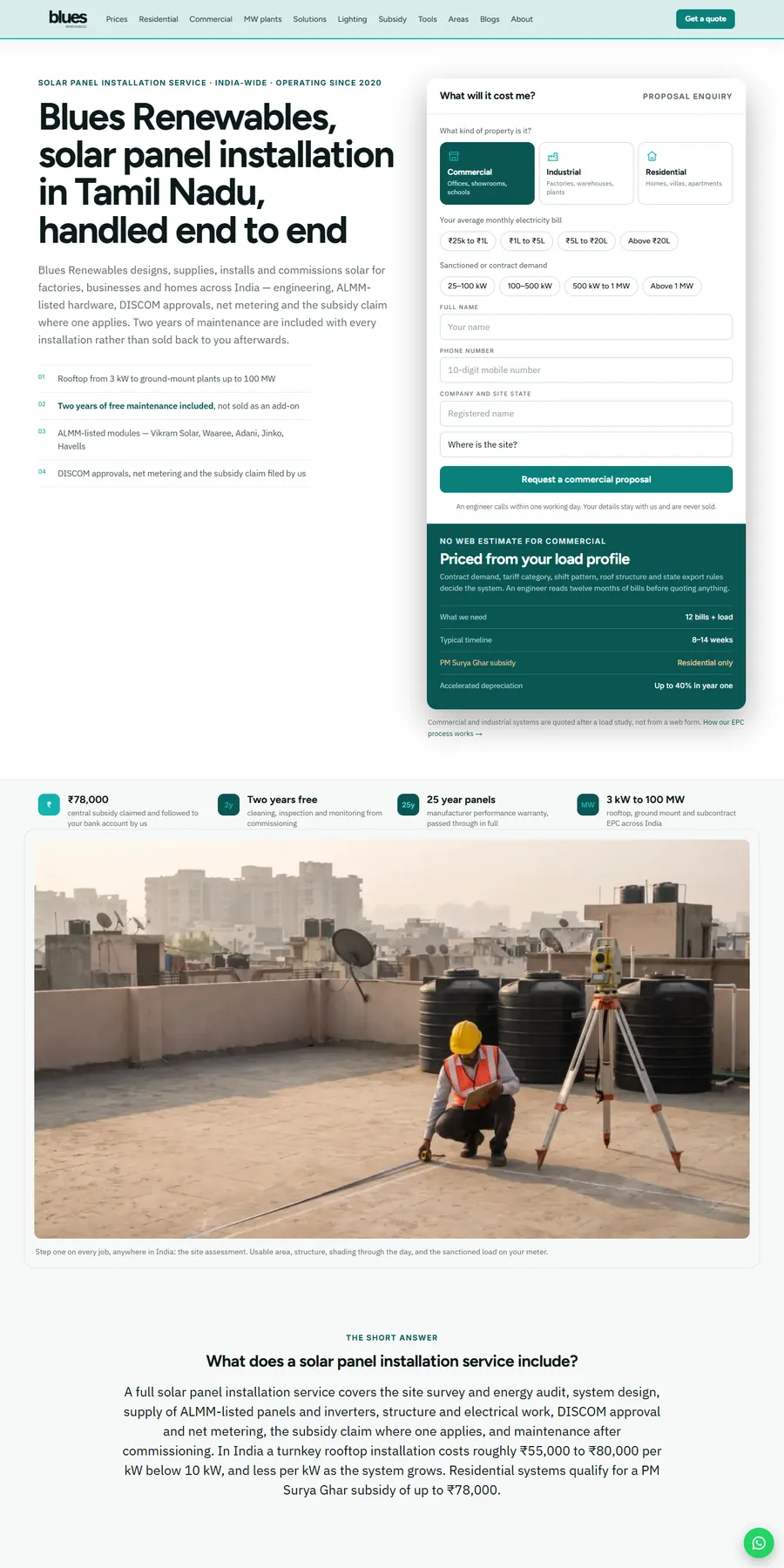
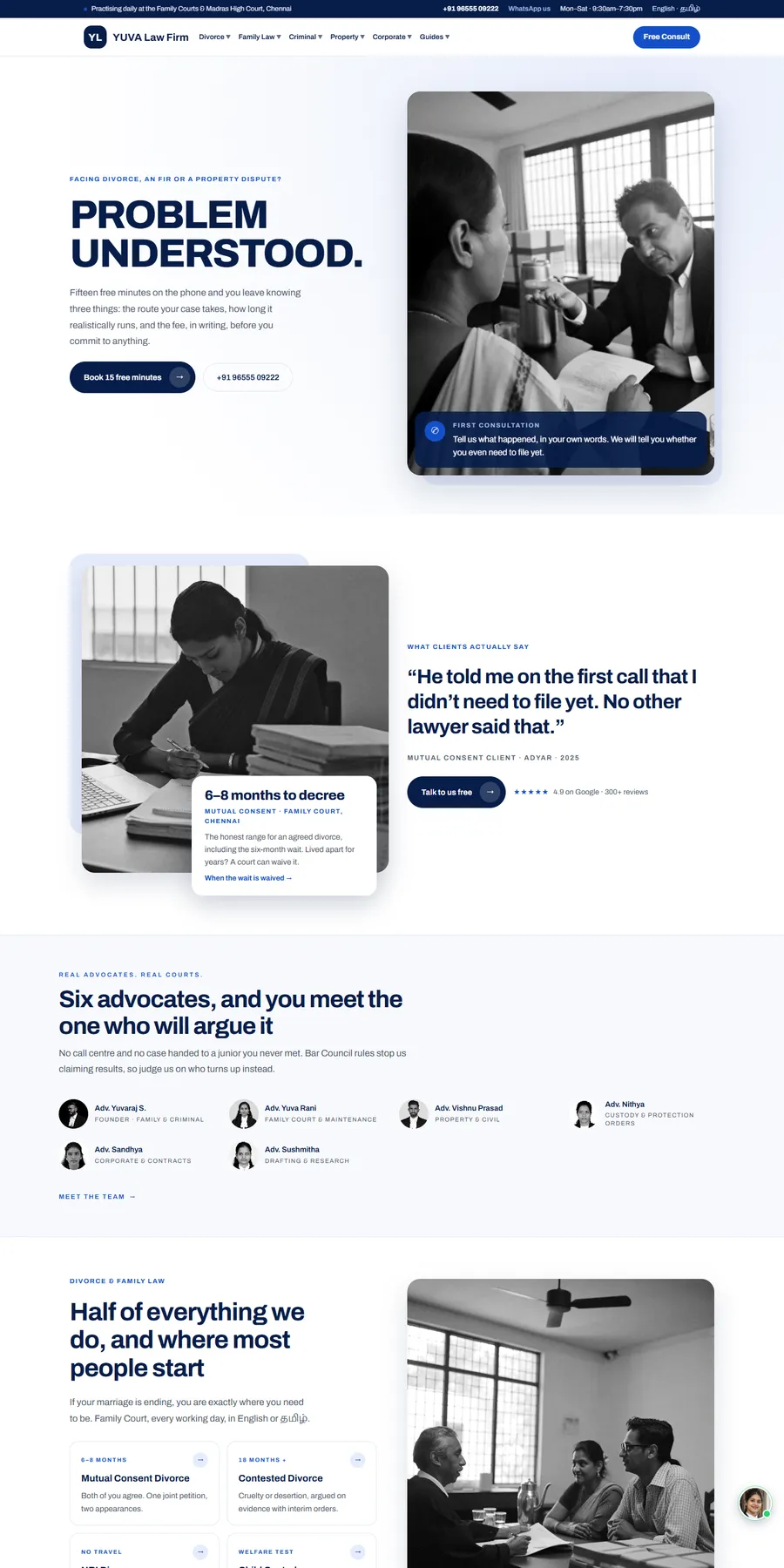
We have not built a website for a financial advisor, RIA or wealth manager, in the US or anywhere else, and we will not pretend otherwise. Our closest proof: Blues Renewables, a rooftop solar installer whose buyers research a large, long-term money decision before they talk to anyone. Its site has price pages, solar and ROI calculators, subsidy guides and 129 local area guides, and every form and call is tracked as a GA4 lead event. It went from no tracked leads to 7 to 10 enquiries a week, and Google clicks rose from 14 to 560 a fortnight in two months (Google Search Console). On your site, the price pages become a fees and minimums page, the calculators become compliance-approved assessments and the area guides become who-we-serve pages. Trucks India shows we build calculators and comparison tools at scale (EMI, on-road price and running cost across 497 truck models). We also built YUVA Law Firm's consultation-led site for a family law practice (not US, no published numbers), another profession with its own advertising rules.

More websites we have designed and built

Process

How your financial advisor website project runs

Typical timeline: 4 to 8 weeks for most advisor sites, with compliance review time in the plan; 8 to 12 weeks for multi-office firms with many advisor bios and location pages. You see progress every week.

  1. Step 01 · Week 1

    Discovery and audit

    We audit your current site, competitors, and how you show up on Google and in AI answers, then agree on goals and a fixed quote.

  2. Step 02 · Weeks 2 to 3

    Strategy and design

    Sitemap, wireframes and full designs for your review. You approve everything before we build.

  3. Step 03 · Weeks 3 to 6

    Build and test

    Development, SEO setup, speed tuning, and testing across devices and browsers.

  4. Step 04 · Launch and beyond

    Launch and grow

    We launch, monitor, and improve based on real data. 30 days of free support included.

What shapes your quote

Scope, not hourly billing

Every project gets a fixed quote within 1 business day, agreed before work starts.

Get my fixed quote →
  • How many niche, service and advisor bio pages you need
  • Which scheduler and CRM we connect, and the fit questions before booking
  • The compliance workflow: approval steps, archiving service and how your CCO or broker-dealer review desk wants drafts
  • Whether we write the content from your Form ADV and interviews, or edit copy you already have
  • Assessments, guides or tools, and the review each one needs
  • Moving off a platform or old site: domain transfer, redirects, the Form ADV listing and multi-office or multi-advisor setups

Financial advisor website questions, answered

Straight answers to what owners ask us, and what they ask Google and AI assistants. Ask us anything else.

How much does a financial advisor website cost?

We quote one fixed price, agreed before work starts, based on the number of pages, features, integrations and content. You get it within 1 business day of a free audit of your current site. There is no hourly billing and no monthly site rental.

How long does it take to build a financial advisor website?

Most advisor sites take 4 to 8 weeks; multi-office firms with many advisor bios and location pages take 8 to 12 weeks. Compliance review time is part of the dated week-by-week plan, so your CCO sees drafts on known dates instead of all at once before launch.

Can you move us off an advisor website platform without losing compliance review?

Yes. We audit what you own and what the platform owns, move the domain into your name, keep the URLs that rank and redirect the rest, and rebuild the approval and archiving steps in your new CMS. Tell your CCO before launch, since a new domain means a Form ADV update.

Who writes the pages, and how much of my time will it take?

We can write them. We start from your Form ADV Part 2A, Form CRS and an interview with each advisor about who you serve and how you work, then deliver copy in short blocks your CCO can approve or mark up. You review drafts on dated weeks in the plan instead of writing from a blank page. If you already have approved copy, we edit and reuse it, which shortens review.

Do I own the website, domain and content?

Yes, from day one. Code, design, content, domain, hosting and analytics accounts are in your name. There is no lock-in, so you can take the site to another developer at any time.

Will my site be SEC or FINRA compliant?

No developer can promise that, and we do not. We build to the rules (Form CRS placement, IAPD and BrokerCheck links, disclosure blocks, archives) and your CCO, compliance consultant or broker-dealer review desk approves every page. A vendor that calls its template compliant is skipping that step.

What must be on an RIA's website?

For an SEC registered firm serving retail investors, the firm-wide requirement is Form CRS, posted prominently and kept current, with working links to the documents it references, such as your Form ADV Part 2A brochure. Most firms also post the brochure, a privacy notice that matches their Regulation S-P notice, and a footer line saying registration does not imply a certain level of skill or training. If you or your reps are FINRA registered and work with retail investors, FINRA Rule 2210 requires BrokerCheck links on the retail home page and on those reps' profile pages. State registered firms follow their state regulator's rules. Your compliance team confirms the full list for your registration.

Should I publish my fees and minimums?

Usually yes. Published fees screen out poor fits before the intro call, and several fee-only firms publish a fee schedule or a minimum for that reason. In an r/taxpros thread, a tax practice owner said publishing prices stopped the price shoppers. Fees on the site must match your Form ADV Part 2A and Form CRS.

Can I show testimonials, Google reviews or award badges on my site?

Under the Marketing Rule you can, with disclosures: client status and compensation for testimonials; date, period, who gave it and any fee paid for ratings. Your CCO decides whether to use them, and we build blocks that cannot be published without the disclosure fields.

Can I put a retirement calculator or model portfolio returns on my site?

Only if your compliance team approves it. Projections and model returns can be hypothetical performance, which needs policies and disclosures, and the SEC settled with nine advisers in 2023 for showing it on public websites. Educational tools that do not project returns are usually simpler to review.

Will a new website get me more clients?

We do not guarantee rankings or lead numbers. What a new site changes is how many referrals and searchers book a call: niche pages, published fees, a scheduler on every page, and tracking that shows which source produced each meeting. On a rooftop solar installer's site (not an advisory firm), the same tracked system took enquiries from none to 7 to 10 a week.

How does my firm show up when someone asks ChatGPT for a fee-only advisor near them?

AI assistants draw on your site, your Google profile, directory listings and public records. We write who you serve, where, your fee model and registration as plain text, add FinancialService and Person schema, and make the site match Form ADV, IAPD and BrokerCheck. No one can guarantee an AI mention.

Can you connect my scheduler, CRM and client portal?

Yes. We embed Calendly or HubSpot meetings, send form leads to Redtail, Wealthbox, Salesforce Financial Services Cloud or HubSpot where your CRM accepts them, and link Schwab, Fidelity, Altruist, eMoney or Advyzon logins from one client center. You keep your own subscriptions; the site links to them.

What makes you different from another financial advisor website design company?

We put the terms in writing first: a fixed quote in 1 business day, a dated plan with review time in it, your ownership of everything and no lock-in. The build covers niche and fee pages, Form CRS, IAPD and BrokerCheck links, disclosure blocks, an approval and archive workflow, tested booking and tracking by source.
Get your free financial advisor website proposal

Four quick questions. You'll get a fixed quote and a free audit of your current site within 1 business day.

  • ✓ No obligation, no sales pressure
  • ✓ Fixed price, never hourly
  • ✓ Your details stay private

Prefer email? info@billionwebstudio.com

Step 1 of 4~60 seconds
What do you need?