Skip to content
Booking projects for next month. Free website audit with every quote.Claim yours →

Construction and manufacturingBooking projects for November

Home Builder Website Development Company for Qualified Build Consults

A family weighing a 12-month custom build studies your finished homes, your process and your license long before they call. We build home builder sites with a plan library, finished-home pages, community and quick move-in pages your office updates in minutes, and a consult form that asks about lot, budget and timeline before anyone books your Saturday.

  • Built for home builders and custom home builders
  • Fixed quote in 1 business day
  • You own everything
yourhomes.com/build-on-your-l…Custom homes builton your landBook a lot reviewTap to callNew consult: owns a 2-acre lotFrom /build-on-your-lot · 8:05 pmTracked as a leadSource: GoogleAI ASSISTANTWho builds custom homes on my lot nearRaleigh?Your Company: licensed NC builder, buildson your lot in Wake County.Source: your website
Illustration: a visit becomes a tracked lead

The short answer

What does a home builder website development company do?

A home builder website development company builds websites for custom and production home builders that turn months of buyer research into booked design consultations, lot evaluations, model home tours and contracts. The site has to show finished homes with real photos, explain how a build works from lot to keys, publish floor plans and elevations, keep quick move-in prices and status current, and stop the inquiries from people with no land and a budget half the size of your smallest plan.

What that means depends on how you build. A custom builder on the client's land needs a portfolio of finished homes by town, a step-by-step process page, a build-on-your-lot page with a lot evaluation request, a financing page that covers construction-to-permanent loans and a consult form that asks about lot status, budget band and timeline. A community builder adds community pages with site plans and HOA fees, quick move-in home pages, model hours, tour booking, interest lists before a phase opens and a page for Realtors.

Billion Web Studio is a home builder website development company that delivers this as one fixed-scope project: design, plan, project, community and area pages, structured data, every call, consult request and tour tracked in GA4, and forms that land in Lasso, HubSpot, GoHighLevel or Buildertrend. You own the site, the domain, the photos and every account from day one, and your listing feeds point back to pages on your own domain.

The market

What the numbers say about home builders and custom home builders online

New homes are a slow, expensive purchase sold in a soft market. The U.S. Census Bureau and HUD estimate 679,000 new homes were sold in 2025, with a December median price of $414,400 and 7.6 months of supply on the market. Most of the builders selling them are small. The figures below show the pressure on price, how long a build runs, how small the typical builder is and where buyers start.

How they choose

How home buyers find and choose a home builder

Nobody buys a new home on the first visit. A custom build starts with a lot, a Pinterest board or a referral from an architect and runs past a year from permit to keys. A quick move-in sale can close in weeks. Here is how US buyers choose a home builder and what your site has to do at each step.

  1. 1

    The spark: a lot, a referral or a listing

    A family buys acreage, an architect gives them your name, or a Realtor sends a quick move-in listing. Their first search is your company name or "custom home builder [county]". The first screen has to say what you build, where, and from what price level, so they know in five seconds whether to keep reading.

  2. 2

    The research: plans, finished homes and cost

    Buyers spend weeks on floor plans, elevations and photos of homes you finished, and they want a rough cost before they ask for a meeting. Plan pages with beds, baths, square feet and "starting from" figures, plus a cost-to-build guide for your county, keep them on your site instead of a portal.

  3. 3

    The check: license, reviews and process

    Before they hand you a deposit they look up your license, read your Google reviews and look for the warranty. A process page with timing for each stage, your license numbers by state, insurance, HBA membership, Parade of Homes entries and client reviews answer the questions they will not ask on the first call.

  4. 4

    The first step: consult, lot review or tour

    Custom buyers request a design consultation or a lot evaluation; community buyers book a model tour or a quick move-in showing. A form that asks lot status, budget band, timeline and financing tells you who is ready, and online tour booking catches the buyer browsing at 9 p.m. on a phone.

  5. 5

    The long middle: financing, selections and the contract

    A custom home runs 11.7 months on average from permit to completion (NAHB). Buyers come back to your financing page, your included-features list, your current offers and your warranty while they decide. The site keeps answering, and your tracking shows which plan, community or project page produced the signed contract.

The problem

Why most home builder websites lose qualified buyers

What we find again and again when we audit sites in this trade. None of it is about how the site looks.

Leak 01

Visitors cannot tell what you build or where

In an r/Homebuilding site review, replies told a luxury builder it was unclear whether the company designs and builds custom homes or sells finished ones, the logo name did not match the domain, and the slow homepage slideshow pushed its controls below the fold on a phone. A buyer who cannot tell in seconds goes back to search.

Leak 02

You only show up when someone types your name

Most small builder sites are Home, About, Gallery and Contact. That gives Google nothing to rank for "custom home builder [county]", "build on your lot [town]" or "farmhouse floor plans [area]". Buyers in r/Homebuilding say they look for the name of every county and town a builder serves. Without a page per county, per finished home and per plan, only people who already know your name find you.

Leak 03

Every inquiry has to be called to be sorted

A contact form that asks only for a message brings people with no land, no lender and a budget far below your smallest plan. One small residential contractor in r/Construction spends over 10 hours a week on estimates for budgets that never fit. Lot status, budget band, timeline and financing questions sort the inquiries before your phone rings.

Leak 04

Quick move-in prices and status are stale

When a price drop, a sold sign or a new rate buydown takes a week and a developer ticket to reach your site, buyers and agents see the old number while a portal already shows the new one. With prices and incentives changing month to month, a stale quick move-in page costs you trust with the agents involved in 88% of home purchases (NAR).

Leak 05

A rented site with a buy-out clause

Some builder sites come inside a marketing retainer with a six-month minimum, or as a "free website" leased over five years with a buy-out fee to move it. In r/smallbusiness an owner lost their site when the freelancer holding the hosting disappeared. Your plan library and project photos are years of work, so they belong in your name.

Leak 06

No way to know which page sold a home

A builder site with no event tracking cannot tell you whether the farmhouse plan, the Wake County page or a Parade of Homes listing brought the buyer who signed. Without that, you keep paying for portals and ads on faith, and the pages that produce consults never get more attention.

Generic vs built for you

Why a generic website fails home builders and custom home builders

A template is built to fit every business, so it fits yours badly. Here is what changes when the site is planned around how home buyers actually buy.

Generic website compared with a website built for home builders and custom home builders
What you needGeneric template siteBuilt for home builders and custom home builders
Floor plansA gallery of plan images with no dataOne page per plan with beds, baths, square feet, garage, elevations, a printable PDF, favorites and "build this on your lot" or "available in these communities"
Finished homesOne slideshow of mixed photosA page per finished home with town, style, size, build time, a short story and real photos, filterable by style and area
Build on your lotNot coveredA page on what a lot needs (survey, utilities, septic or well, slope, setbacks) with a lot evaluation request and survey upload
Lead qualificationName, email and messageA two-step consult form: lot status, county, budget band, timeline and financing first, contact details second
Quick move-in homesA blog post per house that someone forgets to updateStructured home records with address, price, status and move-in date that your office changes in the CMS in minutes
Communities and lotsA map embed and an addressCommunity pages with site plan, lot status, amenities, schools, HOA fees, model hours, directions and an interest list
Offers and financing"Rates as low as" banners with no disclosuresAn offers page with an end date and a disclosure field beside every rate buydown or payment example, reviewed by your lender
Licenses and trustA stock "licensed and insured" badgeLicense numbers by state where required, insurance, HBA and NAHB membership, awards and a warranty page with a service request form

Free self-check · 2 minutes

What your current home builder website is missing

Tick everything your site does today. Each box you cannot tick is a place where a ready-to-buy visitor leaves.

What you need

What every home builder website needs

The features that turn a home builder website from a brochure into the best salesperson you have. We build all of them.

  1. Must-have · 01

    A first screen that says what, where and from what price

    "Custom homes on your land in three named counties" or "New homes from the high $300s in four communities", with your phone number as text and one clear next step. A buyer should know in seconds whether you build their kind of home.

  2. Must-have · 02

    Finished home pages

    One page per finished home with town, style, beds, baths, square feet, build time and a short story, built from real photos. These pages rank for "[style] home builder [town]" and give AI assistants specific facts to repeat.

  3. Must-have · 03

    A floor plan library you can edit

    Plan pages with elevations, a printable plan, favorites, compare, the energy features you can document (insulation, windows, HVAC specs, a HERS rating if the plan was rated) and either a "starting from" figure or a price band if you choose to publish one. Plans are a content type in the CMS, so adding a plan is a form, not a design job.

  4. Must-have · 04

    A process page where every step has a next action

    From first meeting to lot review, design, selections, permit, construction, walkthroughs and warranty, with how long each stage takes. Each step ends in its own call to action: book a lot review, book a design consult, talk to a lender.

  5. Must-have · 05

    Build on your lot and lot evaluation

    What a buildable lot needs, what you check, what it can cost to prepare a site, and a request form that takes an address or parcel number and a survey upload.

  6. Must-have · 06

    Financing and construction loans explained

    How construction-to-permanent loans, deposits and draws work, your preferred lenders and whether buyers must use them. Any rate or payment shown carries the Regulation Z disclosures beside it.

  7. Must-have · 07

    Community and quick move-in pages (community builders)

    Site plan with lot status, amenities, schools, HOA fees, model hours, directions, available homes with price, status and move-in date, and an interest list for the next phase. NAHB data shows 31.5% of built-for-sale homes completed in 2025 sold only after completion, so ready homes need pages that sell.

  8. Must-have · 08

    Areas served backed by real homes

    A page per county or city where you actually build, with homes finished there, lot and permit notes and reviews from those buyers. No pages for towns where you have never worked.

  9. Must-have · 09

    License, insurance, warranty and the team

    License numbers by state where advertising rules require them, insurance, HBA and NAHB membership, Parade of Homes awards, the owner's name and face, the warranty terms and a warranty service request form for homeowners.

  10. Must-have · 10

    A page for Realtors and architects

    Co-op and registration terms for agents, and a short page for architects and designers who refer clients. NAR's 2025 profile found 88% of buyers bought through an agent or broker.

  11. Must-have · 11

    Reviews with permission and nothing gated

    Your Google rating linked to the profile, client quotes used with consent, third-party client survey results where you have them, and review requests sent to every buyer after closing the same way.

  12. Must-have · 12

    Fast photo-heavy pages and structured data

    Compressed, correctly sized images so a gallery does not stall on a phone, Core Web Vitals targets of LCP 2.5 seconds or less, INP 200 ms or less and CLS 0.1 or less, and schema markup for your business, areas served, plans and homes for sale.

What we build

The home builder website we would build for you

Here is the sitemap we would start from. A custom builder on the client's land usually needs Homes and plans, Building with you, Areas and guides, and Trust and company. New home builder website design for a community builder adds Communities and ready homes and the Partners pages. We cut or add pages to match the homes you build and the places you build them.

yourcompany.comHome · every section links here

Homes and plans

  • Floor plan library by style and size
  • One page per plan with elevations
  • Compare plans
  • Finished homes portfolio
  • One page per finished home
  • Included features and standard specs
  • Virtual tours and video walkthroughs

Communities and ready homes

  • Communities hub
  • One page per community with site plan
  • Quick move-in homes with status
  • Model homes and sales center hours
  • Interest list for upcoming phases
  • Current offers and incentives

Building with you

  • How we build: process and timeline
  • Build on your lot
  • Lot evaluation request
  • Design center and selections
  • Financing and construction loans
  • Warranty and homeowner care
  • Warranty service request

Partners

  • Realtor program and registration
  • Architects and designers
  • Preferred lenders

Areas and guides

  • Where we build hub
  • County and city pages backed by real homes
  • Cost to build guide by county
  • Buy vs build guide
  • Choosing a home site guide
  • Questions to ask a builder before signing

Trust and company

  • About the owner and team
  • Licenses, insurance and memberships
  • Reviews and client stories
  • Awards and Parade of Homes
  • FAQ
  • Contact and consult request

Calls, bookings, leads

How we turn visitors into qualified buyers

Good website design for home builders is judged by consults booked, lots reviewed, tours taken and contracts signed, not by visits. This is how we build that path and track each step for a sale that can take a year.

  • 01A two-step consult request that qualifiesStep one asks custom or community home, lot status (own a lot, under contract, still looking), county, budget band, timeline and whether they have talked to a lender. Step two takes contact details. You choose how strict it is: show ranges to filter, or keep every field optional so nobody good is turned away.
  • 02Lot evaluation request with survey uploadAn address or parcel number, acreage, utilities, septic or well status and an optional survey upload. Your site visit starts with the facts instead of a guess.
  • 03Tour booking for models and quick move-insBuyers pick a time from your calendar to see a model or a ready home, with directions and a confirmation. Zillow's 2023 report found 68% of new construction buyers preferred to schedule in-person tours online.
  • 04Plan favorites, brochures and interest listsA buyer saves plans, downloads a plan brochure in exchange for an email, or joins the interest list for a community phase. Each signup is tagged with the plan or community so your follow-up matches what they looked at.
  • 05Leads routed to your CRM and your salespersonForms post into Lasso, HubSpot, GoHighLevel or Buildertrend with the source and page attached, and alert the right person: the owner at a small custom builder, or the online sales counselor at a community builder.
  • 06Click-to-call and text with trackingYour number as text in the header and a sticky call bar on mobile. Dynamic numbers show only to ad and campaign visitors, so your main number stays the same on your site, Google profile and schema.
  • 07A report from page to contractConsults, lot reviews, tours, calls and interest list signups by source and page, in plain numbers each month. When a contract is signed, you can trace it back to the plan, community or finished home page that started it.

AI search

Buyers now ask ChatGPT, Google AI Mode and Perplexity which builders build on their land, which have homes ready this month and who builds energy-efficient homes in their county. BrightLocal's 2026 survey found 45% of consumers used generative AI tools for local business recommendations, up from 6% a year earlier. In BrightLocal's 2026 study of local AI answers, business websites made up about 93% of the unique domains cited and Google Business Profile about 28.5% of all citations. National builders dominate generic answers today; specific, plain pages about what you build and where are what a small builder controls.

Questions your home buyers ask AI assistants

  • Who builds custom homes on rural acreage with a well and septic near Raleigh?
  • Which builders in Knox County have quick move-in homes ready this month?
  • How much does it cost to build a 2,500 square foot house in Collin County?
  • What is the difference between a custom and a semi-custom home builder?
  • Which home builders near me offer a modern farmhouse plan with a first-floor primary suite?
  • Is this home builder licensed, and what warranty do they give?
  • Facts as text, not inside images

    What you build, counties served, price levels, plan specs, build times, license numbers and warranty terms written as plain text. An assistant cannot quote a square footage that only appears on a plan image.

  • Pages that answer buyer questions in the first lines

    Cost to build in your county, how long a custom home takes, what your base price includes, what a lot needs, how construction loans work. Each answered directly at the top of its page, in the words buyers use.

  • Finished homes as citable proof

    A page per finished home with town, style, size and build time gives an assistant a specific, checkable reason to name you for "custom farmhouse builder in [county]".

  • A Google Business Profile set up the way Google allows

    Builders who build on the client's land and have no office open to the public usually run a service-area profile with the address hidden. A sales center staffed during posted hours can be listed as a location, since Google allows locations that receive customers during stated hours. We match the profile's name, phone, service area and license details to your site and HBA listing, and add finished home photos.

  • Structured data for business, plans and homes

    Schema markup for your company, areas served and homes for sale, so search engines and AI systems read the same facts the visitor sees.

  • A plain company fact page

    One page that lists what you build, where, price levels, years building, homes completed, licenses and warranty. It gives assistants a single clean source to check. No one can guarantee an AI mention, and we do not.

Compliance and trust

The rules a home builder website has to get right

A builder site makes claims that state boards, HUD, the CFPB, the FTC, the FCC and the Justice Department have rules about: license numbers, who a home is for, rate buydowns, reviews, texts and access for disabled buyers. We build pages and forms that support these rules. We do not certify legal compliance; your counsel, your lender and your state board confirm what applies to you.

License numbers by state

California requires the license number in all advertising for licensed construction work, including electronic advertising and directory listings, and you may not advertise outside your classification. Florida requires the registration or certification number in every advertisement regardless of medium. North Carolina requires a general contractor license for projects of $40,000 or more. Texas has no statewide home builder license since 2009, though local rules apply. We build an editable license block per state for the footer and About page.

Fair Housing advertising

The Fair Housing Act (42 U.S.C. 3604(c)) makes it unlawful to publish ads for the sale of a dwelling that show a preference based on race, color, religion, sex, handicap, familial status or national origin, and it covers builders, not only agents. Copy describes the home and community, not the buyer, so lines like "perfect for young couples" stay off the site. We add the Equal Housing Opportunity statement as good practice; 55+ communities need your counsel's review.

Rate buydowns and payment examples

Under Regulation Z (12 CFR 1026.24), a stated rate must appear as an annual percentage rate, and a down payment, payment amount, number of payments or finance charge triggers more disclosures. Offers and community pages carry a disclosure field beside every rate or payment example, and we recommend your lender reviews the wording.

Lot sales

The Interstate Land Sales Full Disclosure Act does not apply to subdivisions of fewer than 25 lots, or to lots sold with a home or a contract to build one within two years. A developer selling bare lots in a larger subdivision should check with counsel before we publish lot prices and reservation forms.

Reviews, testimonials and texts

The FTC rule on consumer reviews and testimonials (16 CFR Part 465) bans fake or AI-written reviews, rewards for positive reviews, undisclosed reviews from your own managers and suppressing negative ones. The TCPA requires prior express written consent before autodialed or prerecorded marketing texts to cell phones. We label partner quotes, never gate reviews, and add clear consent text and a STOP path on forms that lead to texts.

Accessibility and privacy

The Justice Department says the ADA applies to the websites of businesses open to the public. We add alt text to plan images, publish plan data as text, make site plans and tour booking work by keyboard and caption video walkthroughs. The privacy policy names the CRM, chat and tracking tools you use.

We build with tools and patterns that support these rules and document what we set up. For legal advice on your own obligations, talk to your attorney.

From the forums

What home builders and custom home builders ask about websites, answered

We read what builders ask each other on r/Homebuilding, r/Construction, r/GeneralContractor, r/RealEstate, r/realtors and r/smallbusiness, and what custom home architects, a key referral source, say on r/Architects and the AIA Custom Residential Architects Network board. The same worries repeat: getting found at all, lead platforms that sell unvetted leads, inquiries with no land or budget, spec homes that sit, and sites the builder does not own. These are their questions, paraphrased, with our straight answers.

Where owners talkr/Homebuildingr/Constructionr/GeneralContractorr/RealEstater/realtorsr/smallbusinessr/ArchitectsAIA Custom Residential Architects Network

Asked on r/Homebuilding

“I am a newer custom builder. How do established builders actually find clients, and do I need more than referrals?”

Our answer: Builders in the threads say referrals, architects and word of mouth come first, and we agree. Replies also say many builders are hard to find at all: a site on your own domain, a Google Maps listing and your local builders association listing are the base. A buyer added what they look for: good photos of finished homes, a short story about the builder and the name of every county and town you build in. That is the site we build; it is where referred buyers check you before they call.

Asked on r/Homebuilding

“Can you review my luxury home building website? What is wrong with it?”

Our answer: Replies said the first screen should say who you are, what you build and where; it was unclear whether the company built custom homes or sold finished ones; the logo and domain names did not match; and a slow slideshow pushed its controls below the fold on a phone. We check those four things first in every audit.

Asked on r/Homebuilding

“I built a custom home builder website template. What would make buyers use it?”

Our answer: The top reply asked for exactly that: buyers do not want to spend a consultation on a plan far over their budget, and a simple questionnaire on bedrooms, size and finish level giving a rough range would help. We can build a cost-to-build guide or a range estimator from your own numbers, clearly labeled as an estimate, or show "starting from" figures on plans. You decide what to publish.

Asked on r/Construction

“Is it crazy to use my website to scare away low-budget leads with price tiers and a "who we are not for" section?”

Our answer: Owners in the thread were split: published minimums filter people out, but can also put off good clients who simply do not know what building costs yet. Our default is a middle path: publish ranges or "starting from" figures, and ask lot status, budget band and timeline on the form so you can sort without turning anyone away at the door.

Asked on r/GeneralContractor

“How do you pre-qualify inbound leads before you spend a day on them?”

Our answer: Replies: give the typical price range on the first call, and ask when they want to start, why now, and whether they have met an architect, designer or another builder. Sticker shock is normal; flat rejection means move on. Our consult form asks those same questions before the call, so the first conversation starts further along.

Asked on r/Construction

“Is a paid home-design platform profile worth it for a building company?”

Our answer: Most replies were negative: two to three years of paying with no job from it, one usable lead in a year, auto-renewal before the year ended and trouble canceling. Custom home architects on r/Architects reported much the same. A site on your own domain stays yours when a subscription ends, and its leads come only to you. A homeowner in r/GeneralContractor said they checked every platform-recommended company's own website and Google reviews before calling, so even platform leads judge you on your site.

Asked on r/Homebuilding

“Our custom starts fell from eight a year to one. What works beyond referrals?”

Our answer: The builder's team already had a Parade of Homes entry, Realtor, lender and architect networks, and letters to people who had just bought buildable lots. That is the right list. The site's job is to catch the land buyer early: a build-on-your-lot page and lot guide for your county, a lot evaluation request, and an interest list for buyers who are a year out. Give the Parade home its own page so people who toured it can find you afterward.

Asked on r/RealEstate

“I built my first spec homes. What is the best way to market them, and is a big listing site enough on its own?”

Our answer: Replies said nothing replaces the MLS through an agent, and that listing sites favor MLS listings. We agree: list through your broker, and give each home its own page on your site with price, status, photos and move-in date, so agents and buyers land on your domain and your other homes. New addresses always exist on your own site, even when a portal does not recognize them yet.

Asked on r/realtors

“I sell new homes for one builder in a few neighborhoods. How do I get organic traffic without paying for it?”

Our answer: The poster's home videos on social media drew likes mostly from coworkers. Organic demand for a community comes from pages people search for: a page per community, each quick move-in home with price and status, model hours and tour booking, all on the builder's domain. Route those leads straight to the person who sells there.

Asked on r/Homebuilding

“I am a newly licensed builder. Do I have to pay an agency thousands a month to show up on Google?”

Our answer: The builder in the thread had already lost over a thousand dollars on a lead marketplace that sold him people with no land or money. Being found starts with pages that match what buyers type: one per county you build in, one per finished home with the town, a plan library with specs as text, a Google Business Profile with project photos, and pages fast enough on a phone. We build those once, at a fixed quote, and you own them. Ads or an SEO retainer can come later if you want them; you do not need them before anyone can find you.

Questions are paraphrased from public threads. We never quote members by name.

Others vs us

Home builder web design options: Billion Web Studio vs a website builder template vs a builder agency on a retainer

The three ways home builders and custom home builders usually get a website, side by side.

Home builder web design options: Billion Web Studio vs a website builder template vs a builder agency on a retainer
Billion Web StudioWebsite builder templateTypical industry agency
Who owns the site, domain and photosYou do, from day one, in your own accountsYou own the content; the site lives on the builder's platformOften the agency, or a leased site with a buy-out fee to move it
Contract and pricingFixed quote in 1 business day, agreed before work starts, no lock-inMonthly subscription, you build it yourselfMonthly retainer bundling site, ads and CRM, often with a minimum term
Floor plans and finished homesPlan and home content types with specs, elevations, favorites and filtersImage galleries you arrange by handUsually present; often built for large production builders
Lead qualificationTwo-step consult form with lot status, budget band, timeline and financingName, email and messageVaries; sometimes multi-step forms inside their own CRM
Quick move-ins, communities and offersYour office updates price, status and offers in minutes in the CMSEdit each page by handOften a support ticket to the agency
Listing feeds and portalsFeeds point back to plan and home pages on your domainNot supportedOften supported, tied to their platform
License display, Fair Housing and rate disclosuresBuilt into the footer, copy review and offers pagesUp to youVaries by agency
Tracking from page to contractGA4 events and CRM source fields, report in plain numbersBasic form countsTheir dashboard, which may stay with them if you leave
TimelineDated week-by-week plan, 4 to 12 weeks by sizeAs fast as you build itVaries; often tied to the start of a retainer

Why Billion Web Studio

What we do better, and why it matters to you

  • A fixed quote in 1 business day, with a free audit

    We review your current builder site: first screen, plan pages, forms, speed, license display and tracking. Then you get a written scope and a fixed price based on pages, features, integrations and content. No hourly billing.

  • You own the site, the domain and the photo library

    Code, design, content, plan files, project photos, hosting, analytics and call tracking accounts in your name. No lease, no buy-out fee and no site that disappears when a retainer ends.

  • Built for how builders sell, not for a service trade

    Many agency pages on custom home builder website design reuse home services advice written for emergency plumbing calls. Ours starts from plans, finished homes, lots, communities, quick move-ins, financing and a sales cycle that can run past a year.

  • Sized for the builder doing five homes a year

    The median NAHB builder member started five homes in 2025 with six people on payroll. We build what a small builder can keep current without a marketing department, and add community and site plan features only when you sell that way.

  • Search setup done before launch, not sold after

    Technical SEO, schema for your company, plans and homes for sale, Core Web Vitals targets on photo-heavy pages, and a redirect map from every old URL, so the pages that already rank keep their place when we switch you over. Call and form tracking by page is live on launch day.

  • A dated plan and a guarantee on it

    A week-by-week plan, weekly written updates and 30 days of free support after launch. If we slip a date because of us, the next month of support is free.

In writing, before we start

  • Fixed quote in 1 business day

    Scope, deliverables and price agreed in writing, with a free audit of your current site. No hourly billing.

  • Launch date in writing

    A dated week-by-week plan and a written update every week. If we slip because of us, the next month of support is free.

  • You own everything

    Code, design, content, domain and accounts are yours from day one. No 12-month contract, no rented site.

  • 30 days of support included

    We watch rankings, forms and call tracking after launch and fix anything that needs it.

Proof, not promises

Results from websites we have built

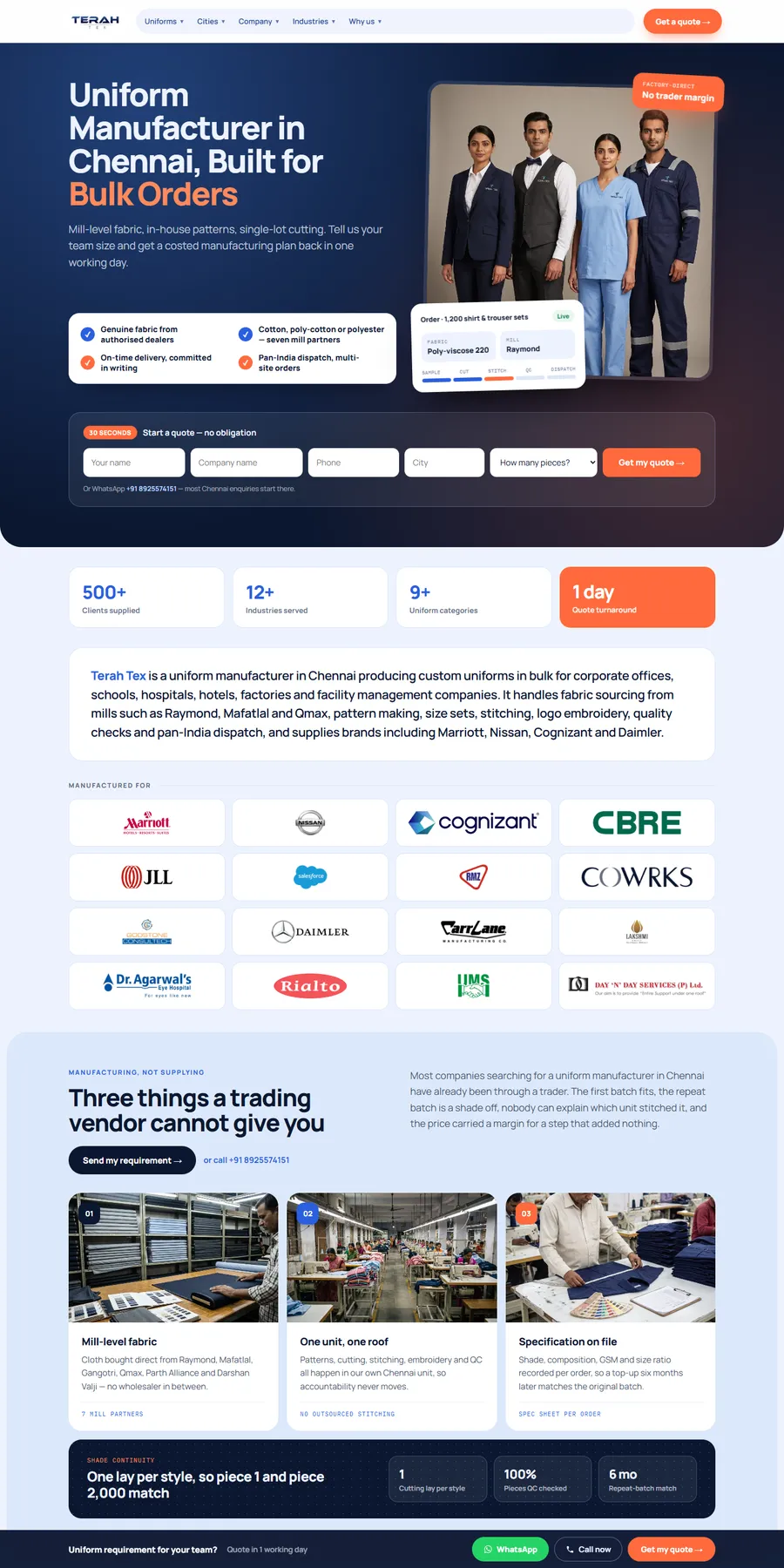
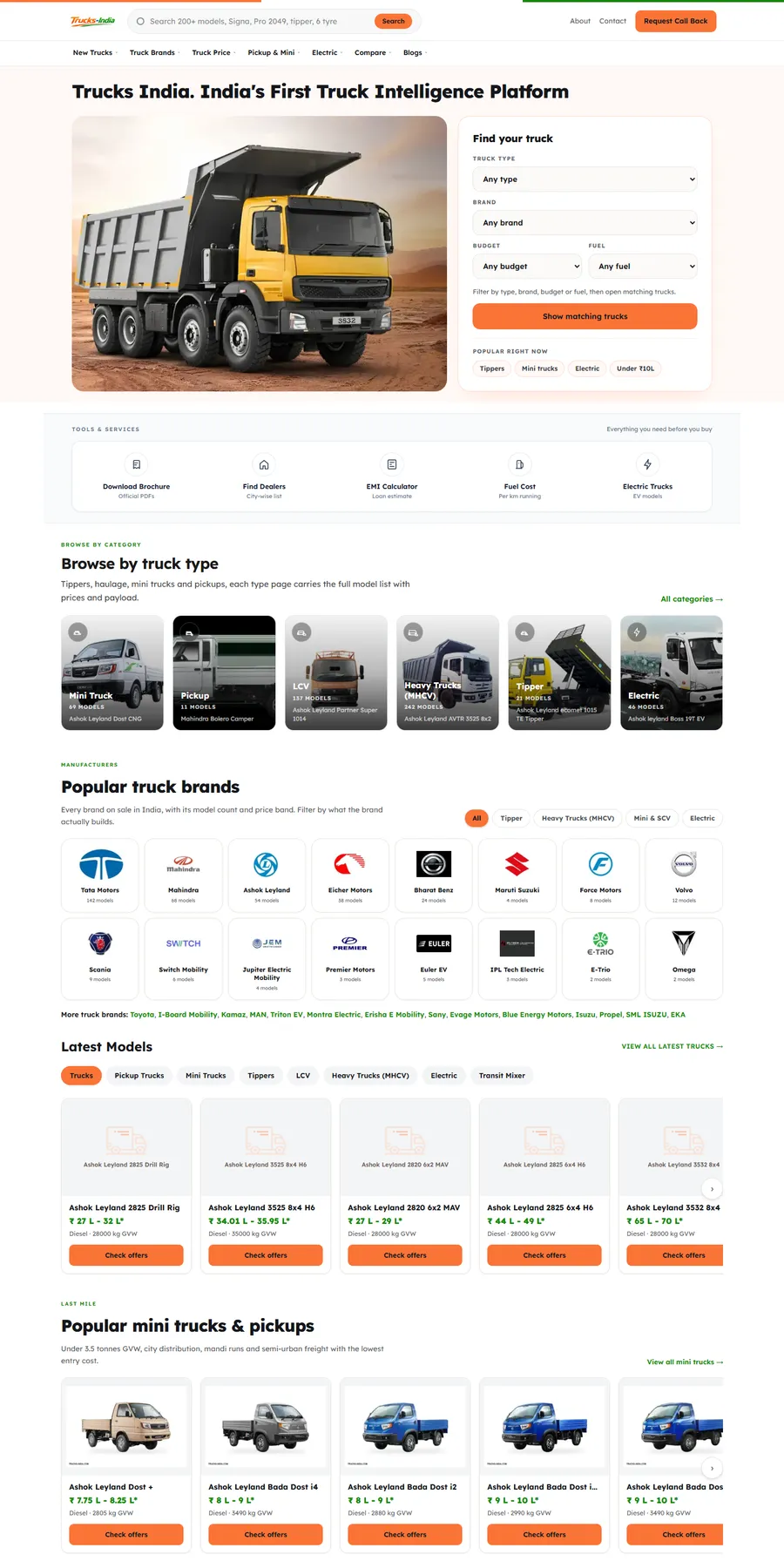
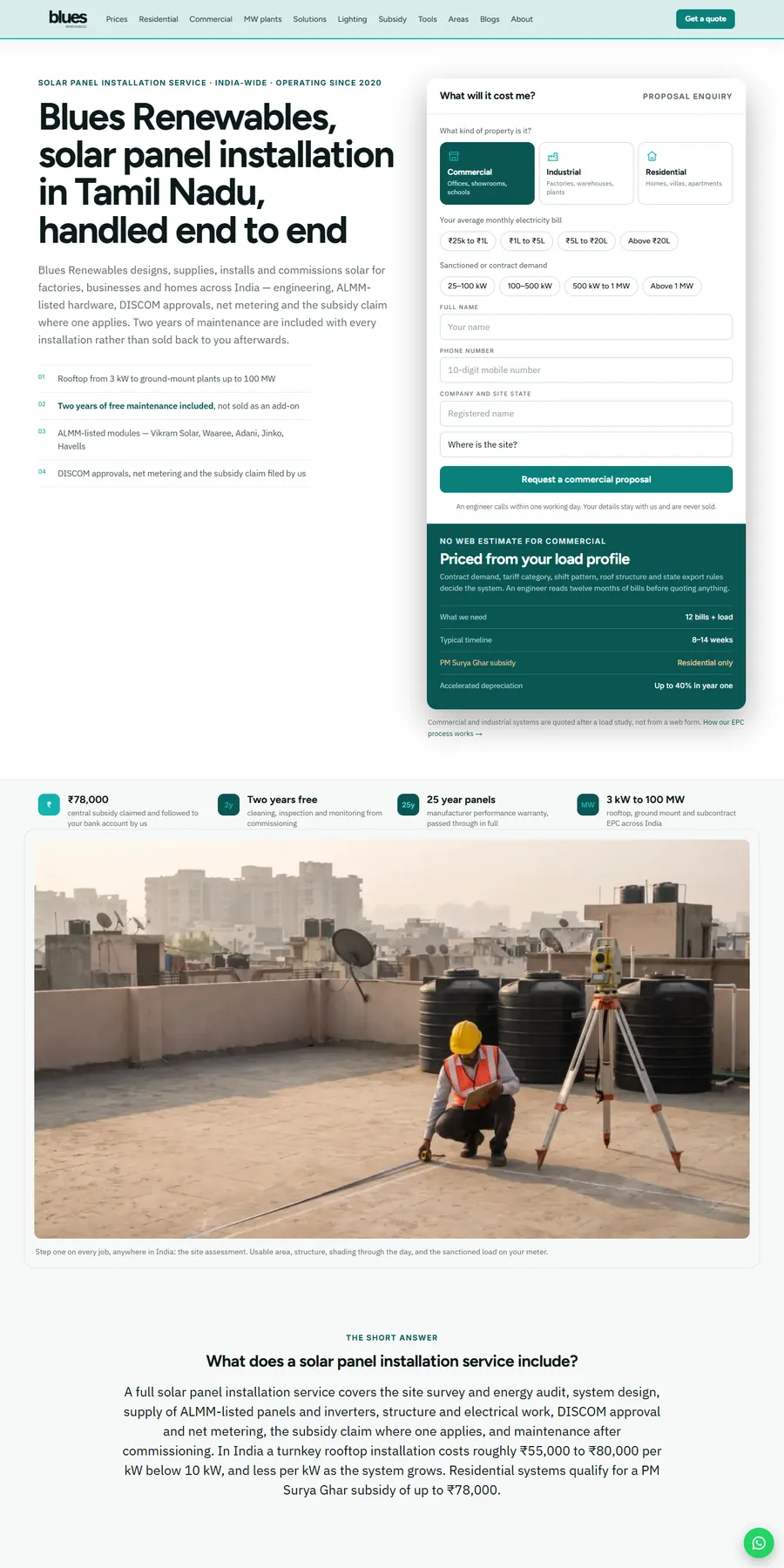
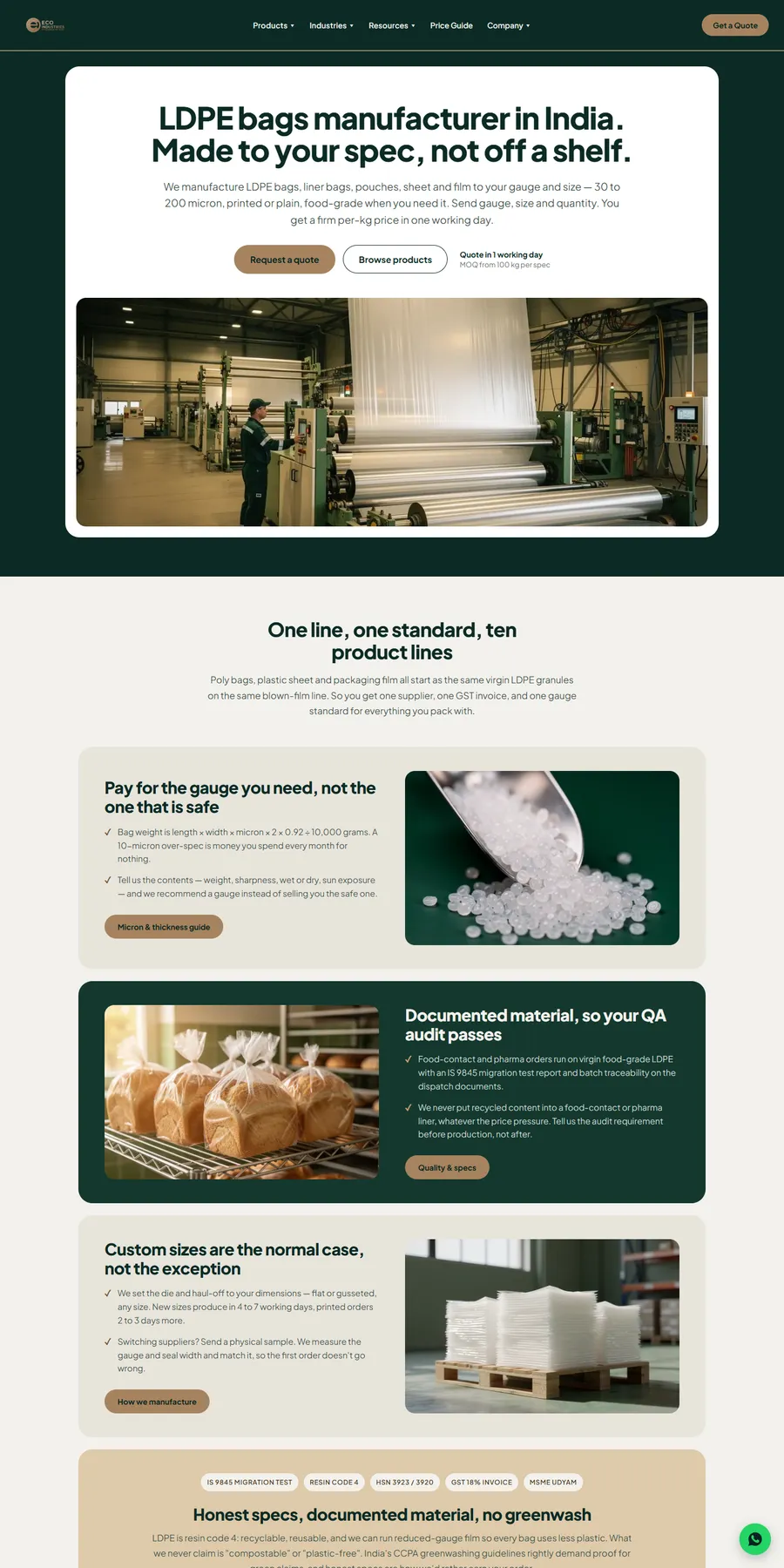
We have not built a website for a home builder yet, and we will not pretend otherwise. Here is the closest measured work. Eco Industries, a packaging manufacturer, went from no inquiries to about 10 leads a week on a 44-page catalog with buyer guides; for you, that catalog is a floor plan library and the guides are cost-to-build and lot guides. Terah Tex went from no website inquiries to about 5 bulk-order leads a week with city pages in six metros and a two-step quote form, the same pattern as a consult form that asks lot, budget and timeline first. Blues Renewables, a rooftop solar installer selling a high-ticket home product, went from no tracked leads to 7 to 10 inquiries a week, and Google clicks rose from 14 to 560 a fortnight in two months, using price pages, 129 local area guides and every call and form tracked in GA4. For you, those are plan pages with starting-from figures, county pages backed by real homes, and tracking from page to contract.

More websites we have designed and built

Process

How your home builder website project runs

Typical timeline: 4 to 8 weeks for most builder sites; 8 to 12 weeks with a large plan library, many communities or many areas served. You see progress every week.

  1. Step 01 · Week 1

    Discovery and audit

    We audit your current site, competitors, and how you show up on Google and in AI answers, then agree on goals and a fixed quote.

  2. Step 02 · Weeks 2 to 3

    Strategy and design

    Sitemap, wireframes and full designs for your review. You approve everything before we build.

  3. Step 03 · Weeks 3 to 6

    Build and test

    Development, SEO setup, speed tuning, and testing across devices and browsers.

  4. Step 04 · Launch and beyond

    Launch and grow

    We launch, monitor, and improve based on real data. 30 days of free support included.

What shapes your quote

Scope, not hourly billing

Every project gets a fixed quote within 1 business day, agreed before work starts.

Get my fixed quote →
  • How many floor plans, finished homes, communities and county pages you need
  • Which CRM or project management tool we connect, and how leads are routed to your sales staff
  • Qualifying consult, lot evaluation, tour booking and interest list flows
  • Whether you need an interactive site plan, listing feed or 3D tour integration
  • Whether we write the content and organize your project and plan photos
  • Moving from your current site: redirects, keeping pages that rank and setting up tracking first

Home builder website questions, answered

Straight answers to what owners ask us, and what they ask Google and AI assistants. Ask us anything else.

How much does a home builder website cost?

We quote one fixed price, agreed before work starts, based on the number of pages, plans and homes, features, integrations and content. You get it within 1 business day of a free audit of your current site. There is no hourly billing and no per-lead fee.

How long does it take to build a home builder website?

Most builder sites take 4 to 8 weeks. Sites with a large plan library, several communities or many counties served take 8 to 12 weeks. You get a dated week-by-week plan before we start, and we can time launch around a Parade of Homes or a community opening.

What pages does a home builder website need?

For a custom builder: finished homes, floor plans, process and timeline, build on your lot, financing, areas served, warranty, about with license details, reviews and a consult request. Community builders add community pages, quick move-in homes, model hours, current offers, interest lists and a Realtor page.

Do I need an interactive site plan or 3D tours?

Only if you sell lots in a community. A custom builder on the client's land does not need one; a plan library and finished home pages do that work. A community builder with phases can use a site plan where buyers filter lots by available, under contract or sold and click a lot for price, size and the plans that fit. We connect the site plan or 3D tour tool you already pay for, or build a simpler lot map, and your office keeps prices, home status and lot status current in the CMS without a developer.

Should I publish prices or starting-from figures?

It is your call. Published ranges filter out budgets that will never fit, and owners in r/Construction worry they also put off good buyers who do not know costs yet. Many builders show "starting from" figures on plans and ask the budget band on the consult form, which sorts leads without hiding everything.

How do I stop getting inquiries from people with no land or the wrong budget?

A two-step consult form that asks lot status, county, budget band, timeline and financing before contact details, a build-on-your-lot page that explains what a lot needs, and plan pages with starting-from figures. You see who is ready before you call back.

Will the site connect to Lasso, HubSpot, GoHighLevel or Buildertrend?

Yes. Forms post into the CRM or project tool you already run with the source and page attached, and alert the owner or the salesperson for that community.

How do my listings on Zillow and other portals relate to my website?

Portals and the MLS are distribution. Your site holds the full record for every plan, community and quick move-in home, and the listing feed points back to it. If you stop paying for a portal, your pages and their search traffic stay yours.

Do I need my license number on my website?

In some states, yes. California and Florida require license numbers in advertising, including online. Texas has no statewide home builder license. We add an editable license block per state to the footer and About page; confirm the rules with your state board.

Do I own the website, domain and photos?

Yes, from day one. Code, design, content, plan files, project photos, domain, hosting and analytics accounts are in your name. There is no lease or buy-out fee, and you can take the site to another developer at any time.

My work is all referrals. Why would I need a better website?

Referrals should stay first. The site is where referred buyers, architects and agents check your finished homes, license and reviews before they call, and where it either confirms the referral or loses it. If you also want buyers who have not heard of you, plan and area pages are how they find you.

How does my company show up in ChatGPT and Google AI answers?

AI assistants lean on your website, your Google profile and your reviews. We write what you build, where, price levels, plan specs and license details as plain text, add finished home pages and structured data, and make your details match everywhere. No one can guarantee an AI mention, and we do not.

Will a new website get me more consults and contracts?

We do not guarantee rankings or lead numbers. What a new site changes is how many visitors become consults and tours, and whether you can see which page started each contract. On a rooftop solar installer's site (not a home builder), the same tracked lead system took inquiries from none to 7 to 10 a week.

What makes you different from other home builder website development companies?

We size the site for a builder doing a handful to two dozen homes a year, not a production builder with a sales team, so your office can keep plans, prices and homes current. We put the terms in writing first: a fixed quote in 1 business day, a dated plan, your ownership of everything and no lock-in. And we are straight about proof: we have not built for a home builder yet, so we show the catalog, quote form and local lead work we have measured.
Get your free home builder website proposal

Four quick questions. You'll get a fixed quote and a free audit of your current site within 1 business day.

  • ✓ No obligation, no sales pressure
  • ✓ Fixed price, never hourly
  • ✓ Your details stay private

Prefer email? info@billionwebstudio.com

Step 1 of 4~60 seconds
What do you need?