Skip to content
Booking projects for next month. Free website audit with every quote.Claim yours →

Home services and tradesBooking projects for November

Tree Service Website Development Company That Wins More Bids

A homeowner with a limb on the garage roof and a homeowner collecting three bids for a dying ash need different pages. We build tree service sites that pre-sell your crew before the estimate visit, screen jobs with photos and tree details, switch to storm mode in minutes and show which source sent every call.

  • Built for tree service companies
  • Fixed quote in 1 business day
  • You own everything
yourtreeco.com/storm-damage24/7 storm treeremoval in DaytonSend tree photosTap to callNew estimate: oak over garageFrom /tree-removal · 3 photosTracked as a leadSource: GoogleAI ASSISTANTWho can remove a tree off my rooftonight?Your Company: insured, named ISAarborists, 24/7 storm crew.Source: your website
Illustration: a visit becomes a tracked lead

The short answer

What does a tree service website development company do?

A tree service website development company builds websites for tree removal, trimming, stump grinding and arborist firms that turn local searches into screened estimate requests, storm calls and booked site visits. The site has to prove your crew is insured and credentialed before the homeowner calls, collect photos and tree details so you stop driving out to tire kickers, and record which page and channel produced each job.

For a residential tree company that means one page per service (a crane removal over a house is a different search from crepe myrtle pruning), a storm and emergency page that can move to the top of the home page the night a storm hits, pest and disease pages for your region, a short list of real town pages, and an insurance and credentials page that names your ISA Certified Arborists with their credential numbers. Firms with HOA, municipal or commercial work get a separate path for property managers.

Billion Web Studio is a tree service website development company that delivers this as one fixed-scope project: design, service and town pages, LocalBusiness schema, a photo-upload estimate form, call and form tracking in GA4, and request forms routed into Jobber, Housecall Pro or the field software you run, where that software supports it. You own the site, the domain and every account from day one, with no per-lead fees and no lock-in.

The market

What the numbers say about tree service companies online

Tree work is sold to homeowners who usually call only when something has gone wrong: a split trunk after a storm, a dead ash leaning toward the house, a limb on the power drop. They collect bids fast, check reviews and, more and more, ask for proof of insurance before anyone climbs. The figures below show how much reviews weigh, why pest and storm pages keep finding new buyers, how tight the crew labor market is and why the estimate form has to work on a phone.

How they choose

How customers find and choose a tree service company

Tree jobs start two ways: an emergency (a storm drops a limb on the roof, a tree splits over the driveway) or a slow-building worry (an ash thinning from the top, an oak over the bedroom, an HOA letter, a home sale inspection). Both end with a homeowner comparing two or three crews. Here is how a US homeowner picks a tree service and what your site has to do at each step.

  1. 1

    The trigger: storm damage or a tree that looks wrong

    The search is plain: "tree fell on house", "emergency tree removal near me", "is my ash tree dying", "stump grinding near me". Your site needs a page for each of those, written in the homeowner's words, with the phone number and a send-photos estimate button above the fold on a phone.

  2. 2

    The shortlist: map pack, AI answer, two or three sites

    Most start on Google Maps or ask an AI assistant. The site and your Google Business Profile have to match on name, phone, hours and service area, and the site has to name the towns you actually work in, so the homeowner in the next county knows you will come.

  3. 3

    The check: insurance, credentials, real job photos

    Homeowners on r/arborists and r/homeowners tell each other to ask for liability and workers' comp, to get the certificate of insurance from the insurer, and to verify ISA certification online. Your site answers that before they ask: named arborists with credential numbers, coverage stated accurately, and a one-click COI request.

  4. 4

    The estimate: photos first, then the visit

    A form that collects photos, tree details and urgency before anyone drives out lets you text a range and drive out only for real jobs.

  5. 5

    The decision: three bids and a fast yes

    Owners on r/arborists say the last bid often wins and a slow quote loses to a cheaper crew. Pages that explain what drives the price (crane, access, hauling, stump grinding), an e-sign estimate link and clear guarantee terms help the homeowner choose you on the day you quote.

The problem

Why most tree service websites lose booked jobs

What we find again and again when we audit sites in this trade. None of it is about how the site looks.

Leak 01

The site is live but the phone stays quiet

An ISA Certified Arborist on r/smallbusiness had a site with a contact form, Google reviews and a Business Profile, and nobody called. Homeowners rarely search for an arborist until something goes wrong, so a site without tree removal, stump grinding, storm and town pages is missing at the exact moments they do search.

Leak 02

Every estimate is a drive to a tire kicker

One owner on ArboristSite reports free estimates for unscreened callers close at 10 to 30%, against 40 to 70% for pre-screened ones. A name, email and message form tells you nothing about tree size, access or power lines, so the crew lead burns a morning on jobs that were never going to sign.

Leak 03

Certified arborists with no names, insured with no proof

Homeowners now verify. BBB notes that the title arborist does not require certification, and homeowners on r/arborists call any hesitation over a certificate of insurance a red flag. A footer badge and the words fully insured lose to the crew that names its ISA arborists and offers the COI up front.

Leak 04

Nothing changes when the storm hits

The night a storm drops trees across your county, the home page still leads with spring pruning. No storm page, no after-hours number in the header, no note telling homeowners to call the utility for downed lines. Storm calls go to whichever crew looks open for emergencies.

Leak 05

One Google profile carries the whole business

NBC4 Washington reported in 2024 on a D.C.-area tree service whose Google Business Profile was disabled; calls and web traffic dropped and three appeals were denied with no reason given, until the station contacted Google. A site with real service, town and storm pages keeps earning searches while the profile is down.

Leak 06

The site is rented inside a monthly program

The tree-only marketing programs we read bundle the website with ads and review tools, and their pages do not say who keeps the site, domain or content if you leave. When you cancel, you can lose the pages that took years to rank and the phone number customers saved.

Generic vs built for you

Why a generic website fails tree service companies

A template is built to fit every business, so it fits yours badly. Here is what changes when the site is planned around how customers actually buy.

Generic website compared with a website built for tree service companies
What you needGeneric template siteBuilt for tree service companies
Estimate requestsName, email and message, then a site visit to learn what the job isA two-step form with photo upload, screening questions and text consent
Storm and emergency workThe same home page during a storm as in MayOne CMS switch puts the storm page on top, with the after-hours number
CredentialsCertified arborists in a stock badgeEach ISA Certified Arborist named with credential number and a link to ISA's verification directory, TCIA accreditation only if held
InsuranceLicensed, bonded and insured, whether all three are true or notCoverage types stated as they are, a request-our-COI button that goes to your agent, and bonded only if you are bonded
State license rulesNothing about licensingYour license number in the header or footer of every page where your state requires it, such as Maryland's L.T.E. No.
Town pagesDozens of city-swap pages with the same textOne page per town you really serve, with local species, permit notes, job photos and reviews from that area
Price questionsCall for a free estimate, and nothing elsePages that explain what changes the cost of removal, trimming and stump grinding, so the homeowner arrives with realistic expectations
OwnershipA site that lives on the builder's platform or inside an agency programCode, design, content, domain and accounts in your name from day one

Free self-check · 2 minutes

What your current tree service website is missing

Tick everything your site does today. Each box you cannot tick is a place where a ready-to-buy visitor leaves.

What you need

What every tree service website needs

The features that turn a tree service website from a brochure into the best salesperson you have. We build all of them.

  1. Must-have · 01

    Full phone number in the header, with tap to call and tap to text

    The number as text on every page and a sticky call bar on mobile, matching your Google profile and schema. One number everywhere, so a homeowner who saved it from your chip truck reaches the same office.

  2. Must-have · 02

    A photo-upload estimate form that screens jobs

    Service and ZIP first, then address, number of trees, rough height, near a structure or power line, up to five photos, urgency and preferred contact. You can text a range from the photos and only drive out to jobs that fit.

  3. Must-have · 03

    One page per tree service you sell

    Tree removal, hazardous and large tree removal, crane removal, trimming and pruning, stump grinding, lot and land clearing, cabling and bracing, plant health care and tree risk assessments. Each answers that job's questions: access, cleanup, chips, permits, timing.

  4. Must-have · 04

    A storm and emergency page with a switch

    What to do when a tree hits a house, photos to take for the insurance claim, a call-the-utility warning for downed lines, your after-hours number and whether storm work is priced differently. One CMS toggle moves it to the top of the home page.

  5. Must-have · 05

    Named arborists, coverage and license numbers on one credentials page

    Each ISA Certified Arborist by name, photo and credential number with a link to ISA's Find an Arborist directory, TCIA accreditation only if you hold it, general liability and workers' comp stated as you actually carry them, a request-our-certificate-of-insurance button routed to your agent, and state license numbers where required.

  6. Must-have · 06

    Recent, dated reviews tied to the job and town

    Your Google rating and review count near the top, with recent reviews shown with their dates and tagged by service and town so a crane-removal review appears on the crane page and in the town it came from. Undated testimonials from years ago tell a homeowner you stopped getting work.

  7. Must-have · 07

    Pest, disease and seasonal pages for your region

    Emerald ash borer treat-or-remove guidance, oak wilt and when to prune oaks, pine beetles or whatever hits your area, plus dormant season pruning. These are what homeowners search when a tree starts to look wrong.

  8. Must-have · 08

    Town pages backed by real jobs

    A service area hub and one page per town you serve, each with local species, permit notes for that city, before and after photos from jobs there and reviews from local customers.

  9. Must-have · 09

    Price-factor pages instead of silence

    What changes the cost of a removal: height, lean, access for the bucket truck, a crane, proximity to the house, hauling and stump grinding. Ranges only if you choose to publish them.

  10. Must-have · 10

    Before and after galleries by service and town

    Real crane picks, crews in PPE, the yard after cleanup. Uploaded from your phone through the CMS and tagged by service and town so they feed the right pages.

  11. Must-have · 11

    A careers page for climbers and groundworkers

    Open roles for climbers, groundworkers, crew leaders, CDL drivers and sales arborists, with pay structure, training and a short mobile application. BLS ranks tree trimming among the highest-injury jobs, so your safety training belongs here.

  12. Must-have · 12

    LocalBusiness schema and fast mobile pages

    LocalBusiness markup with service area, hours, services and named arborists as Person entries, matching the visible text, plus Core Web Vitals targets of LCP 2.5 seconds or less, INP 200 ms or less and CLS 0.1 or less.

What we build

The tree service website we would build for you

Here is the sitemap we would start from for a residential tree service with some commercial work. We cut or add pages to match the jobs you want more of, the equipment you run and the towns your crews actually reach.

yourcompany.comHome · every section links here

Tree services

  • Tree removal
  • Hazardous and large tree removal
  • Crane tree removal
  • Tree trimming and pruning
  • Stump grinding and stump removal
  • Lot and land clearing
  • Cabling and bracing

Storm and tree health

  • Storm damage and 24/7 emergency service
  • Tree on house: what to do first
  • Plant health care and fertilization
  • Insect and disease treatment
  • Emerald ash borer: treat or remove
  • Tree risk assessments and arborist reports (paid consultations)

Estimates and pricing help

  • Free estimate with photo upload
  • What affects tree removal cost
  • What affects stump grinding cost
  • When to prune: seasonal guide
  • Tree permits in our main cities
  • Financing
  • Current offers: winter pruning, military and senior discounts
  • Annual plant health care programs

Service areas

  • Service area hub
  • Town pages backed by local jobs
  • Branch page for each real yard or office
  • Job stories by town

Commercial

  • HOA and property management tree care
  • Municipal and park contracts
  • Tree inventories
  • Commercial request form

Trust and company

  • Our ISA Certified Arborists
  • Insurance and licensing
  • Reviews
  • Before and after gallery
  • Safety and training
  • Careers for climbers and groundworkers
  • Pay your bill and client portal
  • FAQ and contact

Calls, bookings, leads

How we turn visitors into booked jobs

Good website design for tree service companies is judged in signed jobs, not visits: a storm call answered, a screened estimate request, a site visit booked, a crane removal won. This is how we build that path and track every lead to its source.

  • 01Sticky call and text bar on mobileCall and Text stay at the bottom of every page. Each tap is a GA4 event tagged with the page, so you see whether the storm page or the stump grinding page rings the phone.
  • 02A storm call path that skips the formA separate tree-on-house button dials your after-hours line directly. Emergency callers never fill in a form, and you see how many storm calls each weather event brought.
  • 03Photo-screened estimate formRequests arrive with the photos attached and a confirmation text that says when your arborist will call, so the homeowner does not phone three other companies while they wait. The thank-you page fires a GA4 conversion tagged with the page it came from.
  • 04Requests into your field softwareJobber's request form and online booking embed on the site and send leads straight into Jobber, where clients can pick assessment times. For Housecall Pro, ServiceTitan or tree-specific tools like Arborgold, SingleOps, ArborStar or ArborNote, we check what each accepts before we promise a direct connection, and route by email or an automation tool where it does not.
  • 05Routing by ZIP or branchMulti-yard companies get requests routed to the right office by ZIP, with the lead source carried along, the way the national tree companies do it.
  • 06Call tracking that keeps your main number intactTracking numbers appear only for ad and campaign visitors. Your main number stays on the trucks, the door hangers, the schema and the Google profile, so your details stay consistent everywhere.
  • 07A lead dashboard you can open any timeCalls, texts, estimate requests and booked visits by source and page, in a GA4 dashboard set up in your own account. You see whether Local Services Ads, Nextdoor or your own town pages bring the removals you want. A monthly written review is available on a care plan.

AI search

Homeowners now ask ChatGPT, Google AI Mode and Perplexity who to call about a leaning oak. Owners still name Google's map pack and organic results as their most cost-effective channel, and both rely on your Business Profile matching a site with a real page for each service and town. BrightLocal found 45% of consumers used ChatGPT or other AI tools for local business recommendations in 2026, up from 6% a year earlier. Pew found that when Google shows an AI summary, people click a regular result on 8% of visits against 15% without one. Google says there are no special requirements for AI Overviews or AI Mode beyond being indexed and eligible for a snippet, with important content in text. Nobody can promise placement in an AI answer; we build what these tools can read and repeat accurately.

Questions your customers ask AI assistants

  • Who can remove a tree that fell on my house tonight near me?
  • Which tree services in Columbus have an ISA Certified Arborist?
  • Why are my three tree removal quotes so different?
  • Should I treat or remove my ash tree for emerald ash borer?
  • How do I check that a tree company is insured?
  • Do I need a permit to cut down a tree in Austin?
  • Credentials and coverage written as text

    Sentences like: Jane Doe, ISA Certified Arborist, leads our removal crews in Dublin and Westerville. Coverage types, license numbers and storm hours as plain text, not inside a badge image an assistant cannot read.

  • One identity across site, profile and directories

    The same business name, phone, hours and service area on the site, Google Business Profile and the ISA and TCIA directories where you are listed. No marketing taglines stuffed into the business name, which Google's rules forbid.

  • Pages that answer homeowner questions in the first lines

    Why removal quotes differ, when a crane is needed, stump grinding versus removal, when to prune oaks, treat or remove an ash, what a COI is. Each answered up top, in the words a homeowner types.

  • Reviews that name the job and the neighborhood

    Your review request asks every customer the same way and invites them to say what was done and where, such as a crane removal over a garage in a named town. Specific reviews give assistants specific facts to repeat.

  • Structured data that matches the page

    schema.org has no tree service type, so we use LocalBusiness with Service, areaServed and Person entries for named arborists, matching exactly what the visitor sees, as Google's guidance asks.

  • Content in the raw HTML, crawlers not blocked

    Service, town and credential text loads without JavaScript, and robots.txt does not block the search and AI crawlers you want reading the site.

Compliance and trust

The rules a tree service website has to get right

A tree service site makes claims that states, federal agencies, ISA and Google all have rules about: licenses in ads, arborist credentials, insurance, line clearance, reviews, texts and business listings. We build pages and forms that support these rules. We do not certify legal compliance; you confirm licensing with your state, coverage with your insurance agent and texting and contracts with counsel.

License numbers where your state requires them

Maryland law says no one may advertise tree services unless the ad shows Licensed Tree Expert No. or L.T.E. No., or states that all services are limited to trees 20 feet tall or less (Md. Code, Natural Resources 5-423). Rules vary by state and city. If your state requires a license number in ads, we put it in the header or footer of every page.

Credentials, insurance and contract terms stated truthfully

ISA certification belongs to an individual and is renewed on a three-year cycle, so we name each certified person with their credential number, link to ISA's Find an Arborist directory and never call the company itself ISA certified; TCIA Accreditation appears only if the company holds it. The site says insured only with the coverage types you carry, says bonded only if you are bonded, and offers a certificate of insurance sent by your agent. If homeowners sign estimates online or at the door, the FTC Cooling-Off Rule can apply to sales made at their home; your cancellation terms go on the e-sign page, confirmed by your counsel.

Power lines, safety standards and topping

OSHA notes that ANSI Z133 is a voluntary consensus standard, not an OSHA regulation, so we word safety claims accordingly. Work near energized lines is a qualified line-clearance specialty: unless your crews are qualified, pages tell homeowners to call the utility. We do not market tree topping, which BBB warns can injure or kill the tree.

Reviews collected the honest way

The FTC rule announced in August 2024 bans fake and AI-generated reviews, rewards tied to positive or negative sentiment and review suppression. Google bars selectively asking happy customers only. Our review request goes to every customer the same way, with no five-star filter in front of it.

Google profile rules behind your branch and town pages

Google says service-area businesses should hide their address, and a rented mailing address or unstaffed virtual office is not eligible. We build branch pages only for real, staffed yards or offices, keep town pages free of fake addresses, and make the business name match your real name with no city or service stuffed in. We cannot promise a profile is never suspended; we can make sure the site never contradicts your profile.

Text consent and accessibility

Homeowners are angry about unsolicited tree-trimming texts. Our estimate form has an optional, unchecked text consent box in plain words, separate from the terms box, and we never import bought lists. We build to WCAG 2.1 AA: alt text on job photos, labeled form fields, contrast and keyboard navigation.

We build with tools and patterns that support these rules and document what we set up. For legal advice on your own obligations, talk to your attorney.

From the forums

What tree service companies ask about websites, answered

We read what tree service owners ask each other on ArboristSite, TreeBuzz, r/arborists, r/TreeClimbing, r/ArboristSoftware, r/smallbusiness, r/SEO and r/localseo. The same worries keep coming up: a site nobody visits, a suspended Google profile, lead platforms and agencies they do not trust, reviews and how to fill the slow season. These are their questions, paraphrased, with our straight answers.

Where owners talkArboristSiteTreeBuzzr/arboristsr/TreeClimbingr/ArboristSoftwarer/smallbusinessr/SEOr/localseo

Asked on ArboristSite

“I built a simple Squarespace site two years ago and it gets almost no traffic. Should I hire someone or keep doing it myself?”

Our answer: Replies said that on a near-zero budget, one strong page can beat a weak multi-page site, and yard signs and listings with equipment shops and the chamber still matter. The rule of thumb: keep the DIY page while referrals fill your calendar. Hire someone when you want calls from searches like "tree removal in [town]" or "emergency tree service", because those need a page per service and town, an estimate form that screens jobs, and tracking. Our free audit tells you which stage you are at.

Asked on r/SEO

“My Google profile got suspended in peak season and the phone stopped ringing. What should I have done differently?”

Our answer: A lawn care owner on r/SEO described exactly that, and NBC4 Washington reported a D.C.-area tree service in 2024 whose calls dropped after its profile was disabled. Nobody can promise reinstatement. What helps: a site that ranks on its own for your services and towns, a business name and service area that match Google's rules exactly, and a phone number that stays the same on the site, the trucks and the profile.

Asked on r/smallbusiness

“How do I get stump grinding leads from the towns around me, not just my own?”

Our answer: A web agency owner in the thread said to build a page per town so a search for stump grinding in that town lands on the right page, keep it fast, and avoid a low-effort look because buyers judge the crew by the site. We add that each town page needs real local content, photos and reviews, not a city-name swap.

Asked on r/TreeClimbing

“Is it fine to send my review link only to customers I know are happy, so I only get five stars?”

Our answer: A popular r/TreeClimbing tip suggests exactly that. Google bars selectively asking happy customers, and the FTC's 2024 rule bans review suppression. Send the same request to every customer after every job, ask them to say what was done and in which town, and answer the bad ones. Specific recent reviews win more bids than a perfect score.

Asked on ArboristSite

“Lead platforms dominate online and push work to new, inexperienced companies. Do I keep paying or build my own site?”

Our answer: Owners on ArboristSite said to stop relying on lead services and build a solid website, but that a site alone is not enough in a slow month without local social media. A site of your own sends one request to one company: you. We build the website only, on a fixed quote, with no per-lead fees, and you own it. Keep a platform only if your own tracking shows it brings jobs that sign.

Asked on r/SEO

“A prospective agency says I would be renting the website and content, and would have to buy them out to leave. Is that normal?”

Our answer: The top reply called it a major red flag: if you pay for it, you should own it. With us you own the code, design, content, domain and every account from day one, so leaving never costs you your pages.

Asked on r/localseo

“A tree removal business got into the top three of the map results, but the owner says calls did not go up. How?”

Our answer: Replies split between rankings and real call volume. Two things to check first: Google Business Profile reports its own calls and website clicks, so compare those with last year for the same months, and many map calls never reach your website at all. A ranking is worth only the calls it brings, so we track every call, text and estimate request by source and page and separate profile calls from website calls.

Asked on r/ArboristSoftware

“What tools do you use for estimates, scheduling and follow-ups, and what made the biggest difference?”

Our answer: A small tree service owner said the biggest gain came from getting the website and booking system to work together, so site requests land where the schedule lives. We connect the estimate form to Jobber by its own request form, and to other tree software where it accepts outside requests, after checking what each supports.

Asked on TreeBuzz

“Calls drop off every year before the snow. Do email blasts to past clients actually work?”

Our answer: Owners said an email to the client list once or twice a year reliably brings work, and that deferring dormant-season pruning with a winter offer fills the calendar. The site supports that with a dormant pruning page, a winter offer you can switch on in the CMS and a sign-up on the estimate form for seasonal reminders.

Asked on r/arborists

“I am about to build my first tree service website. What should it include, and what do you wish you had added?”

Our answer: Replies listed a home page with service and area, reviews, a quote call to action, about, contact and service pages, and one reminded the owner to stay compliant, especially on accessibility. We add the tree-specific parts most builds miss: named arborists, an insurance page, a photo estimate form, a storm page and town pages.

Questions are paraphrased from public threads. We never quote members by name.

Others vs us

Tree service website design options: Billion Web Studio vs a website builder template vs a tree-only marketing program

The three ways tree service companies usually get a website, side by side.

Tree service website design options: Billion Web Studio vs a website builder template vs a tree-only marketing program
Billion Web StudioWebsite builder templateTypical industry agency
Who owns the site, domain and contentYou do, from day one, in your own accountsYou own the content; the site lives on the builder's platformOften unstated; the site is usually part of the monthly program
Contract and pricingFixed quote in 1 business day, agreed before work starts, no lock-inMonthly subscription, you build and maintain it yourselfMonthly program bundling site, ads and reviews, plus onboarding fees and ad budget
Estimate formTwo steps, photo upload, screening questionsA stock contact formUsually a quote form; tree-specific screening fields vary
Storm and emergency modeOne-switch storm page and after-hours call pathManual edits if you have time that nightVaries; often a 24/7 banner
Arborist credentials and insuranceNamed ISA arborists with credential numbers, COI request, license numbers where requiredWhatever badges you uploadTrust badges; credential and COI detail varies
Town pagesOne per town you serve, backed by local jobs and permit notesOne page per town you copy and editOften many templated city pages
Field software connectionJobber request forms embedded; other tree software checked before we promiseEmbed code if the builder allows itOften the agency's own form and texting tool
Call and estimate tracking by sourceGA4 events plus call tracking, in a dashboard in your own accountBasic form countsTheir dashboard, which may stay with them if you leave
AI search approachPlain-text facts, matching schema and profile, no placement promisesNot addressedSometimes sold with claims of coming up first in ChatGPT

Why Billion Web Studio

What we do better, and why it matters to you

  • A fixed quote in 1 business day, with a free audit

    We review your current tree site, estimate form, Google profile match and tracking, then send a written scope and a fixed price based on pages, features, integrations and content. No hourly billing, no per-lead fees.

  • You own everything from day one

    Code, design, content, domain, hosting, analytics and call tracking accounts in your name. Cancel care plans whenever you like and the site, the town pages and your phone number stay yours.

  • A tree service web design company that knows how tree work is sold

    Three-bid shoppers, insurance checks, photo screening, storm surges, dormant-season pruning and crew hiring are in the plan from week one. A generic template has none of these: no photo-screened form, no storm switch, no named arborists.

  • Credential and license details handled with care

    Named arborists with credential numbers, coverage worded as it is, license numbers where your state requires them, and no topping or line-clearance claims your crews cannot back.

  • Every call and estimate traced to its source

    GA4 conversion events, call tracking and source data passed to your field software, so you see which channel sends crane removals and which sends hedge trims.

  • A dated plan and a guarantee on it

    A week-by-week plan, weekly written updates and 30 days of free support after launch, timed so you launch before storm season rather than during it. If we slip a date because of us, the next month of support is free.

In writing, before we start

  • Fixed quote in 1 business day

    Scope, deliverables and price agreed in writing, with a free audit of your current site. No hourly billing.

  • Launch date in writing

    A dated week-by-week plan and a written update every week. If we slip because of us, the next month of support is free.

  • You own everything

    Code, design, content, domain and accounts are yours from day one. No 12-month contract, no rented site.

  • 30 days of support included

    We watch rankings, forms and call tracking after launch and fix anything that needs it.

Proof, not promises

Results from websites we have built

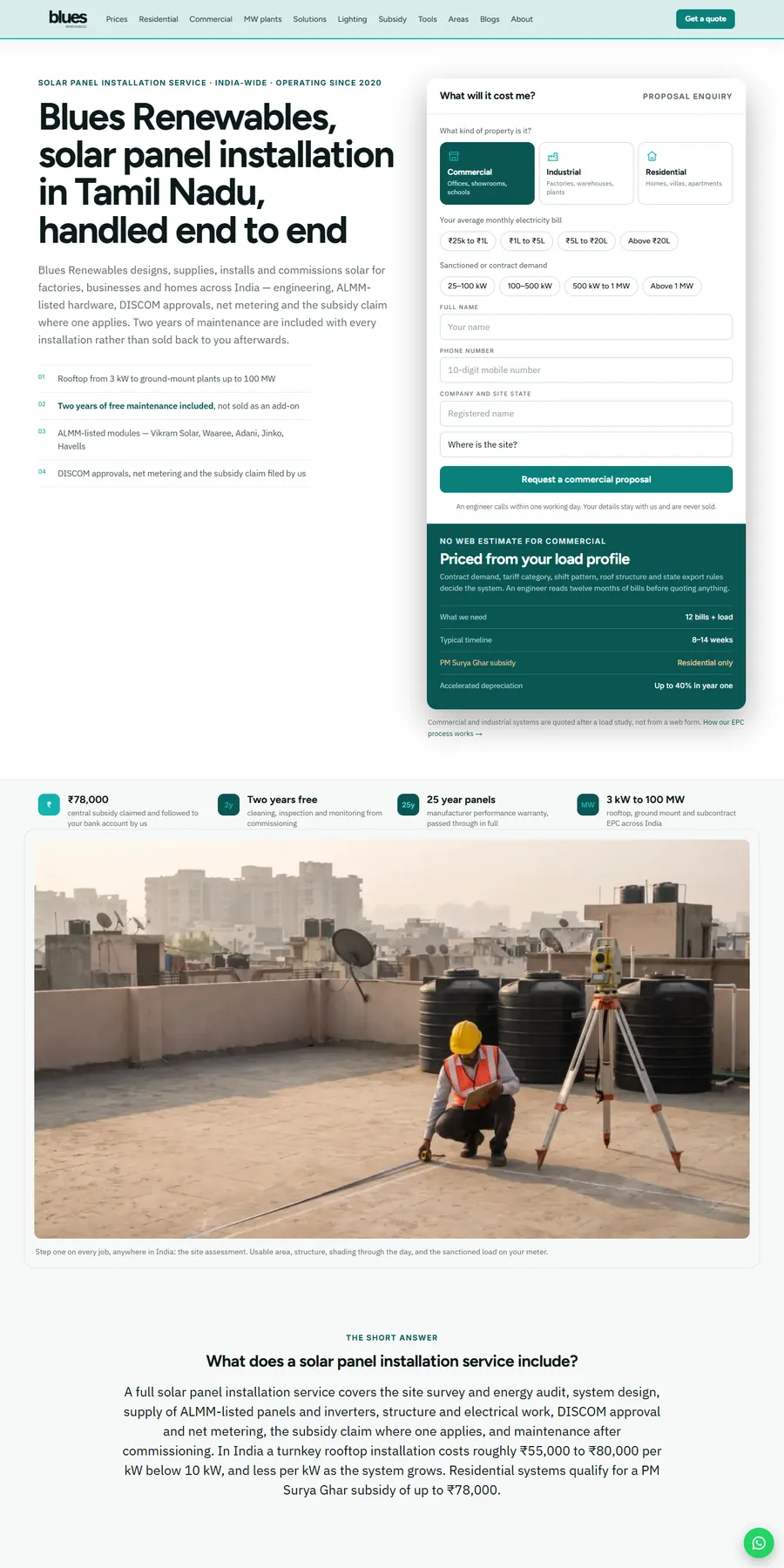
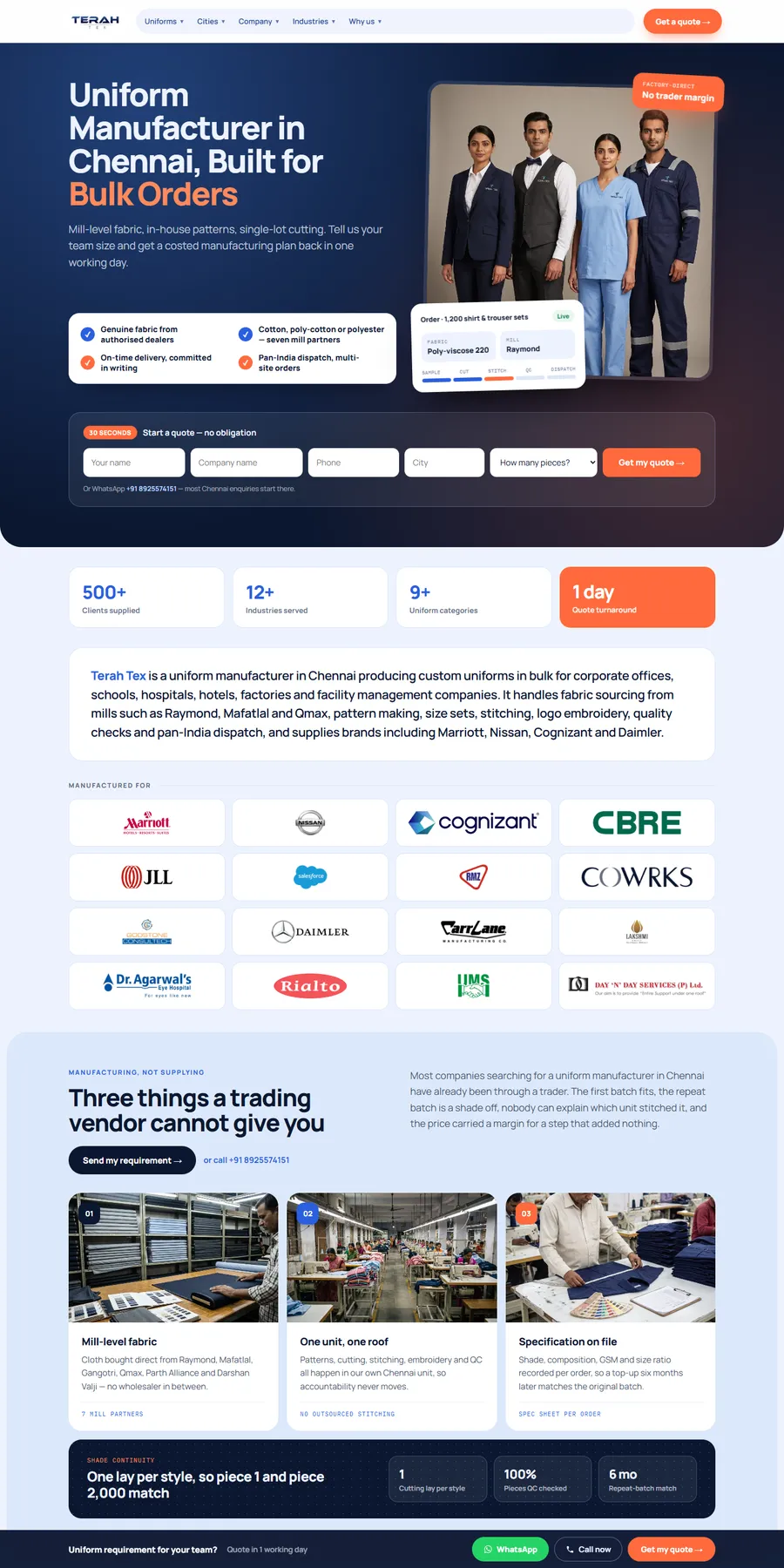
We have not built a website for a tree service company, and our clients are not US businesses. We will not pretend otherwise. The closest proof is Blues Renewables, a rooftop solar installer that, like a tree company, sells big-ticket jobs to homeowners in a defined service area. Its site went from no tracked leads to 7 to 10 enquiries a week, and Google clicks rose from 14 to 560 a fortnight in two months, with every call and form tracked as a GA4 lead event across 325 pages, including 129 local area guides, and mobile Lighthouse scores in the mid 80s to mid 90s. For a tree service, its price pages become pages on what drives removal and stump grinding cost, and its local area guides become a smaller set of town pages backed by real jobs. Terah Tex, a uniform manufacturer, shows the two-step quote form we would use for photo-screened estimates: it went from no website enquiries to about 5 bulk-order leads a week.

More websites we have designed and built

Process

How your tree service website project runs

Typical timeline: 4 to 8 weeks for most tree service sites; 8 to 12 weeks with many town or branch pages. You see progress every week.

  1. Step 01 · Week 1

    Discovery and audit

    We audit your current site, competitors, and how you show up on Google and in AI answers, then agree on goals and a fixed quote.

  2. Step 02 · Weeks 2 to 3

    Strategy and design

    Sitemap, wireframes and full designs for your review. You approve everything before we build.

  3. Step 03 · Weeks 3 to 6

    Build and test

    Development, SEO setup, speed tuning, and testing across devices and browsers.

  4. Step 04 · Launch and beyond

    Launch and grow

    We launch, monitor, and improve based on real data. 30 days of free support included.

What shapes your quote

Scope, not hourly billing

Every project gets a fixed quote within 1 business day, agreed before work starts.

Get my fixed quote →
  • How many service pages, pest and disease pages and real town or branch pages you need
  • Which field software we connect the estimate form to, and what it accepts
  • The photo-upload estimate form, storm mode and ZIP or branch routing
  • Whether we write the content and organize your job photos, crew bios and arborist credentials
  • Moving from your current site or a rented program: redirects, keeping pages that rank and tracking set up first
  • Commercial, HOA and municipal sections or a careers section for crew hiring

Tree service website questions, answered

Straight answers to what owners ask us, and what they ask Google and AI assistants. Ask us anything else.

How much does a tree service website cost?

We quote one fixed price, agreed before work starts, based on the number of pages, features, integrations and content. You get it within 1 business day of a free audit of your current site. There is no hourly billing and no per-lead fee.

How long does it take to build a tree service website?

Most tree service sites take 4 to 8 weeks. Sites with many town or branch pages take 8 to 12 weeks. You get a dated week-by-week plan before we start, and we aim to launch before your storm season rather than in the middle of it.

Do I need a website if most of my work comes from referrals, my trucks and Google Maps?

Yes, because every referral and map click checks you somewhere before calling, and the site is where you show insurance, named arborists and real job photos. It also keeps earning searches if your Google profile is ever suspended, which has happened to a US tree service that was given no reason.

How is this different from the monthly program a tree-only marketing agency sells?

We build the website only, on a fixed quote, and you own the code, design, content, domain, hosting and analytics accounts from day one, with no lock-in, so you can take the site to another developer at any time. Ads, review tools and SEO retainers are optional and separate, so you can run them with anyone and the site stays yours if you stop.

Can the estimate form take photos and still be short?

Yes. Step one is service and ZIP, which takes ten seconds. Everything else, photos included, sits on step two, so you still capture the lead if they stop there.

Do you do arborist website design for consulting arborists and plant health care firms?

Yes. A consulting or plant health care practice needs a different site from a removal crew: a page for each paid service (tree risk assessments, arborist reports for permits and HOAs, plant health care programs), the arborist's ISA credential and any TRAQ qualification named as text, and a booking form for a paid consultation instead of a free estimate. One experienced owner on ArboristSite reports paid estimates close at nearly 100%, so the site should explain what the fee covers.

What should my site say about ISA certification and insurance?

Name each ISA Certified Arborist with their credential number and link to ISA's verification directory; do not call the company ISA certified. State the coverage you actually carry, offer a certificate of insurance sent by your agent, and say bonded only if you are bonded.

My field software company offers me a website. Should I take it?

It can be convenient, but ask who owns the domain, pages and content if you change software, and whether you can add town pages, a photo estimate form and your own tracking. With us the site connects to your software where the software allows it, but it does not depend on it.

My Google Business Profile was suspended. Can you fix it?

We cannot promise reinstatement and no one honestly can. We make the site, business name, service area and phone match Google's rules, and make sure your service and town pages keep earning searches while the profile is down.

How many town pages should a tree service have?

One per town your crews really serve, each with local species, permit notes, job photos and local reviews, plus a service area hub. Copy-paste city pages rarely rank and Google's spam policies treat them as doorway pages.

Should my tree service website show prices?

That is your call. Pages that explain what changes the cost (height, access, crane, proximity to the house, hauling, stump grinding) help screen leads either way. If you want ranges published, we add them and keep them editable.

Will a new website get me more calls?

We do not guarantee rankings or lead numbers. What a new site changes is how many visitors call or send a screened request, and whether you can see where each came from. On a rooftop solar installer's site (not tree work), the same system took tracked enquiries from none to 7 to 10 a week.

Will my tree service show up in ChatGPT or Google's AI answers?

No one can promise that, whatever some vendors claim. We write your services, towns, named arborists, coverage and storm hours as plain text, add matching LocalBusiness schema and make the site agree with your Google profile, so AI tools have accurate facts to repeat.

What happens after launch?

You get 30 days of free support, CMS training so you can post job photos and switch storm mode yourself, and then an optional care plan. If we slip a date because of us, the next month of support is free.
Get your free tree service website proposal

Four quick questions. You'll get a fixed quote and a free audit of your current site within 1 business day.

  • ✓ No obligation, no sales pressure
  • ✓ Fixed price, never hourly
  • ✓ Your details stay private

Prefer email? info@billionwebstudio.com

Step 1 of 4~60 seconds
What do you need?