Skip to content
Booking projects for next month. Free website audit with every quote.Claim yours →

Hospitality, auto and localBooking projects for November

Car Dealership Website Development Company for More Test Drives and Credit Apps

Shoppers find your cars on CarGurus or Facebook Marketplace, then come to your site to check the real price, what their trade is worth and whether they can get approved. We build independent dealer sites on your DMS inventory feed, with the all-in price first on every car, your lender's secure credit app and every lead traced to the vehicle and the source.

  • Built for independent and used car dealers
  • Fixed quote in 1 business day
  • You own everything
yourlot.com/used-trucksTyler's usedtrucks, pricedall-inCheck availabilityTap to callNew lead: 2021 Tacoma TRDTest drive request · 8:12 pmTracked as a leadSource: GoogleAI ASSISTANTWhich used car lot near me has no docfee?Your Dealership: no doc fee, all-in priceshown on every car.Source: your website
Illustration: a visit becomes a tracked lead

The short answer

What does a car dealership website development company do?

A car dealership website development company builds websites for independent and used car dealers that turn marketplace shoppers and local searches into confirmed test drives, credit applications, trade-in appraisals and phone calls. The site has to load every car from your DMS with real photos and the all-in price, answer the doc fee, warranty and credit questions buyers have before they drive over, and record which vehicle and which channel produced each lead.

For a used lot with 10 to 300 cars, that means a fast inventory search and one detail page per VIN, a written rule for sold and in-transit cars, model and category pages such as used trucks under $20,000 in your town, a financing page with your lender's secure credit app embedded, a trade-in page, a pricing policy that states your doc fee and a page for each lot. Buy here pay here stores add an in-house financing page, with payment wording drafted to the Regulation Z ad rules for your counsel to approve.

Billion Web Studio is a car dealership website development company that delivers this as one fixed-scope project: design, inventory templates built on your Frazer, DealerCenter or other DMS feed, AutoDealer and Car schema, call and form tracking in GA4, and a migration plan that keeps the URLs that rank. You own the site, the domain and every account from day one, with no monthly platform lock-in. If you run a franchised store, your OEM website program decides your main site; we build for independents, or a second site where your agreement allows it.

The market

What the numbers say about independent and used car dealers online

Used car retail is crowded and run by small businesses. Independent dealers sell millions of used cars a year, and most of the lots that sell them have a handful of staff, so the owner is often the internet manager too. Most shoppers meet your cars on a marketplace first and check your own site second. The figures below show how much of the used market independents carry, how small most lots are, where buyers look and how fast AI tools have entered car buying.

How they choose

How car shoppers find and choose a car dealership

A used car purchase is a few weeks of browsing and a few hours of deciding. The buyer moves between marketplaces, your site, your reviews and, more and more, an AI assistant, and arrives at your lot already holding a price in mind. Here is how a US buyer picks a used car dealer and what your site has to do at each step.

  1. 1

    The trigger: a need, a budget and a credit worry

    A lease ending, a new baby, a failed inspection or a car that will not survive another winter. Cox found 71% of buyers start out unsure what they will buy, so they search by type and budget: "used trucks under $20,000", "AWD SUV near me", "car lots that finance first-time buyers". Your site needs category and finance pages that match those searches.

  2. 2

    The browse: marketplaces first, your site second

    Used buyers visit 4.8 sites on average and 77% use third-party sites. They find your Tacoma on CarGurus or Facebook Marketplace, then search your lot's name. Your site must show the same car, the same price and the same photos, plus a reason to buy from you: your inspection, your warranty, no doc fee or delivery.

  3. 3

    The check: is the price real and is the car here

    The shopper wants the out-the-door number, the doc fee, the Carfax, whether the car is sold as-is and whether it is on this lot or in transit. FTC staff's September 2026 pricing FAQs say the actual price should be the most prominent amount on listing pages, so a doc fee buried in the footer now costs trust and invites risk.

  4. 4

    The commitment: credit, trade and test drive

    Cox found 48% of buyers want to apply for credit online. Every vehicle detail page offers four separate paths: confirm availability, book a test drive, value my trade and get pre-qualified or apply, with the credit app embedded securely from your DMS or lender.

  5. 5

    The visit and the review

    The buyer arrives with a trade value and an approval in progress, so your desk spends its time on the car instead of paperwork. After delivery, one review link goes to every buyer, and new reviews show on the site with their dates for the next shopper who checks you out.

The problem

Why most car dealership websites lose test drives and finance apps

What we find again and again when we audit sites in this trade. None of it is about how the site looks.

Leak 01

Your site looks like every other lot on the same template

A shopper on r/askcarsales asked why every dealer site looks the same, is hard to use on a phone and opens the same chat pop-up. On DealerRefresh, replies to a new Tampa dealer said many big dealer platforms are slow, full of code errors and not accessible. A cloned template gives a marketplace shopper no reason to pick your lot over the next listing.

Leak 02

The doc fee hides in the disclaimer

A shopper sees $18,995 on your listing, then $19,794 on the buyer's order once the doc fee is added, and leaves feeling baited. Many dealer templates still lead with the pre-fee internet price. Since the FTC's 2026 warning letters and pricing FAQs, that is a legal risk as well as a lost deal.

Leak 03

Sold cars stay listed, or vanish overnight

Shoppers call about a car and hear it was presold days ago; replies on r/askcarsales say listings often stay up until the paperwork closes. The FTC calls advertising cars that are no longer available deceptive. On the search side, a detail page that disappears the day the car sells takes its ranking with it. You need a written sold-car rule, not whatever the feed happens to do.

Leak 04

Vehicle pages Google never indexes

A small Los Angeles dealer on DealerRefresh had cars laid out like blog posts, and replies said each vehicle needs its own page or Google will never index the cars. Another thread listed why VDPs fail to rank: identical templates across thousands of dealers, generic text, minimal schema, slow third-party scripts and no model content linking to them.

Leak 05

Switching providers breaks the credit app and the rankings

Dealers on DealerRefresh report dead links, 404s and keyword drops after a vendor switch with no redirects, and one was told a lender's credit app would stop feeding the DMS if the website changed. Without a redirect map and a credit app plan, a new site can cost leads for months.

Leak 06

You cannot tell which channel sold the car

Marketplace fees, Facebook inventory ads, Google vehicle ads and your own site all claim the sale. Replies on r/askcarsales rate leads from the dealer's own website above third-party leads and say to trust CRM reports, not opinions. Without call tracking and a source on every form, you are guessing where to spend next month.

Generic vs built for you

Why a generic website fails independent and used car dealers

A template is built to fit every business, so it fits yours badly. Here is what changes when the site is planned around how car shoppers actually buy.

Generic website compared with a website built for independent and used car dealers
What you needGeneric template siteBuilt for independent and used car dealers
InventoryCars typed in by hand, or a third-party widget inside an iframeSearch results and one detail page per VIN built on your DMS feed (FTP or API), with photos and price updating on every feed
Price displayInternet price first, doc fee in the fine printAll-in price as the most prominent amount on every card and detail page, doc fee shown, government fees noted as extra
Sold and in-transit carsWhatever the feed doesA written rule: a sold banner with similar cars or a redirect to the model page, plus other-lot labels and in-transit labels where your state allows in-transit listings
Credit applicationsA contact form that emails Social Security numbersYour DMS or lender's secure credit app embedded over HTTPS, never stored in the CMS or sent as plain email
Payment figures"From $299/mo" badges with no termsPayments shown only with APR, term and down payment beside them, and a calculator that states its assumptions
Trade-insA "value your trade" form asking for a name and phoneA VIN or plate lookup or a short photo appraisal form, with a clear note that the online value is an estimate until inspection
Pages that rankHomepage and inventory onlyModel and category pages (used Tacomas, trucks under $20,000, first-time buyer cars) with real content above live inventory
OwnershipSite, domain and Search Console on the vendor's accountCode, content, domain, GA4 and Search Console in your name from day one

Free self-check · 2 minutes

What your current car dealership website is missing

Tick everything your site does today. Each box you cannot tick is a place where a ready-to-buy visitor leaves.

What you need

What every car dealership website needs

The features that turn a car dealership website from a brochure into the best salesperson you have. We build all of them.

  1. Must-have · 01

    The all-in price first on every car

    On search result cards and detail pages, the price that includes your doc fee and any other mandatory dealer fee is the largest and first price. Conditional discounts, such as military or first responder offers, sit beside it with their terms. Tax, title and registration are noted as extra.

  2. Must-have · 02

    One fast detail page per VIN

    30 to 60 photos of the exact car, a walkaround video if you shoot one, VIN and stock number, mileage, equipment, a Carfax or AutoCheck link, warranty or as-is status that matches the Buyers Guide on the window, a recall lookup link and which lot the car sits on.

  3. Must-have · 03

    Inventory synced from your DMS, with a sold-car rule

    We build on the feed your Frazer, DealerCenter or other DMS already exports, so new arrivals, price drops and photos update on the next feed. Sold and in-transit cars follow a rule we agree in writing before launch.

  4. Must-have · 04

    Four tracked paths on every vehicle

    Confirm availability, book a test drive, value my trade and get pre-qualified or apply. Each is its own conversion, tagged with the VIN and the source, plus tap to call and tap to text.

  5. Must-have · 05

    A secure credit application and pre-qualification

    Your lender's or DMS's credit app embedded over HTTPS so applications still reach F&I, and a soft-pull pre-qualification link if your credit provider offers one. Social Security numbers and income never land in the website's database or an inbox.

  6. Must-have · 06

    Financing pages for every credit profile

    How financing works at your lot, the lenders and credit unions you really use, first-time buyer and bad credit paths, what to bring, and for buy here pay here stores, how in-house payments, schedules and the payment portal work, with payment wording drafted to the Regulation Z ad rules for your counsel to approve.

  7. Must-have · 07

    A trade-in and "we buy cars" page

    A VIN or plate lookup, or a short appraisal form with photo upload, that says plainly the online number is an estimate until someone inspects the car. A separate path for owners who want to sell without buying.

  8. Must-have · 08

    Model and category pages with real content

    "Used Toyota Tacoma in Tyler", "Trucks under $20,000", "AWD SUVs", "Cars for first-time buyers": what to check on that model, which years you usually stock and common buyer questions, above a live filtered inventory block.

  9. Must-have · 09

    Pricing policy, inspection and warranty pages

    How you set prices, your doc fee amount or that you charge none, your inspection checklist, included warranty terms in writing and service contracts shown as optional. California dealers also show the total price the CARS Act requires and explain the 3-day cancellation right it gives on used cars priced at $50,000 or less.

  10. Must-have · 10

    Lot pages and dated reviews that match Google

    A page for each lot with address, sales hours (and service hours if different), directions, photos and that lot's inventory, with name, phone and hours identical to its Google Business Profile. Google and DealerRater reviews show as text with source and date, and one review request goes to every buyer after delivery. BrightLocal found 74% of consumers look for reviews written in the last three months.

  11. Must-have · 11

    Spanish pages if you sell in Spanish

    Financing, trade-in, pricing policy and FAQ pages in Spanish, a language switch on every VDP, and Spanish lead auto-replies, so the warranty wording a buyer reads online matches the Spanish Buyers Guide on the window.

  12. Must-have · 12

    AutoDealer and Car schema on fast mobile pages

    AutoDealer markup per lot and Car markup per vehicle with VIN, mileage and an offer price that matches the all-in price on the page, plus Core Web Vitals targets of LCP 2.5 seconds or less, INP 200 ms or less and CLS 0.1 or less.

What we build

The car dealership website we would build for you

Here is the sitemap our used car dealer website design starts from. We cut or add pages to match the cars you actually stock, how you finance and how many lots you run.

yourcompany.comHome · every section links here

Inventory

  • Inventory search with filters
  • Vehicle detail page for every VIN
  • Just arrived and in transit
  • Sold vehicle pages with similar cars
  • Saved vehicles
  • Vehicle request form for cars you do not have
  • Specials with full APR and term disclosures
  • Hold this car (if you take deposits)

Shop by type and budget

  • Used trucks
  • SUVs and AWD
  • Cars by price tier
  • Model pages for your top sellers
  • First-time buyer cars
  • Hybrid and electric

Financing and trade

  • Financing overview
  • Secure credit application
  • Get pre-qualified
  • Bad credit and first-time buyer financing
  • Buy here pay here (if offered)
  • Payment calculator with disclosures
  • Value your trade
  • We buy cars

Why buy here

  • Pricing policy and doc fee
  • Inspection checklist
  • Warranty and service contracts
  • Vehicle history reports
  • Delivery and buying online
  • Reviews

Lots and company

  • A page for each lot with hours and directions
  • Service department
  • About the owner and team
  • Careers for sales staff, techs and detailers
  • FAQ
  • Contact
  • Spanish-language pages (if you sell in Spanish)
  • Legal footer: legal business name, dealer license number, association memberships, privacy notice, accessibility statement

Calls, bookings, leads

How we turn visitors into test drives and finance apps

Good car dealership website design is judged in appointments and applications: a marketplace shopper becomes a confirmed test drive, a credit app, a trade appraisal or a call, and you can see which car and which source produced it. This is how we build that path and track every lead.

  • 01Every lead tagged with the car and the channelAvailability, test drive, trade and credit app each fire their own GA4 conversion carrying the VIN, stock number and source (CarGurus click, vehicle ad, Facebook, organic), so your monthly report shows which trucks and which listings pulled buyers in.
  • 02A credit app that tells the buyer what happens nextAfter the secure application goes to F&I, the thank-you page names who will call, within how many business hours, and what to bring (license, proof of income, proof of address), so the buyer does not apply at the next lot while waiting.
  • 03A two-step trade-in appraisalVIN or plate, mileage and condition first, contact details and photos second. Your appraiser sees the car before the buyer arrives, and the page states the number is an estimate until inspection.
  • 04Tap to call and text on every vehicle, with call trackingDynamic number insertion swaps the shown number for ad and marketplace visitors only. Your main number stays in the schema, footer and Google profile, so your details match everywhere.
  • 05Auto-replies that carry the car and the all-in priceEvery lead gets an instant email or text naming the vehicle, VIN and all-in price, with marketing texts sent only to people who ticked a separate consent box. California dealers need the total price in that first written reply.
  • 06Leads delivered straight into your CRM or DMSLeads go out in ADF/XML or through your CRM's API, so they land in the same queue as your marketplace leads with the source attached, not in a mailbox nobody checks on Sunday.
  • 07A monthly lead report by vehicle and sourceTest drives, credit apps, trade appraisals and calls by channel and page, in plain numbers. You see whether your own site or the marketplace sold last month's trucks.

AI search

Car buyers already ask AI tools for help. Cox found 19% of buyers used AI websites or AI overviews in 2025, and BrightLocal found 45% of consumers now use ChatGPT or other AI tools for local recommendations. When an assistant cannot read your price, mileage and VIN, it quotes the marketplace listing of your own car instead. Nobody can guarantee a mention, but a site machines can read gives AI tools your facts.

Questions your car shoppers ask AI assistants

  • Which used car dealers near me have no doc fee?
  • Where can I buy a used Tahoe under $35,000 near Tampa?
  • Which car lots in San Antonio finance first-time buyers with no credit?
  • Is this used car dealer legit, and what do the reviews say?
  • Which dealers near me will buy my car even if I do not buy one?
  • Can I return a used car I bought from a dealer in California?
  • Price, mileage and VIN in plain HTML

    Every car on its own crawlable URL with year, make, model, trim, price, mileage, VIN and lot location as text on the page, not only inside scripts, hover-overs or behind a lead form.

  • Crawler access checked, not assumed

    We review robots rules, firewall and bot protection settings so reputable search and AI crawlers can reach your vehicle pages, and we check server logs on real detail page URLs after launch.

  • Car and AutoDealer schema that matches the page

    Structured data helps machines read your cars and your lots. It is not a ranking switch, as dealers on DealerRefresh point out, so the offer price in the schema matches the all-in price the buyer sees.

  • Your answers to buyer questions, in your numbers

    Doc fee, as-is or warranty, inspection points, delivery radius, trade-in process and credit options, each answered in plain sentences on the pricing policy page and FAQ, so an assistant can quote your policy instead of guessing.

  • Model and finance pages for question searches

    Pages for "used trucks under $20,000 in your town" or "first-time buyer car loans" give AI tools a specific page to cite when a buyer asks a specific question.

  • Search Console in your account, with question queries reported

    We set up Search Console in your name and report the question-form searches (what, how, is, can) you already appear for, a tip shared by dealers on DealerRefresh, so you can see the AI-style queries reaching you.

Compliance and trust

The rules a car dealership website has to get right

A dealer website is advertising, and in 2026 regulators are reading it closely: the price on every vehicle page, payment badges, credit applications, lead replies and reviews. We build templates and forms that support these rules. We do not certify compliance or give legal advice; your counsel or your state dealer association confirms the wording.

The advertised price is the real price

The FTC warned 97 dealer groups on 13 March 2026, and FTC staff's September 2026 Pricing Transparency FAQs (staff guidance, not a rule) say any page showing an amount a buyer may pay, including inventory search and vehicle listing pages, should show the actual price as the most prominent amount, with the full doc fee included. Only government charges paid directly may be left out. Discounts only some buyers get cannot set the headline price, and in-transit cars should be labeled.

California CARS Act, and the federal CARS Rule status

California's SB 766 took effect 1 October 2026: total price in any ad naming a specific vehicle or financing terms and in the first written communication with a shopper, add-ons disclosed as optional, a 3-day cancellation right on used vehicles priced at $50,000 or less, and two years of ad records. The FTC's federal CARS Rule was vacated by the Fifth Circuit in January 2025 and does not apply, but the FTC Act and state law still do.

Payment and lease advertising

Under Regulation Z (12 CFR 1026.24), a payment amount, down payment, number of payments or finance charge in an ad requires the down payment, repayment terms and APR, and rates must be stated as an APR. Lease ads under Regulation M (12 CFR 1013.7) must say it is a lease and give the total due at signing, the payment schedule, any security deposit and possible end-of-lease charges. We place these beside the payment, not only in the footer.

Credit applications and customer data

The FTC says dealers who arrange financing are financial institutions under the Safeguards Rule: encrypt customer information in transit and at rest, oversee service providers by contract, and notify the FTC within 30 days of discovering that unencrypted information of 500 or more consumers was taken. We embed your lender's or DMS's secure application and keep Social Security numbers and income off the website entirely.

Buyers Guides and state dealer ad rules

Under the FTC Used Car Rule, what a detail page says about warranty or as-is must match the Buyers Guide on the car, and dealers who sell in Spanish need Spanish Buyers Guides. States add their own rules: Virginia requires "VA DLR" in ads that do not clearly name the dealer, and Texas requires the stock number or VIN when a price applies to one specific vehicle, and lets a dealer advertise a specific used car only once it is in the dealer's possession with the title assigned, so in-transit used cars may not be listable there. We ask for your state's dealer advertising guide and build to it.

Reviews, texting consent and accessibility

The FTC's Consumer Reviews and Testimonials Rule bans fake reviews and rewards tied to positive sentiment, so one review link goes to every buyer. The TCPA requires prior express written consent for marketing texts, so forms carry a separate, unticked consent box. The Justice Department says the ADA applies to business websites; we build to WCAG 2.1 AA targets without overlay widgets and never promise lawsuit protection.

We build with tools and patterns that support these rules and document what we set up. For legal advice on your own obligations, talk to your attorney.

From the forums

What independent and used car dealers ask about websites, answered

We read what dealers ask each other on DealerRefresh, including its NIADA-sponsored board for independents, and on r/askcarsales, r/smallbusiness, r/localsearch and Local Search Forum. The same worries come up: sites that all look alike, SEO lost when switching vendors, credit apps tied to one provider, sold cars, small lots that cannot rank and whether ChatGPT can even see the inventory. These are their questions, paraphrased, with our straight answers.

Where owners talkDealerRefresh Automotive Dealer Forumsr/askcarsalesr/smallbusinessr/localsearchLocal Search Forum

Asked on DealerRefresh Automotive Dealer Forums

“I run a 12-car independent lot and every website vendor says I cannot grow without them. What actually matters?”

Our answer: Replies on the thread were practical: make your site the hub where marketplace and social traffic converts, give every car its own page that can rank for year, make, model and city, and check a vendor's existing client sites for speed, valid code and accessibility before you hire. Own your data. We build on that list and put everything in your name.

Asked on r/smallbusiness

“Which general website builder should I use for my car dealer site?”

Our answer: The more experienced reply in that thread said a dealer site needs inventory feeds and APIs that general store builders and a home-made site do not have, and you will hit walls. We agree: the hard part is the DMS feed, the detail page template and the credit app, so we confirm what your DMS exports before we quote.

Asked on r/askcarsales

“Do I enter cars in the DMS and send them to the website, or the other way round? I also want them on CarGurus and Facebook Marketplace.”

Our answer: Replies said it usually flows from the DMS out: you enter the car once and the DMS or inventory tool feeds the website and the marketplaces. We build the site on that same feed so price and photos match everywhere, and we agree how fast sold cars come off.

Asked on DealerRefresh Automotive Dealer Forums

“Will switching website providers kill my SEO and break my credit app?”

Our answer: It can if nobody plans it. Dealers describe dead links and keyword drops when the new vendor skipped redirects, and a credit app that only fed the DMS through the old site. Replies suggest embedding the lender's application on the new site over HTTPS. We crawl the old site, map every URL to a 301, keep vehicle URL patterns where we can, resubmit sitemaps in your Search Console and watch 404s after launch.

Asked on DealerRefresh Automotive Dealer Forums

“I have fewer than 10 cars in Los Angeles. Can I rank at all, and should sold cars stay on the site?”

Our answer: Replies were honest: broad "used cars" searches in LA are nearly out of reach, so lead with your Google profile, reviews and solid on-page basics. One suggested keeping sold detail pages live on the same URL, clearly marked sold with links to similar cars, so pages build up over time; another said use the owner's story to stand out from chains. We set a written sold-car rule with you and never leave a sold car looking available.

Asked on DealerRefresh Automotive Dealer Forums

“I have three used lots in three towns, each with its own site. Should I merge them?”

Our answer: Replies disagreed: one said one domain, another said three towns need local relevance. Everyone agreed on page titles per town, complete Google profile categories, answering reviews and Q&A, and weekly posts featuring a car. We usually build one domain with a page and inventory filter for each lot, after looking at how far apart your towns are.

Asked on DealerRefresh Automotive Dealer Forums

“Should I send happy customers to Google and unhappy ones to a private feedback form?”

Our answer: Replies warned against it: dealers caught gating lost their Google reviews, and a few honest negative reviews make the rest more believable. FTC staff say gating could break the FTC Act. We set up one review link sent to every buyer after delivery, and show reviews on your site as text with source and date.

Asked on Local Search Forum

“I run a we-buy-cars business. How do I rank for sell my car searches?”

Our answer: Replies said target "sell my car near me" and "sell my car in [city]", build a page per real location with genuine content and the address on it, and expect paid search to be faster while SEO takes months. For a dealer, that means a dedicated we-buy-cars page with an appraisal form, separate from trade-ins.

Asked on DealerRefresh Automotive Dealer Forums

“Why did the cars disappear from my Google Business Profile?”

Our answer: Google retired the vehicle listing structured data and its free vehicle listings, and replies pointed dealers to paid vehicle ads through Merchant Center plus stronger category pages. Those ads send clicks to your vehicle detail page, so the page has to be fast, accurate and match the feed price.

Asked on DealerRefresh Automotive Dealer Forums

“Is my website invisible to ChatGPT, and will schema fix it?”

Our answer: Dealers testing real sites found one where price, mileage and VIN were readable in raw HTML, and another where a bot wall sent an AI tool to a marketplace instead. In a separate thread, replies said schema helps crawlers categorize data but will not put a weak site into AI answers by itself. We check crawler access and logs, put vehicle facts in plain HTML and add schema that matches the page.

Questions are paraphrased from public threads. We never quote members by name.

Others vs us

Car dealership website design options: Billion Web Studio vs a website builder template vs a monthly dealer website platform or the site bundled with your DMS

The three ways independent and used car dealers usually get a website, side by side.

Car dealership website design options: Billion Web Studio vs a website builder template vs a monthly dealer website platform or the site bundled with your DMS
Billion Web StudioWebsite builder templateTypical industry agency
Who owns the site, domain and accountsYou do, from day one, in your own accountsYou own the content; the site lives on the builder's platformThe DMS vendor or platform, on a site you rent; leave the vendor and you leave the site
Contract and pricingFixed quote in 1 business day, agreed before work starts, no lock-inMonthly subscription, you build it yourselfMonthly fee, bundled into your DMS bill or on a 12-month or longer contract
Inventory from your DMSBuilt on your DMS feed (FTP or API) with a written sold-car ruleUsually none; cars entered by handBuilt in from the DMS or platform, tied to their stack
All-in price and doc fee displayAll-in price most prominent on every card and VDP, doc fee shownWhatever you typeWhatever the shared template shows; some sell compliance tools as add-ons
Credit applicationYour lender's or DMS's secure app embedded, never stored on the siteA form plugin, often unsuitable for SSNsBuilt in and tied to that DMS or platform; can break if you switch
Vehicle and model pages that rankUnique, fast VDPs plus model and category pages with real contentNot built for inventoryShared templates; thin, look-alike VDPs
AI search readinessPrice, VIN and mileage in plain HTML, crawler access checked, schemaUp to youRarely addressed, or sold as a separate product
Lead tracking by vehicle and sourceGA4 events with VIN, call tracking, leads into your CRM, in your accountsBasic form countsBasic lead emails in the vendor's dashboard, which may stay with them if you leave
Switching laterRedirect map, Search Console handover, credit app plan, no lock-inManual rebuildRebuild from scratch; SEO and credit app at risk

Why Billion Web Studio

What we do better, and why it matters to you

  • A fixed quote in 1 business day, with a free audit

    We review your current dealer site: price display, sold-car handling, credit app, vehicle page speed and tracking. Then we confirm what your DMS exports and send a written scope and a fixed price based on pages, features, integrations and content. No hourly billing.

  • You own everything from day one

    Code, design, content, photos, domain, hosting, GA4, Search Console and call tracking accounts in your name. No monthly platform holding your site, and no lock-in.

  • Built around how a used car lot runs

    Most car dealership web design starts from a shared platform template. Ours starts from your feed, your desk and your buyers: all-in pricing, sold and in-transit rules, the four actions on every vehicle, the credit app, trade-ins, BHPH pages and a page for each lot are in the plan from the first week.

  • Price and payment rules built into the templates

    The FTC holds everyone who controls an ad responsible, including third parties. Our templates put the all-in price first, show the doc fee, place payment disclosures beside payments and carry the total price into California lead replies, for your counsel to approve.

  • A switch that keeps your rankings and your credit app

    We crawl the old site, map every URL to a redirect, keep vehicle URL patterns where possible, plan the credit app move with your lender or DMS, and watch Search Console for 404s after launch.

  • A dated plan and a guarantee on it

    A week-by-week plan, weekly written updates and 30 days of free support after launch. If we slip a date because of us, the next month of support is free.

In writing, before we start

  • Fixed quote in 1 business day

    Scope, deliverables and price agreed in writing, with a free audit of your current site. No hourly billing.

  • Launch date in writing

    A dated week-by-week plan and a written update every week. If we slip because of us, the next month of support is free.

  • You own everything

    Code, design, content, domain and accounts are yours from day one. No 12-month contract, no rented site.

  • 30 days of support included

    We watch rankings, forms and call tracking after launch and fix anything that needs it.

Proof, not promises

Results from websites we have built

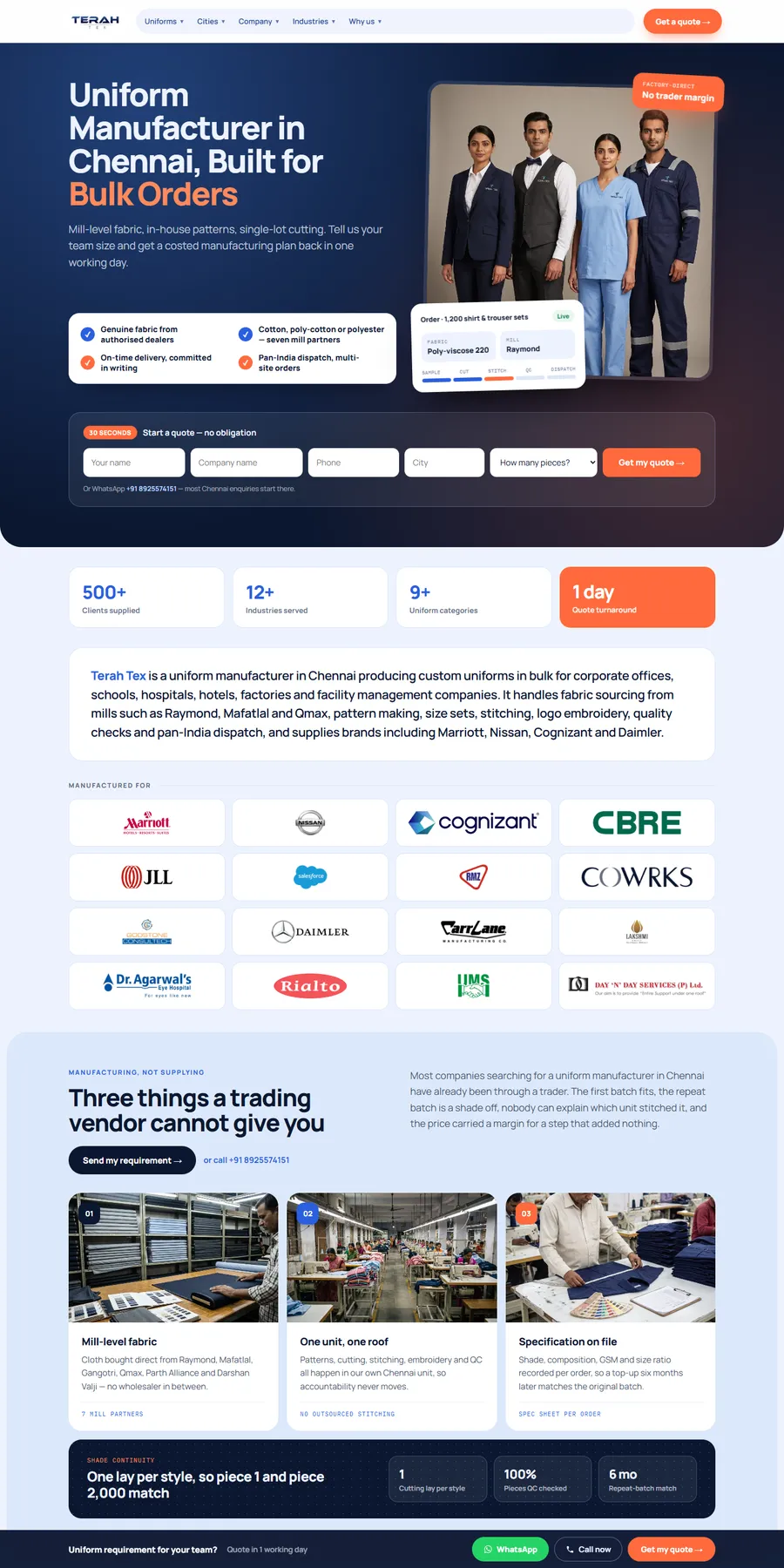
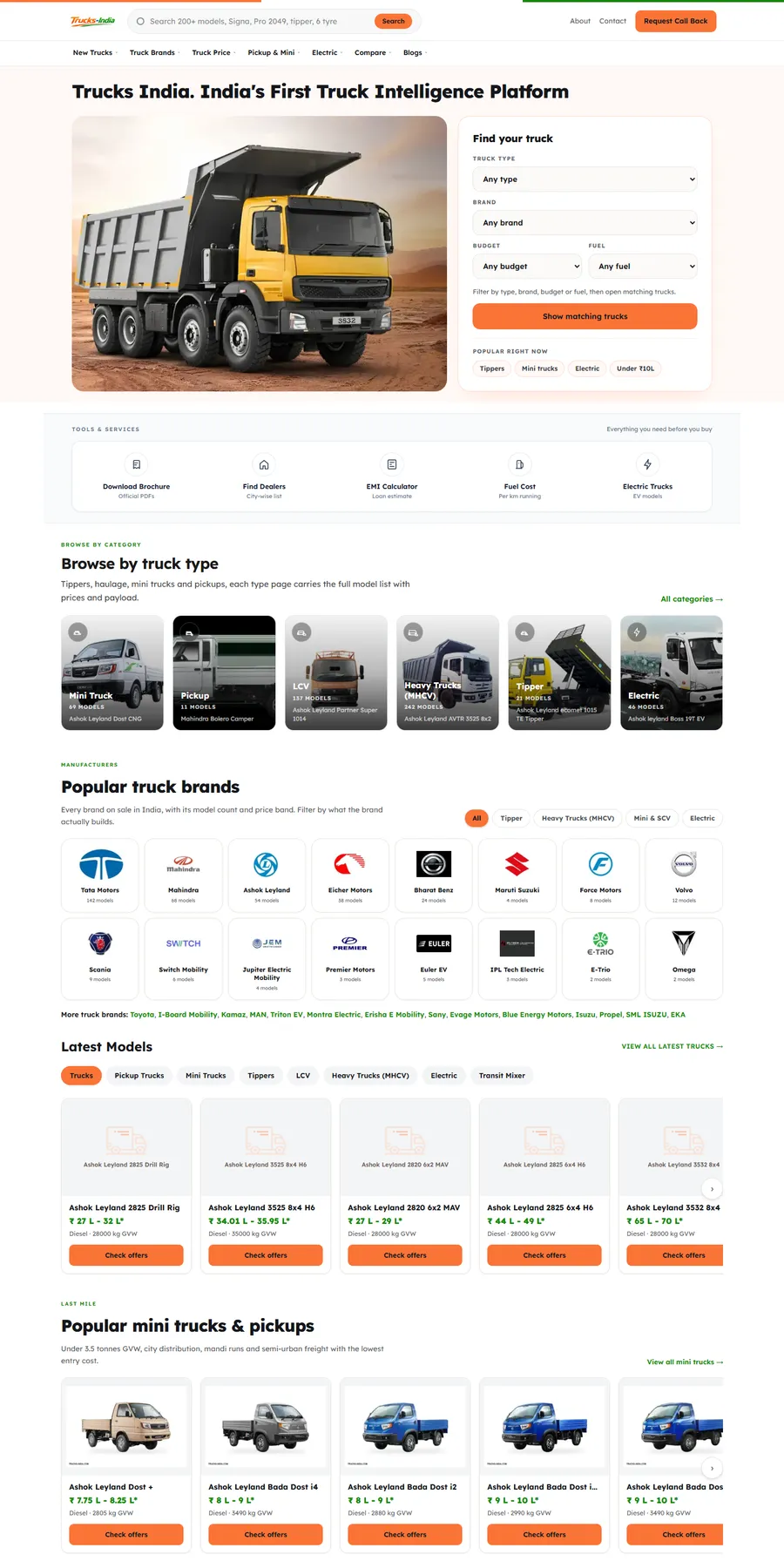
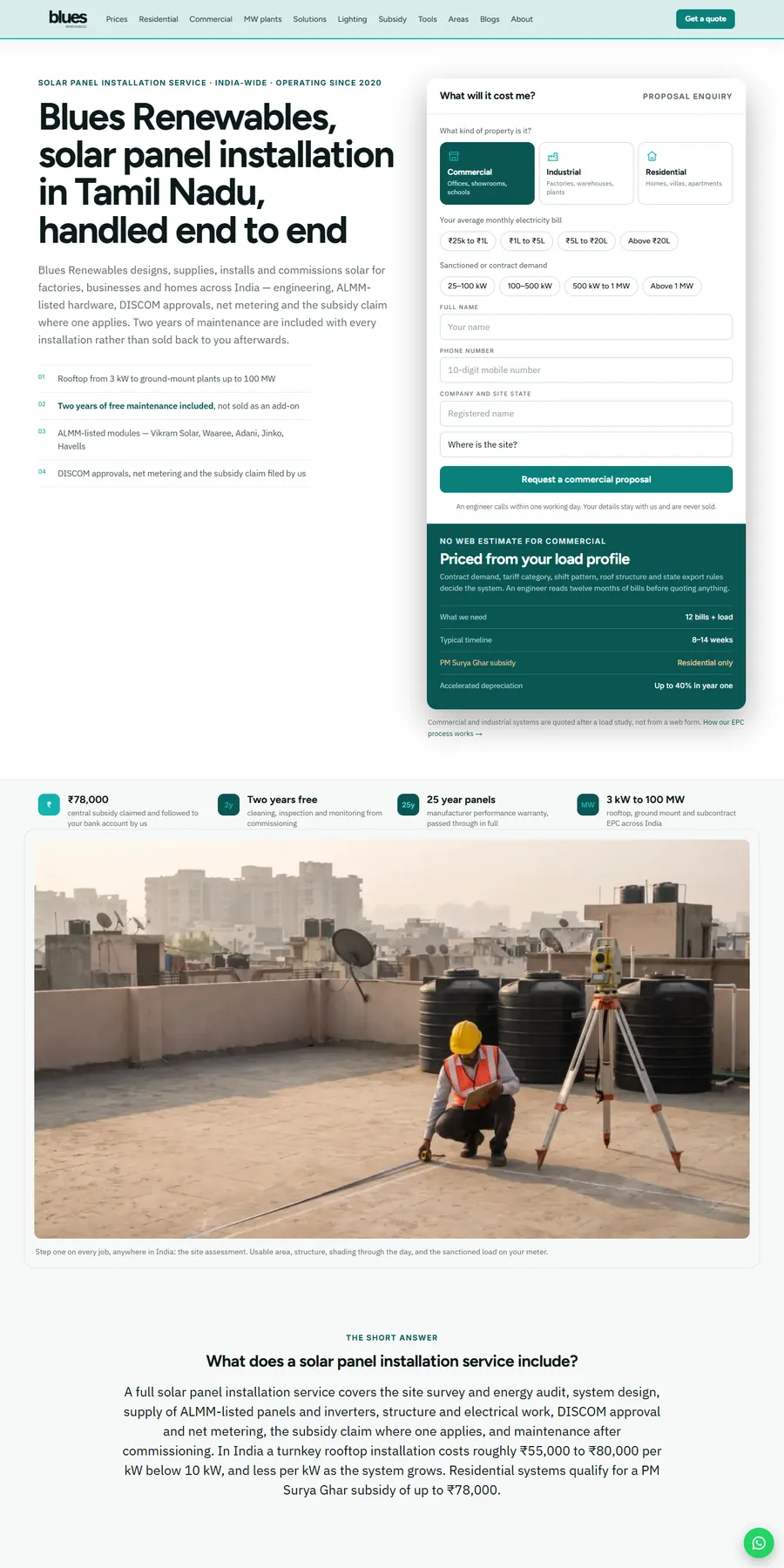
We have not built a website for any car dealership, and we will not pretend otherwise. Here is the closest proof. Trucks India, a commercial vehicle research platform (it does not sell vehicles): 497 truck models and 1,299 variant pages with comparisons, on-road price, EMI (monthly payment) and running cost tools. Weekly Google clicks went from 12 to 292 in five weeks. For you, those templates become VDPs, model pages and a payment calculator with US disclosures. Blues Renewables, a rooftop solar installer: from no tracked leads to 7 to 10 inquiries a week, with every form and call tracked in GA4. Its local area guides become your lot and town pages. Terah Tex, whose site with category pages, city pages and a two-step quote form went from no website inquiries to about 5 bulk-order leads a week, gives us the two-step pattern we use for trade-in appraisals.

More websites we have designed and built

Process

How your car dealership website project runs

Typical timeline: 4 to 8 weeks for a single lot with a simple inventory feed; 8 to 12 weeks for multi-lot groups, BHPH finance sections or large model page sets. You see progress every week.

  1. Step 01 · Week 1

    Discovery and audit

    We audit your current site, competitors, and how you show up on Google and in AI answers, then agree on goals and a fixed quote.

  2. Step 02 · Weeks 2 to 3

    Strategy and design

    Sitemap, wireframes and full designs for your review. You approve everything before we build.

  3. Step 03 · Weeks 3 to 6

    Build and test

    Development, SEO setup, speed tuning, and testing across devices and browsers.

  4. Step 04 · Launch and beyond

    Launch and grow

    We launch, monitor, and improve based on real data. 30 days of free support included.

What shapes your quote

Scope, not hourly billing

Every project gets a fixed quote within 1 business day, agreed before work starts.

Get my fixed quote →
  • Which DMS or inventory tool we connect, and whether it exports by FTP or API
  • How many model, category and finance pages you want written
  • Credit app, pre-qualification, trade-in and payment calculator flows
  • Number of lots, and whether you run a service department or buy here pay here financing
  • Moving from your current provider: redirects, vehicle URL patterns, credit app and tracking
  • Whether we write the content and plan photo standards for your inventory

Car dealership website questions, answered

Straight answers to what owners ask us, and what they ask Google and AI assistants. Ask us anything else.

How much does a car dealership website cost?

We quote one fixed price, agreed before work starts, based on the number of pages, features, integrations such as your DMS feed and credit app, and content. You get it within 1 business day of a free audit of your current site. There is no hourly billing and no monthly platform fee for the build.

How long does car dealership website development take?

A single lot with a simple inventory feed usually takes 4 to 8 weeks. Multi-lot groups, buy here pay here finance sections or large sets of model pages take 8 to 12 weeks. You get a dated week-by-week plan before we start.

Do you build the inventory system or connect to mine, and how fast do sold cars update?

We connect to yours. We build the site on the feed your Frazer, DealerCenter or other DMS or inventory tool already exports, by FTP or API, so price changes and sold cars show as fast as the feed sends them. We agree the feed schedule and a sold-car rule in writing: a clearly marked sold page with similar cars, or a redirect to the matching model page. If your DMS cannot export a feed, we tell you during the free audit, before we quote.

Will the site show the all-in price the FTC and California expect?

Yes. Our templates make the price including your doc fee and other mandatory dealer fees the most prominent amount on search results and vehicle pages, note government fees as extra, and carry the total price into lead auto-replies for California dealers. You approve the wording with your counsel.

Can you keep my lender's credit application?

Usually yes. We embed your lender's or DMS's secure application over HTTPS so it still reaches F&I. We do not store credit applications in the website or send them by plain email, because the Safeguards Rule treats dealers who arrange financing as financial institutions.

Can you add a payment calculator?

Yes, with the APR, term and down payment shown next to any payment it produces, and a note that taxes and fees may not be included. Regulation Z treats a payment amount in an ad as a trigger for those disclosures.

What happens to my SEO if I switch from my current provider?

We crawl the old site, map every URL, including vehicle detail and search result patterns, to 301 redirects, move content you want to keep, resubmit sitemaps in your Search Console and watch 404 reports after launch. Get your domain and Search Console into your own name first if they are not already.

Do I still need CarGurus, Cars.com or Autotrader?

Probably. Cox found 77% of used buyers use third-party sites, so marketplaces bring shoppers. Your own site converts the second visit, gives you leads you do not share and shows which cars and channels sold, so you can judge what each listing fee returns.

Can a small lot rank on Google?

Often yes for specific searches such as a year, make and model in your town, and for model, category and finance pages over time. Broad "used cars" searches in a big city are hard for any small lot. We do not guarantee rankings or lead numbers.

Will this get my cars into ChatGPT and Google AI answers?

Nobody can guarantee placement. We make your cars and answers readable by machines: price, mileage and VIN in plain HTML, crawler access checked, Car and AutoDealer schema that matches the page, and your doc fee, warranty and credit answers written as text.

I am a franchised dealer. Can you build my main site?

Your OEM program may require a certified website provider to keep co-op funds, so check your agreement before replacing it. Where it allows, we can build a second site, such as a used car or pre-owned site, alongside the certified one.

Do I own the website, domain and photos?

Yes, from day one. Code, design, content, photos, domain, hosting, GA4 and Search Console accounts are in your name. There is no lock-in, so you can take the site to another developer at any time.

What makes your website design for car dealerships different from a dealer website platform?

We put the terms in writing first: a fixed quote in 1 business day, a dated plan, your ownership of everything and no lock-in. A site bundled with your DMS or rented from a platform usually stays with that vendor if you leave. Ours covers your DMS feed, all-in pricing, a written sold-car rule, a secure credit app, trade-in and model pages, and tracking by vehicle and source in your own accounts.

Can my staff update specials, banners and the pricing policy?

Yes. You get an editable CMS and a training session at launch, so your team can change specials, homepage banners, staff photos and policy pages without calling us. Inventory still updates itself from your DMS feed.
Get your free car dealership website proposal

Four quick questions. You'll get a fixed quote and a free audit of your current site within 1 business day.

  • ✓ No obligation, no sales pressure
  • ✓ Fixed price, never hourly
  • ✓ Your details stay private

Prefer email? info@billionwebstudio.com

Step 1 of 4~60 seconds
What do you need?