Ecommerce
What Is Average Order Value (AOV)?
Average order value (AOV) stands for Average Order Value.
Average order value (AOV) is the average amount spent each time a customer places an order with an online store, calculated by dividing revenue by the number of orders in the same period.
What average order value means in plain English
AOV answers a simple question: when someone buys, how much do they usually spend? If a store takes $30,000 from 600 orders in a month, its AOV is $50. Store revenue grows in three ways: more visitors, a higher share of them buying, or more spent per order. AOV measures the third.
Platforms define revenue slightly differently, so check what yours includes. Shopify's analytics reference, for example, defines AOV as gross sales minus discounts, divided by orders, leaving out edits, exchanges and returns made after the order. Other reports may include tax and shipping, which is why two dashboards can show different AOV figures for the same week.
Why average order value matters for an online store
Every order carries fixed costs: payment fees, packing, shipping and the ad spend that brought the buyer. A higher AOV spreads those costs over more revenue, so the same traffic produces more profit. AOV also tells you how much you can afford to pay to win an order, which is the starting point for sensible ad budgets.
An average order value example
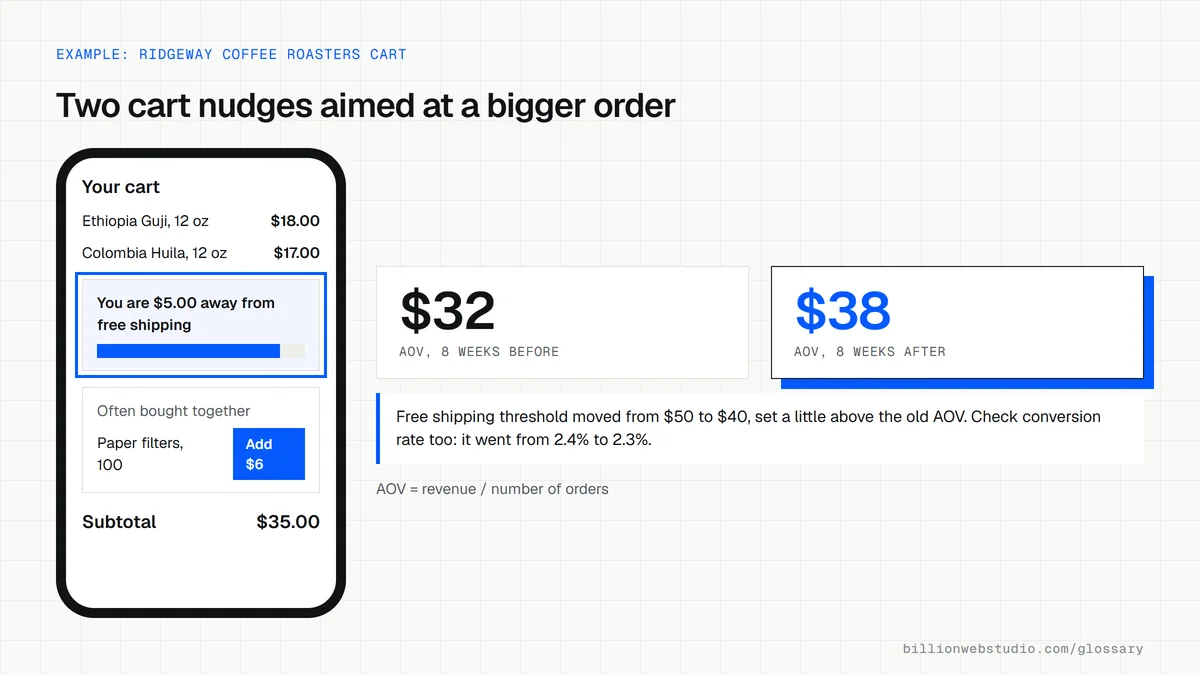
A coffee roaster's AOV is $32, and free shipping starts at $50. Many shoppers buy one bag and pay for shipping. The store lowers the threshold to $40, adds a cart message showing how much more is needed for free shipping, and suggests a matching filter pack. Two months later it compares AOV and conversion rate against the earlier baseline.
Ways to raise average order value
- Set a free shipping threshold a little above your current AOV.
- Show related products or accessories on product pages and in the cart.
- Offer bundles or multi-buy prices on items people often buy together.
- Add volume pricing for business buyers who order in bulk.
- Watch conversion rate alongside AOV, since a tactic that raises one can lower the other.
Work out your Average order value
Average order value calculator
How to find your average order value in Shopify or GA4
- In Shopify, open Analytics, then Reports, and search for the Average order value over time report.
- Group it by month and compare at least the last 12 months, so seasonal peaks do not mislead you.
- In GA4, open Explore and start a Blank exploration. Import Month as a dimension and Average purchase revenue, Purchase revenue and Transactions as metrics, then drag them into Rows and Values.
- Expect small gaps between the two tools: Shopify's AOV subtracts discounts, while GA4 purchase revenue subtracts refunds.
- Write your cost per order for shipping, packing and payment fees next to AOV, since a rise only helps if it outpaces those costs.
What good looks like: AOV holds steady or rises across comparable months while conversion rate stays flat, and it sits well above your fixed cost per order.
Free tool: Shopify Help: Sales reports
Questions to ask your web developer
“Which AOV definition will our reports use?”
A good answer: They state whether tax, shipping, discounts and refunds are included, use that definition in every report, and explain why Shopify and GA4 can differ.
“How will you test a change meant to raise AOV?”
A good answer: They record AOV and conversion rate for a baseline period, change one thing such as the free shipping threshold, and compare both metrics over an equal period afterward.
“Can the cart show a free shipping progress bar and add-ons without slowing the page?”
A good answer: Yes, using the platform's built-in features or a single well-reviewed app, with a mobile speed test before and after it goes live.
Average order value (AOV): common questions
What is a good average order value?
There is no universal good AOV, because it depends on what you sell and what each order costs you. A furniture store and a sock shop will never be comparable. The useful benchmark is your own trend: track AOV monthly and judge each change against shipping costs, margins and conversion rate.
What is the difference between AOV and customer lifetime value?
AOV measures what a single order is worth on average. Customer lifetime value estimates how much one customer spends across all their orders over time. A store with a modest AOV can still be very profitable if customers return often, so it is worth tracking both numbers together.
Sources
Want a website that gets this right?
Every Billion Web Studio build includes technical SEO, schema and speed work as standard, with a fixed quote within 1 business day.