Working with an agency
What Is a Fixed Price Contract?
A fixed price contract is an agreement in which a vendor delivers a defined scope of work for one set price, whatever the work actually costs the vendor. If the job takes longer than planned, the vendor absorbs the extra cost.
What a fixed price contract means in plain English
You agree the deliverables and the price before work starts, and the price changes only if the scope changes through an approved change request. US federal procurement rules describe a firm-fixed-price contract as one whose price is not adjusted for the contractor's actual costs, which places maximum risk and full responsibility for profit or loss on the contractor.
Because the vendor carries that risk, fixed price work depends on a detailed scope. Vendors either build a buffer for unknowns into the price or ask for a discovery phase first, so the deliverables are clear enough to quote with confidence.
Why a fixed price contract matters for a website buyer
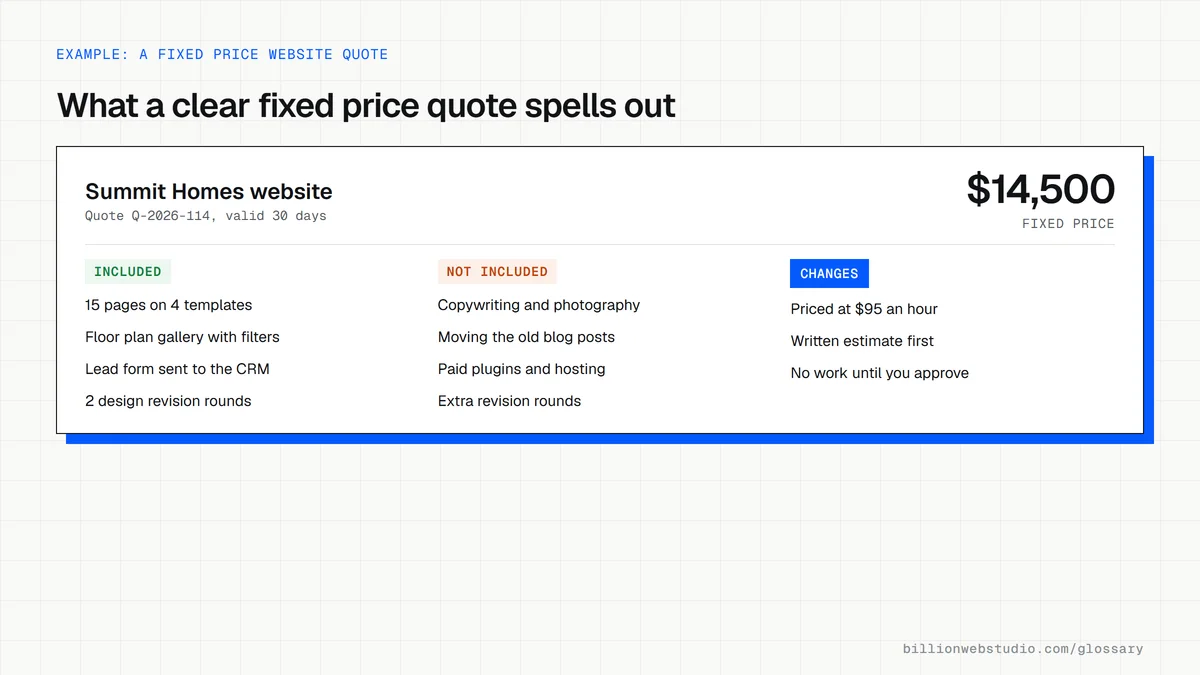
A fixed price gives you budget certainty, which makes approval easier and agencies simpler to compare. You pay for outcomes, not hours, so slow progress is the vendor's problem rather than yours. The trade-off is flexibility, because new ideas mid-project become priced change requests. Billion Web Studio works this way and sends a fixed quote within one business day.
A fixed price contract example
A home builder agrees a fixed price for a 15-page website with a floor plan gallery, a lead form and a CMS the sales team can update. Halfway through, the owner asks for a mortgage calculator. Because it is not in the scope, the agency sends a short change request with its own price and timeline, which the owner approves before any work on it begins.
Common fixed price contract mistakes
- Signing a fixed price on a vague brief, which invites disputes over what the price included.
- Assuming fixed price means unlimited revisions, when the contract usually caps design rounds.
- Picking the lowest fixed quote without checking what it leaves out, such as content migration or redirects.
- Having no written process for pricing and approving new ideas during the project.
Fixed price vs time and materials vs retainer: which to choose
| Question | Fixed price | Time and materials | Retainer |
|---|---|---|---|
| How the price is set | One price for an agreed scope | Hours worked at agreed rates, plus materials | A set monthly fee for a block of hours or services |
| Who carries overrun risk | The vendor | The buyer | The buyer, within the monthly cap |
| Changing direction | Needs a priced change request | Possible at any time, and the bill grows | Possible within the monthly hours |
| Best for | A website with a clear, written scope | Work that cannot be scoped up front, such as rescuing a stalled build | Ongoing updates, SEO and maintenance after launch |
| What to check | Exclusions and how changes are priced | A not-to-exceed ceiling and regular time reports | What happens to unused hours and the notice period |
How to check a fixed price quote before you sign
- Find the scope list and count the pages, templates, forms and integrations; anything not listed is not included.
- Look for an exclusions section covering copywriting, content migration, redirects, hosting, stock photos and paid plugins.
- Check how many design revision rounds are included and what counts as one round.
- Read the change request clause: it should state a rate and require your written approval before extra work starts.
- Check the acceptance criteria and payment schedule so you know when work counts as done and when each payment is due.
What good looks like: A scope detailed enough that another agency could quote the same build, a written exclusions list, a capped number of revision rounds and a priced change process.
Questions to ask your web developer
“What is not included in this price?”
A good answer: A written exclusions list, such as copywriting, photography, old post migration, paid plugins and hosting, each with an optional price.
“How do you price a change request, and how quickly do we get the estimate?”
A good answer: A stated rate, a written estimate within a few business days, and no work on the change until you approve it.
“What happens to the price if the project runs late on your side?”
A good answer: The price stays the same, the contract states who causes which delays, and any new schedule is agreed in writing.
Fixed price contract: common questions
What is the difference between fixed price and time and materials?
With fixed price, you agree one price for a defined scope and the vendor carries the risk of overruns. With time and materials, you pay for hours worked at agreed rates plus expenses, so you carry that risk but can change direction freely. Fixed price suits clear scopes, while time and materials suits uncertain or evolving work.
What are the disadvantages of a fixed price contract?
Changes cost extra and need a change request, so the contract bends less when needs shift. Vendors may add a contingency to the price to cover their risk, and a poorly defined scope can lead to arguments over what was included. Detailed scoping also takes time before the build can start.
Sources
Want a website that gets this right?
Every Billion Web Studio build includes technical SEO, schema and speed work as standard, with a fixed quote within 1 business day.