Working with an agency
What Is a Milestone Payment?
A milestone payment is a payment released when an agreed stage of a project, called a milestone, is completed and accepted, instead of paying everything up front or at the end. Website projects often split the fee across deposit, design approval and launch.
What a milestone payment means in plain English
A milestone is a checkpoint with a clear deliverable, such as approved designs or a working staging site. The contract sets a payment against each one, either a fixed amount or a percentage of the total. When the vendor delivers and the client signs off, that payment falls due. The term appears in many fields, from freelance platforms to construction contracts and drug licensing deals.
Freelance marketplaces often hold milestone funds in escrow: the client deposits the money, and the platform releases it once the client approves the work. Agency contracts usually skip escrow and invoice each milestone directly after it is accepted.
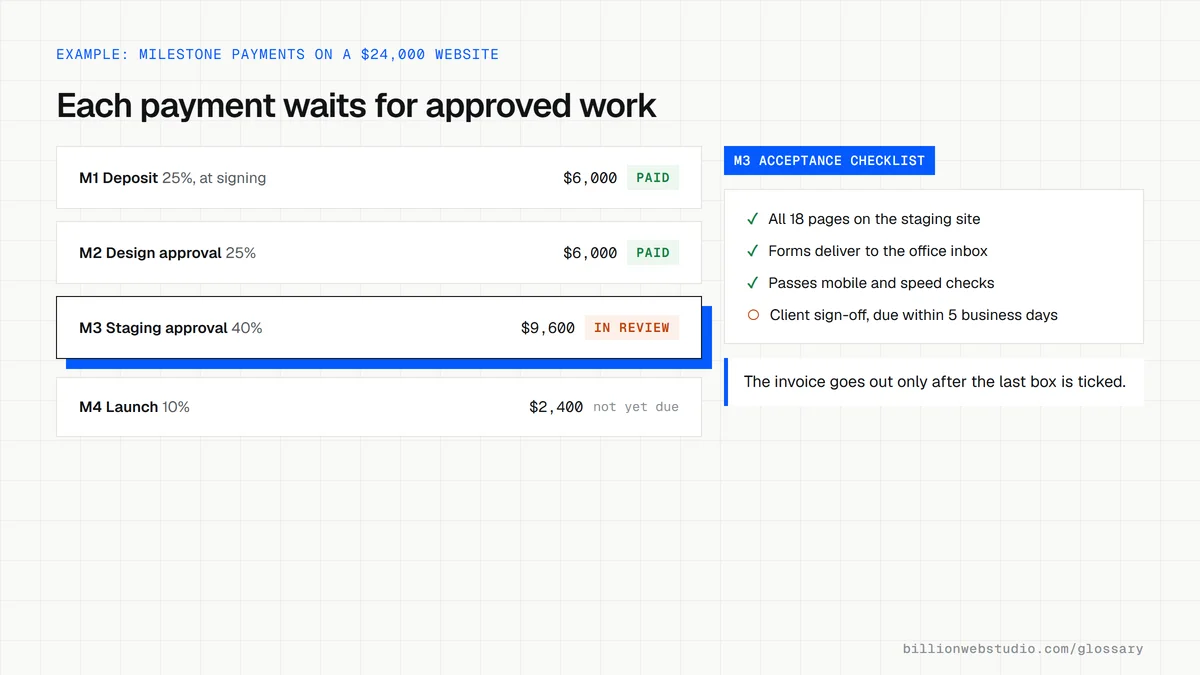
Why milestone payments matter for a website project
Milestones share risk fairly. The client never pays far ahead of the work delivered, and the vendor is paid as value is created instead of waiting months for one final invoice. Each payment also forces a formal check: if the designs are wrong, they get fixed before development starts, which costs far less than fixing them after launch.
A milestone payment example
A law firm signs a fixed-price website project. The schedule sets 30 percent as a deposit at signing, 30 percent when the homepage and inner page designs are approved, 30 percent when the full site is approved on the staging server, and the final 10 percent at launch. Each milestone lists exactly what must be delivered before its invoice is sent.
Common milestone payment mistakes
- Tying milestones to calendar dates instead of finished, approved deliverables.
- Leaving acceptance criteria vague, so nobody can agree when a milestone is complete.
- Paying most of the fee up front, which leaves the client little leverage if work stalls.
- Sitting on feedback for weeks, which delays the next milestone and the vendor's cash flow.
- Not stating what happens to paid and unpaid milestones if the project is cancelled midway.
Copy this milestone payment schedule
PAYMENT SCHEDULE

Total fixed fee: $18,000

M1  Signing                  20%   $3,600
    Due when this agreement is signed.
M2  Design approval          30%   $5,400
    Homepage and two inner page designs approved in writing.
M3  Staging approval         30%   $5,400
    Full site on staging passes the acceptance checklist.
M4  Launch                   20%   $3,600
    Site live on the client's domain, redirects in place.

Acceptance: the client reviews each milestone within 5 business
days. Written approval, or no written feedback within that time,
accepts the milestone. Invoices are payable within 14 days.

Cancellation: accepted milestones are paid in full; work on the
next milestone is billed in proportion to the work completed.
How to check the milestone schedule in a web proposal
- List each milestone with its amount or percentage and confirm they add up to the quoted total.
- Check that every payment after the deposit is tied to a deliverable you can review, such as approved designs or a staging site, not a calendar date.
- Read the acceptance criteria for each milestone and the number of days you have to review.
- Check that the final payment falls due at launch or after a short warranty period, not before the site is live.
- Find the cancellation clause and confirm how paid and in-progress milestones are settled.
What good looks like: Payments follow delivered work, the deposit is modest, each milestone has a written definition of done and a review window, and the schedule adds up to the quoted total.
Questions to ask your web developer
“What exactly will we receive at each milestone before you send the invoice?”
A good answer: A named deliverable and an acceptance checklist per milestone, such as a staging link with every page and form working.
“What happens if our feedback is late?”
A good answer: A stated review window in the contract, after which the milestone counts as accepted or the timeline moves by the same number of days.
Milestone payment: common questions
What is the difference between a milestone payment and an advance payment?
An advance payment, or deposit, is paid before work begins, usually to secure the vendor's time. A milestone payment is earned by delivering a specific stage of the work and is paid after the client accepts it. Many contracts combine both: a deposit at signing, then milestone payments as each stage is approved.
How many milestones should a website project have?
There is no fixed rule. A simple site might use three, such as deposit, design approval and launch, while a larger build may add milestones for discovery, development and content migration. Fewer milestones mean bigger payments and longer gaps between checks, so tie each one to a deliverable you can actually review.
Want a website that gets this right?
Every Billion Web Studio build includes technical SEO, schema and speed work as standard, with a fixed quote within 1 business day.