Working with an agency
What Is a Discovery Phase?
A discovery phase is the research stage at the start of a website or software project, where the team studies business goals, users, content and technical constraints before anything is designed or built, so the scope and price rest on facts.
What a discovery phase means in plain English
Discovery is about understanding the problem before committing to a solution. The team interviews stakeholders, reviews analytics and search data, audits the current site and its content, talks to or observes users, and lists technical limits such as systems the site must connect to. The UK government's Service Manual is blunt about one rule: do not start building during discovery.
The output is a set of decisions and documents, not a website: goals and success measures, a sitemap or information architecture, key user journeys, technical requirements, risks and a scoped plan with a firmer estimate. The same guidance says stopping after discovery is not a failure when the evidence shows the project should not go ahead.
Why a discovery phase matters for a website project
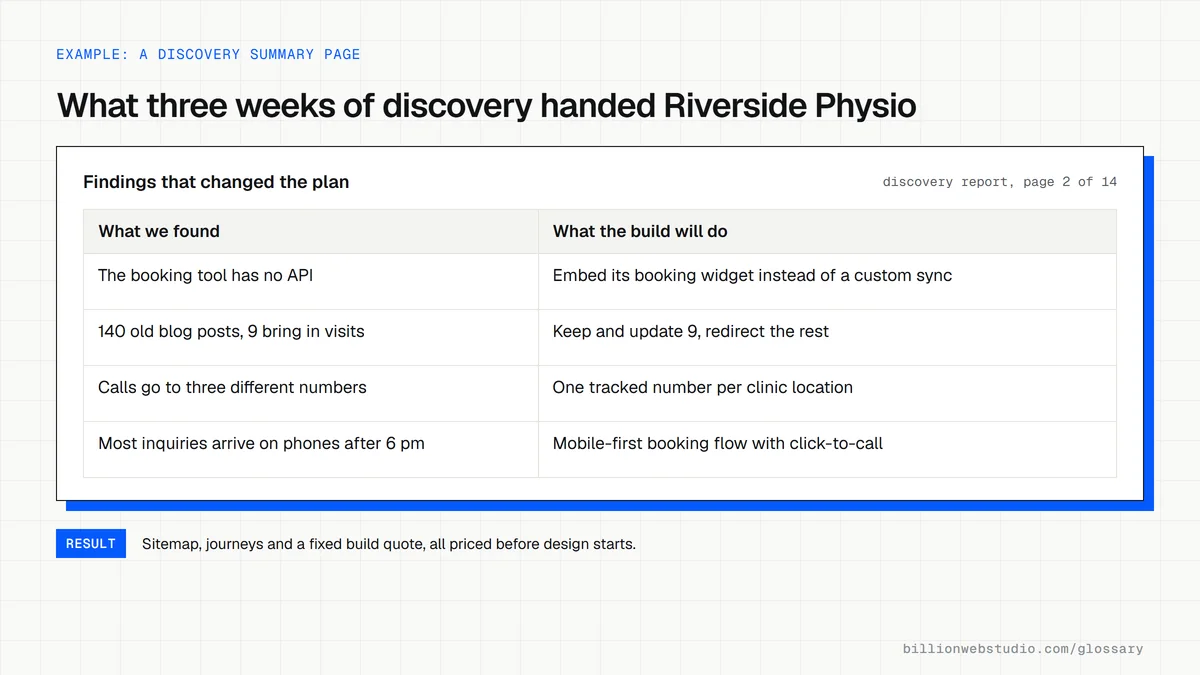
Website budgets usually go wrong because of what nobody knew at the start: a booking system with no API, hundreds of old pages that need redirects, a sales team tracking leads in a spreadsheet. Discovery finds these early, when changing the plan costs a meeting rather than a rebuild. It also produces a scope you can take to any agency for a fair, comparable quote.
A discovery phase example
A senior living group plans one new site for five communities. In discovery the agency learns that most inquiries come from adult children browsing on phones, that each community's tour form emails a different inbox, and that Google shows outdated phone numbers. The plan that follows adds one shared tour booking flow, call tracking and a page per community, all priced before design starts.
Common discovery phase mistakes
- Skipping discovery on a complex project to save time, then paying for it in rework.
- Treating discovery as a sales call instead of paid, documented research.
- Leaving the people who handle leads and customers out of the interviews.
- Ending discovery without a written scope, sitemap and estimate you get to keep.
- Starting design or code before the problem is understood.
Copy this discovery deliverables checklist
DISCOVERY PHASE: WHAT WE RECEIVE

Research
[ ] Stakeholder interviews, with names and roles (include front desk and sales)
[ ] Analytics and Search Console review: top pages, queries and lead sources
[ ] Current site audit: every page marked keep, merge, redirect or delete
[ ] Integration list: CRM, booking, payments, email, with API access confirmed

Decisions
[ ] Goals and how each will be measured after launch
[ ] Sitemap and the 3 to 5 key user journeys
[ ] Content plan: who writes, who supplies photos, due dates
[ ] Technical requirements: platform, hosting, WCAG 2.2 AA

Plan
[ ] Risks and open questions, each with an owner
[ ] Build estimate and timeline
[ ] Ownership: all documents are ours to keep and share with any vendor
How to check a discovery phase proposal before you sign
- Find the list of deliverables and confirm it includes a sitemap, key user journeys, technical requirements and a priced build estimate.
- Check who will be interviewed; it should include the staff who answer calls, handle leads or serve customers, not only the owners.
- Look for a fixed fee and a set number of weeks for discovery, priced separately from the build.
- Confirm in writing that you own the documents and may share them with any vendor.
- List the access the team needs, such as analytics, Search Console and your CRM, and plan to grant it in the first week.
What good looks like: A separately priced discovery with named deliverables you own, interviews beyond leadership, and a clear end point where you decide whether, and with whom, to build.
Questions to ask your web developer
“What will we have in hand at the end of discovery?”
A good answer: A named list of documents, including the sitemap, journeys, requirements, risks and estimate, plus a redacted sample from a past project.
“What would make you recommend building less, or not building at all?”
A good answer: Specific triggers, such as a booking system with no API or data showing most pages get no visits, and an example of a plan they scaled back.
“How much can the build price move after discovery?”
A good answer: Discovery ends with a fixed quote or a narrow range, and the proposal states in advance how the final figure will be set.
Discovery phase: common questions
Is a discovery phase worth paying for?
For complex projects, usually yes, because it turns guesses into a documented scope and lowers the risk of costly changes later. For a small, well-understood site, a short briefing call and a clear checklist may be enough. Ask what documents you will receive and whether you can use them with another vendor.
How long does a discovery phase take?
It depends on the size of the project. A small business website might need a few meetings and a week or two of research, while a large platform can take much longer. For UK government digital services, the GOV.UK Service Manual says around 4 to 8 weeks is typical.
Sources
Want a website that gets this right?
Every Billion Web Studio build includes technical SEO, schema and speed work as standard, with a fixed quote within 1 business day.