Working with an agency
What Is Scope Creep?
Scope creep is the gradual, uncontrolled growth of a project beyond what was originally agreed, as extra features, pages or changes are added without adjusting the budget or deadline. Left unchecked, scope creep pushes website projects past their launch date and budget.
What scope creep means in plain English
Scope creep rarely arrives as one big request. It is a string of small ones: one more landing page, a second language, a quick tweak to the booking flow, a new stakeholder who wants the design changed. Each sounds minor, but together they add weeks of work that nobody planned, priced or scheduled.
Scope creep is different from a planned change. When a new idea is written up, priced and approved before work starts, the scope has changed on purpose, and the timeline and budget move with it. Scope creep is the version where the work grows but the agreement does not.
Why scope creep matters for a website project
Scope creep costs money even when nobody sends a bigger bill. Launch slips, so leads and sales from the new site start later. Teams rush to absorb the extra work, so testing gets cut and bugs reach customers. Relationships suffer too, because the client feels nickel-and-dimed or the vendor feels taken for granted.
A scope creep example
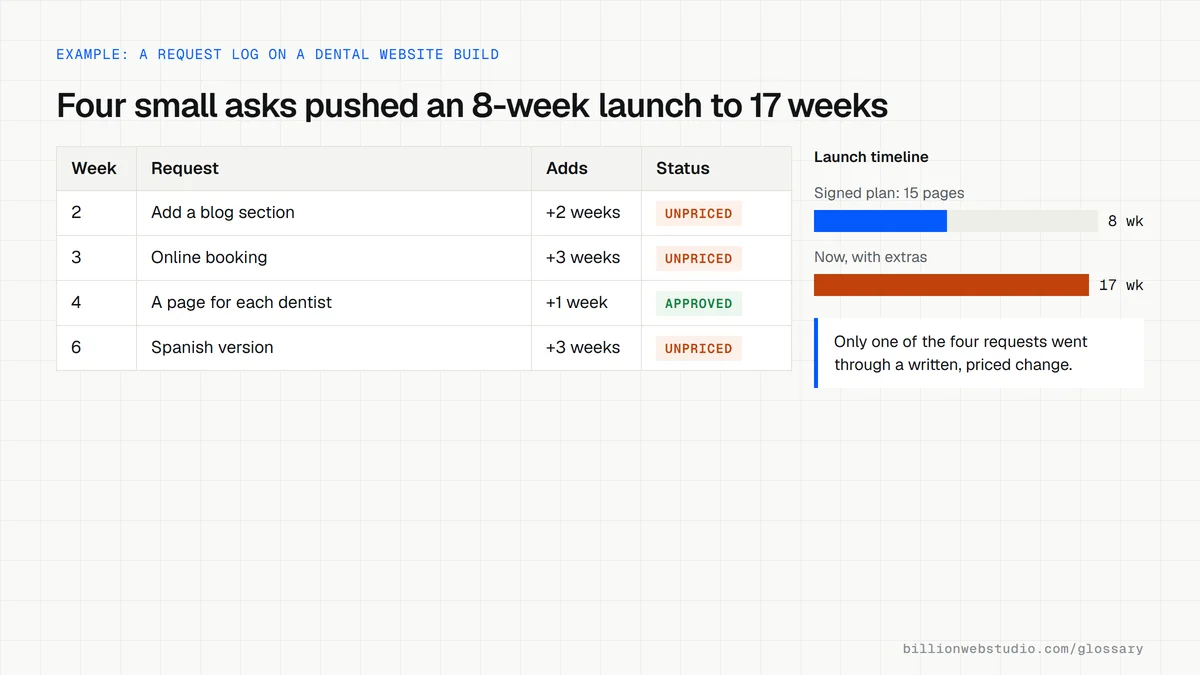
A dental group signs for a 15-page site. During design, the marketing lead asks for a blog, then online booking, then a page per dentist, then a Spanish version. None of it is in the statement of work, and nobody pauses to reprice. Launch moves from eight weeks to five months, and the final invoice turns into a dispute.
How to prevent scope creep
- Write a detailed statement of work that names every page, feature and revision round.
- List what is out of scope as clearly as what is in scope.
- Agree a simple change request process: describe it, price it, approve it, then build it.
- Name one decision maker on the client side who signs off each stage.
- Keep a parking lot list of good ideas for a second phase after launch.
Copy this change request email
Subject: Change request #4: Spanish version of service pages

Hi Maria,

You asked for Spanish versions of the 6 service pages. This is not in
the signed statement of work (section 2 lists English pages only), so
here is what it would add:

- Work: language switcher, hreflang tags, loading your translations,
  testing on desktop and mobile
- Estimate: 22 hours, $2,640 at the agreed rate of $120/hour
- Timeline: launch moves from June 6 to June 13
- Not included: the translation itself (you supply the text)

Reply "approved" to add it now, or we can list it for phase two after
launch. We will not start until we hear from you.

Thanks,
Sam, Project lead
How to check a website project for scope creep
- Open the signed statement of work and list its deliverables in the first column of a spreadsheet.
- Go through project emails, chat threads and meeting notes since kickoff, and list every request in a second column with its date.
- Mark each request as in scope, approved change (written, priced and signed) or unpriced extra.
- Ask the project manager for hours logged against the original estimate, broken down by deliverable.
- Compare the launch date in the statement of work with the current one, and note which requests moved it.
What good looks like: Every request outside the statement of work has a matching written change with a price and a new date. If unpriced extras keep appearing, or hours run ahead of the estimate while deliverables stay unfinished, the project is creeping.
Questions to ask your web developer
“How will you tell us when a request is outside the scope?”
A good answer: They flag it in writing at the time, before doing the work, with an estimate of hours, cost and the effect on the launch date.
“Who on your side can approve or refuse a change?”
A good answer: A named project lead, plus a rule that no one on the team starts an unapproved extra, however small, without sign-off from that lead and from you.
“Can we see hours used against the estimate during the project, not only at the end?”
A good answer: A report every week or two showing hours spent per deliverable against the estimate, so overruns show up while there is still time to act.
Scope creep: common questions
Is scope creep always bad?
Not every change is bad. New ideas that surface mid-project can make the website better. The problem is uncontrolled change. When each new request is written down, priced and approved, it becomes a planned change, and the budget and launch date stay honest.
Who is responsible for scope creep?
Both sides share it. Clients add requests, but vendors also cause scope creep when they agree to extras without flagging the cost, or polish features nobody asked for. A clear scope document and the habit of saying that is a change, here is the cost, protect both parties.
Want a website that gets this right?
Every Billion Web Studio build includes technical SEO, schema and speed work as standard, with a fixed quote within 1 business day.