Working with an agency
What Is Project Scope?
Project scope is the full set of work a project will deliver, including its features, deliverables, boundaries and exclusions, agreed before the work starts. On a website project, the scope names the pages, features, integrations and content to be built.
What project scope means in plain English
Project scope answers one question: what exactly are we building, and what are we not? Project managers often split it in two. Product scope is what the finished thing does, such as a booking form that syncs with your calendar. Project scope is the work needed to deliver it, from design and development to content migration, testing and training.
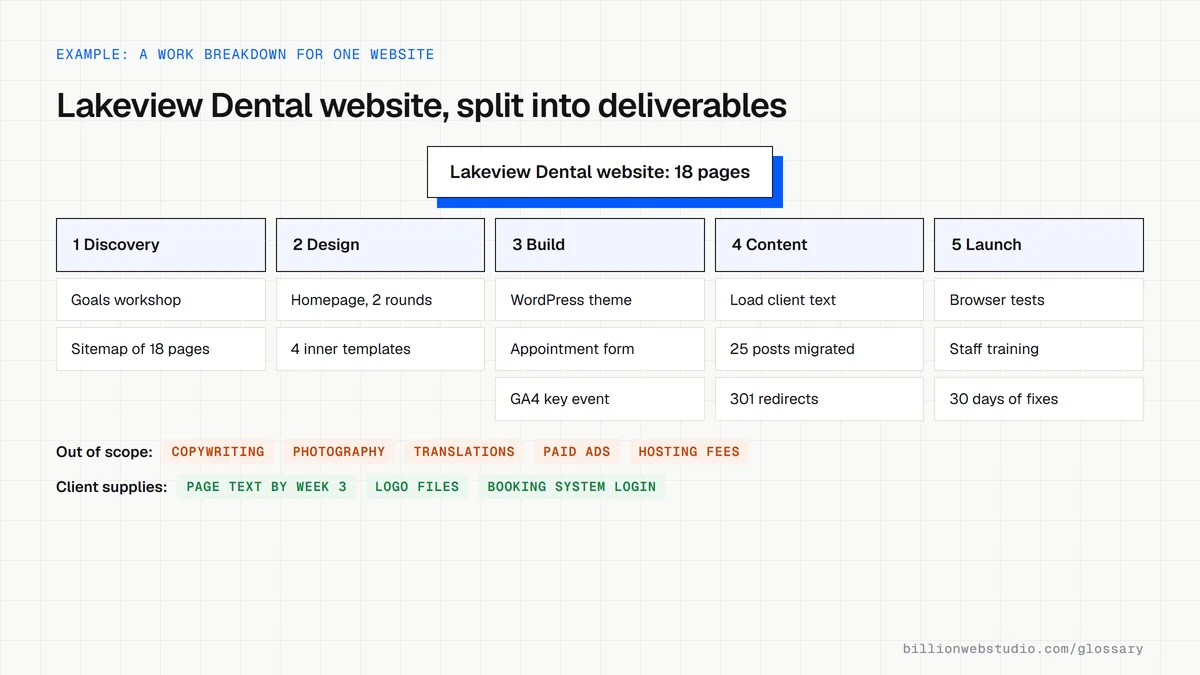
Scope is usually captured in a scope statement, then broken into a work breakdown structure, a list of every deliverable split into smaller tasks. In agency work, the agreed scope goes into the statement of work and becomes the baseline against which every later request is judged.
Why project scope matters for a website
Price, timeline and quality all hang on scope. Two agencies quoting the same vague brief can differ hugely because each imagined a different site. A clear scope lets you compare quotes fairly, gives the team a fixed target and makes it obvious when a request is new work. Without one, extra pages and features slip in unpriced, which is how scope creep starts.
A project scope example
A roofing company's scope might read: a 20-page WordPress site with home, about, contact, six service pages and ten city pages; a quote form sent to the sales inbox and tracked as a key event in GA4; migration of 30 blog posts with 301 redirects; and staff training. Out of scope: copywriting, photography, paid ads and an online store.
Common project scope mistakes
- Describing the goal, such as a modern site that gets more leads, instead of the deliverables that will achieve it.
- Leaving out exclusions, so each side assumes different things about copy, photos or hosting.
- Not stating who supplies text, images and logins, or by what date.
- Setting scope on guesses for a complex build instead of running a discovery phase first.
- Changing scope in passing emails without updating the price and timeline.
Copy this website scope checklist
WEBSITE PROJECT SCOPE: Lakeview Dental (example.com)

1. Pages and templates
   - Templates: home, service, team member, blog post, contact
   - Pages at launch: 18 (list attached)
2. Features and integrations
   - Appointment request form: sends to front desk inbox, tracked as a GA4 key event
   - Online booking: link to the existing booking system (no custom build)
3. Content
   - Client supplies all page text by week 3; agency loads it
   - Migrate 25 blog posts with a 301 redirect for every old URL
4. Design: 2 revision rounds on the homepage, 1 on each inner template
5. Testing: current Chrome, Safari, Edge and Firefox; iPhone and Android
6. Launch and handover: staff training, admin logins, 30 days of fixes
7. Out of scope: copywriting, photography, translations, paid ads, hosting fees
8. Acceptance: each item signed off in writing by the office manager
How to check a project scope before work begins
- Open the scope next to the quote. Count the pages, templates and features it names, and confirm each one appears as a line in the price.
- Highlight every vague phrase, such as modern design, basic SEO or as needed, and ask for each to be replaced with a number or a named deliverable.
- Find the out-of-scope list. If copywriting, photography, hosting, translations or data entry are not mentioned at all, ask which side covers them.
- Read the client responsibilities: what you must supply, such as text, logos and logins, and the date each one is due.
- Pick three items and read their acceptance criteria. A test such as a form entry reaching the sales inbox can be checked; looks great cannot.
What good looks like: Every deliverable can be counted, every exclusion is written down and each item has a test for done. A handy check from the PMI work breakdown standard is the 100% rule: the listed pieces add up to all of the work, with nothing missing and nothing extra.
Questions to ask your web developer
“Which parts of this scope are estimates, and what would change them?”
A good answer: They point to the riskiest items, such as a link to an old booking system, state the assumption behind each estimate and say what happens to price and dates if the assumption proves wrong.
“How many revision rounds are included for design and for content?”
A good answer: A set number per stage, such as two rounds on the homepage design and one on each inner template, with a written definition of a round and the rate for extra rounds.
“How will we handle a request that is not in this scope?”
A good answer: A written change request showing the cost and the effect on the launch date, approved by your named decision maker before anyone starts on it.
Project scope: common questions
What is the difference between project scope and scope creep?
Project scope is the agreed boundary of the work. Scope creep is what happens when that boundary moves without a matching change to budget or timeline, through a series of small unapproved additions. A written scope makes creep visible, because any request not in the document can be flagged, priced and approved.
What should a website project scope include?
List the pages or templates, features and integrations, SEO work such as content migration and redirects, the number of design revision rounds, testing, training and launch support. Then add the exclusions, the client's responsibilities and the acceptance criteria that decide when each part counts as finished.
Who defines the project scope?
Both sides do. The client brings goals, must-haves and a budget, and the vendor turns them into specific deliverables and estimates. On larger projects a discovery phase does this work formally. One decision maker on the client side should sign off the final scope before design begins.
Sources
Want a website that gets this right?
Every Billion Web Studio build includes technical SEO, schema and speed work as standard, with a fixed quote within 1 business day.