Working with an agency
What Is Outsourcing?
Outsourcing is hiring an outside company or freelancer, under a contract, to carry out work or a business function that your own employees could otherwise do, such as payroll, customer support or website development.
What outsourcing means in plain English
Instead of hiring and managing staff for a task, you pay a specialist firm to deliver it. Outsourcing describes who does the work, not where it happens. When the provider works from another country it is often called offshore outsourcing, or nearshore outsourcing when that country is close by or shares similar working hours.
Businesses outsource whole functions, such as accounting or IT support, or single projects, such as building a new website. White-label outsourcing is a variant in which an agency hires another firm to do client work that is delivered under the agency's own brand.
Why outsourcing matters for a business website
Few small and mid-sized businesses can justify an in-house web team of designers, developers and SEO specialists. Outsourcing the build gives access to all of those skills for the length of the project, and the cost stops when the work is done. The risks are less direct control, communication gaps across time zones and losing access to your own site if the contract is unclear about ownership.
An outsourcing example
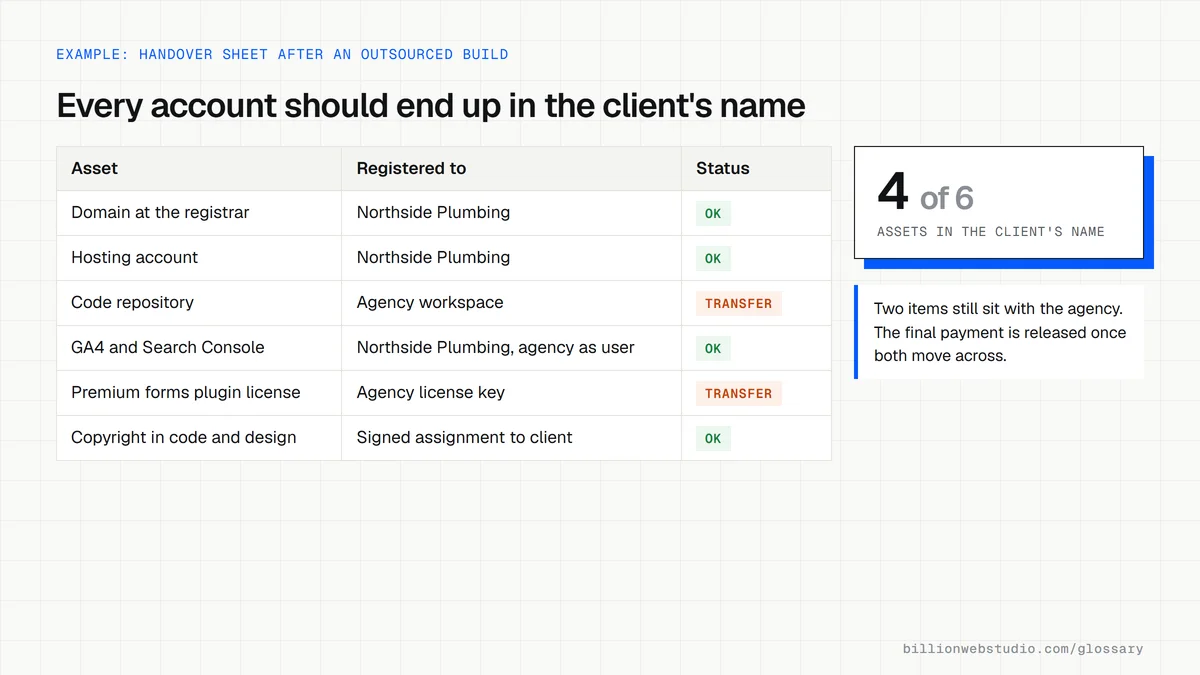
A regional accounting firm has one marketing manager and no developers. It outsources its website redesign to an agency under a statement of work covering design, build, content migration and launch. The manager keeps charge of goals and approvals, receives progress updates each week, and the firm retains ownership of the code, domain and analytics accounts when the project ends.
Common outsourcing mistakes
- Choosing a provider on hourly rate alone, without checking past work, communication and process.
- Outsourcing the decisions along with the work, leaving nobody inside the business accountable.
- Not writing down who owns the code, design, content, domain and accounts.
- Skipping a clear scope, then arguing later over what the price covered.
- Ignoring time zone gaps when agreeing meeting times and response times.
Which outsourcing setup fits which website job
| Setup | Best for | Who manages the work | Main risk to plan for |
|---|---|---|---|
| Freelancer | A small site, a single feature or occasional fixes | You do, directly | One person: holidays, illness or a move to other work leave you with no cover |
| Agency | A full build that needs design, development and SEO together | The agency's project manager | Paying for layers of management on a small job |
| White label partner | Agencies selling web work they do not build in-house | The reselling agency | Quality problems surface under the agency's own brand |
| Dedicated or augmented team | Ongoing product work that needs steady developer hours | You set priorities; the vendor handles hiring | You still need someone in-house who can direct technical work |
| Offshore or nearshore provider | Larger volumes of work where cost matters | Shared across time zones | A short daily overlap slows answers and approvals |
How to check an outsourcing contract before you sign
- Search the contract for the words assign and assignment. Look for a clause that transfers copyright in the code, designs and content to your business once you have paid.
- Find the list of accounts: domain registrar, hosting, analytics, Search Console and any paid plugins or fonts. Each should be registered to your business email, with the provider added as a user.
- Look up your domain at lookup.icann.org to see which registrar holds it, then confirm you can log in to that registrar account yourself.
- Read the termination or exit clause. It should say what the provider hands over when the contract ends, such as a full backup, the code repository and every login, and within how many days.
- If the provider will handle customer data, check for a data processing clause and a rule on subcontractors. For personal data of people in the EU, GDPR Article 28 bars a processor from bringing in another processor without your prior written authorization.
What good looks like: A signed written assignment of copyright to your business, every account registered in your name, and an exit clause with a named handover list and deadline. Under US law a transfer of copyright ownership is not valid unless it is in writing and signed by the owner.
Free tool: ICANN Registration Data Lookup
Questions to ask your web developer
“Who will actually do the work, and will any of it be subcontracted?”
A good answer: They name the people and their roles, say where they are based and how many working hours overlap with yours, and list any subcontractors in writing, with your approval needed before a new one is added.
“What do we receive if we end the contract tomorrow?”
A good answer: A specific handover list: the code in a repository you own, a full site backup, admin logins transferred to you and notes on how the site is deployed, delivered within an agreed number of days of the final payment.
“How will you report progress, and how fast do you respond to problems?”
A good answer: A written update on a fixed day each week, one named contact, and response times set by severity, such as the same business day for an outage and two business days for a minor change.
Outsourcing: common questions
What is the difference between outsourcing and offshoring?
Outsourcing means a separate company does the work. Offshoring means the work happens in another country. They often overlap, as when you hire an agency abroad, but not always: a company can offshore by opening its own office overseas, or outsource to a firm in the same city.
What are the advantages and disadvantages of outsourcing?
Advantages include access to specialist skills, lower fixed costs, faster starts and the freedom to scale up or down. Disadvantages include less day-to-day control, dependence on one supplier, possible quality or communication problems and data security risks. A clear contract, scope and ownership terms reduce most of these risks.
Sources
Want a website that gets this right?
Every Billion Web Studio build includes technical SEO, schema and speed work as standard, with a fixed quote within 1 business day.