Working with an agency
What Is White Label?
White label describes a product or service made by one company and sold by another under the seller's own brand, with the real maker kept invisible to the end customer. Store-brand groceries and agency websites built by outside developers are common examples.
What white label means in plain English
The name comes from a plain white label that a reseller can cover with its own branding. In retail, a supermarket's own-brand cereal may come from a large food maker. In digital services, a marketing agency may sell websites, SEO or apps that a specialist partner actually builds, while the client only ever sees the agency's name.
White label is close to, but not the same as, private label. Private label usually means a product made for one retailer to its own specification. White label products and services are often generic and can be resold by many companies at once. In agency work, people use the two terms loosely.
Why white label matters for agencies and their clients
For an agency, white label work adds services without hiring a full in-house team and helps it take on more projects in busy months. For the end client, it can mean specialist work delivered through one familiar contact. The risk is quality and control: the agency's reputation rests on a partner the client never meets, so contracts and checks matter.
A white label example
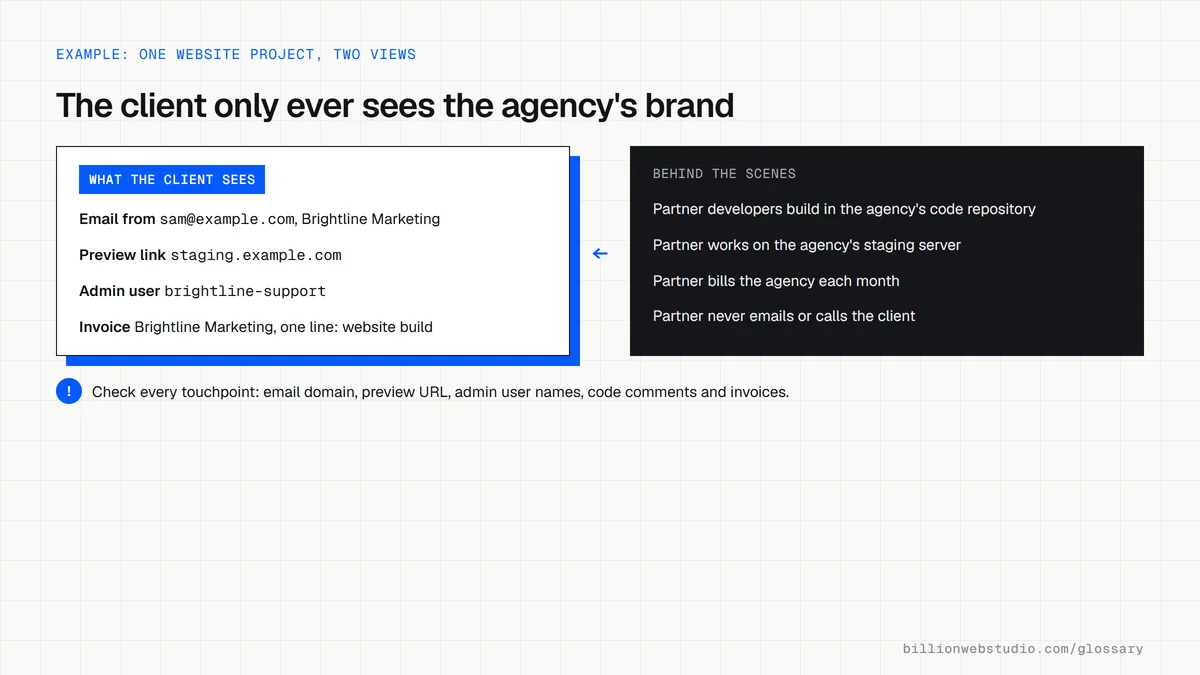
A marketing agency wins a contract for a new ecommerce site but has no developers. It hires a white label development partner, which builds the site to the agency's designs, works under the agency's project name and talks only to the agency team. The client deals solely with the agency, which handles the relationship, billing and support.
What to check in a white label partner
- A non-disclosure agreement and a clear rule that the partner never contacts your clients directly.
- Written ownership terms so the code, design and accounts pass to you or your client.
- Real examples of past work at the quality your clients expect.
- Response times, time-zone overlap and who handles bugs after launch.
- Coding standards, SEO practices and accessibility levels that match what you promise clients.
Copy this white label partner agreement checklist
WHITE LABEL PARTNER AGREEMENT: CLAUSES TO INCLUDE
Agency: Brightline Marketing    Partner: [development partner]

[ ] Services: what the partner builds, at what rates or fixed fees
[ ] Unbranded delivery: no partner names in code, footers, admin users,
    emails or anything the client receives; agency domains for staging
[ ] Non-solicitation: no direct contact with agency clients during the
    agreement and for 12 months after
[ ] Confidentiality: client names, files and logins; survives the end
[ ] Ownership: copyright assigned in writing to the agency on payment
[ ] Data: data processing terms; subcontractors listed and approved
[ ] Quality: QA checklist, accessibility and speed targets per project
[ ] Support: bug-fix period, response times, out-of-hours contact
[ ] Exit: handover of code and access within an agreed number of days
How to check a white label partner agreement
- Find the non-solicitation clause: the partner must not contact, pitch or accept work from your clients directly, during the agreement and for a set period after it.
- Check that the confidentiality clause covers client names, files and logins, and still applies after the agreement ends.
- Read the ownership clause: copyright in the work should be assigned to you in writing, so you can pass it on to your client.
- Look for unbranded delivery rules: no partner name in code comments, site footers, email domains, admin user names or anything the client receives.
- If client customer data is involved, confirm the partner signs data processing terms and lists its own subcontractors.
- Check the support terms: the bug-fix period after launch, response times and who answers if a client site goes down at night.
What good looks like: A signed agreement covering non-solicitation, confidentiality, a written copyright transfer, unbranded delivery and support times. Where EU personal data is involved, the partner is a subprocessor, and GDPR Article 28 needs the client's prior written authorization before it is brought in.
Questions to ask your web developer
“How do you keep your name out of the work we deliver?”
A good answer: They work in your project tools and code repositories, use your staging domain, remove their credits from code and themes, and never email your client from their own domain.
“What happens if one of our clients contacts you directly?”
A good answer: They refer the client back to you the same day and do not quote for or take on the work, as the non-solicitation clause requires.
“Can we see your QA checklist before the first project?”
A good answer: A written checklist covering browsers, devices, page speed, accessibility checks and SEO basics such as redirects and page titles, with results shared for every delivery.
White label: common questions
Is white labeling legal?
Yes, reselling a partner's work under your own brand is a normal business arrangement when the contract allows it. Problems arise if you make false claims about the product, break a supplier agreement or ignore labeling rules for regulated goods. This is a general answer, not legal advice for your situation.
What is white label web development?
White label web development is when an agency or consultant sells websites under its own brand while an outside development team builds them. The development partner stays invisible to the end client. Agencies use it to offer website builds, maintenance or ecommerce without hiring developers in-house.
Sources
Want a website that gets this right?
Every Billion Web Studio build includes technical SEO, schema and speed work as standard, with a fixed quote within 1 business day.