Working with an agency
What Is Time and Materials (T&M)?
Time and materials (T&M) stands for Time and Materials.
Time and materials (T&M) is a pricing model in which the client pays for the actual hours worked at agreed hourly or daily rates, plus the cost of materials or third-party expenses, instead of one fixed price for the whole project.
What time and materials means in plain English
The vendor logs the time each person spends and bills it at their agreed rate, usually weekly or monthly, along with costs such as software licenses, stock photos or premium plugins. US federal procurement rules define a T&M contract the same way: labor at fixed hourly rates that already include overhead and profit, with materials billed at cost.
Those federal rules also allow T&M only when the extent or duration of the work cannot be estimated accurately at the start, and they require a ceiling price. Private buyers can borrow the habit: agree a not-to-exceed cap and ask to be warned well before the budget is reached.
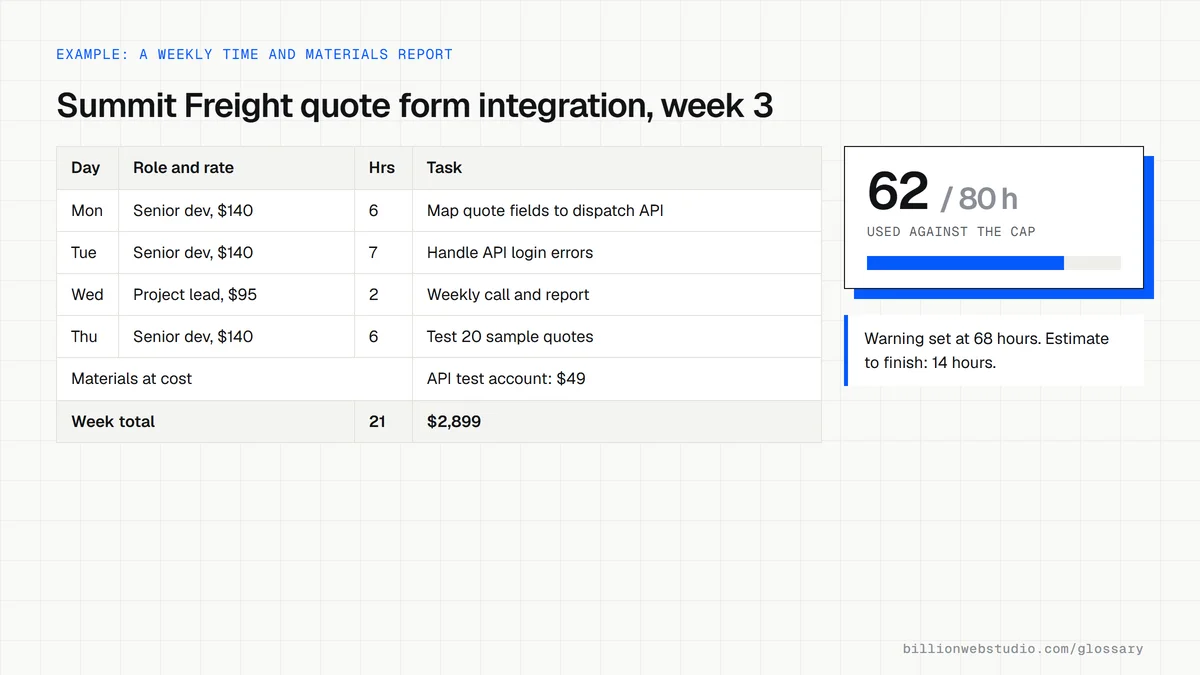
Why time and materials matters for a website buyer
T&M gives you flexibility. You can change priorities every week, which suits ongoing development, early-stage products and projects whose requirements only become clear as work goes on. The cost is uncertainty: the final bill depends on how many hours the work takes, so you need to watch timesheets and progress closely rather than relying on a single quoted figure.
A time and materials example
A trucking company hires a developer on T&M to connect its website quote form to a dispatch system with poor documentation. The hourly rate is agreed, with a cap of 80 hours before anyone must approve more. Weekly reports show hours spent, what was built and what remains, so the owner can stop, continue or change direction with full information.
Common time and materials mistakes
- Agreeing T&M with no budget cap or early warning threshold.
- Not asking for itemized timesheets that show who did what and for how long.
- Using T&M for a well-defined brochure site, where a fixed price would give more certainty.
- Paying senior rates for junior work because the contract does not list roles and rates.
Fixed price vs time and materials vs retainer: which to use
| Model | Price certainty | Room to change | Fits best | Main risk for the buyer |
|---|---|---|---|---|
| Fixed price | High: one agreed total | Low: changes need a priced change request | A well-defined build, such as a brochure site | The vendor pads the price to cover unknowns |
| Time and materials, no cap | Low | High: priorities can change every week | Unclear scope and ongoing product work | Hours keep running with no ceiling |
| Time and materials with a not-to-exceed cap | Medium: spend cannot pass the cap without approval | High, up to the cap | Integrations or discovery work with a known budget | The cap is reached before the work is finished |
| Retainer | High per month | Medium: within the included hours or tasks | Ongoing upkeep and small changes | Paying for time you do not use |
How to check a time and materials quote before you sign
- Find the rate card: each role, such as senior developer, designer or project lead, with its hourly or daily rate.
- Look for the not-to-exceed cap and the point at which the vendor must warn you. The federal T&M payment clause requires notice once costs expected in the next 30 days would take spending past 85% of the ceiling, a sensible trigger to copy.
- Check how materials are billed: at cost with receipts, or with a markup, and whether you approve purchases above a set amount.
- Ask for a sample timesheet. It should show the date, person, role, hours and a description of each task.
- Confirm how often you are invoiced and that you can pause or stop the work at the end of any billing period.
What good looks like: Named roles with rates, a written cap with an early warning point, materials at cost or at a stated markup, and an itemized timesheet with every invoice.
Questions to ask your web developer
“What range of hours do you expect, and what would push it to the top?”
A good answer: A low and a high estimate, with the specific risks that drive the high end, such as poor API documentation, rather than a single number with no reasoning.
“Who will log hours on our project, and at which rate?”
A good answer: Named people mapped to roles on the rate card, and a commitment that each task is billed at the rate of the role that did it.
“How will you warn us before we reach the cap?”
A good answer: A written alert at an agreed point, such as 85% of the cap, showing hours used, work completed and a revised estimate to finish.
Time and materials (T&M): common questions
Is time and materials better than fixed price?
Neither is better in general. Time and materials suits work whose scope is uncertain or likely to change, because you pay only for the effort used. Fixed price suits a well-defined project, because the vendor commits to the cost. Many buyers use fixed price for the main build and time and materials for later changes.
What does a not-to-exceed clause mean in a T&M contract?
A not-to-exceed clause sets the most the client will pay under a time and materials agreement. The vendor bills actual hours and costs up to that ceiling and cannot charge more without written approval. It keeps the flexibility of T&M while protecting the budget from runaway hours.
Sources
Want a website that gets this right?
Every Billion Web Studio build includes technical SEO, schema and speed work as standard, with a fixed quote within 1 business day.