Working with an agency
What Is a Retainer?
A retainer is a fee paid in advance, often monthly, to reserve a professional's time or services, such as a lawyer, consultant or web agency. With a website retainer, the client pays a set amount each month for ongoing updates, fixes and support.
What a retainer means in plain English
The word comes from retain, meaning to keep someone on hand. Lawyers have long used retainers as an upfront payment held against future work. Agencies use the word more loosely for a recurring monthly agreement: you pay a fixed amount, and in return they set aside time or deliver an agreed list of services each month.
Agency retainers usually take one of three forms. An hours retainer buys a block of time, such as 10 hours a month. A deliverables retainer buys set outputs, such as four blog posts and a monthly report. An access retainer pays for availability, such as advice or priority support, whatever the hours used.
Why a retainer matters for a business website
A website is never finished. Plugins need updates, security patches arrive, forms break when third-party tools change, and marketing wants new landing pages. A retainer means someone who already knows your site is ready to act, often faster than hiring help one job at a time. It also turns unpredictable fixes into a known monthly cost.
A retainer example
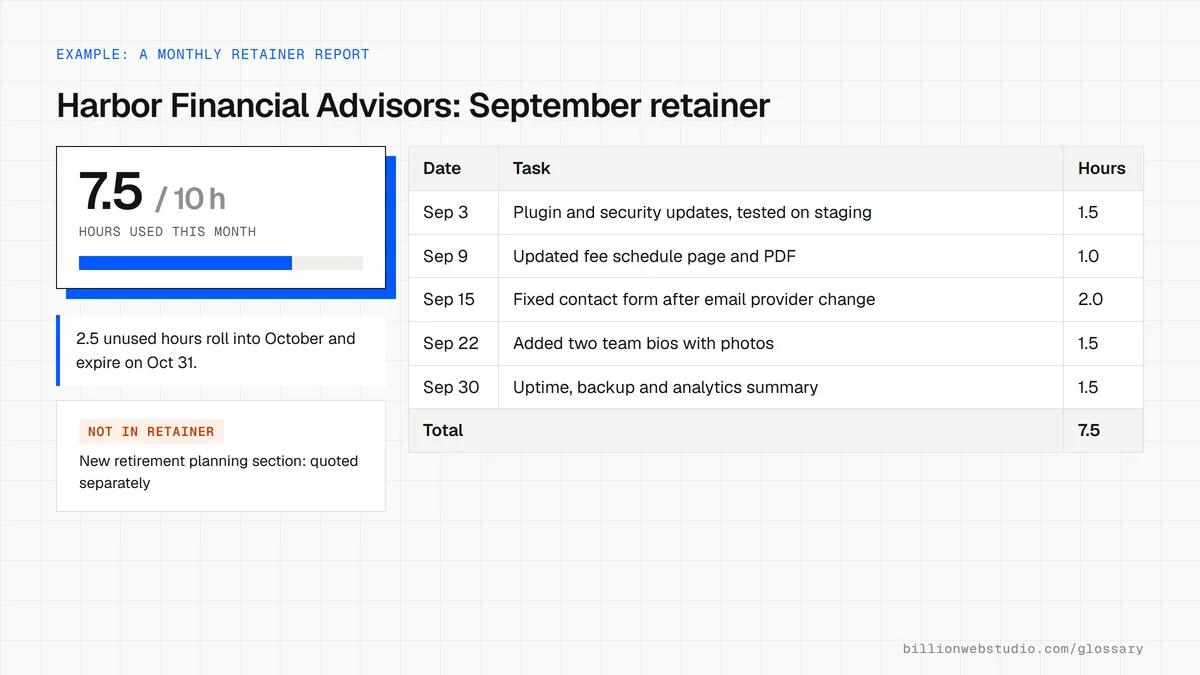
A financial advisor pays a monthly website retainer covering plugin and security updates, uptime monitoring, backups, two hours of content changes and a short analytics report. Unused hours do not roll over. When a bigger project comes up, such as a new service section, the agency quotes it separately so the retainer stays focused on upkeep.
Common retainer mistakes
- Signing without a written list of what the monthly fee includes and excludes.
- Not knowing whether unused hours roll over or expire each month.
- Paying a retainer while the agency, not you, controls the domain, hosting and accounts.
- Locking into a long contract with no notice period or way to cancel.
- Never reading the monthly report to check the retainer still matches what you need.
Hours, deliverables or access: which retainer to choose
| Retainer type | You pay for | Best when | Check in the agreement |
|---|---|---|---|
| Hours retainer | A fixed block of time each month | Requests are frequent but unpredictable, such as edits and small fixes | Rollover rule, overage rate and how time is logged |
| Deliverables retainer | A set list of outputs, such as pages, posts or reports | The work repeats in the same shape every month | How each output is defined and what happens if you skip a month |
| Access retainer | Availability, advice or priority support | You need a fast response more than a volume of work | Response times, contact channels and any cap on use |
| Hybrid retainer | A base of routine tasks plus a small block of hours | You want upkeep done on schedule and some flexible time | Which tasks come out of the hours and which do not |
How to check a retainer agreement before you sign
- Find the line that says what the monthly fee buys: a number of hours, a list of deliverables or availability. If it does not say which, ask before signing.
- Look for the rollover rule: whether unused hours carry into next month, for how long, and whether they are lost if you cancel.
- Check the rate for work above the included amount, and whether the agency must ask you before going over.
- Read the term and notice clauses: the minimum commitment, how many days of notice end the retainer and whether the fee can rise during the term.
- Ask for a sample monthly report and check that it shows time or tasks item by item, not just a total.
What good looks like: The agreement names the unit you are buying, the rollover rule, the overage rate and the notice period, and each monthly report can be matched line by line to the invoice.
Questions to ask your web developer
“What happens to hours we do not use this month?”
A good answer: A clear written rule, such as unused hours roll over for one month and then expire, with the running balance shown on every monthly report.
“How quickly do you respond to retainer requests, and does urgent work cost more?”
A good answer: Stated response times for normal and urgent requests, a definition of urgent, and whether work outside business hours is billed at a different rate.
“When does a request move out of the retainer into a separate quote?”
A good answer: A set threshold, such as any request larger than a stated number of hours, gets its own quote, so new features do not quietly use up the time meant for upkeep.
Retainer: common questions
What is the difference between a retainer and a project fee?
A project fee pays for one defined piece of work with a start and end, such as building a new website. A retainer pays for an ongoing relationship, usually monthly, covering maintenance, small changes or advice. Many businesses pay a project fee for the build and a retainer for care after launch.
Is a retainer fee refundable?
It depends on the agreement and the profession. With lawyers, unearned parts of an advance payment are often returned when the work ends, while agency retainers usually pay for time or availability that is not refunded. Read the cancellation and refund terms before signing. This is a general overview, not legal advice.
Want a website that gets this right?
Every Billion Web Studio build includes technical SEO, schema and speed work as standard, with a fixed quote within 1 business day.