Working with an agency
What Is an RFP?
RFP stands for Request for Proposal.
An RFP (request for proposal) is a document a business or public body sends to several vendors describing a project, its goals and requirements, and asking each vendor to submit a proposal with its approach, timeline and price. The buyer then compares proposals to choose a supplier.
What an RFP means in plain English
An RFP turns a buying decision into a fair comparison. Instead of taking calls from many agencies and getting proposals in different shapes, you write down what you need once and ask everyone to answer the same questions by the same deadline. Proposals that follow one format are easy to score side by side.
Two related documents often get confused with it. A request for information (RFI) gathers background while you are still exploring options. A request for quotation (RFQ) asks only for prices when the work is already fully defined. An RFP sits in between: the goal is clear, but you want vendors to propose how to reach it.
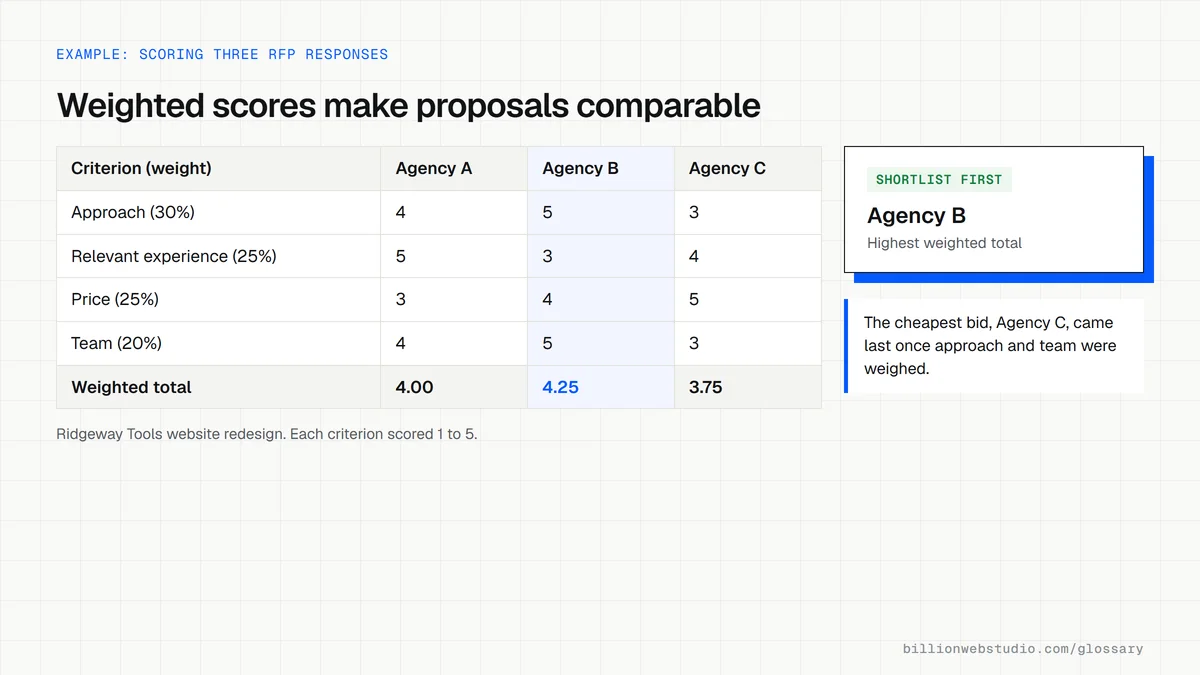
Why an RFP matters when buying a website
A website touches sales, marketing, IT and often legal, so unclear requirements get expensive. Writing an RFP forces the team to agree on goals, must-have features, integrations, budget range and deadlines before vendors quote. The result is proposals you can actually compare, fewer surprises in the contract and a clearer statement of work once you choose.
An RFP example
A manufacturer wants a new site that brings in distributor inquiries. Its RFP explains the product range, current traffic, the CRM integration it needs, a budget range and a three-week window for proposals. Five agencies respond in the same format, two are shortlisted for a call, and the winning proposal becomes the basis for the statement of work.
What to include in a website RFP
- Company background, the audience the site serves and the business goals, such as more qualified leads.
- Current site problems, with access to analytics so vendors can see real traffic and conversions.
- Required pages, features and integrations, such as the CRM, booking system or payment gateway.
- Technical needs like the CMS, hosting, accessibility level, page speed targets and protection of existing rankings.
- Budget range, timeline, how proposals will be scored and the deadline for vendor questions.
Common RFP mistakes
- Hiding the budget, which produces proposals that are impossible to compare.
- Listing features without explaining the business problem they should solve.
- Sending the RFP to dozens of vendors instead of a short list of serious ones.
- Giving vendors too little time to ask questions and prepare a thoughtful response.
Copy this website RFP outline
REQUEST FOR PROPOSAL: Website redesign
Issued by: Ridgeway Tools Inc. (example.com)

1. About us: products, customers, how we sell
2. Goals: for example, more distributor inquiries from the site
3. Current site: platform, monthly visits, top pages, known problems
4. Scope: pages, features, integrations (CRM, product search)
5. Technical needs: CMS, hosting, accessibility target (WCAG 2.2 AA),
   a redirect plan that protects existing rankings
6. Budget range: $40,000 to $60,000
7. Timeline: proposals due Nov 20, decision Dec 5, launch by April
8. Questions: email rfp@example.com by Nov 6; answers shared with all
9. What to send: approach, team, timeline, itemized price,
   two case studies, three references (10 pages max)
10. How we score: approach 30%, experience 25%, price 25%, team 20%
How to check your website RFP before you send it
- Read it as a vendor would and write down every question you would ask. Each answer you add now saves a round of emails later.
- Confirm it states a budget range, the proposal deadline, the target launch date and one named contact for questions.
- Check that it lists the scoring criteria and their weights, such as approach 30%, experience 25%, price 25% and team 20%. US federal rules require an RFP to state every factor that affects the award and its relative importance, a habit worth copying.
- Make sure it tells vendors exactly what to send back: the sections, the format and a page limit, so proposals arrive in the same shape.
- Attach the data a vendor needs to price the work, such as an analytics export, the current sitemap and the list of integrations.
What good looks like: A vendor could price the work without a call, knows how proposals will be scored, and every proposal you receive answers the same sections in the same order.
Questions to ask your web developer
“What assumptions did you make where our RFP was unclear?”
A good answer: A short list of named assumptions, each tied to part of the price, so you can see what changes if an assumption turns out to be wrong.
“Who from your proposal will actually work on our project?”
A good answer: Names and roles for the people who will design, build and manage it, with the share of their time on your project, not only the sales lead who wrote the proposal.
“Can you show a past project close to ours that we can verify?”
A good answer: A live site you can visit, the scope they delivered on it and a client contact you are allowed to call.
RFP: common questions
What is the difference between an RFP and an RFQ?
An RFP asks vendors how they would solve a problem and what it would cost, so proposals differ in approach. An RFQ asks only for prices on a clearly defined item or service, so responses differ mainly on cost. Use an RFP when you want ideas and expertise, and an RFQ when you already know exactly what you need.
How long should an RFP be?
Long enough to explain goals, requirements, budget and how you will choose, and no longer. For a typical business website, a few clear pages beat a long template full of boilerplate. Vendors write better proposals when they can quickly see what matters most to you.
Sources
Want a website that gets this right?
Every Billion Web Studio build includes technical SEO, schema and speed work as standard, with a fixed quote within 1 business day.