AI search
What Is Perplexity SEO?
Perplexity SEO is the work of making a website easy for Perplexity, an AI answer engine, to find, read and cite, so that the numbered source links in its answers point to your pages when people ask about your field.
What Perplexity SEO means in plain English
Perplexity answers questions by searching the web in real time and writing a reply, and its help center says every answer includes numbered citations linking to the original sources. Perplexity SEO is the informal name for improving your chances of being one of those sources. The label comes from the marketing industry, not from Perplexity, which has not published a ranking guide as of October 2026.
Most of the work overlaps with good SEO and generative engine optimization: pages that can be crawled, direct answers near the top, facts in plain text and a clear author or business behind the content. The part specific to Perplexity is technical access, because Perplexity uses its own crawlers that your server, CDN or firewall must let through.
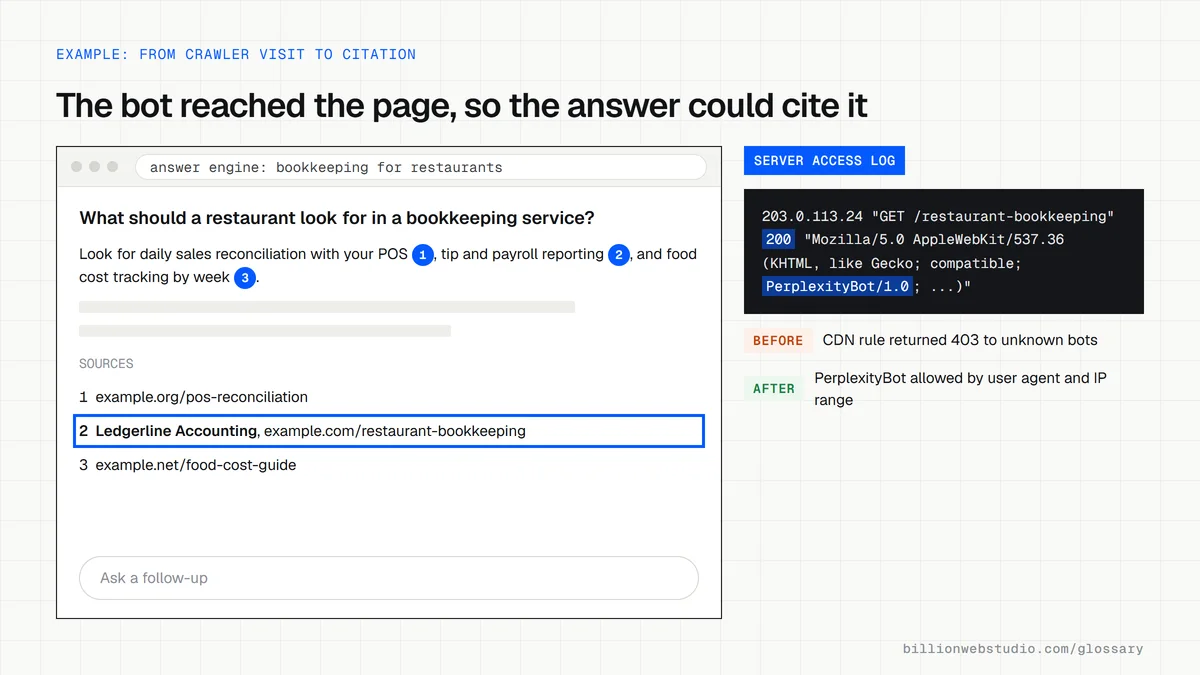
How Perplexity's crawlers reach your website
Perplexity documents two user agents. PerplexityBot is designed to surface and link websites in Perplexity's search results, and Perplexity says it is not used to crawl content for AI foundation models. Perplexity-User fetches a page when a person's question needs it, and because a user requested the fetch, it generally ignores robots.txt rules.
Perplexity publishes the IP ranges for both in JSON files and advises site owners using a web application firewall to allow those ranges explicitly. Changes to robots.txt can take up to 24 hours to show in Perplexity's systems. If PerplexityBot is blocked, your pages are unlikely to appear as sources in its search results.
A Perplexity SEO example
An accounting firm notices that Perplexity cites two competitors, but never the firm itself, when asked about bookkeeping for restaurants. Its server logs show no PerplexityBot visits, because a bot-protection rule at the CDN was blocking unknown crawlers. After allowing PerplexityBot by user agent and published IP range, the firm also rewrites its restaurant page so the first paragraph answers the question directly, then re-runs the same prompts monthly.
How to check Perplexity SEO on your own site
- Read your robots.txt and confirm PerplexityBot is not disallowed for the pages you want cited.
- Check CDN and firewall bot rules, since many block unfamiliar crawlers by default.
- Search your server logs for PerplexityBot and Perplexity-User to confirm they reach your pages.
- Ask Perplexity your buyers' real questions and record which sources it cites over time.
- Look for perplexity.ai as a referral source in your analytics and note which landing pages it sends visitors to.
Copy this robots.txt that lets PerplexityBot in
# PerplexityBot follows only the group that names it,
# so repeat any private paths in its group
User-agent: PerplexityBot
Allow: /
Disallow: /cart/
Disallow: /account/

# Every other crawler
User-agent: *
Disallow: /cart/
Disallow: /account/

# Perplexity-User fetches pages on request and generally
# ignores robots.txt, so control it at the firewall if needed

Sitemap: https://www.example.com/sitemap.xml
How to check whether Perplexity can crawl and cite your site
- Open yourdomain.com/robots.txt in a browser and look for a User-agent: PerplexityBot group, or a User-agent: * group, that disallows the pages you want cited.
- Ask your host or developer for the last 7 days of access logs and search them for PerplexityBot and Perplexity-User. A 200 status means the page was served, while 403 or 429 means something blocked it.
- In your CDN or firewall dashboard, open the bot or WAF rules and confirm PerplexityBot is allowed, ideally matched against the IP ranges Perplexity publishes in its perplexitybot.json file.
- Ask Perplexity five questions your buyers ask, open the sources for each answer and note which domains are cited.
- In GA4, open Reports, then Acquisition, then Traffic acquisition, switch the table to Session source / medium and search for perplexity to see visits and landing pages.
What good looks like: PerplexityBot requests to your public pages return 200, robots.txt does not disallow it, and over a few months more of your tracked questions cite your pages. Perplexity says a robots.txt change can take up to 24 hours to register.
Free tool: Perplexity crawler documentation
Questions to ask your web developer
“Does our CDN or firewall block AI crawlers by default, and which ones are allowed?”
A good answer: They can name the exact rule, show that PerplexityBot is allowed by user agent and checked against Perplexity's published IP list, and explain how Perplexity-User requests are handled.
“How will you measure whether Perplexity cites us?”
A good answer: A fixed set of buyer prompts is run every month with the cited URLs recorded, alongside perplexity.ai referral sessions, landing pages and key events from GA4.
“Which pages should Perplexity cite, and does each answer its question in the first paragraph?”
A good answer: They name a short list of target pages, each opening with a direct, factual answer, with dates and figures on those pages kept current.
Perplexity SEO: common questions
Is Perplexity SEO different from Google SEO?
Mostly no. Both reward crawlable pages with clear, accurate answers. The differences are practical: Perplexity uses its own crawlers that must be allowed separately, it shows sources as numbered citations, and it does not offer a Search Console style report, so you measure through prompts, server logs and referral traffic.
Does Perplexity use my content to train AI models?
According to Perplexity's crawler documentation, PerplexityBot is not used to crawl content for AI foundation models, and Perplexity-User is not used for web crawling or to collect training content. The documentation describes PerplexityBot as surfacing and linking websites in Perplexity's search results.
What are Perplexity source labels?
Perplexity can label a whole website as Government, Academic or Trusted after a source review that asks questions such as whether a site corrects mistakes and names its authors. Perplexity says partnerships and payments do not affect labels, and most domains carry no label at all.
Sources
Want a website that gets this right?
Every Billion Web Studio build includes technical SEO, schema and speed work as standard, with a fixed quote within 1 business day.