AI search
What Is Query Fan-Out?
Query fan-out is a technique Google uses in AI Mode and AI Overviews that breaks one question into several related searches, runs them at the same time across subtopics and data sources, and combines the results into one answer.
What query fan-out means in plain English
A long question usually hides several smaller ones. Instead of matching the whole sentence to pages, Google's AI features work out the sub-questions, search for each one in parallel and then write a single response from what they find. Google first described the approach on March 5, 2025, when it introduced AI Mode, as issuing multiple related searches concurrently across subtopics and multiple data sources.
Google's documentation says both AI Overviews and AI Mode may use query fan-out, and that the extra searches help it find a wider and more diverse set of supporting pages to link. Deep Search, a research option in AI Mode, applies the same idea at larger scale and can issue hundreds of searches, according to Google's May 2025 announcement.
Why query fan-out matters for a business website
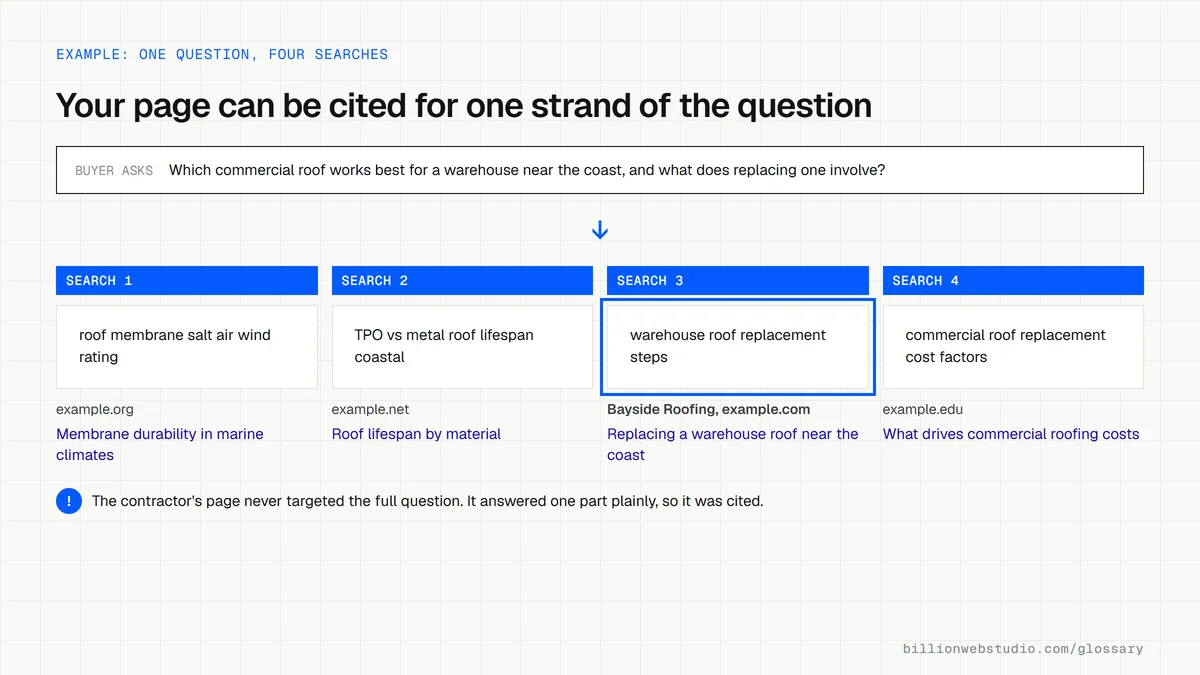
Your page can be cited for a sub-question you never targeted as a keyword. A page that clearly answers one specific part of a bigger buying question, such as lead times, minimum order size or what an installation involves, can earn a link inside an answer to a much broader query. Thin pages that only repeat a main keyword give the fan-out searches little to pick up.
It also means coverage beats repetition. A site that answers the related questions buyers ask, each on a well-linked page or section, offers more entry points than a site with one long page targeting a single phrase.
A query fan-out example
A homeowner asks AI Mode which heating system suits a drafty older house in a cold climate and whether switching is worth the cost. Behind the scenes, the system might search separately for cold-climate heat pump performance, insulation in older homes, typical installation steps and local incentives. An HVAC company with a clear page on retrofitting older homes could be cited for that one strand, even though the full question names no brand or service.
What is not known about query fan-out
- Google does not show which sub-searches it ran for a given answer, so any tool claiming to list them is making an estimate.
- Google has not published how many fan-out searches a normal AI Mode answer uses, beyond describing Deep Search as issuing hundreds.
- Google says there are no extra technical requirements for its AI features, so there is no fan-out tag or setting to add.
- Clicks from fan-out citations are counted inside the Web search type in Search Console, not reported separately.
How one buyer question splits into sub-questions your pages can answer
| Sub-question inside the query | Page or section that should answer it | What the answer has to state |
|---|---|---|
| Which roof membranes cope with salt air and high wind? | Coastal roofing service page | The membranes you install, the wind rating each carries and the warranty terms |
| How long does each roof type last? | Roof types comparison guide | Expected service life ranges, with the manufacturer or study named as the source |
| What does a warehouse roof replacement involve? | Roof replacement process page | The steps, a typical timeline and whether the building can stay open |
| What does it cost? | Pricing or estimate page | The main price drivers, a starting price or range, and how a quote is worked out |
| Who can do it nearby? | Service area and contact page | Towns covered, licenses held and how soon someone can inspect the roof |
Copy these Search Console regex filters
# Queries of eight words or more
# (Add filter > Queries > Custom (regex) > Matches regex)
^(\S+\s+){7,}\S+$

# Queries that start with a question word
^(how|what|which|why|when|where|who|can|does|do|is|are|should)\b

# Comparison queries, which often split into several sub-searches
\b(vs|versus|compare|comparison|alternative|alternatives)\b
How to check which long questions already find your pages
- In Google Search Console, open Performance, then Search results, keep Search type on Web and set the date range to the last 3 months.
- Select + Add filter, choose Queries, then Custom (regex), paste the eight-words-or-more pattern from the regex box on this page and select Apply.
- Sort the table by Impressions, click a query that matters to your business, then open the Pages tab to see which of your URLs Google showed for it.
- For each strong query, write down the smaller questions inside it and check that the page answers each one in plain words under its own heading.
- Swap in the question-word pattern and repeat, listing sub-questions that no page answers yet as candidates for new sections.
What good looks like: Long queries earn impressions across several relevant pages, each page appears for questions it answers directly, and the number of such queries rises from quarter to quarter. Google publishes no target figure for this.
Free tool: Search Console Help: Performance report filters
Questions to ask your web developer
“Which sub-questions will get their own page, and which a section on an existing page?”
A good answer: They decide from Search Console queries and real sales questions: a sub-question with its own demand and intent gets a page, a supporting detail becomes a clearly headed section, and nothing is split just to raise the page count.
“How will we know the new answer sections are being found?”
A good answer: They compare impressions for the long-query filter on the changed pages before and after, and keep a monthly log of which tracked questions cite the site in AI Mode.
Query fan-out: common questions
Does query fan-out change keyword research?
It widens it. Alongside your main keywords, list the follow-up questions a buyer would need answered before deciding, then make sure each one has a clear answer somewhere on your site. Fan-out searches look for those specific answers, so a page that covers them plainly has more chances to be cited.
Is query fan-out only used in AI Mode?
No. Google's documentation says both AI Overviews and AI Mode may use query fan-out. Google has also explained that AI Mode applies the same idea to visual searches, running several searches about different parts of a photo and combining them into one response.
Can I see the fan-out queries that led to my page?
Not directly. As of October 2026, Google does not publish the sub-searches behind an AI answer, and Search Console reports AI feature traffic inside the Web search type. Watching which pages gain impressions for long, specific queries gives an indirect view.
Sources
- Google Search Central: AI features and your website
- Google blog: Expanding AI Overviews and introducing AI Mode, March 5, 2025
- Google blog: AI Mode in Google Search, updates from Google I/O 2025, May 20, 2025
- Google blog: Google expert explains AI Mode's query fan-out method, March 5, 2026
- Search Console Help: Performance report advanced filtering (RE2 regex)
Want a website that gets this right?
Every Billion Web Studio build includes technical SEO, schema and speed work as standard, with a fixed quote within 1 business day.