AI search
What Is Generative Engine Optimization (GEO)?
Generative engine optimization (GEO) stands for Generative Engine Optimization.
Generative engine optimization (GEO) is the practice of improving how often, and how accurately, a brand and its content are cited in answers written by AI tools such as ChatGPT, Gemini, Perplexity and Google AI Overviews.
What generative engine optimization means
A generative engine is a search tool that writes an answer instead of only listing links. It reads several sources, combines them and often cites a few. Generative engine optimization is the work of making your pages likely to be among those sources, and making sure what the AI says about your business is correct.
The term comes from a research paper by Pranjal Aggarwal and colleagues, first posted in November 2023 and accepted at the KDD 2024 conference. The authors proposed a framework for measuring and improving how visible a source is in AI-generated responses, and reported that their methods raised visibility by up to 40% in their tests.
Why GEO matters for a business website
Buyers increasingly ask an AI tool for a shortlist before visiting any website. If the answer names three firms and yours is not one of them, you lose the lead without ever seeing it in your analytics. GEO also protects accuracy: outdated prices, old addresses or a stale service list on your own pages can be repeated back to buyers as fact.
A GEO example
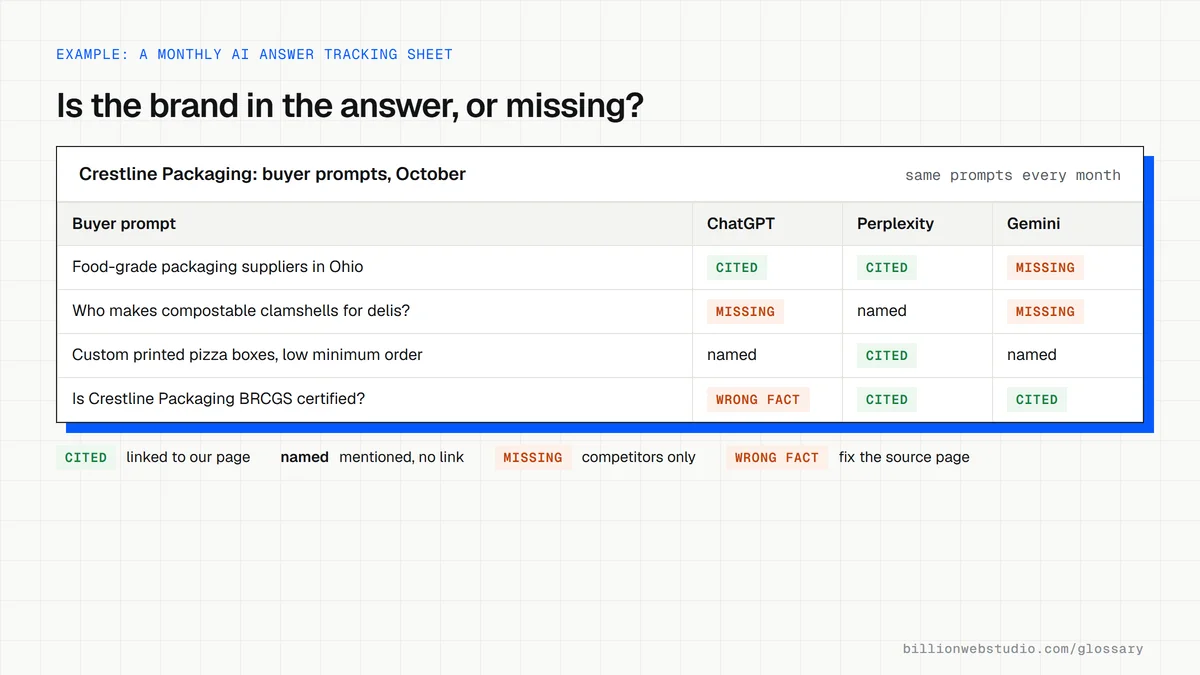
A packaging manufacturer asks ChatGPT and Perplexity which suppliers in its region make food-grade packaging, and finds it is never mentioned. Its product pages are mostly images with little text. The team adds plain text specifications, certifications, a clear statement of where it ships, and a comparison table, then reruns the same prompts each month to see whether citations change.
How to check GEO on your own site
- Ask several AI assistants the questions your buyers ask and note which sources they cite.
- Confirm your key pages are indexed in Google Search Console, since Google's AI features only link to pages that are indexed and eligible for a snippet.
- Check that prices, locations and services appear as plain text, not only inside images or PDFs.
- Correct outdated facts about your business on your own site and on directory listings.
- Make sure robots.txt, your CDN and your firewall are not blocking crawlers you want to read your pages.
AI crawlers and what blocking each one changes
| User agent | Company | What it does | If you block it in robots.txt |
|---|---|---|---|
| OAI-SearchBot | OpenAI | Finds pages to show in ChatGPT search answers | Your pages are not shown in ChatGPT search answers |
| GPTBot | OpenAI | Collects content that may train OpenAI models | Signals your content should not be used for training |
| PerplexityBot | Perplexity | Finds and links sites in Perplexity results | Your pages can drop out of Perplexity results |
| Claude-SearchBot | Anthropic | Indexes content to improve Claude search answers | Less visibility in Claude search answers |
| ClaudeBot | Anthropic | Collects content that may train Anthropic models | Signals future content should be left out of training |
| Google-Extended | A robots.txt token for Gemini Apps and Vertex AI | No effect on Google Search inclusion or ranking |
How to check if AI assistants cite your business
- Write 10 questions a buyer asks before choosing a supplier like you, such as food-grade packaging suppliers in Ohio.
- Ask each one in ChatGPT, Perplexity, Gemini and Copilot in a fresh chat, and record whether your brand is cited with a link, named without one, or missing.
- Note the sources each answer cites: those are the pages you need to match, or the sites where you need to be listed.
- In GA4, open Reports, then Acquisition, then Traffic acquisition, switch the first column to Session source and search for chatgpt, perplexity and copilot.
- Run the same questions every month in the same sheet so changes are easy to see.
What good looks like: Your brand appears with a correct description for most questions about your core service, and every fact the assistants repeat, such as location, services or certifications, matches your current website.
Questions to ask your web developer
“How will you track whether AI assistants mention us?”
A good answer: A fixed list of buyer prompts run monthly in named assistants, logged with the date, whether we were mentioned or linked and whether the facts were right, plus GA4 sessions referred by AI tools.
“Which AI crawlers do our robots.txt, CDN and firewall block today?”
A good answer: They show the current rules and bot settings, explain the difference between search crawlers such as OAI-SearchBot and training crawlers such as GPTBot, and let us choose each one deliberately.
Generative engine optimization (GEO): common questions
Is GEO replacing SEO?
No. GEO builds on SEO rather than replacing it. Google states that its AI features rely on the same fundamentals as regular search, so pages that are crawlable, indexed, useful and trusted are also the starting point for being cited in generative answers.
How do you measure generative engine optimization?
There is no single official metric. Most teams track a fixed set of buyer prompts across AI tools, recording whether the brand is mentioned or cited, and watch referral visits from AI tools in analytics. Google includes AI Overview and AI Mode traffic in the Web search type in Search Console.
Sources
- arXiv: GEO: Generative Engine Optimization (Aggarwal et al., KDD 2024)
- Google Search Central: AI features and your website
- OpenAI: Overview of OpenAI crawlers
- Perplexity: Perplexity crawlers
- Anthropic: Does Anthropic crawl data from the web
- Google Search Central: Google's common crawlers (Google-Extended)
Want a website that gets this right?
Every Billion Web Studio build includes technical SEO, schema and speed work as standard, with a fixed quote within 1 business day.