AI search
What Is a Knowledge Graph?
A knowledge graph is a database that stores facts as entities, such as people, places, companies and products, together with the relationships between them. Google's Knowledge Graph is the best-known example and feeds the factual answers and knowledge panels in Google Search.
What a knowledge graph means in plain English
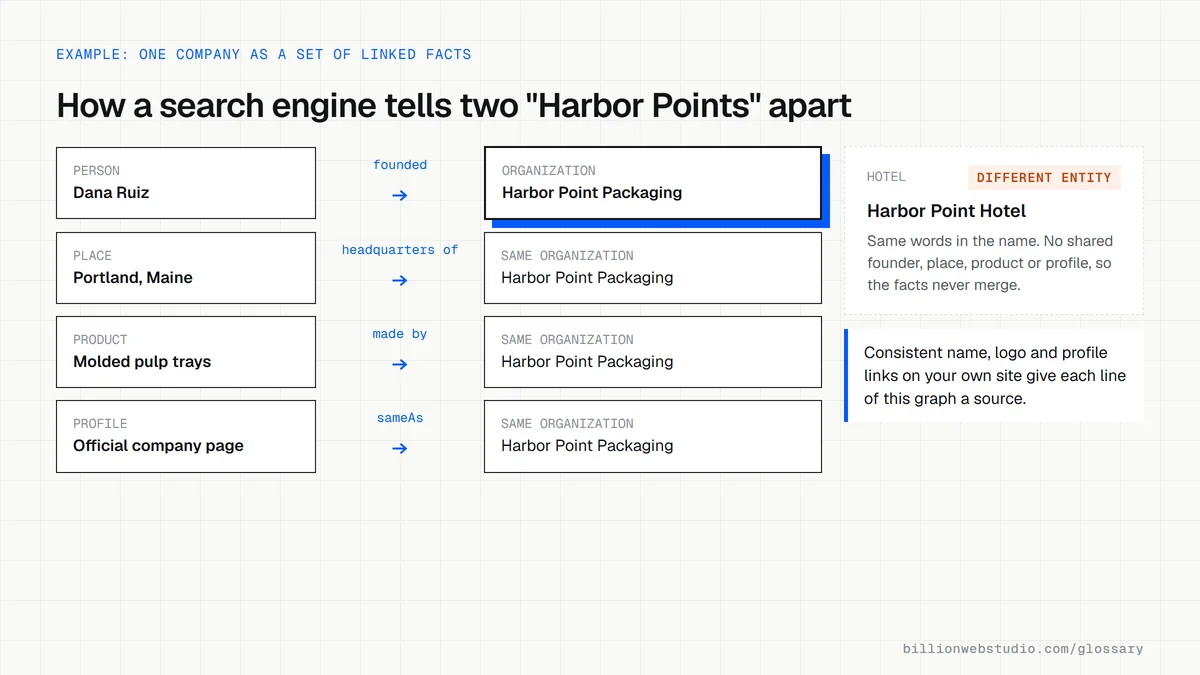
Picture a map where every dot is a real thing, such as a company, its founder, its city and its products, and every line says how two dots relate: founded by, located in, makes. That is a knowledge graph. Because it stores meaning rather than words, a search engine can tell a jaguar the animal from Jaguar the car maker.
Google launched its Knowledge Graph on May 16, 2012 under the phrase things, not strings, with more than 500 million objects and 3.5 billion facts. By May 2020 Google said it held over 500 billion facts about five billion entities, drawn from the web, licensed data, public databases and content owners themselves.
Why the Knowledge Graph matters for a business website
When Google treats your business as a known entity, it can connect your name, logo, website, social profiles and services with confidence. That supports a knowledge panel on brand searches and reduces the chance of being confused with a similarly named firm. Facts held about entities also inform answers in Google's search features, so wrong or missing facts can travel further than one results page.
You cannot edit the Knowledge Graph directly. You influence it by publishing consistent facts: the same business name, address and logo on your site and profiles, plus Organization structured data that Google says helps it disambiguate your organization and can influence the logo and knowledge panel it shows.
A knowledge graph example
A packaging manufacturer called Summit shares its name with a hotel chain and a software firm, and brand searches show a mix of all three. The company adds Organization markup with its legal name, logo, founding date and sameAs links to its LinkedIn page and trade directory listings, makes its About page state those facts in plain text, and uses the same name and logo everywhere it is listed.
Common knowledge graph mistakes
- Using different versions of the business name, logo or address across the website and online profiles.
- Adding structured data that claims facts the visible page does not show.
- Leaving out sameAs links to the official profiles that confirm who you are.
- Expecting markup alone to create a knowledge panel, when Google decides that from many sources.
- Ignoring outdated facts on third-party sites that Google may still be drawing on.
Copy this Organization markup
<script type="application/ld+json">
{
  "@context": "https://schema.org",
  "@type": "Organization",
  "@id": "https://www.example.com/#organization",
  "name": "Harbor Point Packaging",
  "legalName": "Harbor Point Packaging LLC",
  "url": "https://www.example.com/",
  "logo": "https://www.example.com/images/logo-512.png",
  "description": "Manufacturer of molded pulp trays and protective packaging for food producers.",
  "foundingDate": "2009",
  "telephone": "+1-207-555-0142",
  "address": {
    "@type": "PostalAddress",
    "streetAddress": "120 Wharf Road",
    "addressLocality": "Portland",
    "addressRegion": "ME",
    "postalCode": "04101",
    "addressCountry": "US"
  },
  "sameAs": [
    "https://www.linkedin.com/company/example-harbor-point-packaging",
    "https://www.youtube.com/@example-harborpoint"
  ]
}
</script>
How to check what Google knows about your business as an entity
- In a private browser window, search Google for your exact business name, then your name plus your city, and note whether a knowledge panel appears and whether it describes you or a namesake.
- Paste your homepage URL into the Rich Results Test and open the detected Organization item. Check the name, url, logo and sameAs values it reads.
- Open every sameAs link and confirm each profile uses the identical business name, the same logo and a link back to your homepage.
- Compare the markup with your About page: the legal name, founding date and address should also appear there in plain text.
- Run the homepage through URL Inspection in Search Console and confirm the Google-selected canonical matches the url in your markup.
What good looks like: One Organization item with no critical errors, a logo of at least 112 by 112 pixels, sameAs links that all lead to profiles you control, and the same facts on your site, your profiles and any panel Google shows.
Free tool: Google Rich Results Test
Questions to ask your web developer
“Which page carries our Organization markup, and which profiles are listed in sameAs?”
A good answer: One page, usually the homepage or About page, holds it, and every sameAs URL is an official profile or listing that describes this business and no other.
“How does the markup stay correct when our address, logo or name changes?”
A good answer: The values come from one settings source in the CMS, so a change updates the markup, footer and contact page together, and the markup is retested in the Rich Results Test after each change.
Knowledge Graph: common questions
Is the Knowledge Graph the same as a knowledge panel?
No. The Knowledge Graph is Google's underlying database of facts about entities. A knowledge panel is the information box Google shows in search results when you look up one of those entities. The panel displays a small selection of what the graph holds.
Can I add my business to Google's Knowledge Graph?
There is no submission form. Google builds the graph automatically from sources across the web, licensed data and content owners. Consistent business details, Organization structured data with sameAs links and accurate listings on reputable sites make it easier for Google to recognize your business as an entity.
What is the Google Knowledge Graph Search API?
The Knowledge Graph Search API is a read-only tool that returns individual matching entities in JSON-LD using schema.org types. Google says it is not suitable as a production-critical service and recommends its Cloud Enterprise Knowledge Graph product for new users.
Sources
- Google blog: Introducing the Knowledge Graph, things, not strings, May 16, 2012
- Google blog: Google's Knowledge Graph and knowledge panels, May 20, 2020
- Knowledge Panel Help: How Google's Knowledge Graph works
- Google Search Central: Organization structured data
- Google for Developers: Knowledge Graph Search API
Want a website that gets this right?
Every Billion Web Studio build includes technical SEO, schema and speed work as standard, with a fixed quote within 1 business day.