AI search
What Is Agentic Commerce?
Agentic commerce is online shopping in which an AI agent acts for the buyer, finding, comparing and sometimes paying for products or bookings inside a chat or search tool, while the merchant still sells, ships and handles returns.
What agentic commerce means in plain English
In ordinary ecommerce, the shopper visits your store, adds items to a cart and checks out. In agentic commerce, the shopper tells an AI assistant what they want, and the assistant searches catalogs, compares options and, where the platform allows it, completes the purchase or booking in the same conversation. Shopify describes agentic commerce as AI agents helping shoppers discover, compare and purchase products within a conversation.
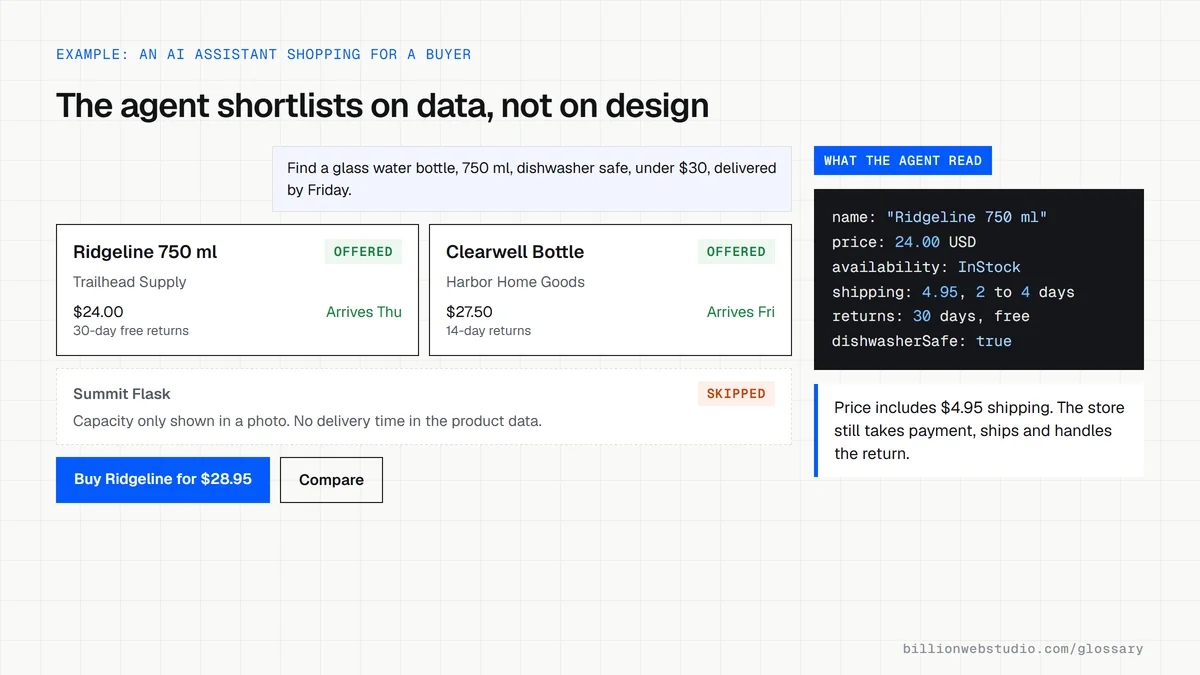
The agent does not replace the store. Behind the scenes, it reads your product data, sends the order to your systems and passes a payment token instead of raw card details. You still accept or decline the order, charge the payment, ship the goods and deal with refunds.
How agentic commerce works as of October 2026
Several open standards now carry these orders. On September 29, 2025, OpenAI and Stripe released the Agentic Commerce Protocol alongside Instant Checkout in ChatGPT. On January 11, 2026, Google announced the Universal Commerce Protocol, developed with Shopify, Etsy, Wayfair, Target and Walmart, to power checkout in AI Mode and the Gemini app. Visa and Mastercard announced agent payment programs in April 2025.
Rollout is uneven. Shopify's June 2026 guide says purchases through these AI channels are limited to US buyers, that ChatGPT orders finish on the merchant's own site in an in-app browser, and that Google's native checkout is open to select US brands while a wider rollout continues. How agents choose which merchant to show is not published in detail by any of these companies.
Why agentic commerce matters for a business website
An AI agent cannot admire your homepage. It judges you on data: price, stock, shipping cost, return policy, reviews and product attributes. If that data is missing, stale or inconsistent between your site and your product feeds, the agent may skip your product or quote the wrong price. Google's protocol FAQ states that merchants remain the merchant of record and must keep feeds, return policies and contact details current in Merchant Center.
An agentic commerce example
A shopper asks an AI assistant for waterproof hiking boots under a set budget, in a wide fit, that can arrive before a trip next week. The agent checks several stores' product data, filters out listings that do not state width or delivery times, and offers three pairs. The shopper picks one and confirms. The store receives a normal order through its platform, ships the boots and emails the tracking number as usual.
Common agentic commerce mistakes
- Keeping key product facts such as size, material or compatibility only inside images where agents cannot read them.
- Letting prices or stock in your product feed drift away from what the website shows.
- Publishing a vague returns policy that an agent cannot summarize for a buyer.
- Assuming every AI assistant can buy from every store, when access depends on the platform, country and merchant eligibility.
- Rebuilding the store before fixing the product data that agents actually read.
Copy this product markup with shipping and returns
{
  "@context": "https://schema.org",
  "@type": "Product",
  "name": "Ridgeline Glass Water Bottle, 750 ml",
  "sku": "RGB-750-SAGE",
  "image": "https://www.example.com/images/rgb-750-sage.jpg",
  "description": "Dishwasher-safe borosilicate glass bottle, 750 ml, with a silicone sleeve.",
  "brand": { "@type": "Brand", "name": "Ridgeline" },
  "offers": {
    "@type": "Offer",
    "url": "https://www.example.com/products/rgb-750-sage",
    "price": 24.00,
    "priceCurrency": "USD",
    "availability": "https://schema.org/InStock",
    "itemCondition": "https://schema.org/NewCondition",
    "shippingDetails": {
      "@type": "OfferShippingDetails",
      "shippingRate": { "@type": "MonetaryAmount", "value": 4.95, "currency": "USD" },
      "shippingDestination": { "@type": "DefinedRegion", "addressCountry": "US" },
      "deliveryTime": { "@type": "ShippingDeliveryTime",
        "handlingTime": { "@type": "QuantitativeValue", "minValue": 0, "maxValue": 1, "unitCode": "DAY" },
        "transitTime": { "@type": "QuantitativeValue", "minValue": 2, "maxValue": 4, "unitCode": "DAY" } }
    },
    "hasMerchantReturnPolicy": { "@type": "MerchantReturnPolicy", "applicableCountry": "US",
      "returnPolicyCategory": "https://schema.org/MerchantReturnFiniteReturnWindow",
      "merchantReturnDays": 30, "returnMethod": "https://schema.org/ReturnByMail",
      "returnFees": "https://schema.org/FreeReturn" }
  }
}
How to check your product data is ready for AI shopping agents
- Open your best-selling product page in Google's Rich Results Test and confirm Merchant listings is detected with a price, availability, shipping details and a return policy.
- Compare the price and stock the test reads with what the page shows a shopper and what your product feed holds. All three should match to the cent.
- In Google Merchant Center, open Products and then the Needs attention tab, and fix the issues on your top sellers first, such as price mismatches or missing identifiers.
- Read each product description as if the photos did not exist: size, material, fit and compatibility should all be stated in text.
- Ask an AI assistant for your product type with a budget and a delivery date, and check whether it quotes your price, shipping time and return window correctly.
What good looks like: The Rich Results Test shows valid merchant listing items with no critical errors, the Needs attention tab is clear for your top products, and every AI answer you test repeats your current price and policies accurately.
Free tool: Google Rich Results Test
Questions to ask your web developer
“Is our product feed generated from the same data as the website, and how often does it update?”
A good answer: The feed and the product pages read from one product database, prices and stock sync at least daily or on every change, and a mismatch report flags anything that drifts.
“Which AI shopping channels can our platform sell through today, and in which countries?”
A good answer: They name each channel, its eligibility rules and countries from the platform's current merchant documentation, and the exact setting that has to be switched on in your admin.
“How will we tell orders from AI channels apart from normal web orders?”
A good answer: Each order carries a sales channel or source field naming the AI platform, and the same label flows into analytics so revenue by channel can be reported.
Agentic commerce: common questions
Is agentic commerce live yet?
Partly. As of October 2026, AI assistants from OpenAI, Google and Microsoft can show products and, for eligible merchants, take buyers through checkout, mostly for US shoppers. Coverage depends on the platform, your ecommerce system and your country, so check each platform's merchant documentation.
Who handles refunds when an AI agent buys from my store?
You do. Under both the OpenAI and Stripe protocol and Google's Universal Commerce Protocol, the business stays responsible for accepting the order, taking payment, fulfillment and returns. The AI platform passes the order and a payment token, then the merchant's normal processes take over.
Do I need a new website for agentic commerce?
Usually not. Most of the work is in product data: complete titles, attributes, accurate prices and stock, clear shipping and return policies, and a product feed that matches the site. Shopify merchants can manage AI channels from an Agentic Storefronts setting in the admin.
Sources
- Stripe newsroom: Stripe powers Instant Checkout in ChatGPT and releases the Agentic Commerce Protocol, September 29, 2025
- OpenAI developers: Agentic Commerce key concepts
- Google blog: New tech and tools for retailers in an agentic shopping era, January 11, 2026
- Google for Developers: Universal Commerce Protocol FAQ
- Shopify: Agentic commerce on Shopify, how it works, June 18, 2026
- Visa: Visa announces new era of commerce featuring AI, April 30, 2025
- Mastercard: Mastercard unveils Agent Pay, April 29, 2025
- Google Search Central: Merchant listing (Product, Offer) structured data
- Merchant Center Help: The Needs attention tab
Want a website that gets this right?
Every Billion Web Studio build includes technical SEO, schema and speed work as standard, with a fixed quote within 1 business day.