SEO
What Is E-E-A-T?
E-E-A-T stands for Experience, Expertise, Authoritativeness and Trustworthiness.
E-E-A-T (experience, expertise, authoritativeness and trustworthiness) is the set of qualities Google's search quality raters use to judge whether content and its creators can be trusted. Google says E-E-A-T is not a single ranking factor, and that trust matters most.
What E-E-A-T means in plain English
E-E-A-T comes from Google's Search Quality Rater Guidelines, the handbook for people who review search results and report whether Google's systems are working. Experience means first-hand knowledge, such as having used the product. Expertise means the knowledge or skill a topic needs. Authoritativeness means being a go-to source. Trust means the page is accurate, honest, safe and reliable.
Google added the first E, for experience, on December 15, 2022. The guidelines place trust at the center of the family: an untrustworthy page has low E-E-A-T however expert or well known its author seems. The current edition of the guidelines is dated September 11, 2025.
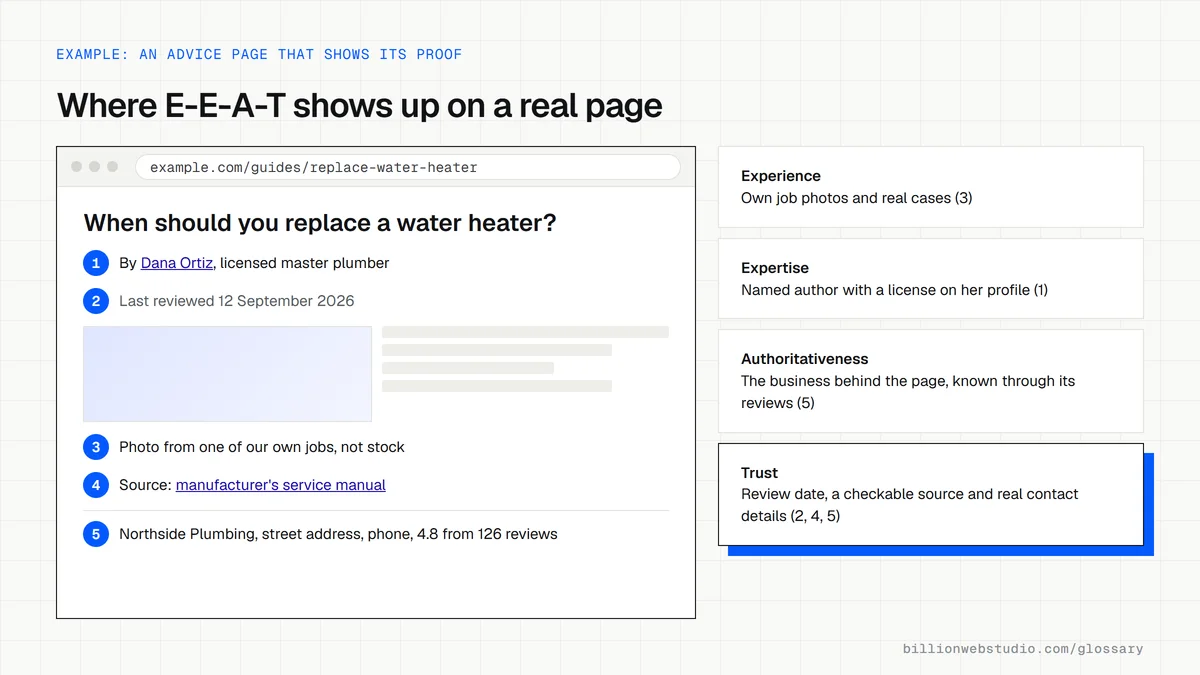
Why E-E-A-T matters for a business website
Raters cannot change rankings, and their scores are not fed directly into ranking. Instead, Google says its systems use a mix of signals that tend to line up with good E-E-A-T. The practical effect for a business is simple: pages that prove who you are, show real work and give accurate answers earn trust from searchers and from Google.
The bar rises for topics that can affect a person's health, money or safety, which the guidelines call Your Money or Your Life (YMYL) topics. A law firm, clinic or financial advisor needs clearer proof of who wrote the advice and why they are qualified than a landscaping company's blog post about spring planting does.
An E-E-A-T example
Two accounting firms publish a page on small business tax deadlines. The first is unsigned and repeats generic advice. The second names the accountant who wrote it, links to her profile and qualifications, cites the official tax authority, shows the firm's address and reviews, and adds a worked example from a typical client situation. The second page shows far stronger E-E-A-T.
How to show E-E-A-T on your own website
- Name the author of every advice page and link to a profile that states their experience and qualifications.
- Publish a clear About page with your physical address, phone number and real contact options.
- Show genuine proof such as case studies, original photos of your work and independent reviews.
- Cite official sources for any facts, rules or figures you state.
- Keep forms and payments secure so visitors can act on the page safely.
Copy this Article markup with author details
<script type="application/ld+json">
{
  "@context": "https://schema.org",
  "@type": "Article",
  "headline": "When should you replace a water heater?",
  "datePublished": "2026-03-04T09:00:00-07:00",
  "dateModified": "2026-09-12T10:30:00-06:00",
  "author": {
    "@type": "Person",
    "name": "Dana Ortiz",
    "jobTitle": "Licensed master plumber",
    "url": "https://example.com/team/dana-ortiz"
  },
  "publisher": {
    "@type": "Organization",
    "name": "Northside Plumbing",
    "url": "https://example.com/"
  }
}
</script>
How to check E-E-A-T signals on your own pages
- Open your three most visited advice or service pages and check each names a real author or reviewer, linked to a profile that states their experience and qualifications.
- Look for a last reviewed or updated date, and for links to the official sources behind any rules, prices or figures.
- Click through to your About and Contact pages. They should show the business's real address, phone number and who runs it.
- Search Google for your business name plus the word reviews, and read what customers and other sites say about you.
- Paste one article URL into the Rich Results Test and check that the Article markup names the same author as the visible byline.
What good looks like: Every advice page names a qualified person, cites official sources and shows a review date, the About page proves a real business, and independent reviews describe you well. Google says trust matters most of the four qualities.
Free tool: Google: helpful content self-assessment
Questions to ask your web developer
“Who will write or review the content on our site, and how will their credentials be shown?”
A good answer: Content is written or checked by someone with real experience of the work, usually your own staff, and each page links to an author profile with their role, licenses and years in the trade.
“How will you prove first-hand experience on our service pages?”
A good answer: Original photos from your jobs, real project details, before and after examples and customer reviews, instead of stock images and generic copy.
“Will you add author structured data, and how will it stay accurate?”
A good answer: Article markup with the author as a Person and author.url pointing to the profile page, generated from the same field as the visible byline and tested in the Rich Results Test.
E-E-A-T: common questions
Is E-E-A-T a ranking factor?
Not directly. Google says E-E-A-T itself is not a specific ranking factor. Its systems use many signals that can identify content with good experience, expertise, authoritativeness and trust, and its human raters use E-E-A-T to check whether those systems return helpful, reliable results.
What is the difference between E-A-T and E-E-A-T?
E-A-T covered expertise, authoritativeness and trustworthiness. In December 2022 Google added experience, meaning first-hand or life experience with the topic, such as a review written by someone who actually used the product. The extra letter recognizes that personal experience can make content trustworthy even without formal credentials.
Which part of E-E-A-T is most important?
Trust. Google's rater guidelines call trust the most important member of the E-E-A-T family, because an untrustworthy page has low E-E-A-T however experienced or expert its creator appears. Experience, expertise and authoritativeness matter mainly as evidence that supports trust.
Sources
Want a website that gets this right?
Every Billion Web Studio build includes technical SEO, schema and speed work as standard, with a fixed quote within 1 business day.