Building and hosting
What Is a Full Stack Developer?
A full stack developer is a programmer who builds both the frontend of a website, meaning the screens visitors see and use, and the backend, meaning the server, database and logic behind it, so one person can deliver a feature end to end.
What full stack developer means in plain English
A stack is the set of technology layers a website runs on. The top layer is the browser interface, written in HTML, CSS and JavaScript, often with a framework such as React. Below it sit the server code, in languages like JavaScript on Node.js, PHP or Python, plus a database and the hosting that runs everything.
A full stack developer is comfortable working across all those layers. They might design a database table in the morning, write the code that saves form entries at lunch, and build the form itself in the afternoon. Most still have deeper strength on one side, which is worth asking about.
Why a full stack developer matters for a business
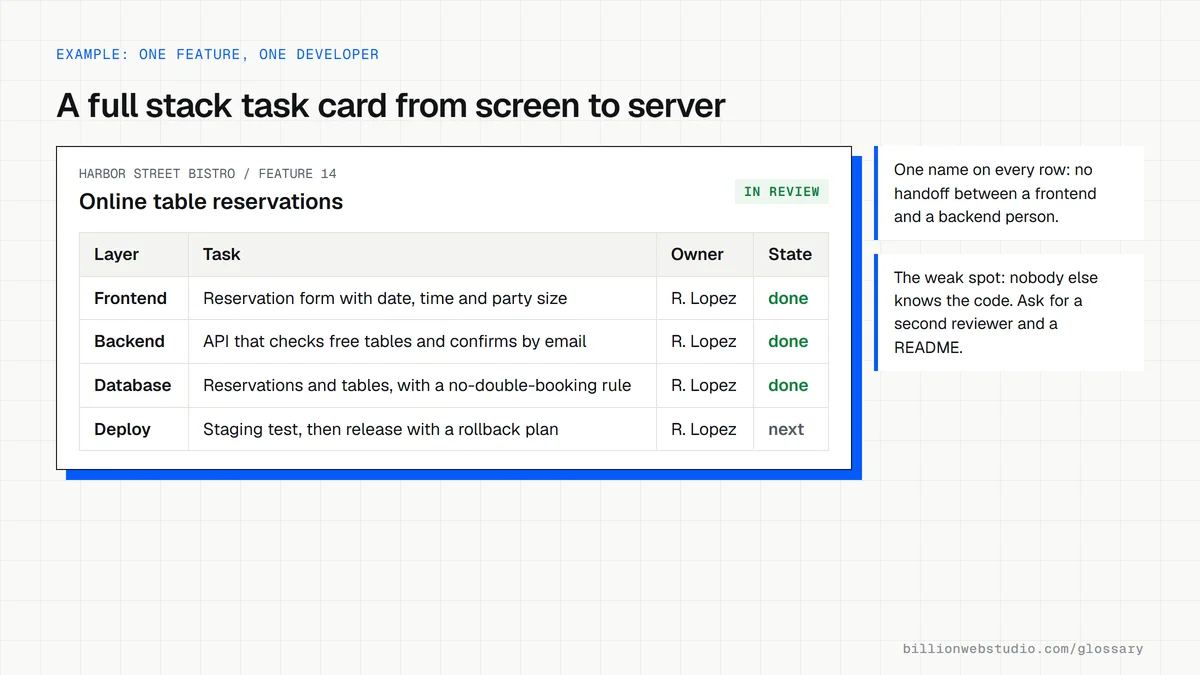
Fewer handoffs mean fewer misunderstandings. On a small project, a prototype or an internal tool, one full stack developer can move faster and cost less than separate frontend and backend specialists. They also see how a change in one layer affects the others.
Breadth has limits. Full stack is a programming role, so visual design, copywriting, accessibility review and SEO strategy are separate skills. Larger builds still benefit from specialists, and one person holding all the knowledge creates a risk if they leave without documentation.
A full stack developer example
A home care agency wants caregivers to apply online instead of filling in paper forms. A full stack developer builds the application form, writes server code that checks each entry and stores it securely in a database, and adds a password-protected page where the hiring manager can filter and review applicants.
What to check before hiring a full stack developer
- Ask which side of the stack they are strongest in and see work that proves it.
- Confirm they have shipped and maintained live projects, not only tutorials or demos.
- Agree who handles design, content and SEO, since those sit outside the developer role.
- Require documentation and access to all code repositories and hosting accounts in your name.
Full stack developer, specialists or an agency: who fits which project
| Option | Fits best | Watch out for |
|---|---|---|
| One full stack developer | Prototypes, internal tools and small apps with a clear scope | One person holds all the knowledge, so insist on documentation |
| Frontend and backend specialists | Products with a demanding interface and complex data or integrations | More handoffs, and someone must own the overall plan |
| Agency team | Lead-generating websites that also need design, copy, SEO and testing | Higher cost, so ask who actually writes the code |
| Freelancer for one layer | Fixing or extending one part of an existing site | Check they can work with the stack and code you already have |
How to check a full stack developer's proposal before you sign
- Find the technology list. It should name the frontend framework, server language, database and hosting, not just say full stack.
- Ask for one live project and a short walkthrough of its code repository, so you see real work on both the screens and the server.
- Look for named tasks on each layer, such as form validation, database tables, API endpoints and deployment, each with its own estimate.
- Read what is excluded. Design, copywriting, SEO and accessibility testing are often outside a developer's scope.
- Confirm the code repository, hosting and database accounts will be created in your company's name.
What good looks like: The proposal names the whole stack, estimates each layer separately, says who covers design and content, and puts the code and every account under your ownership from day one.
Questions to ask your web developer
“Which side of the stack is your strongest, and who reviews your work on the other side?”
A good answer: An honest answer naming their deeper side, plus a review habit such as a second developer, automated tests or both.
“How will you document the project so another developer can take over?”
A good answer: A README in the repository covering setup, environment settings, deployment and the database structure, updated with each release.
“How do you release changes and roll them back?”
A good answer: Changes go to a staging copy first, then live through a repeatable process, and the previous version can be restored quickly if something breaks.
Full stack developer: common questions
What does a full stack developer do?
A full stack developer writes the code for both what users see and what happens on the server. Typical tasks include building page layouts and forms, writing server logic, designing databases, connecting outside services such as payments or a CRM, and deploying the finished site or application to hosting.
Is a full stack developer the same as a web designer?
No. A web designer decides how a site looks and how people move through it, usually in design tools. A full stack developer turns those designs into working code and builds the systems behind them. Some people do both, but they are different skills.
Should a small business hire a full stack developer or a team?
One full stack developer can suit a small, well-defined project or an internal tool. A website that must win leads usually also needs design, copy, SEO and testing skills, which a team or agency covers. Decide based on scope, timeline and who will maintain the result.
Want a website that gets this right?
Every Billion Web Studio build includes technical SEO, schema and speed work as standard, with a fixed quote within 1 business day.