SEO
What Is a Featured Snippet?
A featured snippet is a Google search result that shows a short answer taken from a web page before the page's title and link, usually near the top of the results. Google picks featured snippets automatically, and site owners cannot request one.
What a featured snippet means in plain English
A normal search result shows a page title first, then a short description. Google describes featured snippets as special boxes where that format is reversed, so the descriptive text comes first. The text is taken from the page itself and often answers the question in a sentence or two, or as a short list. Featured snippets can also appear inside People also ask boxes.
Google's systems decide whether a page would make a good featured snippet for a given search. No special code makes a page eligible. Google's own documentation answers the question of how to mark a page as a featured snippet with two words: "You can't."
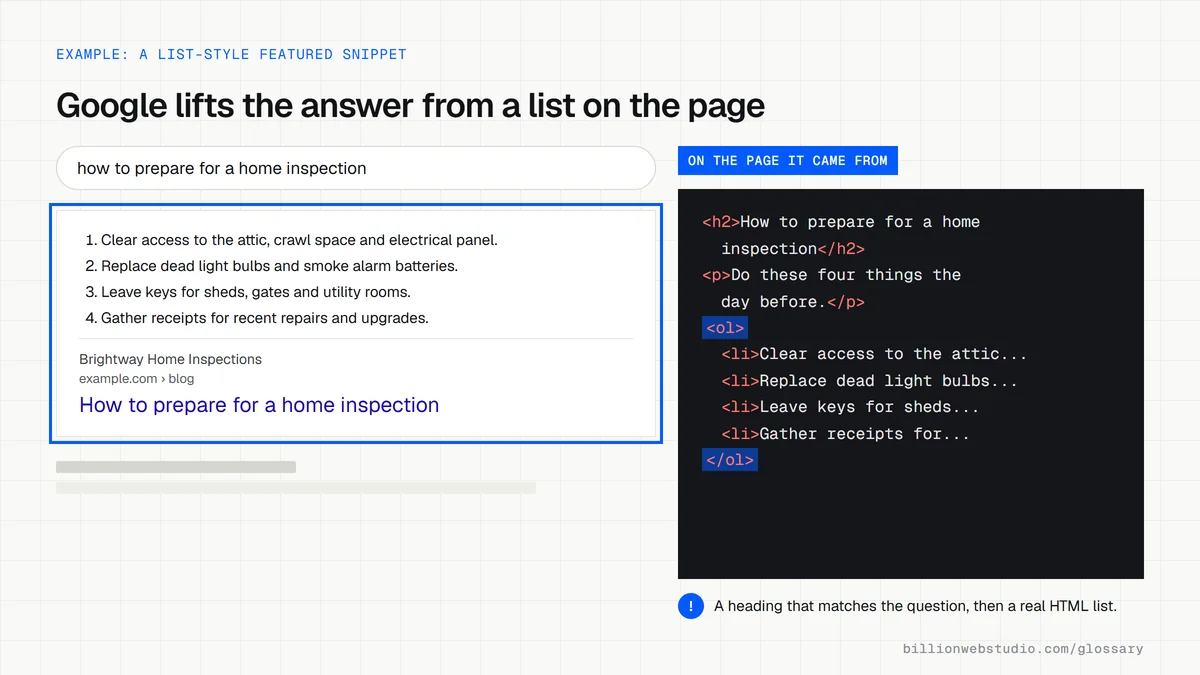
Why featured snippets matter for a business website
A featured snippet puts your answer and your brand in a highly visible spot, which can win clicks from searchers who want more detail. It also shows that Google considers your page a clear answer to that question. The trade-off is that when the snippet answers everything, some searchers get what they need without clicking at all.
A featured snippet example
Someone searches "how often should an AC be serviced". Google shows a box with two sentences from an HVAC company's guide giving a clear recommendation, followed by the guide's title and link. The page earned the spot because it answered the question directly under a heading that matched the search, then went into detail further down the page.
How to make a page eligible for a featured snippet
- Put a direct one or two sentence answer right under a heading that matches the question.
- Use real HTML lists and tables for steps, comparisons and prices so they are easy to extract.
- Target question searches where Google already shows a snippet, and answer more clearly than the current one.
- Make sure the page is indexed, since Google can only pick snippets from pages in its index.
- Avoid the nosnippet rule unless you truly want to stop Google from showing snippets of the page.
Copy this answer block pattern
<h2>How to prepare for a home inspection</h2>
<p>Do these four things the day before, so the inspector can reach every system.</p>
<ol>
  <li>Clear access to the attic, crawl space and electrical panel.</li>
  <li>Replace dead light bulbs and smoke alarm batteries.</li>
  <li>Leave keys for sheds, gates and utility rooms.</li>
  <li>Gather receipts for recent repairs and upgrades.</li>
</ol>
<!-- Text you never want quoted in any snippet -->
<p data-nosnippet>Prices valid for bookings made before 31 December 2026.</p>
How to check whether your page can win a featured snippet
- List the questions customers ask you, then search each one on Google in a private window to see whether a featured snippet appears and which site holds it.
- In Google Search Console, open Performance, click + Add filter, choose Query and enter the question to see your page's average position for it.
- Open your page and check the answer sits directly under a heading that matches the question, as one or two sentences or a real HTML list or table.
- View the page source and search for nosnippet and max-snippet, which can stop Google from quoting your text.
What good looks like: The page is indexed, ranks for the question, answers it in the first lines under a matching heading, and carries no nosnippet rule or data-nosnippet attribute on the answer.
Free tool: Google Search Console
Questions to ask your web developer
“How will our content be structured so Google can lift a clear answer?”
A good answer: Questions as headings, a direct one or two sentence answer right below each, then the detail. Steps go in numbered HTML lists and comparisons in HTML tables, never in images of text.
“Does the site use any robots rules that block snippets?”
A good answer: They can show the robots meta tags and headers each template sends, and nosnippet, data-nosnippet or a low max-snippet appear only where you asked for them.
“Which featured snippets are we targeting, and how will you track them?”
A good answer: A short list of questions where a snippet already shows and your page ranks, with a monthly manual check of who holds each one and the Search Console clicks for those queries.
Featured snippet: common questions
How do I get a featured snippet on Google?
You cannot request or mark up a page for one, because Google picks featured snippets automatically. You can improve your chances by answering a common question clearly at the start of a relevant section, using lists or tables where they suit the answer, and making sure the page is indexed and genuinely useful.
Can I stop Google from showing my page as a featured snippet?
Yes. The nosnippet rule blocks all snippets for a page, including featured snippets, and the data-nosnippet attribute excludes specific text. Lowering the max-snippet setting can reduce eligibility while keeping regular snippets, but Google says only nosnippet guarantees the page will not appear as one.
What is the difference between a featured snippet and an AI Overview?
A featured snippet quotes text from a single page and links to it. An AI Overview is a summary Google generates with AI, drawing on several sources and linking to them. Neither needs special markup: Google says a page only has to be indexed and eligible to show a snippet.
Sources
Want a website that gets this right?
Every Billion Web Studio build includes technical SEO, schema and speed work as standard, with a fixed quote within 1 business day.