SEO
What Is Domain Authority?
Domain authority (DA) is a score from 1 to 100, created by the SEO software company Moz, that predicts how well a website might rank based mainly on its backlinks. Google does not use domain authority as a ranking factor.
What domain authority means in plain English
Domain authority is a forecast made by an SEO tool, not a measurement from Google. Moz crawls the web with its own index, looks at which sites link to yours and how strong those linking sites are, then turns that into a single number. A higher score suggests a stronger link profile than a site with a lower score.
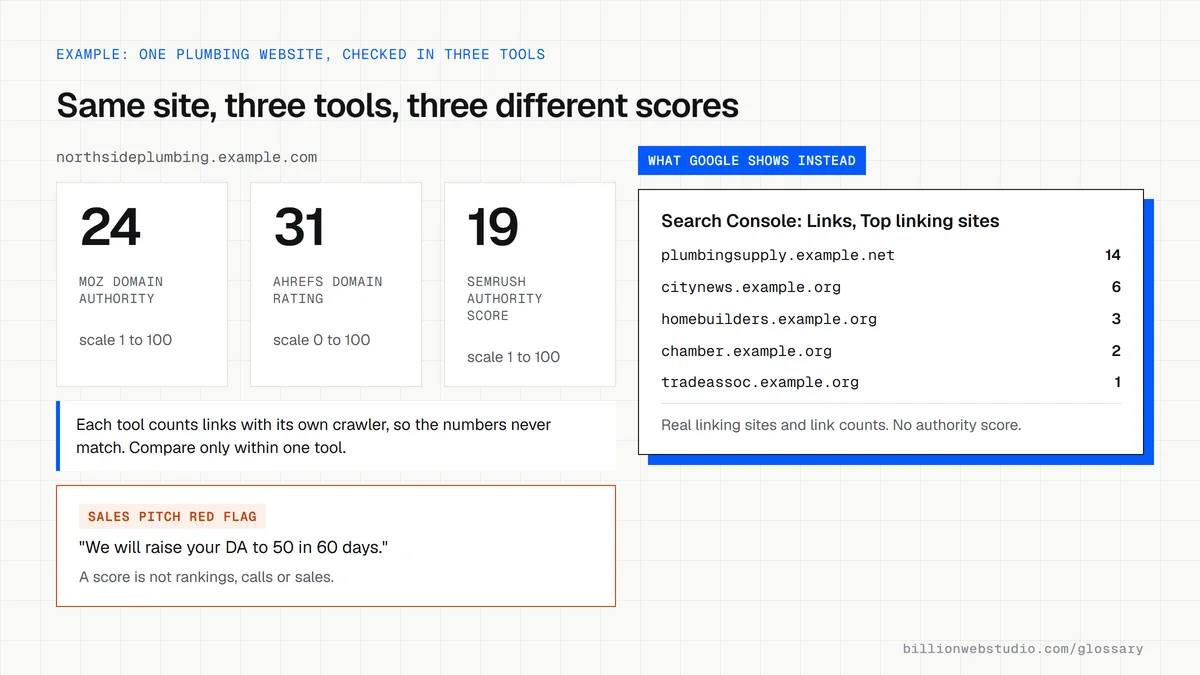
Moz says the score is calculated from several factors, including linking root domains and the total number of links. Other SEO tools sell similar numbers under their own names, such as Ahrefs Domain Rating and Semrush Authority Score. Each tool builds its version from its own crawl, so the same site gets a different score in each one.
Why domain authority matters, and where it does not
Google's documentation says it uses link analysis systems, including PageRank, to understand how pages link to each other. It does not use Moz's score, and Moz states that domain authority is not used by Google and has no effect on search results. Treat the number as a rough benchmark for comparing link profiles, never as a goal.
This matters when you hire help. Some sellers promise to raise your DA with cheap link packages. The score can climb while rankings, leads and sales stay flat, and buying links for ranking purposes breaks Google's spam policies. What moves a business site is useful pages, a clean technical setup and genuine links from relevant sites.
A domain authority example
Two plumbing companies work in the same city. One has a domain authority of 35 because local news sites and suppliers link to it; the other has 12. The first may find competitive terms easier. But if the second company's service pages answer local searches better and load faster, it can still outrank the first for many of the searches that bring calls.
Common domain authority mistakes
- Treating the score as a Google ranking factor, when Google has never used it.
- Paying for link packages that promise a higher score, which can break Google's spam policies.
- Comparing your score from one tool with a competitor's score from a different tool.
- Expecting a strong domain to rescue a page that does not answer the search well.
- Worrying about small monthly swings that come from the tool updating its own index.
Domain authority and its look-alikes compared
| Score | Made by | Scale | Built from |
|---|---|---|---|
| Domain Authority (DA) | Moz | 1 to 100 | Backlink data from Moz's own link index |
| Domain Rating (DR) | Ahrefs | 0 to 100, logarithmic | The number and strength of unique linking domains |
| Authority Score (AS) | Semrush | 1 to 100, refreshed every two weeks | Link power, organic traffic and spam signals |
| None | No public score | Google analyzes links with systems such as PageRank but shows no sitewide number |
How to check domain authority without being misled by it
- Enter your domain in Moz's free Domain Analysis tool and note the Domain Authority.
- Enter three competitors that rank on page one for your main service search, in the same tool, and compare your score with theirs.
- Open Google Search Console, click Links and read Top linking sites under External links to see the real sites behind any score.
- Recheck once a month at most. Scores move when each tool refreshes its own data, not only when your links change.
What good looks like: Your score sits in the same range as the competitors ranking for your main searches, and the linking sites in Search Console are real, relevant businesses and publications. There is no pass mark, because Google does not use the score.
Free tool: Moz free Domain Analysis
Questions to ask your web developer
“If you report an authority score, which tool is it from and what will you compare it with?”
A good answer: One named tool used every month, compared with the specific competitors ranking for your target searches, and reported next to rankings and leads rather than on its own.
“How will you earn links, and can I see examples?”
A good answer: Specific outreach to suppliers, associations, local media and partners, with live links from past clients as proof. No promise to reach a target score by a date.
Domain authority: common questions
Does Google use domain authority?
No. Domain authority is a metric built by Moz, and Moz itself says it is not used by Google and has no effect on search results. Google does analyze links between pages, including through PageRank, but it does not use the sitewide authority score that SEO tools display.
What is a good domain authority score?
There is no universal good score, because the number only means something compared with the sites you compete against. A local business with a score of 20 can lead its market if rivals sit at 10, while a national brand at 60 may still trail its competitors. Compare against the sites ranking for your target searches.
How do I increase domain authority?
Earn links from relevant, trusted websites such as suppliers, industry associations, local press and partners who genuinely reference your work. Publishing useful resources that others want to cite also helps. Avoid bought links and link schemes: they break Google's spam policies and do nothing for leads even if the score rises.
Sources
Want a website that gets this right?
Every Billion Web Studio build includes technical SEO, schema and speed work as standard, with a fixed quote within 1 business day.