SEO
What Is a Google Core Update?
A Google core update is a significant, broad change to the algorithms and systems Google uses to rank search results, released several times a year and aimed at showing more helpful, reliable pages rather than targeting specific sites.
What a Google core update means in plain English
Google changes its ranking systems constantly, mostly in small ways nobody notices. A few times a year it makes a bigger adjustment that reassesses content across the web, and it announces these on the Google Search Status Dashboard with start dates and rollout lengths. Google compares a core update to refreshing a list of recommended restaurants: some entries move up, others move down, and a lower place is not a judgment that a page is bad.
Core updates are different from spam updates, which target sites breaking specific policies, and from manual actions, which a Google reviewer applies to one site and reports in Search Console. As of October 2026, the dashboard lists two core updates this year: the March 2026 core update, which began on 27 March, and the May 2026 core update, which began on 21 May.
Why a Google core update matters for a business website
A business that gets most of its inquiries from organic search can see lead volume change within days of a rollout, with nothing changed on its own site. Rollouts listed on the dashboard since 2024 have lasted from about 6 days to 45 days, so rankings can swing for weeks before they settle. Knowing the dates stops owners from blaming a recent redesign or a new agency for a shift that came from Google.
An example of a Google core update
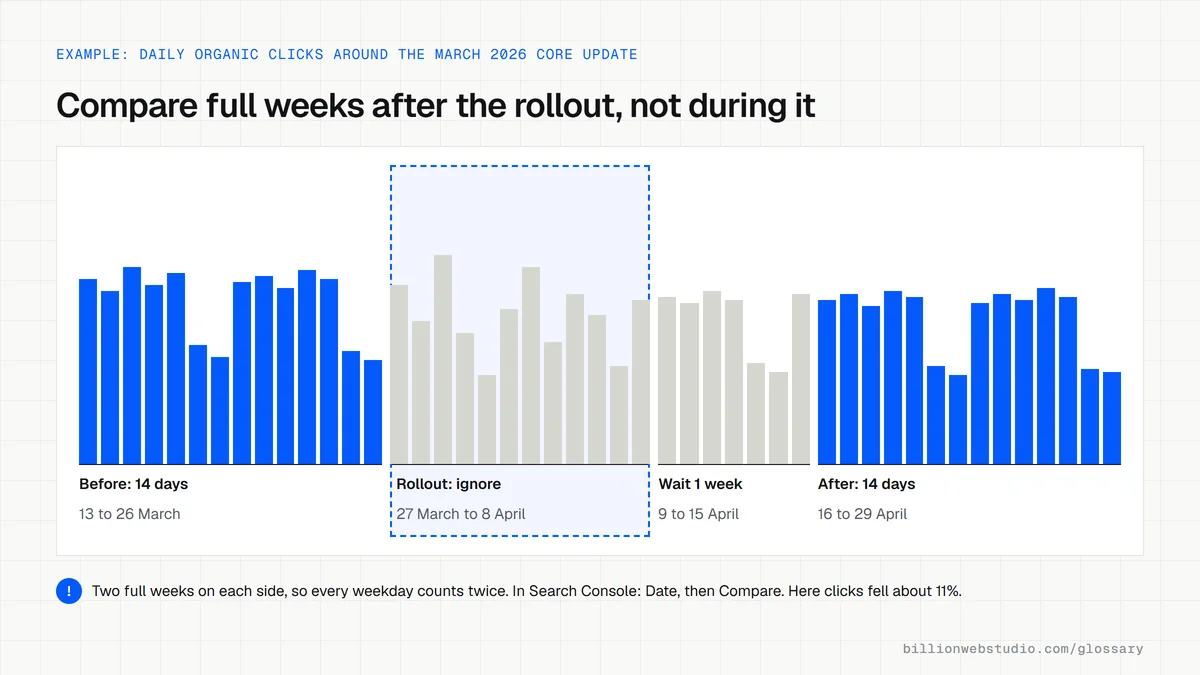
A roofing company notices organic calls falling in the middle of a rollout. It waits until the dashboard shows the update complete, then one more week, and compares the weeks after with the weeks before in Search Console. Most service pages hold steady, but thin blog posts copied from manufacturer brochures have dropped. It rewrites the useful ones with its own job photos and advice, and merges the rest into fewer, fuller guides.
How to respond to a Google core update
- Check the Google Search Status Dashboard to confirm an update was rolling out when your traffic changed.
- Wait until the rollout has finished, then at least a full week more, before comparing data, as Google recommends.
- Compare matching periods before and after in the Search Console Performance report, broken down by page and by query.
- Treat small position drops as normal movement and investigate only large, lasting falls.
- Improve pages for readers with original detail and clear expertise, and remove content only as a last resort.
Recent core updates and the first fair day to compare
| Core update | Started | Finished | Compare data from |
|---|---|---|---|
| June 2025 | 30 June 2025 | 17 July 2025 | 25 July 2025 |
| December 2025 | 11 December 2025 | 29 December 2025 | 6 January 2026 |
| March 2026 | 27 March 2026 | 8 April 2026 | 16 April 2026 |
| May 2026 | 21 May 2026 | 2 June 2026 | 10 June 2026 |
How to check whether a core update affected your site
- Open the Google Search Status Dashboard and note when the latest core update started and when it was marked complete.
- In Google Search Console, open Performance, click the Date filter, choose Compare and set two equal periods: one before the rollout started and one beginning a full week after it ended.
- Click the Pages tab and sort by the clicks difference column to see which pages lost or gained most.
- Repeat on the Queries tab to see whether the losses are on buying searches or on informational ones.
- Open the Manual actions report. A green check mark confirms the change is not a penalty.
What good looks like: A few positions up or down on a handful of queries is normal movement. A large, lasting fall concentrated in one section, with no manual action and no new Page indexing errors, points to a quality reassessment worth acting on.
Free tool: Google Search Status Dashboard
Questions to ask your web developer
“If our traffic drops during a core update, what will you check before changing anything?”
A good answer: They wait until the rollout ends plus a week, compare matching periods by page and query in Search Console, and rule out technical faults and manual actions before touching content.
“What will you change on pages that lost rankings?”
A good answer: Specific fixes tied to the pages that fell, such as adding first-hand detail, merging thin posts or updating outdated facts, not sitewide rewrites or mass deletions.
Google core update: common questions
How often does Google release core updates?
Google says it makes significant, broad core updates several times a year, plus smaller core changes it does not announce. The announced ones appear on the Google Search Status Dashboard, which listed four core updates in 2023, four in 2024 and three in 2025.
Can a site recover from a Google core update?
Yes. Google says improvements can take effect within a few days, but its systems may need several months to confirm that a site is consistently helpful, and some changes only show after the next core update. Google also warns there is no guarantee, since other sites may simply have become more useful.
Is a Google core update a penalty?
No. Google says core updates do not target specific pages or sites, and a drop does not mean a page broke any rule. It means Google now rates other pages as more useful for those searches. Penalties for rule breaking are called manual actions and appear in the Manual Actions report in Search Console.
Sources
Want a website that gets this right?
Every Billion Web Studio build includes technical SEO, schema and speed work as standard, with a fixed quote within 1 business day.