SEO
What Is a Long-Tail Keyword?
A long-tail keyword is a specific search phrase that fewer people search for than a broad term but that shows a clearer need, such as "emergency plumber open Sunday in Dallas" instead of "plumber".
What a long-tail keyword means in plain English
The name comes from a demand curve. A few broad terms, like "plumber", get huge search volume and form the tall head of the curve. Behind them stretches a long tail of thousands of specific phrases, each searched rarely. Long-tail keywords are usually longer, but what defines them is low individual volume and a precise need.
Together, those rare phrases can add up to a lot of traffic. Google's SEO Starter Guide makes a related point: people who know a topic well use different words when they search, and Google's language matching systems can connect a page to many queries it never states word for word.
Why long-tail keywords matter for a business website
Broad terms are crowded and slow to win, and the people searching them are often still browsing. Long-tail searchers have usually narrowed down what they want, so a page that answers their exact question is closer to their decision. For a new or small site, long-tail keywords are also the realistic place to start ranking and earning leads.
A long-tail keyword example
A landscaping company in Charlotte will struggle to rank for "landscaping". It can rank for "drought tolerant landscaping ideas for Charlotte yards" or "cost to install sod in Charlotte". Each phrase brings a small number of visitors, but they are local, specific and close to hiring someone. A set of pages answering twenty such phrases can bring more inquiries than one page chasing the broad term.
How to find long-tail keywords
- Type a broad term into Google and note the autocomplete suggestions and People also ask questions.
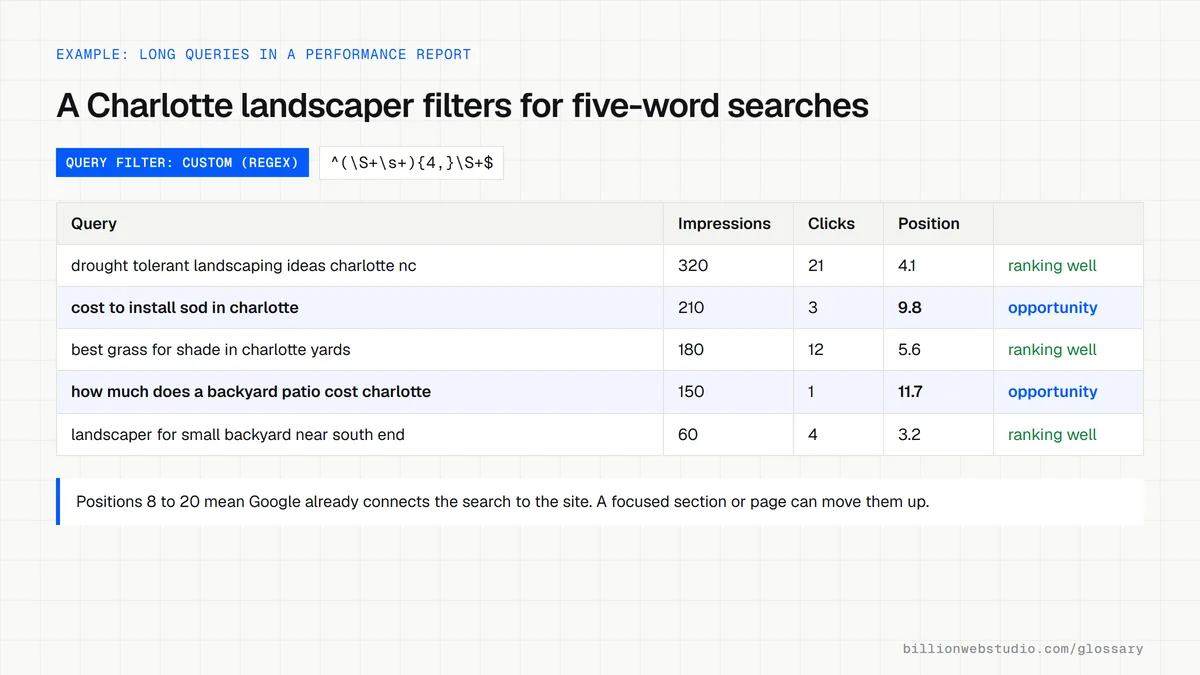
- Open the Performance report in Google Search Console and look for longer queries that already bring impressions.
- Ask your sales and support team for the exact questions customers ask before buying.
- Add your city, service type, price or problem to a broad term to make it specific.
- Decide whether each phrase deserves its own page or a section on an existing page.
Copy these Search Console regex filters
Queries of five words or more:
^(\S+\s+){4,}\S+$

Queries phrased as a question:
^(how|what|why|when|which|where|who|can|does|is|are|should)\b

Queries about cost or price:
(cost|price|how much|cheap)
How to find the long-tail keywords your site already ranks for
- In Google Search Console, open Performance, then Search results, and set the date range to the last 3 months.
- Click + Add filter, choose Queries, change the filter type to Custom (regex), paste the five-word pattern from the regex box on this page and click Apply.
- Click the Average position box above the chart so the table shows position next to clicks and impressions, then sort the Queries table by Impressions.
- Mark every long query where your average position is between about 8 and 20: Google already links it to your site, but the page does not answer it well enough to rank near the top.
- Click a marked query, open the Pages tab to see which URL ranks for it, then add a section to that page or plan a new page if the intent is different.
What good looks like: A healthy site shows dozens of five-word queries with impressions, and the best ones are spread across several pages instead of all landing on the homepage.
Free tool: Google Search Console
Questions to ask your web developer
“Which long-tail searches will each new page target, and where did they come from?”
A good answer: Each page has one main phrase and a few close variants, taken from Search Console queries, the questions Google suggests and the questions customers ask the sales team, written down in a keyword map.
“How will you avoid making a thin page for every small variation of a phrase?”
A good answer: Variants that want the same answer are grouped on one page. A new page is only made when the searcher needs a different answer, such as a cost guide versus a booking page.
Long-tail keyword: common questions
What is an example of a long-tail keyword?
"Running shoes" is a broad head term. "Best running shoes for flat feet" is a long-tail keyword: fewer people search it, but the searcher knows exactly what they need. For a service business, "same day AC repair in Phoenix" is a long-tail version of "AC repair".
Are long-tail keywords easier to rank for?
Usually, yes. Fewer sites build pages aimed at very specific phrases, so competition is lighter, and a focused page that answers the exact question has a good chance of ranking. They are not always easy, though: some long phrases in competitive industries still attract strong rival pages.
How many words is a long-tail keyword?
There is no official word count. Many long-tail keywords have three or more words, but the defining feature is low search volume for each phrase and a specific need. A two-word term can be long-tail if few people search it, and some long phrases are searched very often.
Sources
Want a website that gets this right?
Every Billion Web Studio build includes technical SEO, schema and speed work as standard, with a fixed quote within 1 business day.