SEO
What Is Search Intent?
Search intent is the goal a person has when they type a query into a search engine, such as learning something, buying something or finding a specific website. Pages that match the intent behind a search are more likely to rank and convert.
What search intent means in plain English
Two searches can share words but want different things. Someone typing "website cost" wants a price range, while someone typing "website design company near me" wants to hire. Google's Search Quality Rater Guidelines define user intent as what the user is trying to accomplish when they search, and note that one query can carry several intents.
The guidelines group intents into Know queries (find information), Do queries (accomplish a goal, such as buying or downloading), Website queries (reach a specific site or page) and Visit-in-person queries (find a place nearby). SEO tools often use a similar four-way split: informational, navigational, commercial and transactional.
Why search intent matters for your website
Google tries to show results that meet the searcher's need, so a page built for the wrong intent struggles however well it is written. A sales page rarely ranks for a how-to question, and a long guide rarely ranks for a ready-to-buy search. Matching intent also lifts conversions, because visitors land on the page that answers what they came for.
A search intent example
A pest control company wants to rank for "termite treatment cost". The top results are all price guides explaining ranges and factors, not booking pages. So the company publishes a cost guide that explains typical prices and what affects them, then links to its termite treatment service page and a quote form. The guide matches the intent, and the service page catches people ready to book.
How to check the search intent of a keyword
- Search the keyword yourself and note what type of page ranks: guides, product pages, local listings or comparisons.
- Look at the features Google shows, such as a map of local businesses for local intent or shopping results for buying intent.
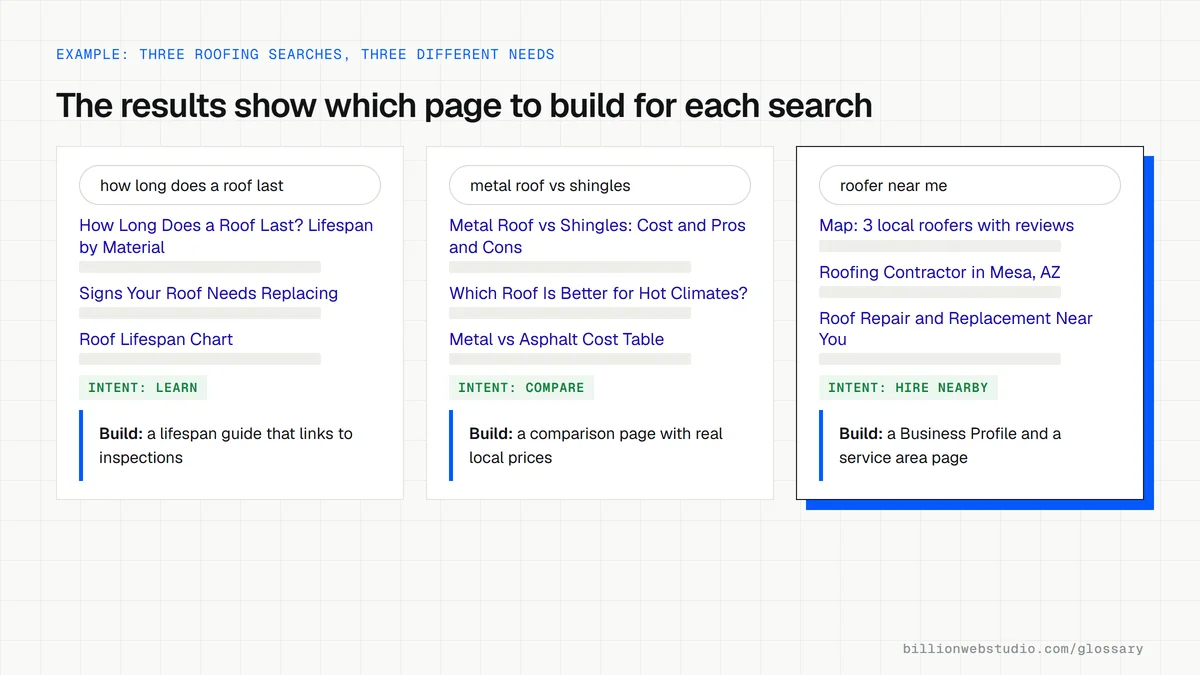
- Read the wording: words like how, what and why usually signal research, while price, near me and hire signal buying.
- Give each page one main intent instead of trying to inform, compare and sell in equal measure.
Search intent types and the page that matches each
| Intent | Example query | What usually ranks | Page to build |
|---|---|---|---|
| Informational (Know) | how long does a roof last | Guides and explainers | A guide that links to the service |
| Commercial | metal roof vs shingles | Comparisons and reviews | A comparison page with costs, pros and cons |
| Transactional (Do) | book a roof inspection | Service and booking pages | A service page with pricing and a form |
| Navigational (Website) | northside roofing reviews | The brand's own pages and profiles | Clear homepage, reviews and contact pages |
| Local (Visit in person) | roofer near me | Map results and local pages | A Business Profile plus a service area page |
How to check if a page matches the search intent it gets
- In Google Search Console, open Performance, click + Add filter, choose Page, paste the URL of a page you want leads from and click Apply.
- Open the Queries tab and sort by Impressions.
- Label each of the top 20 queries: research (how, what, cost, ideas), comparison (best, vs, reviews), action (book, hire, quote, near me) or brand.
- Compare the labels with the page type. A service page fed mostly by research queries, or a guide fed mostly by action queries, is mismatched.
- Fix the mismatch by adding a section that answers the main intent, or by building a separate page for it and linking the two.
What good looks like: Service pages draw mostly action and local queries, guides draw mostly research queries, and average position improves on the queries the page was realigned to.
Free tool: Google Search Console
Questions to ask your web developer
“For each target keyword, what does the first page of results show today, and what type of page will you build?”
A good answer: A short note per keyword naming the page types that rank, such as guides, comparison pages or local listings, and the matching page type they plan, rather than one service page for every keyword.
“What will you do when the results for a keyword are mixed?”
A good answer: They build the page type that dominates the results and cover the secondary intent with a short section or a link to another page, instead of mixing a full guide and a sales page into one.
Search intent: common questions
What are the four types of search intent?
SEO tools usually name four: informational (learn something), navigational (reach a specific site), commercial (compare options before buying) and transactional (buy or act now). Google's own rater guidelines use a different set: Know, Do, Website and Visit-in-person queries. Both describe the same idea: what the searcher wants to achieve.
How do you identify search intent?
Search the keyword and study the first page of results. If Google shows guides, the intent is informational; product or service pages suggest buying intent; a map with businesses means local intent. The results show what Google has learned searchers want, which is the strongest clue available.
Why is search intent important for SEO?
Google ranks pages that satisfy the searcher, not just pages that mention the keyword. A page that matches intent earns more clicks and keeps visitors engaged, while a mismatched page can sit on page two even with strong content. Intent also tells you which type of page to build in the first place.
Sources
Want a website that gets this right?
Every Billion Web Studio build includes technical SEO, schema and speed work as standard, with a fixed quote within 1 business day.