SEO
What Is Duplicate Content?
Duplicate content is the same or nearly the same text appearing at more than one URL, either within one website or across different websites. Google groups the copies and usually shows only one of them in search results.
What duplicate content means in plain English
Search engines treat every URL as a separate page, even when two addresses show identical words. A website can create copies without anyone writing twice: the same page served over http and https, with and without www, with sorting or filter codes in the address, or as a printable version. Google calls the job of picking one address from a group of duplicates canonicalization.
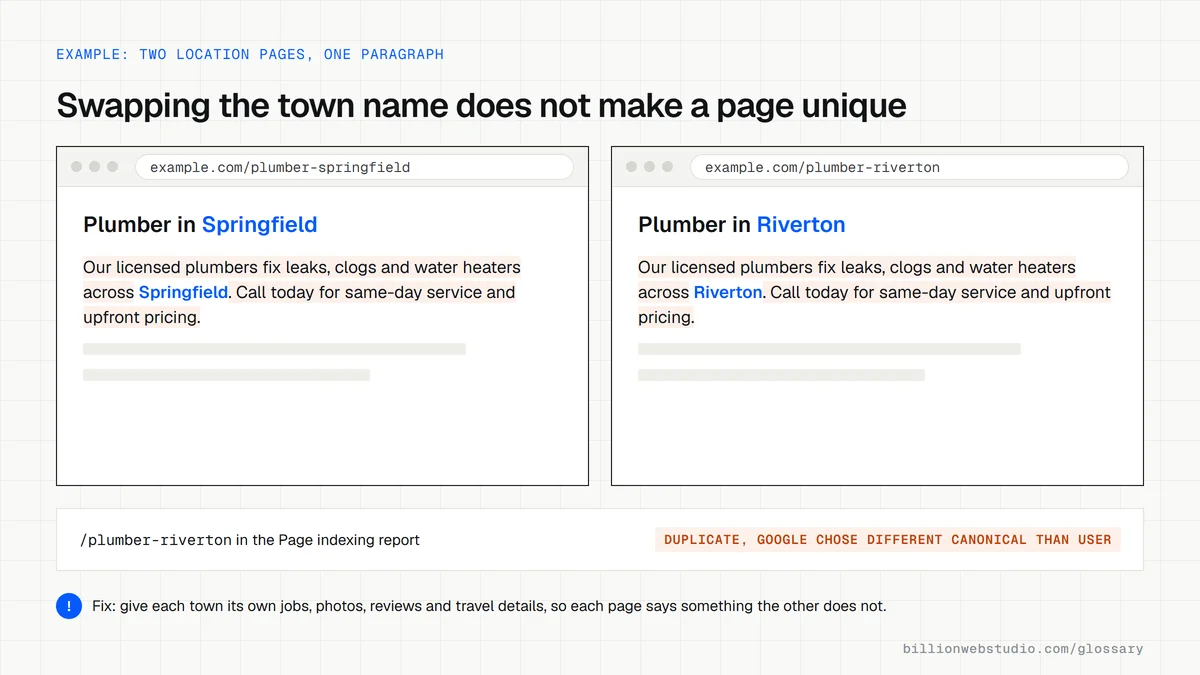
Duplicate content also covers near copies, such as product pages that differ only by color, or location pages that repeat the same paragraphs with a different town name. Copying another website's text is a separate problem. Google's spam policies treat scraping, meaning republishing other sites' content without adding value, as a violation.
Why duplicate content matters for your rankings
Google says some duplication on a site is normal and does not break its spam policies, so there is no automatic penalty. The cost is quieter. Google decides which copy to show, and it may not choose the page you want. Links and other signals can be split across versions, and Google crawls duplicates less often, which slows the discovery of pages that matter.
An example of duplicate content
A furniture store sells one oak table in four finishes, and each finish has its own URL with an identical description. Search Console lists three of them as Duplicate without user-selected canonical, and Google happens to show the walnut version for oak table searches. The store writes a unique description for the main page, adds a canonical tag on the variants pointing to it, and links to that page from its menus.
How to find and fix duplicate content
- Open the Page indexing report in Google Search Console and look for reasons that start with the word Duplicate.
- Use the URL Inspection tool to compare the canonical you declared with the one Google selected.
- Retire unwanted copies with a 301 redirect, and use a canonical tag for copies that must stay live.
- Point every internal link and sitemap entry at the preferred URL rather than at its variants.
- Write genuinely different copy for each location and product page instead of swapping a single word.
- Avoid using noindex or robots.txt to choose between duplicates, since Google advises against both for this job.
Which fix for which kind of duplicate
| Duplicate | Example | Best fix |
|---|---|---|
| Host or protocol variants | The http and www versions of every page | 301 redirect to one version, sitewide |
| Tracking and sort parameters | /roofing?utm_source=facebook | Canonical tag on the clean URL, and internal links to the clean URL |
| Product variants | One table in four finishes at four URLs | Canonical to the main product, or unique copy for variants people search for by name |
| Templated location pages | Same paragraph with a different town name | Rewrite with local detail, or merge thin ones into one service area page |
| Old page replaced by a new one | /services-old next to /services | 301 redirect the old URL |
| Printer-friendly or AMP copies | /roofing/print | Canonical tag pointing to the main page |
How to find duplicate content on your website
- In Google Search Console, open Indexing, then Pages, and scroll to Why pages aren't indexed.
- Click each reason that starts with Duplicate, plus Alternate page with proper canonical tag, to see the URLs involved.
- For important pages, paste the URL into the inspection bar at the top and compare User-declared canonical with Google-selected canonical.
- To find copies on other sites, copy a distinctive sentence from your page and search for it on Google inside quotation marks.
- Type your domain with and without www, and with http instead of https. Each variant should redirect to one version.
What good looks like: The Duplicate reasons list only URLs you expect, such as tracking or filter variants, Google-selected canonical matches your declared canonical on key pages, and every host and protocol variant redirects to one address.
Free tool: Search Console Page indexing report
Questions to ask your web developer
“How will the site stop one page from loading at several addresses?”
A good answer: One preferred host and protocol enforced with 301 redirects, a self-referencing canonical on every template, and internal links that always use the clean URL without tracking or sort parameters.
“For our location or product variant pages, what will make each one different?”
A good answer: Each page gets its own facts: local projects, photos, reviews, staff, prices or specifications. Pages without enough unique detail are merged rather than published as near copies.
Duplicate content: common questions
Does Google penalize duplicate content?
Not in normal cases. Google states that some duplicate content on a site is normal and not a violation of its spam policies. It simply chooses one version to show. Action is reserved for deliberate abuse, such as scraping other sites' content and republishing it with no added value to manipulate rankings.
How much duplicate content is acceptable on a website?
Google publishes no percentage. Repeated elements such as headers, footers, legal text and short product specifications are expected on most sites. The risk grows when whole pages are copies, because Google may index the wrong one or skip some altogether. Aim for every page you want ranked to say something no other page on the site says.
What is the difference between duplicate content and keyword cannibalization?
Duplicate content means two URLs carry the same or nearly the same text. Keyword cannibalization means two different pages compete for the same search query, even if their wording differs. Both can leave Google showing the weaker page, but duplicates are fixed with redirects or canonical tags, while cannibalization usually needs pages merged or refocused.
Sources
Want a website that gets this right?
Every Billion Web Studio build includes technical SEO, schema and speed work as standard, with a fixed quote within 1 business day.