SEO
What Is Off-Page SEO?
Off-page SEO covers the actions taken outside a website that help it rank, mainly earning links and mentions from other sites, collecting customer reviews and keeping business listings such as a Google Business Profile accurate.
What off-page SEO means in plain English
On-page SEO is what you say about yourself; off-page SEO is what the rest of the web says about you. Search engines look at which other sites link to your pages, what words they use in those links, and how your business is described in reviews, directories and news. These outside signals are harder to fake, which is why they carry weight.
Why off-page SEO matters for a business website
Google uses links both to find pages and to judge how relevant they are, so a site no one links to struggles in competitive searches. For local businesses, Google says prominence is shaped by information from across the web, including links, articles and directories, and by review count and score. Off-page work also builds real-world reputation that brings referrals beyond search.
An example of off-page SEO
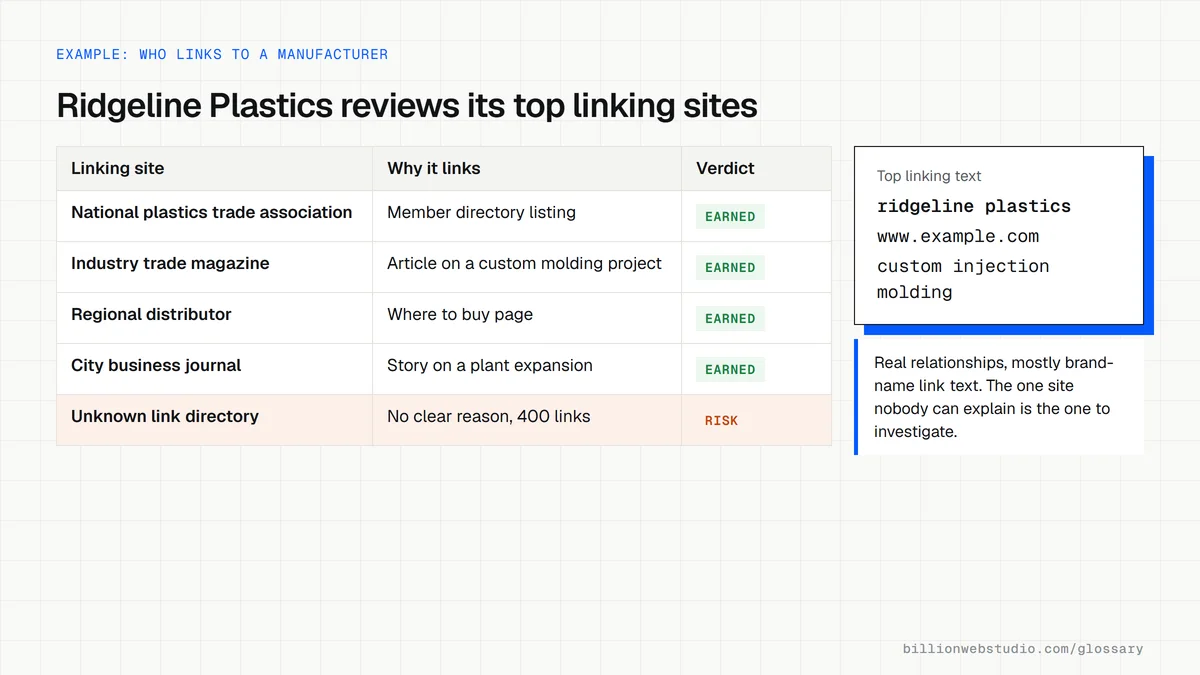
A plastics manufacturer joins its national trade association and gets listed in the member directory with a link. It sends an application story to a trade magazine, which publishes it with a link to the relevant product page. Distributors add the company to their where to buy pages, and satisfied buyers leave reviews on its Business Profile.
Off-page SEO tactics that break Google's rules
- Buying links that pass ranking credit without marking them sponsored or nofollow.
- Swapping links with other sites purely to cross-link.
- Paying for automated link-building services or mass directory submissions.
- Publishing guest posts or press releases stuffed with keyword-rich anchor text.
- Offering customers money or discounts in exchange for reviews.
Which links need rel sponsored, ugc or no attribute
| Link | Who chose to link | Attribute it should carry |
|---|---|---|
| A trade magazine article about your project | The editor, on its merits | None needed |
| A sponsored post or paid directory upgrade | You paid for it | rel="sponsored" (nofollow also acceptable) |
| A blogger who got free products in exchange for a link | A deal was made | rel="sponsored" |
| A comment or forum post you wrote with your link | You did | rel="ugc", set by the site owner |
| A supplier's where to buy page | The supplier, for its customers | None needed |
How to check who links to your site in Search Console
- In Google Search Console, click Links in the left menu.
- Under External links, open Top linking sites and click More to see the full list of domains that link to you.
- Go through the list and mark each site as a real customer, supplier, association, publication or local organization, or as a site you do not recognize.
- Back on the Links page, open Top linking text to see the words other sites use when they link to you.
- Open Top linked pages to check which of your pages earn links. Service and product pages with none are where outreach should focus.
What good looks like: Most linking sites are real organizations connected to your trade or area, link text is mostly your brand name or plain URLs, and your main service pages have at least a few external links each.
Free tool: Search Console Links report help
Questions to ask your web developer
“Where exactly will new links and mentions come from?”
A good answer: A list of named, relevant targets such as trade associations, suppliers, local media and industry publications, with the reason each would link, and a monthly report listing every live link URL.
“Do you pay for any links, placements or guest posts?”
A good answer: Any paid placement is disclosed to you and carries rel="sponsored" or rel="nofollow". They do not use link networks, link swaps or automated directory submissions.
Off-page SEO: common questions
What are examples of off-page SEO?
Common examples include earning links from industry associations, suppliers and local news sites, getting mentioned in trade publications, collecting and replying to customer reviews, keeping a Google Business Profile complete, and listing the business accurately on reputable directories. Each one is an outside signal that a real business stands behind the website.
Is guest posting still safe for SEO?
Writing for respected publications to reach their readers is fine. Google's spam policies treat guest posts as link spam when they exist mainly to pass ranking credit, especially with keyword-rich anchor text. If a guest post includes a link in exchange for payment or a favor, it should carry a rel="sponsored" or rel="nofollow" attribute.
Is off-page SEO more important than on-page SEO?
Neither works well alone. Links pointing at a page that is thin, slow or blocked from indexing achieve little, and an excellent page with no outside signals can struggle in competitive markets. Most businesses get the best return by fixing on-page and technical basics first, then earning links and reviews steadily.
Sources
- Google Search Central: Link best practices for Google
- Google Search Central: Spam policies for Google web search
- Google Business Profile Help: Tips to improve your local ranking on Google
- Google Search Central: Qualify your outbound links to Google
- Google Maps Help: Maps user contributed content policy (fake engagement)
- Search Console Help: Links report
Want a website that gets this right?
Every Billion Web Studio build includes technical SEO, schema and speed work as standard, with a fixed quote within 1 business day.