Building and hosting
What Is a Domain Name?
A domain name is the human-readable address people type to reach a website, such as example.com. The Domain Name System (DNS) translates it into the numeric IP address of the server, so visitors never need to remember numbers.
What a domain name means in plain English
Computers find each other using IP addresses, long strings of numbers that are hard to remember and can change over time. A domain name is the friendly label that sits on top of that number. When someone types your domain, their browser asks a DNS server which IP address it belongs to, then loads your site from that server.
Domain names are read from right to left. In example.com, ".com" is the top-level domain (TLD) and "example" is the part you choose. Anything added in front, such as shop.example.com, is a subdomain. Each part, called a label, can use letters, digits and hyphens and can be up to 63 characters long.
Why a domain name matters for your business
Your domain appears on business cards, ads, email addresses and every search result. A short name that is easy to spell gets typed correctly and remembered. It also carries your search history, because links from other sites point to it, so changing domains later means redirecting every URL. At Billion Web Studio, you own the code, design, content, domain and accounts.
A domain name example
A plumbing business called Rivera Plumbing registers riveraplumbing.com through a registrar and pays a yearly fee. The registrar records the company as the registrant. The company then points the domain's DNS records at its web host for the website and at its email provider for mail, so one name runs both the site and addresses like office@riveraplumbing.com.
Common domain name mistakes
- Letting a developer or agency register the domain in their own account, so you cannot move it without their help.
- Switching off auto-renew and losing the domain when a payment card expires.
- Choosing a name with hyphens or unusual spelling that people mistype after hearing it.
- Leaving an old email address on the registrar account, which is where renewal and transfer notices are sent.
- Changing domains during a redesign without redirecting every old URL to its new home.
What the domain status codes in a lookup mean
| Status | What it means | What to do |
|---|---|---|
| ok | Normal state, with nothing pending and no locks set | Ask your registrar to add a transfer lock |
| clientTransferProhibited | Your registrar blocks any transfer to another registrar | Keep it on, and remove it only when you move |
| clientHold | The domain is pulled from DNS, so the website and email stop working | Contact your registrar at once, often about payment or contact details |
| autoRenewPeriod | The registry renewed an expired domain for a limited grace time | Pay the renewal now or the registrar may delete it |
| redemptionPeriod | Deletion was requested, and the domain is held for 30 days | Ask your registrar to restore it, usually for an extra fee |
| pendingDelete | It was not restored in time and will be purged within days | It can no longer be restored, so act during redemption |
How to check who owns your domain and when it expires
- Go to the ICANN Registration Data Lookup tool and enter your domain, such as example.com.
- Note the registrar name, the expiration date and the domain status codes in the result.
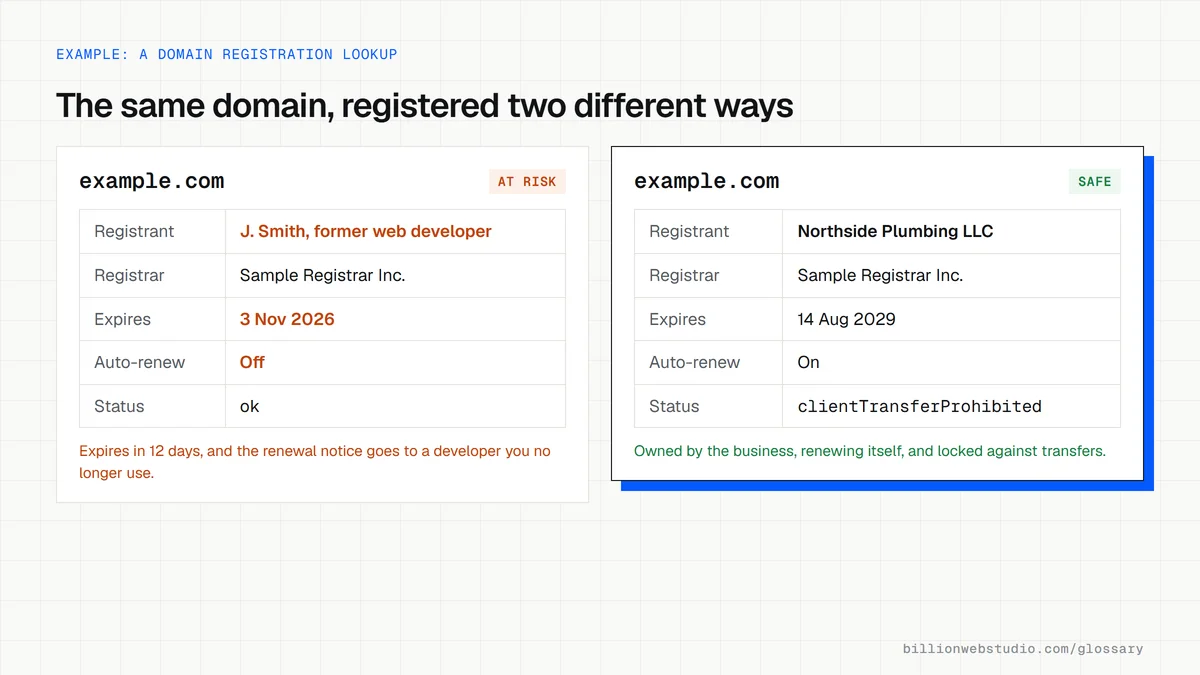
- Log in to that registrar and open the domain. Confirm the registrant is your company, not a person or an agency, and that the account email is one the business controls.
- Check that auto-renew is on and that the payment card on file has not expired.
- Confirm the transfer lock is on unless you are in the middle of moving registrars.
What good looks like: Your business is the registrant, the expiration date is months away with auto-renew on, and the status shows clientTransferProhibited, so nobody can move the domain without unlocking it first.
Free tool: ICANN Registration Data Lookup
Questions to ask your web developer
“Will the domain be registered in our company's name and in our own registrar account?”
A good answer: Yes. The business is the registrant, the account login and email belong to the business, and the developer gets user access rather than ownership.
“Who will receive the renewal and transfer emails?”
A good answer: A shared company address such as admin@ or it@ on your domain, not one person's inbox, so notices are seen even when staff change.
“If we stop working together, what do you need to do before we can move the domain?”
A good answer: Nothing, because the domain already sits in your account. They can explain the unlock and authorization code steps so you can move it yourself.
Domain name: common questions
Do you own a domain name forever?
No. You pay a registrar for the right to use a domain for one or more years at a time. As long as you renew before it expires, the name stays yours and your renewal takes priority over anyone else. If you let it lapse, someone else can eventually register it.
Is a domain name the same as a website?
No. The domain is only the address. The website is the set of files and data stored on a web hosting server. You can hold a domain with no website on it, or move your website to a new host while keeping exactly the same domain.
What is the difference between a domain name and a URL?
A domain name is one part of a URL. In https://example.com/contact, the domain is example.com, https is the protocol, and /contact is the path to one specific page. A single domain can have thousands of URLs sitting beneath it.
Sources
Want a website that gets this right?
Every Billion Web Studio build includes technical SEO, schema and speed work as standard, with a fixed quote within 1 business day.