SEO
What Is an SEO Audit?
An SEO audit is a structured review of a website that finds the technical, content and link problems stopping its pages from being crawled, indexed and ranked by search engines, and ranks the fixes by their likely impact on traffic and leads.
What an SEO audit means in plain English
Think of an SEO audit as a building survey for a website. The reviewer checks three layers. Technical: can search engines crawl and index every important page, and how fast does it load on phones. Content: does each page answer a real search clearly without duplicating another page. Authority and local signals: which sites link in, and do business details match across the web.
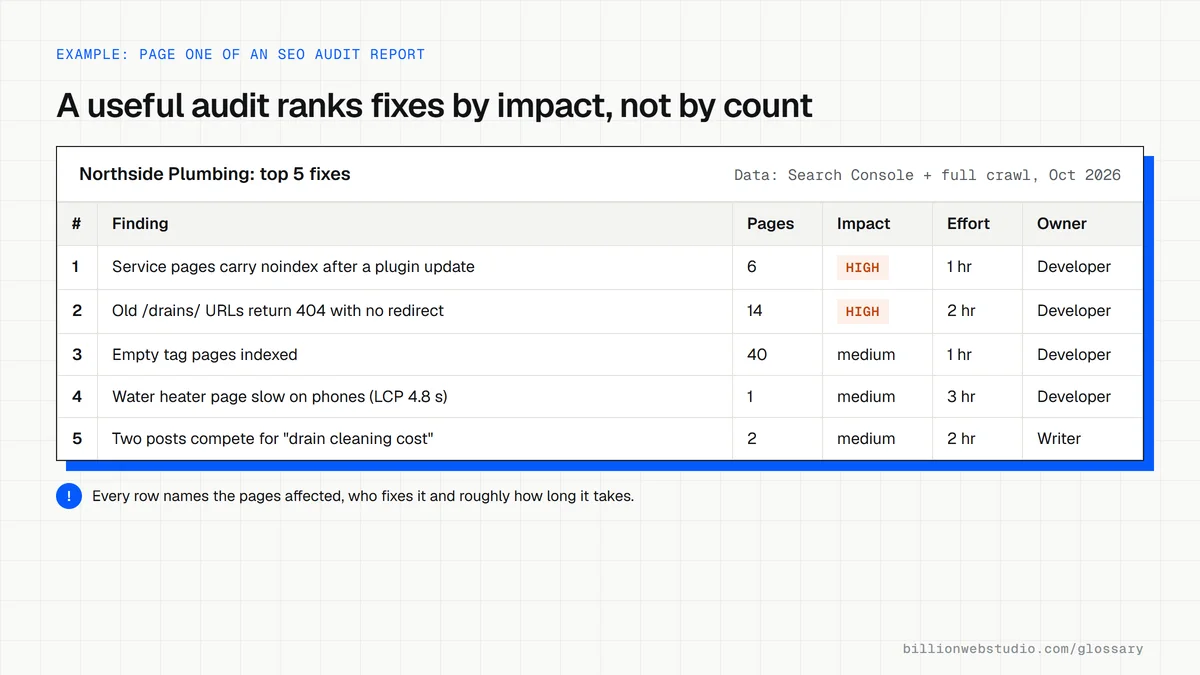
The useful output is not a long list of warnings exported from a tool. It is a short, prioritized plan that says what is wrong, why it costs traffic or inquiries, how to fix it and who should do it. Google's own advice on hiring help lists a review of site content or structure as one of the services an SEO may provide.
Why an SEO audit matters for a business website
Problems that hurt search visibility rarely announce themselves. A plugin update adds noindex to service pages, a redesign breaks old URLs, or two blog posts start competing for the same query. An audit finds these before they compound, and it gives an owner a baseline to measure against. Running one before a redesign is especially valuable, because it records which pages earn traffic so none are lost in the move.
An example of an SEO audit
An accounting firm's organic inquiries have been flat for a year. The audit finds 40 near-empty tag pages indexed, a contact page missing from the sitemap, and service pages that load slowly on phones because of oversized images. It also spots that the firm sits on page two for tax planning plus its city name. The fix list puts the indexing and speed issues first, then a rewrite of that page.
How to run a basic SEO audit on your own site
- Open the Page indexing report in Search Console and read why each excluded page is not indexed.
- Compare the last three months with the same months a year earlier in the Performance report.
- Test your homepage and main service template in PageSpeed Insights for Core Web Vitals.
- Confirm your business name, address and phone number match on your website and Google Business Profile.
- Ask any auditor to explain each fix in plain language, and walk away from anyone who guarantees a number one ranking, as Google itself warns.
Tool export vs a useful SEO audit report
| What you receive | Automated tool export | Useful SEO audit report |
|---|---|---|
| Order of issues | Sorted by the number of warnings | Sorted by likely effect on traffic and inquiries |
| Evidence | A score and a generic rule name | Affected URLs, screenshots and Search Console data |
| False alarms | Flags harmless items, such as long titles on old posts | Drops warnings that do not affect crawling, indexing or ranking |
| How to fix | A link to a general help article | Steps written for your platform, such as WordPress or Shopify |
| Who does it | Not stated | An owner named for each fix: developer, writer or owner |
| Proof it worked | Run the tool again for a new score | A metric to recheck, such as indexed pages or clicks |
How to check an SEO audit report before you act on it
- Look for a summary page that ranks the issues by likely effect on traffic or inquiries, not a raw list of warnings sorted by how many there are.
- Pick three findings and confirm each one names the affected URLs, shows evidence such as a screenshot or Search Console export, and says how to fix it.
- Check that the auditor used your own Search Console data, such as the Page indexing and Performance reports, and not only a third-party crawler.
- Paste two of the flagged URLs into the URL Inspection tool in Search Console and confirm the problem still exists today.
- Make sure every fix has an owner (you, your developer or a writer) and a number to recheck afterward, such as indexed pages or clicks to that page.
What good looks like: The top fixes fit on one page, each one is tied to pages that bring or should bring inquiries, and warnings that do not affect crawling, indexing or ranking are left out or clearly marked as low priority.
Free tool: Google Search Console URL Inspection
Questions to ask your web developer
“Which data will the audit use, and do you need access to our Search Console and analytics?”
A good answer: Yes: read access to Search Console and GA4, plus a full crawl of the site. The report states the date of each data pull, so any finding can be rechecked later.
“How will you decide which fixes come first?”
A good answer: Each finding is scored for impact and effort, and pages that already earn traffic or inquiries come first. The first five fixes appear in the summary with an estimate of hours.
“What happens after you deliver the report?”
A good answer: A walkthrough call, a fix list in a format our team can track, and a recheck after the fixes ship that confirms each one in Search Console.
SEO audit: common questions
How often should you do an SEO audit?
Most business websites benefit from a full audit once a year and a lighter monthly check of Search Console for indexing errors and traffic drops. Run an extra audit before and after any redesign, platform move or domain change, since these are the moments when rankings are most often lost by accident.
Can I do an SEO audit myself?
Yes, for the basics. Google Search Console is free and shows indexing problems, search queries, Core Web Vitals and manual actions for your own site. A deeper audit adds a crawler that checks every URL, a review of content against search intent, and backlink analysis, which take more time and experience to interpret well.
What does an SEO audit include?
A typical audit covers crawling and indexing, site speed and mobile experience, URL structure and redirects, duplicate or thin content, titles and headings, internal linking, structured data, backlinks and, for local businesses, the Google Business Profile. It should end with a prioritized list of fixes, not just a score.
Sources
Want a website that gets this right?
Every Billion Web Studio build includes technical SEO, schema and speed work as standard, with a fixed quote within 1 business day.