Conversion and analytics
What Is Conversion Rate Optimization (CRO)?
Conversion rate optimization (CRO) stands for Conversion Rate Optimization.
Conversion rate optimization (CRO) is the process of increasing the percentage of website visitors who take a desired action, such as buying or inquiring, by studying how people use your pages and testing changes that remove friction.
What conversion rate optimization means
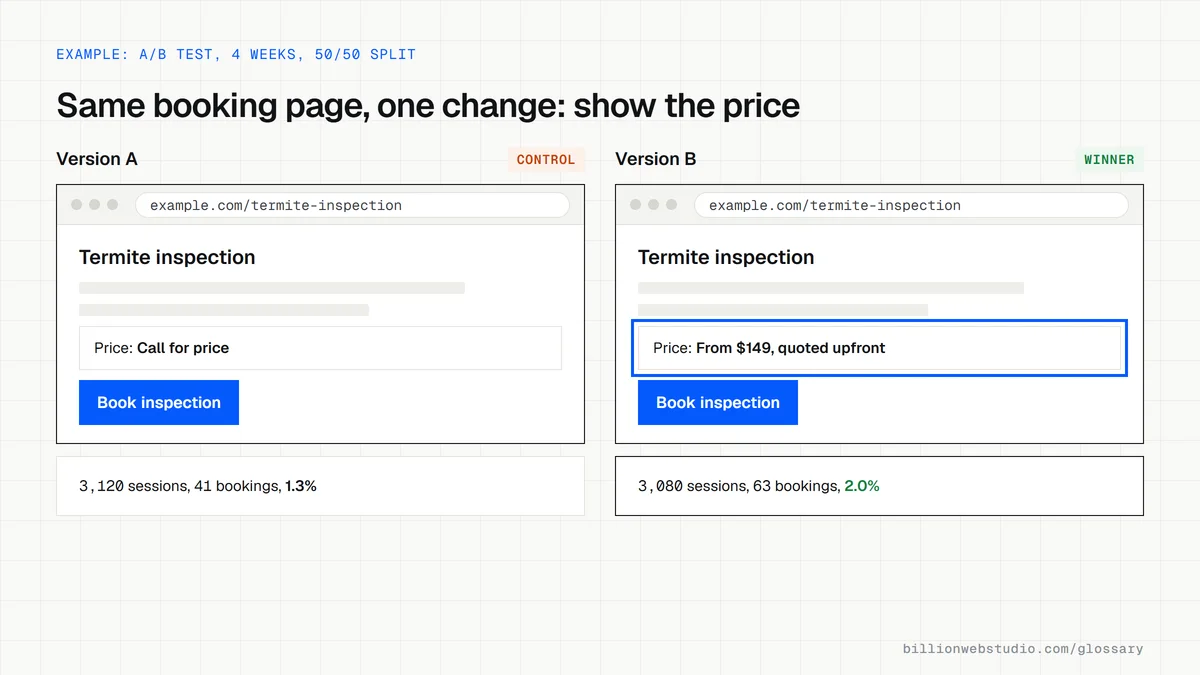
CRO treats your website as something you improve with evidence rather than opinion. You measure where visitors drop off, find out why using analytics, heatmaps, session recordings and customer feedback, then change one thing at a time and check the result. The goal is more leads or sales from the traffic you already have.
CRO covers everything that affects a decision: headlines, offers, page speed, trust signals such as reviews and guarantees, form length, pricing clarity and mobile usability. It is ongoing work rather than a one-off project, because buyers, rivals and your own offers keep changing.
Why CRO matters for a business website
Paid traffic keeps getting more expensive, and organic traffic takes months to build. CRO improves the return on both, because every gain applies to all future visitors. It also reduces guesswork in redesigns: instead of replacing a whole site on a hunch, you fix the pages and steps that are measurably losing customers.
The CRO process step by step
- Set up tracking so every lead, sale and key step is recorded in analytics.
- Find the pages and steps where most visitors leave without acting.
- Use heatmaps, recordings and short surveys to understand why they leave.
- Write a clear hypothesis, for example that a shorter form will raise quote requests.
- Test the change, with an A/B test when traffic allows, and measure the result.
- Keep what works, note what did not, and move to the next problem.
A CRO example
A dental practice sees plenty of visits to its implants page but few consultation requests. Session recordings show mobile visitors scrolling past a long price table and leaving. The team moves a short cost summary and a Book a consultation button near the top, adds patient reviews beside the form, and tracks requests for the next eight weeks.
Which CRO research method answers which question
| Method | What it tells you | Free tool | Best when |
|---|---|---|---|
| Funnel report | Which step loses the most people | GA4 Funnel exploration | Each step, from service page to lead, is tracked as an event |
| Heatmaps | What people click and how far they scroll | Microsoft Clarity | A page gets traffic but few actions |
| Session recordings | Where individual visitors hesitate, loop back or give up | Microsoft Clarity | You need the reason behind a drop-off |
| One-question survey | What stopped people, in their own words | A poll in your site builder or a Google Form | You have a guess but no evidence |
| Usability test with 5 people | Whether real people can finish the task at all | A video call with screen sharing | Before a redesign or a new form goes live |
| A/B test | Whether the change itself caused the result | Google Optimize closed in September 2023; most testing tools are paid | The page gets enough conversions for a reliable answer |
Copy this test plan template
CRO TEST PLAN

Page: [URL, e.g. example.com/services/emergency-plumbing]
What we saw: [evidence, e.g. scroll map shows most mobile visitors stop above the form]
Source of evidence: [GA4 funnel, Clarity heatmap, recordings, survey]
Why we think it happens: [one sentence]

Change: [one change only, e.g. move a 4-field quote form under the headline]
Who sees it: [all visitors, or mobile only]
Primary metric: [e.g. quote submissions per session, a GA4 key event]
Guardrail metric: [a number that must not fall, e.g. phone taps per session]

Start date: [date]
Run for: [full weeks, never stopped mid-week]
Decision rule: [keep if primary metric rises and guardrail holds]

Result: [numbers before and after]
Decision: [kept, reverted or retest]
How to find the biggest conversion leak on your site
- In GA4, click Explore and start a Funnel exploration. Add steps for viewing a service page, starting your quote form and your lead key event.
- Add Device category as the breakdown so mobile and desktop show as separate rows.
- Note the step with the highest abandonment rate and the page where it happens.
- Open that page in Microsoft Clarity, filter to the same device and look at its scroll map, click map and a handful of recordings.
- Write one hypothesis for that step, such as a shorter form or a visible price, before changing anything on the page.
What good looks like: You end with one named step, one page and one testable change, backed both by the drop-off numbers in GA4 and by the behavior you watched in Clarity.
Free tool: GA4 Funnel exploration
Questions to ask your web developer
“How do you decide what to test first?”
A good answer: They rank ideas by the size of the drop-off each one addresses and the traffic on that page, and show the data behind the top items instead of starting from a generic best-practice list.
“How will you know a change worked with the traffic we have?”
A good answer: They estimate whether your traffic can support an A/B test. If not, they compare full weeks before and after, pause other changes on that page and report the result with its limits stated.
“Where will you record what was tested and what happened?”
A good answer: A shared log with the date, page, hypothesis, result and decision for every change, so wins are kept and ideas that failed are not tried again by accident.
Conversion rate optimization (CRO): common questions
Is CRO part of SEO?
They are separate but connected. SEO brings visitors from search, while CRO increases how many of those visitors act. Many improvements help both, such as faster pages, clearer content and better mobile layouts. Running them together means extra traffic arrives on pages that are ready to convert it.
How long does conversion rate optimization take?
CRO is ongoing. Simple fixes, like repairing a broken form or adding a phone button on mobile, can show results within weeks. Formal tests need enough visitors to give a reliable answer, so low-traffic sites often make fewer, bolder changes and judge them over a longer period.
Sources
Want a website that gets this right?
Every Billion Web Studio build includes technical SEO, schema and speed work as standard, with a fixed quote within 1 business day.