Conversion and analytics
What Is Cost per Lead (CPL)?
Cost per lead (CPL) stands for Cost Per Lead.
Cost per lead (CPL) is the average amount a business spends on marketing to get one new lead, calculated by dividing the cost of a campaign or channel by the number of leads it produced in the same period.
What cost per lead means in plain English
A lead is someone who shares contact details or gets in touch, through a form, a call, a chat or a booking. CPL puts a price on each of those inquiries. If a month of ads costs $3,000 and brings 60 leads, the cost per lead is $50. The same formula works for SEO, directories or trade shows, as long as you count all the costs.
Ad platforms report a close relative. Google Ads shows cost per conversion, which is total cost divided by conversions, so when the only conversion you track is a lead, that figure is the campaign's CPL. Google's Local Services Ads go a step further and bill per lead rather than per click.
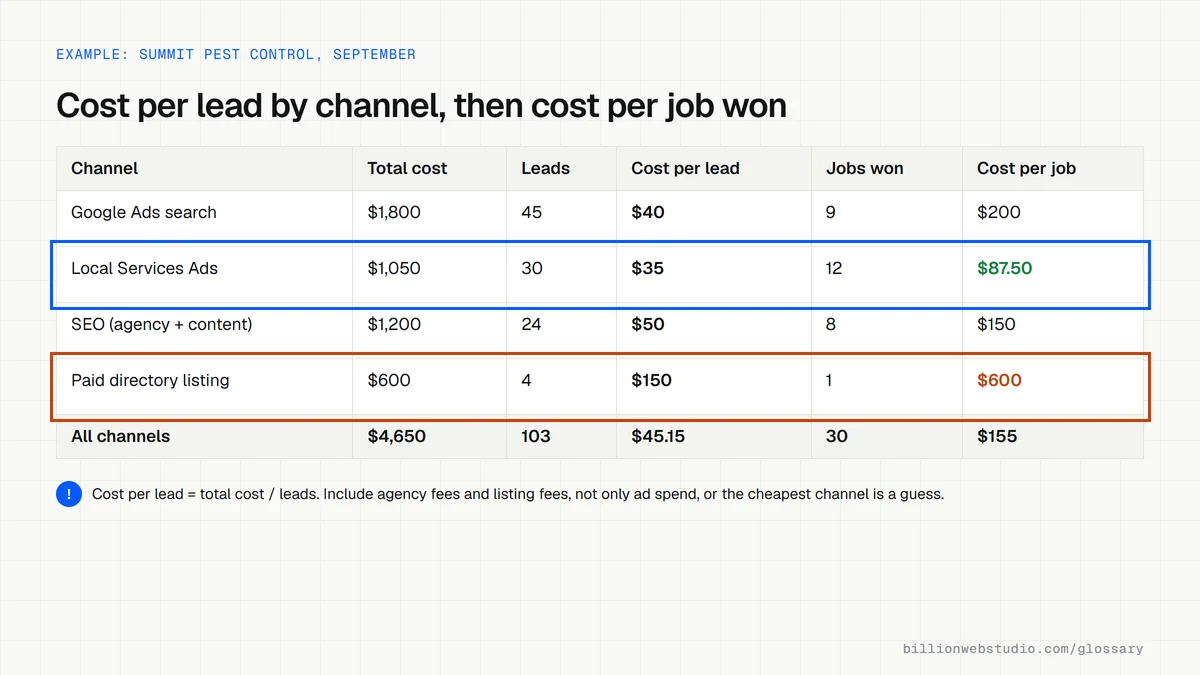
Why cost per lead matters for a business website
CPL lets you compare channels that otherwise look nothing alike. A cheap click is worthless if the landing page never turns visitors into inquiries, while a pricey click can be a bargain on a page that converts well. Because your website sits between the ad and the inquiry, a faster page or a clearer form can lower CPL with no change in ad spend.
A cost per lead example
A roofing company spends $2,400 on Google Ads in a month and gets 40 form and call leads, a CPL of $60. It also pays $900 for a directory listing that sends 6 leads, a CPL of $150. Ads look cheaper, but when the owner checks which leads became jobs, the directory leads closed more often, so the next step is comparing cost per customer too.
Common cost per lead mistakes
- Counting only ad spend and leaving out agency fees, software and staff time.
- Tracking phone calls for one channel but not another, which makes the channels impossible to compare.
- Chasing the lowest CPL with offers that attract people who never buy.
- Judging your figure against a generic industry average instead of your own profit per customer.
- Counting duplicate and spam submissions as leads, which makes CPL look lower than it really is.
Work out your Cost per lead
Cost per lead calculator
How to work out your real cost per lead for each channel
- In Google Ads, open Campaigns, set the date range to last month and read the Cost, Conversions and Cost / conv. columns.
- Open Goals, then Conversions, then Summary, and check which actions are set as Primary. If page views or button clicks are primary, Cost / conv. is not a cost per lead.
- In GA4, open Reports, Acquisition, Traffic acquisition and choose your lead event in the Key events column to count leads from every channel, including unpaid ones.
- Add calls from call tracking and Local Services Ads, then remove spam and repeat contacts from the same person.
- Total every cost per channel for the month, including agency, directory and software fees, and divide by that channel's leads.
What good looks like: Every channel has one CPL built from all of its costs, and you know your ceiling: profit per customer multiplied by the share of leads that become customers.
Free tool: Google Ads Help: Primary and secondary conversion actions
Questions to ask your web developer
“Which costs are included in the cost per lead you report to us?”
A good answer: Ad spend plus management fees, tools and listing fees, shown per channel, with the formula written on the report.
“How exactly do you count a lead?”
A good answer: Only real contacts: form submissions, calls above a set length and booked appointments, with spam and repeat contacts removed before dividing.
“Will you report cost per customer as well as cost per lead?”
A good answer: Yes, once we share which leads became paying jobs through a CRM field or an offline conversion import, so channels are compared on sales rather than inquiries.
Cost per lead (CPL): common questions
What is a good cost per lead?
A good CPL is one your business can afford given how many leads become customers and what each customer is worth. If one in five leads buys and each sale earns $1,000 in profit, paying $100 per lead still leaves room. Work backward from your own close rate and margin rather than a published average.
What is the difference between CPL and CPA?
Cost per lead measures the cost of an inquiry. Cost per acquisition, common in ad platforms, measures the cost of whatever action you set as the conversion, which can be a lead, a sale or a sign-up. For a service business that tracks only leads the two match, while for an online store they usually differ.
Sources
Want a website that gets this right?
Every Billion Web Studio build includes technical SEO, schema and speed work as standard, with a fixed quote within 1 business day.