Building and hosting
What Is a Landing Page?
A landing page is a standalone web page built around one specific goal, such as booking a call or downloading a guide, that visitors reach from an ad, email or search result. It removes distractions so more visitors take that single action.
What a landing page means in plain English
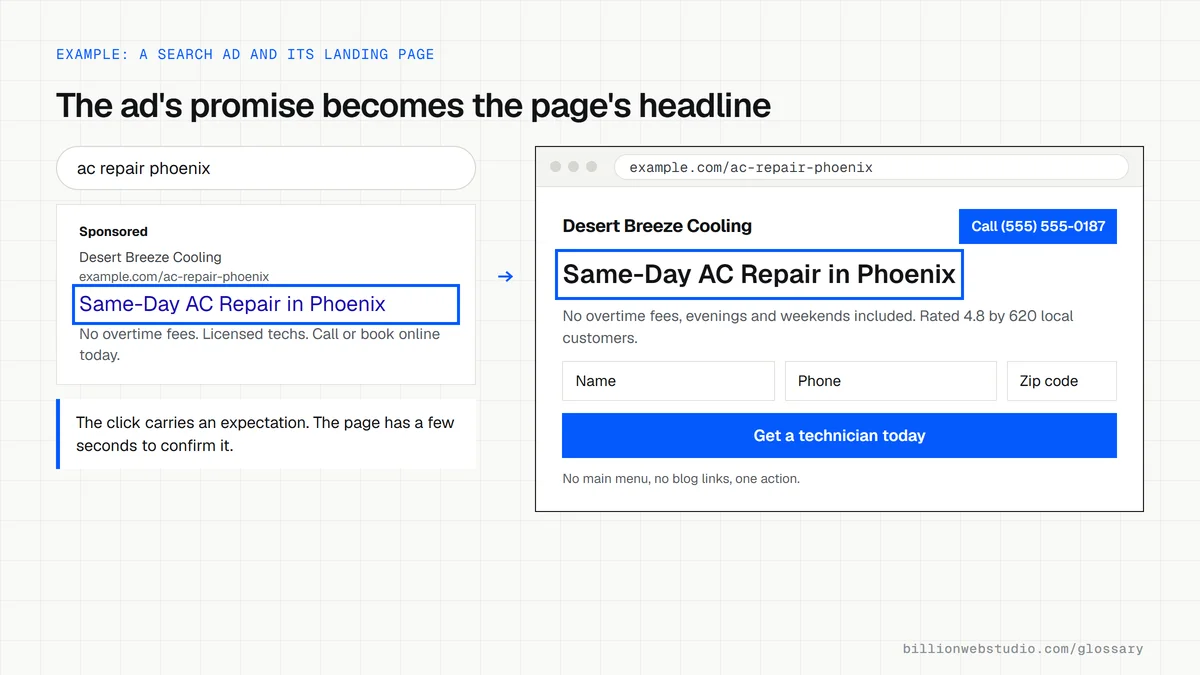
Any page a visitor arrives on can loosely be called a landing page, but in marketing the term means a page designed around one offer. It matches the promise of the ad or link that brought the visitor, explains the offer, answers objections and asks for one action. There is often no full menu, so visitors have fewer ways to wander off.
A homepage serves everyone: new visitors, returning customers, job seekers and suppliers. A landing page serves one audience with one message. That focus is why paid campaigns send clicks to dedicated pages rather than the homepage, and why many businesses build a separate landing page for each service, location or campaign they promote.
Why landing pages matter for leads
When an ad promises same-day AC repair and the page that opens talks about company history, people leave. A focused landing page keeps the message consistent from click to form. In Google Ads, landing page experience is one of the components of Quality Score, Google's rating of how relevant and useful your page is to people who click your ad.
A landing page example
A roofing company runs search ads for roof replacement in Dallas. The ad opens a page headed "Roof Replacement in Dallas, Free Inspection This Week," with three photos of local jobs, short customer reviews, a financing note and a four-field quote form. The phone number is tappable on mobile, and the form appears again at the bottom of the page.
Common landing page mistakes
- Sending ad clicks to the homepage instead of a page that matches the ad.
- Asking for too much information in the form before the page has earned any trust.
- Letting the page load slowly on phones, so visitors leave before the form appears.
- Putting several competing offers or calls to action on the same page.
- Not tracking form submissions and calls, so nobody knows which page actually produces leads.
Copy this landing page brief
LANDING PAGE BRIEF
Page URL:        example.com/ac-repair-phoenix
Traffic source:  Google Ads, campaign "AC Repair Phoenix"
Ad promise:      Same-day AC repair in Phoenix, no overtime fees
Audience:        Homeowners with a broken AC, on a phone, in a hurry
Headline:        Same-Day AC Repair in Phoenix (must match the ad)
One action:      Tap to call, or a 3-field form: name, phone, zip code
Proof:           Review rating, license number, 3 local job photos
Objections:      Price range, arrival window, warranty
Remove:          Main menu, blog links, other offers
Tracking:        Form submits and call clicks marked as GA4 key events
Review after:    30 days: conversion rate and cost per lead
How to check a landing page against the ad that sends traffic
- Open the ad and the landing page side by side, and check the page headline repeats the ad's main promise and location.
- In Google Ads, open Keywords from the Campaigns menu, click the columns icon and add Landing Page Exp. from the Quality score section.
- Sort by that column and start with keywords rated Below average.
- Run the page through PageSpeed Insights on the Mobile tab and check Largest Contentful Paint is in the good range.
- Submit the form yourself, then open Reports > Realtime in GA4 and confirm it appears in the key events card.
What good looks like: Landing Page Exp. reads Average or Above average, LCP is 2.5 seconds or less on mobile, and every test submission shows up as a key event.
Free tool: Google Ads Help: Quality Score components
Questions to ask your web developer
“Will each ad group get its own landing page, or will several ads share one?”
A good answer: Each main service or location gets its own page whose headline matches the ad, and pages are only shared when the offer is identical.
“How will calls and form submissions be tracked?”
A good answer: Form submits and tap-to-call clicks are set up as key events in GA4 and imported into Google Ads, and they show you a test submission arriving before launch.
“How will you test changes once the page is live?”
A good answer: One change at a time, such as the headline or form length, judged on conversion rate over enough traffic to trust, with results shared each month.
Landing page: common questions
What is the difference between a landing page and a homepage?
A homepage introduces your whole business and links to everything, so it serves many kinds of visitors. A landing page focuses on one offer for one audience, usually with a single call to action and little navigation. Campaign traffic usually belongs on the page that matches the offer.
Does a landing page need to be a separate website?
No. A landing page usually lives on your main domain, at an address such as example.com/roof-replacement. Keeping it on your own site builds your domain's search history, uses your existing analytics, and avoids paying for a separate landing page tool.
Should landing pages be indexed by Google?
It depends on the page. A service or location landing page with useful, unique content should be indexed so it can rank. Short-lived campaign pages and near-duplicate test versions are often set to noindex to keep thin copies out of search results.
Sources
Want a website that gets this right?
Every Billion Web Studio build includes technical SEO, schema and speed work as standard, with a fixed quote within 1 business day.