Conversion and analytics
What Is a Sales Funnel?
A sales funnel is the series of steps a person takes from first hearing about a business to becoming a paying customer, usually grouped as awareness, interest, decision and action. Fewer people remain at each step, which gives the funnel its narrowing shape.
What a sales funnel means in plain English
Picture a wide opening at the top where everyone who finds your business enters, and a narrow end where buyers come out. Along the way people read a blog post, visit a service page, compare prices, fill in a form and finally sign or pay. Each step loses some people, so the shape narrows.
Marketers often label the stages top, middle and bottom of funnel. Top-of-funnel content answers broad questions. Middle-of-funnel pages help people compare options. Bottom-of-funnel pages, such as pricing, quote and booking pages, ask for the decision. A good website has a clear page for each stage and an obvious next step between them.
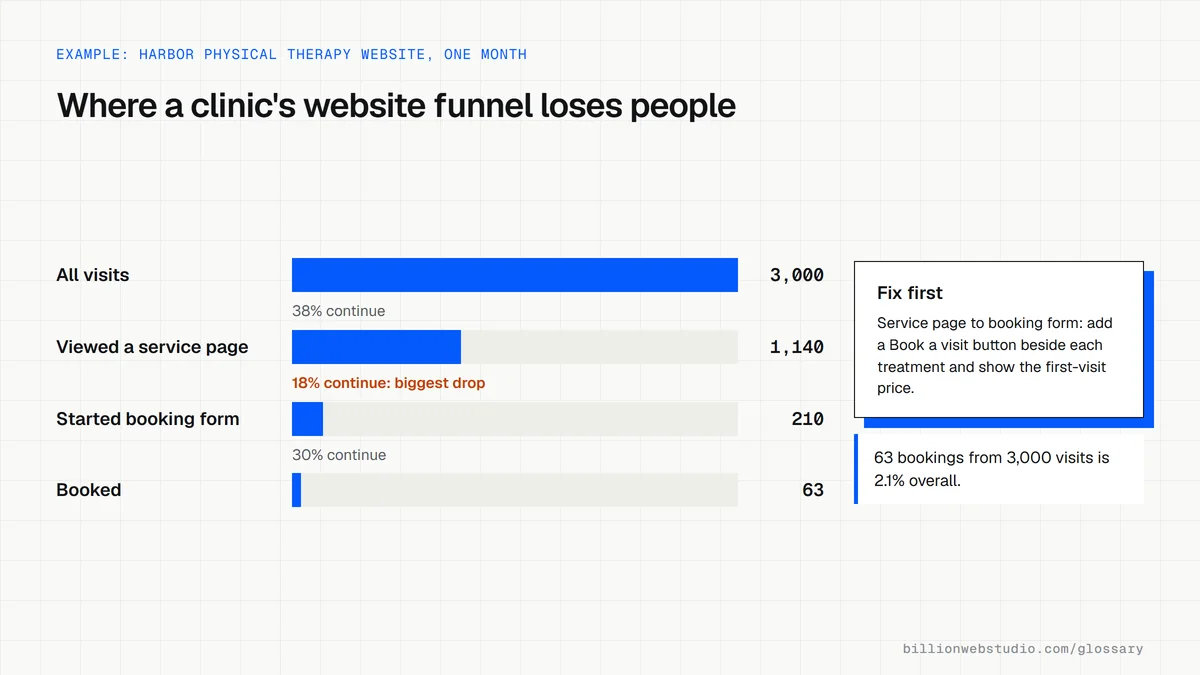
Why a sales funnel matters for your website
Without a funnel view, a website gets judged only on total traffic, which hides where buyers drop out. Mapping the funnel shows whether the problem is too few visitors, visitors who never reach a service page, or forms that put people off. Fixing the weakest step often adds more leads than paying for more traffic to a leaky site.
A sales funnel example
Imagine a roofing company whose site gets 2,000 visits a month. Of those, 600 reach a service page, 80 open the quote form and 20 submit it. The biggest loss sits between the service page and the form, so the owner adds a clearer quote button, a shorter form and real project photos, then watches whether submissions rise.
Common sales funnel mistakes
- Sending paid ads to the home page instead of a page built for that one offer.
- Asking for the sale on every page, even when the visitor is still researching.
- Skipping tracking, so nobody can see which step loses the most people.
- Treating the funnel as finished, when offers, prices and buyer questions change over time.
What to measure at each stage of a website sales funnel
| Stage | Typical page | Signal to track in GA4 | If it is weak |
|---|---|---|---|
| Awareness | Blog post or guide | Sessions and new users from search and social | Answer more of the questions buyers actually search for |
| Interest | Service page | Views of service pages, including visits that arrive from guides | Link each guide clearly to the matching service |
| Decision | Pricing, reviews or quote page | form_start, the first interaction with a form | Shorten the form and show price ranges or proof near it |
| Action | Quote or booking confirmation | generate_lead or a booking event marked as a key event | Check the form sends and the event fires once per lead |
| Retention | Review request, reorder or rebooking page | Returning users and repeat purchases | Follow up after each job with a review or rebooking link |
How to build your website's sales funnel report in GA4
- In GA4, click Explore and choose the Funnel exploration template.
- Click the pencil icon next to Steps and name the first step, such as Service page, with the condition page_view where the page path contains /services/.
- Click Add step for each later stage, such as form_start and then your lead key event, and click Apply. A funnel can have up to 10 steps.
- Keep the funnel closed so everyone must start at step one, or make it open if visitors can join at any step.
- Add Device category as a breakdown and read the abandonment rate between each pair of steps.
What good looks like: Every step has data, the largest drop is at a step you can explain, and the same funnel compared month by month shows that step improving after each fix.
Free tool: GA4 Funnel exploration
Questions to ask your web developer
“Which pages on our site belong to each stage of the funnel?”
A good answer: They map every page type to a stage, show how each guide links to a service page, and point out any stage that has no page at all.
“How will we see where visitors drop out?”
A good answer: Each stage has a tracked event, and a GA4 funnel exploration from service page to lead is set up before launch, so drop-off can be compared once the site is live.
“What happens to a lead after it leaves the website part of the funnel?”
A good answer: Form and call leads go straight to a CRM or shared inbox with their source, so later sales steps can be connected back to the pages that started them.
Sales funnel: common questions
What are the stages of a sales funnel?
A common model uses four stages: awareness, interest, decision and action. Another well-known version is AIDA, which stands for attention, interest, desire and action. Some businesses add a retention stage after the sale. The labels matter less than knowing which page on your site serves each stage.
What is the difference between a sales funnel and a marketing funnel?
The terms overlap. A marketing funnel usually covers the early stages, where people discover a business and become leads. A sales funnel often refers to the later stages, where a lead is qualified, receives a proposal and buys. Many small businesses simply run one funnel that covers the whole journey.
Sources
Want a website that gets this right?
Every Billion Web Studio build includes technical SEO, schema and speed work as standard, with a fixed quote within 1 business day.