Conversion and analytics
What Is a Value Proposition?
A value proposition is a short, clear statement of the benefit a business delivers, who it is for and why that customer should choose it over the alternatives. On a website, the value proposition usually forms the main homepage headline and supporting line.
What a value proposition means in plain English
A value proposition answers a visitor's first question: why should I pick you? It is not a slogan or a mission statement. A good one names the customer, the problem solved or result delivered, and what makes the offer different, such as speed, price certainty, a specialty or a guarantee. Nielsen Norman Group frames it as the answer to why someone should choose this company over others.
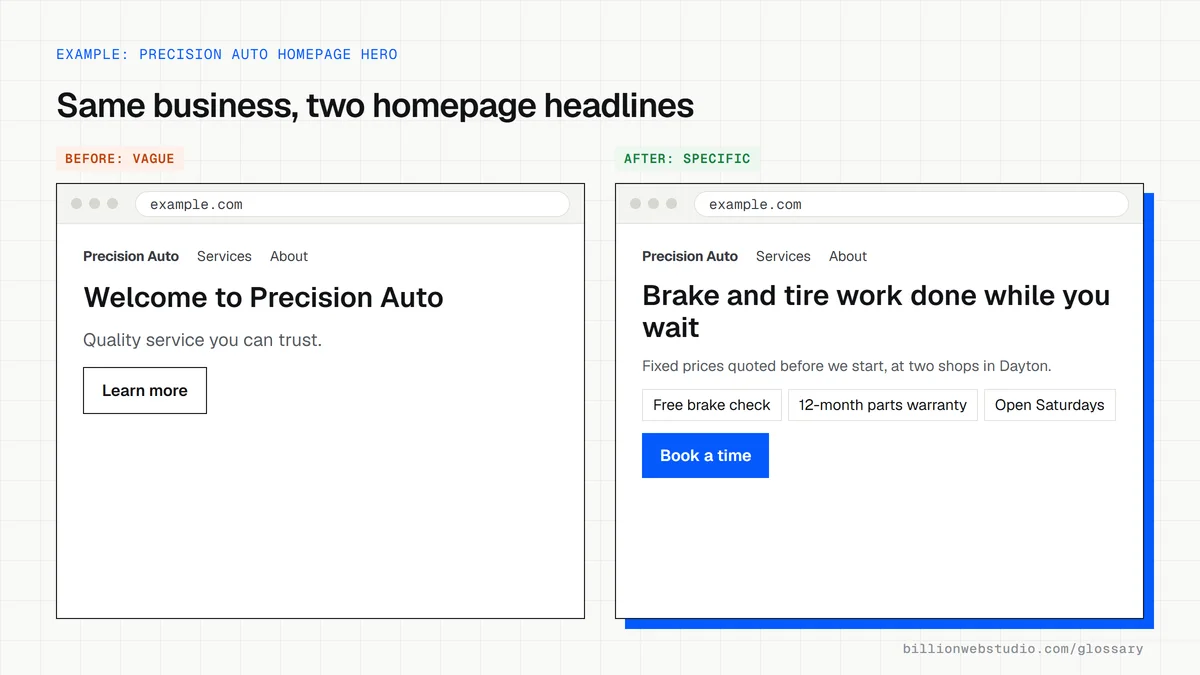
On a page it usually has three parts. A headline states the main benefit in plain words. A sentence or two underneath explains what you do and for whom. Then a few specific proof points, such as response times, certifications or reviews, back the claim up. Every other element on the page should support that same message.
Why a value proposition matters for a business website
Visitors arriving from search or ads decide quickly whether a site is relevant, and many will not scroll to find out. A vague hero line such as Welcome to our website leaves them to work out what you sell and why it is better. A sharp value proposition can lift conversion rate without any extra traffic, sharpens ad copy and gives sales staff one consistent story to tell.
A value proposition example
A commercial cleaning company's homepage reads: Quality cleaning services you can trust. Every competitor says the same. The rewrite reads: Office cleaning after hours, with the same vetted crew every night and a fixed monthly price. The supporting line names the cities covered, and three proof points follow: insured staff, next-day fixes for missed tasks and a one month notice period. The company then tests both versions against its quote request rate.
Common value proposition mistakes
- Describing what you are, such as a full service agency, instead of what the customer gets.
- Relying on claims every competitor also makes, like quality, trusted and best in class.
- Packing several benefits into one headline so none of them lands.
- Writing in industry jargon instead of the words customers use to describe their problem.
- Promising a benefit that the rest of the page, and the service itself, do not back up.
Copy this value proposition worksheet
VALUE PROPOSITION WORKSHEET

Customer: [who you serve, in their own words]
  e.g. Restaurant owners in Austin
Problem or goal: [what they need fixed or achieved]
  e.g. A walk-in cooler that fails on a Friday night
Result you deliver: [the outcome, not the service name]
  e.g. Cooling back on before the next service
Why you, not others: [something a competitor cannot easily claim]
  e.g. Technicians who only work on commercial kitchens, on call every night

Headline (one line): [result] for [customer]
  e.g. Same-night cooler repair for Austin restaurants
Supporting line (one sentence): [how it works + the difference]
  e.g. Commercial-only technicians, on call every night, with common parts in the van.
Proof points (three): [a number, a guarantee, a credential]
Call to action: [the next step in plain words]
  e.g. Call the night line
How to test your value proposition in five seconds
- Open your homepage on a phone and take a screenshot of what shows before any scrolling.
- Show the screenshot for five seconds to someone who does not know your business, then put it away.
- Ask three questions: what does this company do, who is it for, and why would you pick it over another one?
- Repeat with three to five people and write down their exact words.
- Compare their answers with the customer, result and difference you meant to state. Any gap points to the line to rewrite.
What good looks like: Most people name your service, your customer and at least one real difference in their own words, and nobody answers with a phrase every competitor also uses.
Questions to ask your web developer
“What will our homepage headline say, and what is it based on?”
A good answer: A draft headline and supporting line built from your customer reviews, sales conversations and competitor sites, with the reason the chosen benefit leads instead of the others.
“How will the value proposition carry through the rest of the site?”
A good answer: Service and landing pages restate the same core promise for each audience, ads and meta descriptions use matching words, and proof such as reviews or guarantees sits beside each claim.
“Can we test the headline after launch?”
A good answer: Yes. Quote requests are tracked as a key event, and headline versions are compared over full weeks, or with an A/B test if traffic allows.
Value proposition: common questions
What is the difference between a value proposition and a slogan?
A value proposition explains the specific benefit you offer, to whom and why it beats the alternatives, so it is written to inform a buying decision. A slogan is a short, memorable brand line built for recall, often used in ads. A slogan can be vague and still work; a value proposition cannot.
Where should a value proposition go on a website?
Put it at the top of the homepage, in the hero section, as the main headline with a supporting sentence. Repeat a version of it on key landing pages and service pages, matched to each audience. Visitors who land deep in the site through search should still see why to choose you without visiting the homepage.
What is a unique value proposition?
A unique value proposition is a value proposition built around something competitors do not offer or cannot easily copy, such as a specialty, guarantee or delivery model. It is close in meaning to a unique selling proposition. The word unique stresses the difference itself, rather than only the benefit to the customer.
Sources
Want a website that gets this right?
Every Billion Web Studio build includes technical SEO, schema and speed work as standard, with a fixed quote within 1 business day.