Skip to content
Booking projects for next month. Free website audit with every quote.Claim yours →

Construction and manufacturingBooking projects for November

Biotech Website Development Company for Biotechs, CROs and Testing Labs

A sponsor shortlists CROs from referrals, then checks each site for the assay, the matrix, the quality system and the turnaround before asking for a quote. An investor or a senior scientist checks your pipeline and team the same way. We build biotech and lab sites that answer those checks in plain text and turn the visit into a study quote, a partnering call or an application.

  • Built for biotech companies and contract research and testing labs
  • Fixed quote in 1 business day
  • You own everything
yourlab.com/bioanalysisGLP LC-MS/MSbioanalysisRequest a quoteTap to callStudy quote: PK, 600 samplesRat plasma · from /bioanalysisTracked as a leadSource: GoogleAI ASSISTANTWhich US CROs run GLP LC-MS/MSbioanalysis?Your Company: GLP LC-MS/MS bioanalysis,10-day standard turnaround.Source: your website
Illustration: a visit becomes a tracked lead

The short answer

What does a biotech website development company do?

A biotech website development company builds websites for two kinds of life science business. Therapeutics, platform and tools companies need a site that investors, pharma partners and the scientists they want to hire can trust: the science, the pipeline, the team, publications and news. Contract research organizations (CROs) and testing labs need a site that sells capacity: each assay or study type, the species and matrices you handle, your instruments, your quality systems and turnaround, and a quote request a sponsor can complete without a call.

For a CRO or testing lab that means one page per service with methods, sample requirements, turnaround and accreditation scope in HTML, a study quote form that asks what your scientists need to price the work, sample submission and shipping instructions, and a quality page with GLP, CLIA or ISO/IEC 17025 status stated exactly. For a therapeutics company it means a pipeline chart in text rather than an image, a science page a generalist investor can follow, publications with links, a team and advisory board page, careers with real roles and, for public companies, an investor relations section.

Billion Web Studio is a biotech website development company that delivers this as one fixed-scope project: service, science, pipeline, quality and careers pages, a study quote flow routed to business development and your CRM, Organization schema, and every quote request, call and application tracked as a GA4 event. The B2B lead system behind it took two manufacturers we built for from no inquiries to about 10 and about 5 leads a week. You own the site, domain and accounts from day one, with no lock-in.

The market

What the numbers say about biotech companies and contract research and testing labs online

The US bioscience economy is large and crowded, and the buyers in it are careful. Sponsors, partners and investors compare many companies on paper before they talk to one, and the paper is now mostly your website. The figures below come from BIO and TEConomy, the FDA, 6sense and Forrester.

How they choose

How partners and buyers find and choose a biotech company

A sponsor choosing a CRO and an investor judging a startup follow the same pattern: a referral or a search builds a short list, the website decides who stays on it, and only then does anyone call. Here is how a sponsor picks a lab, and what your site has to do at each step.

  1. 1

    The need: a study, an assay or a second lab

    A program needs GLP bioanalysis for a toxicology study, a cell-based potency assay, extractables and leachables testing or a backup lab because the current one keeps slipping. The search is specific: "GLP LC-MS/MS bioanalysis rat plasma", "flow cytometry CRO", "USP 71 sterility testing lab". You need a page for each service written in those words, not one services page.

  2. 2

    The short list: referrals, colleagues, search and AI

    On r/biotech, sponsors say referrals and board recommendations drive the first names. Each name then gets looked up, and some buyers ask ChatGPT or Google AI Mode which labs run a given assay. If your site does not say plainly which assays, species, matrices and quality systems you cover, you drop off before anyone calls.

  3. 3

    The capability check

    Scientists and QA check instruments, validated methods, sample volumes, turnaround, data formats, the date of your last GLP inspection or audit, CLIA certificate type and the scope of your ISO/IEC 17025 accreditation. These belong on the page as text with documents beside them, not behind a sales call.

  4. 4

    The quote and the SOW

    The sponsor sends the study design, sample numbers and timelines and asks several labs for a quote. A form that collects those details, accepts a protocol under NDA and states when you will reply gets you into the comparison. Sponsors on r/clinicalresearch describe quotes for the same study that differ by more than double, so the lab that states its assumptions clearly looks safer.

  5. 5

    The decision and the repeat study

    Procurement negotiates, QA may audit, and the scientists come back to your site to check you again. After the first study, a client resources area with sample submission forms, shipping instructions and a portal link makes the second study easier to send to you than to anyone else.

The problem

Why most biotech websites lose partner and buyer inquiries

What we find again and again when we audit sites in this trade. None of it is about how the site looks.

Leak 01

One services page for forty assays

A list of capabilities with a contact button. A scientist searching for a specific assay in a specific matrix cannot tell whether you run it, so the lab with a page for that assay gets the quote request instead, even when your method is better.

Leak 02

The pipeline and the science are pictures

A pipeline chart exported as an image, a platform explained in a slide graphic and publications listed without links. Search engines and AI assistants cannot read any of it, investors on a phone cannot zoom it, and the page goes stale because only the designer can edit it.

Leak 03

No quality facts, or the wrong ones

"FDA approved lab" (no such status), "ISO certified" with no standard, body or scope, an accreditation logo used for tests outside the scope, or a CLIA claim with no certificate type. Sponsor QA teams check these, and one sponsor on r/biotech asks every CRO for the date of its last GLP inspection before shortlisting it.

Leak 04

The quote path is an email address

No study type, species, matrix, sample count, timeline or NDA option, and no stated reply time. Business development spends the first call collecting basics, and a sponsor comparing four labs moves on to the ones that already asked the right questions.

Leak 05

Pre-approval claims that create regulatory risk

Pipeline pages that call an investigational drug "safe and effective", patient stories that read like promotion, or press language copied onto the site without review. FDA rules bar promoting investigational products as safe or effective, and public companies also have SEC disclosure rules to think about.

Leak 06

Careers that send scientists to LinkedIn and leave

Candidates check the team, the investors and the science before they apply. A careers page with no roles, no lab photos and no team context loses the scientists you need, and on r/biotech candidates say a startup's backers should be visible on its site.

Our research

We checked 18 real biotech websites. Here is what we found.

On October 23, 2026 we opened the homepages of 18 biotech companies and contract research and testing labs that rank in Google Maps in 10 US metros, the way a customer would on a phone, and ran a mobile Lighthouse test on each. Every number below comes from that check.

  • 64/100

    median mobile Lighthouse performance score (90 or more is good)

  • 8.7 s

    median time to show the main content on a phone (target: 2.5 seconds or less)

  • 3 MB

    median homepage download on a phone, before anyone scrolls

  • 17 of 17 took longer than 2.5 seconds to show their main content in a mobile Lighthouse test

  • 1 of 18 show a tap-to-call link on the first phone screen

  • 5 of 18 show a clear call, book or quote button on the first screen

  • 6 of 18 have a contact or quote form on the homepage

  • 7 of 18 let visitors book or schedule online

  • 3 of 18 describe the business to Google with business schema markup

  • 12 of 18 have Google Analytics or Tag Manager installed

  • None of 18 use call tracking

  • 3 of 18 show a copyright year of 2024 or older (of the sites that show one)

  • 4 of 18 have images with no alt text

  • 12 of 18 link to a privacy policy

  • 7 of 18 offer live chat or texting

What this means for your biotech website

The three biggest gaps in the sample. Each is fixable, and each is a reason a customer picks the next result instead of you.

See how your site compares →
  1. 1

    17 of 17 took longer than 2.5 seconds to show their main content in a mobile Lighthouse test. Google counts 2.5 seconds or less as a good Largest Contentful Paint. Slow first screens lose visitors before they see your phone number.

  2. 2

    None of the 18 use call tracking. Calls are the main lead source in most local trades. Without call tracking you cannot see which marketing made the phone ring.

  3. 3

    Only 1 of 18 show a tap-to-call link on the first phone screen. Most of these searches happen on phones. A number that is not a tap-to-call link, or sits below the fold, costs calls.

How we checked: Google Maps results for “biotechnology company” in Boston, Cambridge, San Diego, South San Francisco, Durham, Seattle, Gaithersburg, Philadelphia, Houston, Denver; the two highest-ranked independent businesses per city (chains and directory listings left out). 20 homepages sampled, 18 loaded for our checker (the rest blocked automated visits), 17 scored by Lighthouse in mobile mode. Lighthouse is a lab test and varies run to run; it is not the same as Google's real-user Core Web Vitals. Businesses are not named. Checked October 23, 2026.

Generic vs built for you

Why a generic website fails biotech companies and contract research and testing labs

A template is built to fit every business, so it fits yours badly. Here is what changes when the site is planned around how partners and buyers actually buy.

Generic website compared with a website built for biotech companies and contract research and testing labs
What you needGeneric template siteBuilt for biotech companies and contract research and testing labs
Services and assaysA bullet list of capabilities on one pageOne page per assay or study type with methods, species, matrices, sample requirements, instruments, turnaround and a quote button
Quote requestA contact form with name, email and messageA two-step study quote form: study type and sample count first, then protocol upload under NDA, timelines, GLP or non-GLP, and a stated reply time
Quality and accreditationBadge images and "FDA approved" wordingGLP compliance statement, CLIA certificate type and number, ISO/IEC 17025 body, certificate number and current scope PDF, audit and inspection history as you choose to share it
Science and pipelineA pipeline image and a slide graphicA pipeline table in HTML your team can edit, a science page in plain language with figures, and publications with DOIs and posters
Sample logistics"Contact us for shipping details"Sample submission forms, chain of custody, packaging and shipping instructions, receiving hours and holiday cutoffs
Investors and partnersA news page last updated at the seed roundTeam, advisory board, partners and investors shown with permission, a dated news feed and, for public companies, an investor relations section
Hiring"Send your CV" or a LinkedIn linkRoles by team and site from your applicant tracking system, lab photos, benefits and a short mobile apply path
Tracking and ownershipForm emails to one inbox, site rented on a platformQuote requests, calls, downloads and applications as separate GA4 events and CRM records, with site, domain and analytics in your name

Free self-check · 2 minutes

What your current biotech website is missing

Tick everything your site does today. Each box you cannot tick is a place where a ready-to-buy visitor leaves.

What you need

What every biotech website needs

The features that turn a biotech website from a brochure into the best salesperson you have. We build all of them.

  1. Must-have · 01

    One line that says what you do and for whom

    "GLP and non-GLP bioanalysis and immunogenicity testing for small and large molecules, from discovery through IND-enabling studies" or "A clinical-stage company developing oral therapies for rare liver disease." A sponsor or an investor should know in five seconds whether to keep reading.

  2. Must-have · 02

    A page per assay, study type or service

    LC-MS/MS bioanalysis, ligand binding and immunogenicity, cell-based assays, flow cytometry, PK and toxicology studies, microbiology, stability, extractables and leachables or environmental testing, as you run them. Each page lists methods, species and matrices, sample volume, instruments, turnaround, data deliverables and a quote button.

  3. Must-have · 03

    A study quote form built for scientists

    Request a Quote in the header of every service page. Step one asks study type, sample count and contact details; step two takes species, matrix, timelines, GLP or non-GLP, protocol upload and an NDA request. Files go to secure storage you control, and the confirmation states when the sponsor will hear back.

  4. Must-have · 04

    A quality page with exact claims

    GLP compliance and inspection history as you choose to share it, CLIA certificate type and number for clinical labs, ISO/IEC 17025 accreditation with the accreditation body, certificate number and a link to the current scope, CAP accreditation where true. No "FDA approved" wording, because no such lab status exists.

  5. Must-have · 05

    Sample submission and client resources

    Sample submission forms, chain of custody, packaging and shipping instructions, receiving hours, holiday cutoffs, a link to your client portal and a page on data deliverables and report formats. Clients bookmark these pages and come back for every study.

  6. Must-have · 06

    Instruments and facility

    Instrument make and model, throughput, BSL level where it matters, vivarium or cleanroom details and real photos of the lab. A scientist can judge fit from this list faster than from any sales call.

  7. Must-have · 07

    Science and platform in plain language

    For therapeutics and platform companies, a science page that a generalist investor can follow in two minutes, with figures in text and a deeper section for specialists. Mechanism, modality and what makes the approach different, without claims the data does not support.

  8. Must-have · 08

    A pipeline your team can update

    Program, modality, indication and stage as an HTML table or chart built from data, so an update after a readout takes minutes and the site never shows a stage you have already passed. Investigational programs are described by stage, never as safe or effective.

  9. Must-have · 09

    Publications, posters and scientific team

    Peer-reviewed papers with DOIs, posters and conference talks, and bios for the scientists sponsors will work with. These are the pages that win the credibility check, and the pages Google and AI assistants cite.

  10. Must-have · 10

    Careers that recruit scientists

    Open roles by team and site from your applicant tracking system, lab and team photos, benefits, and a short apply path that works on a phone. BIO and TEConomy count almost 150,000 bioscience establishments competing for the same people.

  11. Must-have · 11

    Investor relations for public companies

    SEC filings, press releases, events and presentations, governance documents and an investor contact, with email alerts. If you use the website as a disclosure channel, your counsel decides how it is set up under Regulation FD.

  12. Must-have · 12

    Schema, speed and a clean move

    Organization schema matching the visible text, Core Web Vitals targets of LCP 2.5 seconds or less, INP 200 ms or less and CLS 0.1 or less, and a 301 redirect map that keeps every URL that already earns traffic.

What we build

The biotech website we would build for you

Here is the sitemap we start from for a CRO or testing lab, with the therapeutics sections a platform or clinical-stage company adds. Good biotech website design starts from this list of pages, not a homepage layout. We cut or add pages to match the studies and programs you want more of.

yourcompany.comHome · every section links here

Services

  • Bioanalysis (LC-MS/MS)
  • Ligand binding and immunogenicity
  • Cell-based and potency assays
  • Flow cytometry
  • In vivo pharmacology and toxicology
  • Microbiology and sterility testing
  • Stability and release testing
  • Request a quote

Quality and facility

  • Quality systems: GLP, CLIA, ISO/IEC 17025 scope
  • Audits and inspections
  • Instruments and equipment list
  • Facility tour with photos
  • Data integrity and deliverables

Client resources

  • Sample submission forms
  • Chain of custody
  • Packaging and shipping instructions
  • Receiving hours and holiday cutoffs
  • Client portal login
  • FAQ: turnaround, sample volumes, NDAs, pricing basis

Science and pipeline

  • Our science or platform
  • Pipeline
  • Program pages by indication
  • Publications and posters
  • Partnering

Company and careers

  • About and history
  • Leadership and scientific team
  • Scientific advisory board
  • Investors and partners
  • News
  • Careers and open roles
  • Contact and site addresses

Investors (public companies)

  • SEC filings
  • Press releases
  • Events and presentations
  • Governance
  • Email alerts and IR contact

Calls, bookings, leads

How we turn visitors into partner and buyer inquiries

Good website design for biotech companies is judged in qualified conversations: a sponsor with a real study and timeline, a partner asking for a call, a scientist applying. This is how we build each path and track it.

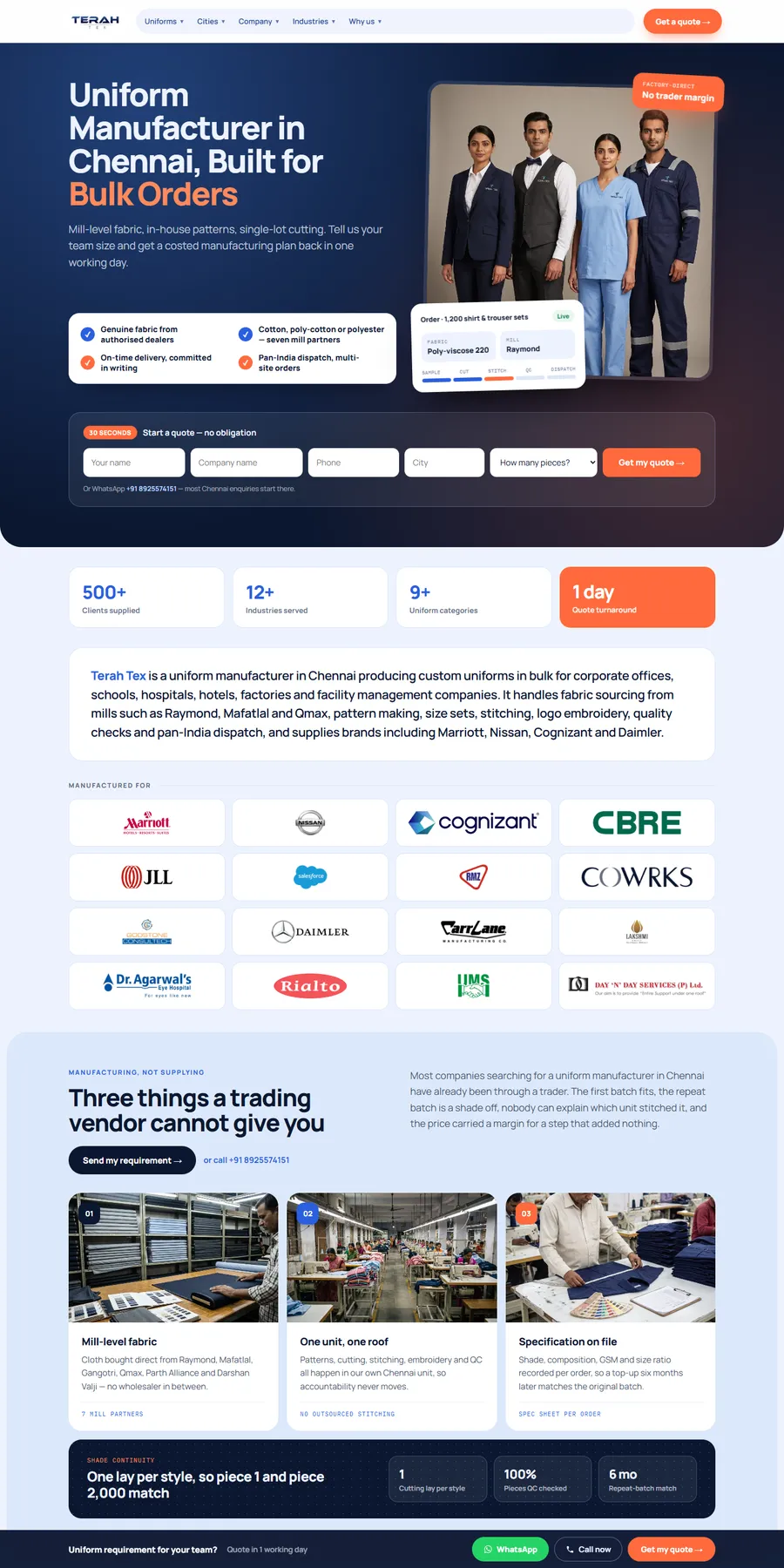
  • 01A two-step study quote formStep one asks study type, sample count and contact details, so even a partial request reaches you. Step two takes species, matrix, GLP or non-GLP, timelines, protocol upload and an NDA request. We used a two-step quote form for Terah Tex, a bulk uniform manufacturer that went from no website inquiries to about 5 bulk-order leads a week.
  • 02Secure document uploadProtocols, sample manifests and draft SOWs go to encrypted storage you control, and the notification carries a link instead of an attachment your mail server may block. For CLIA labs that receive patient information, forms run through a vendor that signs a business associate agreement.
  • 03Routing to the right scientist and your CRMRequests route by service line to the right business development lead or study director and land in HubSpot or Salesforce with page and campaign source attached. We send test requests end to end before and after launch.
  • 04A confirmation that states your reply timeThe sponsor gets a reference number, what happens next and when to expect a quote. Your team gets a reminder if a request sits unanswered, because a slow first reply is how labs lose studies they were qualified to win.
  • 05Separate paths for sponsors, partners, investors and candidatesStudy quotes go to business development, partnering inquiries to the business team, investor questions to IR and applications to HR. Each is its own conversion event, so a job application never counts as a sales lead.
  • 06Conference and campaign landing pagesA page for each conference, poster or outreach campaign, with a matching quote or meeting link, so you can see which booth conversation or email turned into a request. Ads and emails land on that page, not the homepage.
  • 07A monthly report in plain numbersQuote requests, calls, document downloads and applications by source and page. Every request and call is a GA4 lead event, the same setup that tracks every form and call on the Blues Renewables site we built.

AI search

Scientists and sponsors now ask AI assistants which labs run an assay, which CROs have GLP capacity, or what a company's platform does. Forrester's 2026 study found 94% of business buyers use AI during their buying process. Google says its AI Overviews and AI Mode need nothing extra beyond being indexed and eligible for a snippet, with important content in text. For a biotech or lab, that means services, methods, quality systems and science written where machines can read them.

Questions your partners and buyers ask AI assistants

  • Which US CROs run GLP LC-MS/MS bioanalysis for rat and dog plasma?
  • List contract labs that do USP 71 sterility testing with 14-day turnaround.
  • Which ISO 17025 accredited labs test extractables and leachables for drug packaging?
  • What does this biotech company's platform do, and what stage is its lead program?
  • Who offers flow cytometry immunophenotyping as a service near Boston?
  • What should I ask a CRO before signing a study SOW?
  • Methods and matrices as text

    Assays, species, matrices, sample volumes, turnaround and instruments written as HTML text and tables. An assistant cannot repeat a turnaround time that only exists inside a PDF brochure.

  • One page per assay and program

    AI answers are built from pages that match a specific question. A page about immunogenicity testing for biologics can be cited for that question; a single services page usually cannot.

  • Quality facts an assistant can verify

    Name GLP, CLIA and ISO/IEC 17025 status, the accrediting body and the scope the same way on every page, so an assistant asked for an accredited lab can match you.

  • Answers to the questions sponsors ask

    Sample requirements, NDAs, typical timelines, data deliverables, how quotes are built and what changes the price, each answered in the first lines of the page.

  • Organization schema and named people

    Structured data for the company, sites and contact points that matches the visible page, plus scientist bios and linked publications, so assistants read the same facts a sponsor does.

  • One identity everywhere

    The same company name, addresses and services on your site, LinkedIn, research services marketplaces and conference listings. Conflicting details give assistants conflicting facts to repeat.

Compliance and trust

The rules a biotech website has to get right

A biotech or lab website makes claims about products under investigation, quality systems and, for public companies, information investors trade on. We build pages and forms that support those rules and flag every claim for your regulatory, quality or legal lead. We do not certify compliance.

No promotion of investigational products

21 CFR 312.7 says a sponsor may not represent in a promotional context that an investigational new drug is safe or effective for the use under investigation, and may not commercialize it before approval; it does not restrict the exchange of scientific information. 21 CFR 812.7 sets the same limits for investigational devices. Pipeline and program pages describe stage, mechanism and published data, and your regulatory lead reviews them.

Promotional content after approval

FDA treats most promotional material, including website content, as labeling, and oversees advertising for prescription drugs; the FTC handles advertising claims for most over-the-counter health products. Once a product is approved, product pages follow your approved labeling and your review process, and we build the site so reviewed content is the only content that goes live.

Lab quality claims stated exactly

CLIA (42 CFR 493) requires labs that test human specimens for diagnosis or health assessment to hold a current certificate for the category of testing, with an exception for research labs that do not report patient-specific results. GLP (21 CFR 58) covers nonclinical studies that support FDA applications. Accreditation bodies limit claims of ISO/IEC 17025 accreditation to the accredited scope, so we show the body, certificate number and current scope, and never write "FDA approved lab".

Public companies: the website as a disclosure channel

Regulation FD (17 CFR 243.100) requires public disclosure of material information shared selectively. The SEC's 2008 guidance on company websites says a company must consider whether its site is a recognized channel of distribution, whether posting makes information available to the market, and whether investors had a reasonable time to react. Your counsel decides how the investor section is used; we build it so filings, releases and alerts publish reliably.

Patient data and testimonials

CLIA clinical labs that take patient information through web forms use vendors that sign a HIPAA business associate agreement. The FTC rule on consumer reviews and testimonials (16 CFR 465), in force since October 2024, bans fake or misrepresented testimonials, so sponsor quotes are real, used with permission and attributed by role when the sponsor cannot be named.

Accessibility

The Justice Department says the ADA applies to the web content of businesses open to the public, which matters most for clinical labs and patient-facing pages. We build to WCAG 2.2 AA as standard practice: alt text on figures, color contrast, labeled forms, keyboard navigation and tagged PDFs. We do not label any site "ADA compliant".

We build with tools and patterns that support these rules and document what we set up. For legal advice on your own obligations, talk to your attorney.

Asked online

What biotech companies and contract research and testing labs ask about websites, answered

We read what founders, sponsors, lab owners and CRO staff ask each other on r/biotech, r/labrats, r/clinicalresearch and r/toxicology, and in YouTube comments under videos about starting a lab or a CRO. The same themes come up: sponsors pick on referrals and capability checks, quotes for the same study vary widely, and new labs and CROs struggle to get in front of sponsors. These are their questions, paraphrased, with factual answers.

Where owners talkr/biotechr/labratsr/clinicalresearchr/toxicologyYouTube comments on lab and CRO business videos

From r/biotech

“How do sponsors actually choose a CRO?”

Our answer: Replies described the real process: define scope and must-haves, check what each CRO can do against your timelines, get SOWs and quotes, involve procurement, and often take a board member's or executive's recommendation. The website's job is to pass the capability check that follows the referral, with a page for each service, quality facts and a quote form that asks for the study details.

From r/biotech

“What is it like to find a CRO, and what would make it easier?”

Our answer: Sponsors said referrals drive the choice, and one sends a questionnaire to several CROs asking about instrument sensitivity, how often the study ran right the first time, the date of the last GLP inspection and monitoring staff. Answer those questions on your service and quality pages before anyone asks, and you are easier to shortlist.

From r/biotech

“I started a small CRO and won a couple of clients through networking. How do I market it?”

Our answer: Replies said start with clear client profiles and what sets you apart. For a new CRO, that means a page per service you are strong in, the team that will run the work with real bios, and a quote form that makes a first small study easy to send. Networking still opens the door; the site keeps you on the list after it.

From r/clinicalresearch

“I am starting a new CRO. How do I find sponsors to quote?”

Our answer: The most upvoted replies said sponsors will ask whether you have an in-house team for contracts, data management, statistics, operations and safety, and told the founder to stop calling themselves new. Your site should show exactly which services you run in-house, who runs them and what you partner for, because sponsors check that before they send a protocol.

From r/labrats

“What would a CRO charge to screen about 500 compounds, and how do we get a number?”

Our answer: The advice was to ask several providers for an initial quote, noting that established assays usually have a cost per well. If your lab can publish a price basis or a typical range for standard assays, do it; if not, a quote form that collects compound count, concentrations and readout gets the sponsor a number faster than an email chain.

From r/labrats

“Is finding new clients a big problem for industry labs?”

Our answer: Replies said that is what business development is for, and that it is harder for broad, commodity services than for niche ones. That is an argument for niche pages: a page per assay, matrix and application lets the specialist buyer find you, while a generic page competes on price with every other lab.

From r/toxicology

“I own a small CLIA-certified toxicology lab. How do I make it profitable and grow?”

Our answer: Growth for a clinical lab depends on ordering providers, payers and test menu, not only marketing. The site should make ordering easy for providers: a test menu with specimen requirements and turnaround, requisition forms, a courier or shipping page and a contact for account setup, with patient forms through a vendor that signs a BAA.

From r/clinicalresearch

“We received CRO quotes ranging from 1.5 to 4.2 million for the same study. What should we ask?”

Our answer: Replies pointed to assumptions, timelines and how easy each team was to work with. Labs and CROs can make this easier: state on service pages what a standard study includes, what changes the price and how timelines are set, so a sponsor comparing quotes trusts yours.

From r/biotech

“How do I judge a biotech startup before joining it?”

Our answer: Candidates said ask about runway, investors and leadership, and one noted that a company backed by well-known investors should show that on its website. Scientists read your site before they reply to a recruiter, so team, investors with permission, science and real open roles all help hiring.

From YouTube comments on a video about starting a laboratory business

“I want to start a testing lab. Do I need a license for it?”

Our answer: In the US, a lab that tests human specimens for diagnosis, prevention, treatment or health assessment needs a CLIA certificate from CMS for the category of testing it performs (42 CFR 493.3); research labs that do not report patient-specific results are excepted. Some states add their own licensing. Nonclinical studies that support FDA applications follow GLP rules (21 CFR 58). Once certified, show the certificate type and number on your site.

From YouTube comments on a video explaining what a CRO is

“We breed lab animals and run in vivo and in vitro services. How hard is it to grow into a CRO?”

Our answer: Sponsors judge a new CRO on the studies it has already run and its quality system. Start with the models and assays you do well, give each its own page with species, endpoints, timelines and deliverables, state GLP status exactly, and name the scientists who run the work. A quote form that asks for study design gets you into sponsors' comparisons.

From YouTube comments on a video about starting a clinical research CRO

“I want to start a small CRO offering data management and regulatory submissions while I keep my day job. Where do I start?”

Our answer: Sponsors buy specialist services on credentials and references, so the site should list the exact services you offer, your experience by phase and therapeutic area, the systems you work in and sample deliverables with confidential details removed. A quote form that asks study phase, scope and timelines, plus a LinkedIn profile that matches the site, covers what a sponsor checks first.

Questions are paraphrased from public posts and comments on Reddit, YouTube, forums and social media. We never quote anyone by name.

Others vs us

Biotech web design options: Billion Web Studio vs a website builder template vs a typical life science marketing agency

The three ways biotech companies and contract research and testing labs usually get a website, side by side.

Biotech web design options: Billion Web Studio vs a website builder template vs a typical life science marketing agency
Billion Web StudioWebsite builder templateTypical industry agency
Who owns the site, domain and contentYou do, from day one, in your own accountsYou own the content; the site lives on the builder's platformOften the agency, on a contract
Contract and pricingFixed quote in 1 business day, agreed before work starts, no lock-inMonthly subscription, you build it yourselfMonthly retainer, often on a 12-month or longer contract
Timeline and plan4 to 8 weeks for most sites, 8 to 12 for large service catalogs, a dated week-by-week plan, and the next month of support free if we slip a dateAs fast as you can write and build it yourselfVaries; ask for a dated plan in writing
Service and assay pagesOne page per assay with methods, species, matrices, sample volume and turnaroundWhatever you write into a generic layoutUsually present, often written for brand rather than for the scientist
Study quote requestTwo-step form, protocol upload under NDA, routing by service line, stated reply timeA contact formVaries; often a contact form tied to a marketing platform
Quality and regulatory wordingGLP, CLIA and ISO/IEC 17025 stated exactly; investigational programs described by stage; flagged for your reviewUp to youVaries by agency
Pipeline and publicationsEditable HTML pipeline, publications with DOIs, scientist biosImage uploadsOften present; check who can edit it after launch
TrackingQuote requests, calls, downloads and applications as separate GA4 events and CRM recordsBasic form countsTheir dashboard, which may stay with them if you leave

Why Billion Web Studio

What we do better, and why it matters to you

  • Built for the scientist who decides

    Most biotech web design starts from brand and animation. Ours starts from interviews with your study directors, QA lead and business development lead, so each page carries the methods, matrices, quality facts and turnaround a sponsor checks.

  • A fixed quote in 1 business day, with a free audit

    We review your current site, service pages, quote path, quality claims and tracking, then send a written scope and a fixed price based on pages, features, integrations and content. No hourly billing.

  • A B2B quote system with measured results

    The catalog pages, technical guides and two-step quote form we built for Eco Industries and Terah Tex took both manufacturers from no inquiries to steady weekly leads. The same structure becomes assay pages, method guides and a study quote form.

  • Claims checked before launch

    Investigational program wording, GLP, CLIA and accreditation claims, testimonials and investor pages are flagged for your regulatory, quality or legal lead before anything goes live.

  • You own everything from day one

    Code, design, content, domain, hosting, analytics, Search Console and CRM connections in your name, with an editable CMS and training so your team can update the pipeline, news and roles.

  • A dated plan and a guarantee on it

    A week-by-week plan, weekly written updates and 30 days of free support after launch. If we slip a date because of us, the next month of support is free.

In writing, before we start

  • Fixed quote in 1 business day

    Scope, deliverables and price agreed in writing, with a free audit of your current site. No hourly billing.

  • Launch date in writing

    A dated week-by-week plan and a written update every week. If we slip because of us, the next month of support is free.

  • You own everything

    Code, design, content, domain and accounts are yours from day one. No 12-month contract, no rented site.

  • 30 days of support included

    We watch rankings, forms and call tracking after launch and fix anything that needs it.

Proof, not promises

Results from websites we have built

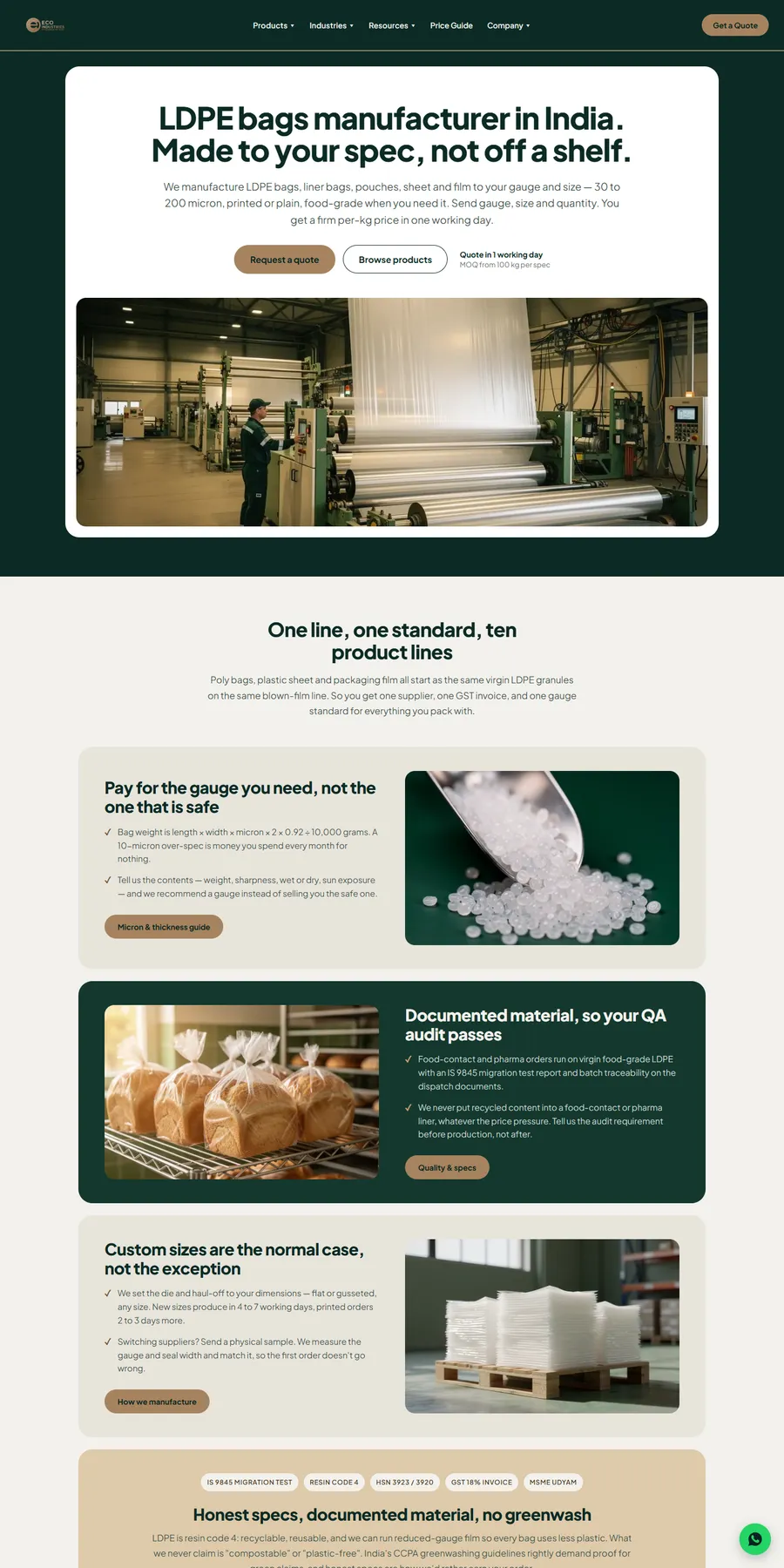
Our proof is measured B2B work where technical buyers research before they request a quote, the same way a sponsor shortlists a lab. Eco Industries, an LDPE packaging manufacturer, went from no enquiries to about 10 leads a week after we built a 44-page catalog, industry and delivery pages and technical buyer guides, and fixed 370 broken canonical references left by the old site. Terah Tex, a bulk uniform manufacturer, went from no website enquiries to about 5 bulk-order leads a week with 16 category pages and a two-step quote form. For a CRO or testing lab, the catalog becomes assay and study pages, the technical guides become method and sample requirement pages, and the quote form becomes a study quote request with protocol upload.

More websites we have designed and built

Process

How your biotech website project runs

Typical timeline: 4 to 8 weeks for most biotech and lab sites; 8 to 12 weeks for large service catalogs, many assay pages or an investor relations section. You see progress every week.

  1. Step 01 · Week 1

    Discovery and audit

    We audit your current site, competitors, and how you show up on Google and in AI answers, then agree on goals and a fixed quote.

  2. Step 02 · Weeks 2 to 3

    Strategy and design

    Sitemap, wireframes and full designs for your review. You approve everything before we build.

  3. Step 03 · Weeks 3 to 6

    Build and test

    Development, SEO setup, speed tuning, and testing across devices and browsers.

  4. Step 04 · Launch and beyond

    Launch and grow

    We launch, monitor, and improve based on real data. 30 days of free support included.

What shapes your quote

Scope, not hourly billing

Every project gets a fixed quote within 1 business day, agreed before work starts.

Get my fixed quote →
  • How many service, assay, program and site pages you need
  • Whether we write the scientific and method content from interviews with your team
  • The quote flow: document upload, NDA handling, routing rules and CRM connection
  • Investor relations section and filing feeds for public companies
  • Moving from your current site: redirects, keeping pages that rank and setting up tracking first
  • Careers integration, several lab sites or more than one brand

Biotech website questions, answered

Straight answers to what owners ask us, and what they ask Google and AI assistants. Ask us anything else.

How much does a biotech website cost?

We quote one fixed price, agreed before work starts, based on the number of pages, features, integrations and content. You get it within 1 business day of a free audit of your current site. There is no hourly billing.

How long does it take to build a biotech or lab website?

Most take 4 to 8 weeks. Large service catalogs, many assay pages or an investor relations section take 8 to 12 weeks. You get a dated week-by-week plan before we start, and we can time launch around a conference or a financing announcement.

We are a pre-revenue therapeutics company. What does our site need?

A clear statement of what you are developing and for whom, a science page a generalist investor can follow, an editable pipeline, team and advisory board, publications, news and careers. Investigational programs are described by stage and mechanism, never as safe or effective.

We are a CRO or testing lab. What should our site include?

A page per assay or study type with methods, species, matrices, sample volume and turnaround, a quality page with exact GLP, CLIA or ISO/IEC 17025 status, sample submission and shipping pages, scientist bios and a study quote form that takes a protocol under NDA.

Should we publish prices for our assays?

Where you can, a price basis or a typical range for standard assays helps, because sponsors compare labs before they call. Where pricing depends on the study, list what drives the price and make the quote form collect those details so the first reply can include a number.

Can sponsors upload protocols safely?

Yes. Uploads go to encrypted storage you control, with a link in the notification rather than an attachment, and an NDA request in the form. For clinical labs that receive patient information, forms run through a vendor that signs a business associate agreement.

How should we show GLP, CLIA and ISO 17025 on the site?

Exactly as your certificates and inspection records support: GLP compliance statement, CLIA certificate type and number, ISO/IEC 17025 accreditation body, certificate number and a link to the current scope. Claims stay within the accredited scope, and the site never says "FDA approved lab".

Who writes the scientific content?

We do, from interviews with your scientists, method documents, posters and papers. Your team reviews every page, and your regulatory or quality lead approves any claim before launch.

Can the site handle investor relations for a public company?

Yes. We build filings, press releases, events, governance and email alerts into the site, fed from your filing or newswire provider where possible. How the site is used for disclosure under Regulation FD is your counsel's call.

Our site is years old. Will a rebuild lose our search rankings?

Not if the move is planned. We keep the URLs that earn traffic, 301 redirect the rest, carry over content that works and fix technical errors. On Eco Industries we fixed 370 broken canonical references left by the old site.

How do we show up in Google and in ChatGPT when scientists search for our services?

Google says its AI features need nothing extra beyond being indexed and eligible for a snippet, with important content in text. We write services, methods, quality facts and FAQs as text, add a page per assay, and add Organization schema. No one can guarantee an AI mention, but a specific site gives assistants accurate facts to cite.

Will a new website bring us more studies?

We do not guarantee rankings or lead numbers. What a new site changes is how many qualified sponsors send a request after checking you, and whether you can see where each one came from. For two B2B manufacturers we built for, Eco Industries and Terah Tex, the sites went from no inquiries to about 10 and about 5 leads a week.

What should we ask a biotech web design company before hiring one?

Ask who writes the scientific content and how claims are reviewed, where uploaded protocols are stored, who owns the domain, hosting and analytics, whether the price is fixed, and what quote request numbers their B2B sites have produced. Vague answers usually mean a vague site.
Get your free biotech website proposal

Four quick questions. You'll get a fixed quote and a free audit of your current site within 1 business day.

  • ✓ No obligation, no sales pressure
  • ✓ Fixed price, never hourly
  • ✓ Your details stay private

Prefer email? info@billionwebstudio.com

Step 1 of 4~60 seconds
What do you need?