Skip to content
Booking projects for next month. Free website audit with every quote.Claim yours →

Professional servicesBooking projects for November

Staffing Agency Website Development Company for Client Orders and Better Applicants

A plant manager short six forklift operators for Monday looks you up after your recruiter calls. A CNA checks that your agency is real before she sends her resume. Both judge you on the same website. We build staffing sites with two clear front doors, a job board on your own domain fed by your ATS, pay ranges where the law wants them and tracking that tells a client order from an application.

  • Built for staffing agencies and recruiting firms
  • Fixed quote in 1 business day
  • You own everything
youragency.com/hire-talentWarehouse staffingin ColumbusRequest talentTap to callNew order: 6 forklift driversFrom /light-industrial · 7:12 amTracked as a leadSource: GoogleAI ASSISTANTStaffing agency near me for warehousejobs?Your Agency: light industrial staffing, 3branches, same-week fills.Source: your website
Illustration: a visit becomes a tracked lead

The short answer

What does a staffing agency website development company do?

A staffing agency website development company builds websites for staffing agencies and recruiting firms that win client orders and attract qualified candidates from the same site. It has to convince a hiring manager who was just cold-called that your agency knows their industry and fills orders fast, and convince a job seeker who has been burned by fake postings that your jobs are real, the pay is stated and applying takes minutes on a phone.

For a light industrial or clerical agency that means branch pages for every real office, a job board with one page per open order, Spanish pages and a short mobile application. For IT, engineering, healthcare or finance recruiting it means industry and role pages, a "request talent" form for clients, case studies, salary guides and a candidate path for contractors and travelers. For direct hire and executive search it means a fast, specific credibility site with the searches you run and the recruiters who run them.

Billion Web Studio is a staffing agency website development company that delivers this as one fixed-scope project: client and candidate paths, industry, role and branch pages, a job board fed by Bullhorn, JobDiva, Avionté, TempWorks or the ATS you use, JobPosting schema with pay ranges, and GA4 tracking that separates client orders from applications. You own the site, the domain and every account from day one, with no lock-in.

The market

What the numbers say about staffing agencies and recruiting firms online

Staffing is a high-volume, two-sided business. The American Staffing Association counts nearly 2.2 million temporary and contract employees at work in an average week, and BLS counted almost 2.5 million jobs in temporary help services in September 2026. Every one of those placements starts with a client order and a candidate who trusted your agency enough to apply. The numbers below show the scale and why trust is the first thing your site has to earn.

How they choose

How employers and candidates find and choose a staffing agency

Clients rarely find a staffing agency on Google first. A recruiter calls, a contact refers you, or an order goes out to several agencies at once, and then the hiring manager looks you up. Candidates arrive from job boards, Google for Jobs and referrals, and check that you are real before they apply. Here is how both sides choose, and what your site has to do at each step.

  1. 1

    The client looks you up after the call

    A plant manager, practice manager or IT director gets your email or call and searches your name. Owners on r/RecruitmentAgencies say this is the moment the decision is made. The site has to show your niche in the first screen, the roles you fill, the markets you cover and a way to send an order without another phone call.

  2. 2

    The client checks fit and risk

    Do you know their industry? How fast do you send candidates? How do you screen: background checks, drug tests, skills tests, safety training? Are your temps covered by your workers' comp and insurance? Industry pages, a plain "how we screen" page, case studies and named recruiters answer those questions before the first meeting.

  3. 3

    The candidate finds the job

    A job seeker sees your posting on a job board or in Google's job results, then often goes to your own site to apply, because applications sent through one-click buttons feel lost. Each open order needs its own page on your domain with the pay range, shift, location, start date and whether it is temp, temp-to-hire or direct hire.

  4. 4

    The candidate checks you are real

    Job scam losses reported to the FTC more than tripled from 2020 to 2023. Candidates look for a real office address, a branch phone, recruiters with names and faces, recent Google reviews and an email domain that matches the site. A site with none of these looks like the scams they have been warned about.

  5. 5

    The application, the placement and the next order

    A short mobile application, a clear note on what happens next and a recruiter who calls back turn an applicant into a placement. Pay, timesheet and benefits pages keep temps working with you. Client case studies, a review request after each assignment and a reorder link bring the next order.

The problem

Why most staffing agency websites lose client and candidate leads

What we find again and again when we audit sites in this trade. None of it is about how the site looks.

Leak 01

Your site looks like every other agency's

Skyscrapers, handshakes and "people are our greatest asset". A recruiter on r/recruiting described exactly that stock-photo look. A hiring manager who has just been cold-called by five agencies cannot tell yours knows forklift certifications, travel nurse compacts or SOC analysts from one that does not.

Leak 02

The job board breaks or lies

One agency owner on r/RecruitmentAgencies said the job feed from their ATS to the website worked 30 to 40% of the time. Jobs stay up after the order is filled, applications vanish, and candidates who applied to a closed job leave angry reviews. Google also does not allow expired jobs in its job results and can take manual action.

Leak 03

Your jobs live on someone else's site

If your openings only exist on paid job boards, you rent your candidate flow. In April 2026 an owner on r/RecruitmentAgencies reported that organic feeds to one big board had stopped and unsponsored posts went invisible. Job pages on your own domain, with structured data Google can read, keep a share of applicants that no one can switch off.

Leak 04

Clients and candidates share one inbox

A single contact form means resumes bury the client order that arrived at 7 a.m., and the sales team never learns which page brought a new account. Your site needs separate paths, forms and tracking for "hire talent" and "find a job".

Leak 05

No pay range, in states where one is required

Colorado, California, Washington, New York and a growing list of states require pay ranges in job postings, and Virginia, Maine and Connecticut added laws in 2026. Candidates on r/recruitinghell call out postings without them. A job template with no pay field is a compliance gap and a reason to skip your job.

Leak 06

Candidates cannot tell you are real

No office address, no branch phone, a generic email domain and no named recruiters are the same red flags candidates list when they warn each other about fake recruiting firms. With job scams at record levels, a vague site loses the careful applicants you want most.

Our research

We checked 16 real staffing agency websites. Here is what we found.

On October 23, 2026 we opened the homepages of 16 staffing agencies and recruiting firms that rank in Google Maps in 10 US metros, the way a customer would on a phone, and ran a mobile Lighthouse test on each. Every number below comes from that check.

  • 64/100

    median mobile Lighthouse performance score (90 or more is good)

  • 8.9 s

    median time to show the main content on a phone (target: 2.5 seconds or less)

  • 1.9 MB

    median homepage download on a phone, before anyone scrolls

  • 15 of 16 took longer than 2.5 seconds to show their main content in a mobile Lighthouse test

  • None of 16 show a tap-to-call link on the first phone screen

  • 7 of 16 show a clear call, book or quote button on the first screen

  • 8 of 16 have a contact or quote form on the homepage

  • 7 of 16 let visitors book or schedule online

  • 5 of 16 describe the business to Google with business schema markup

  • 10 of 16 have Google Analytics or Tag Manager installed

  • None of 16 use call tracking

  • 4 of 16 show a copyright year of 2024 or older (of the sites that show one)

  • 5 of 16 have images with no alt text

  • 8 of 16 link to a privacy policy

  • 12 of 16 offer live chat or texting

What this means for your staffing agency website

The three biggest gaps in the sample. Each is fixable, and each is a reason a customer picks the next result instead of you.

See how your site compares →
  1. 1

    None of the 16 show a tap-to-call link on the first phone screen. Most of these searches happen on phones. A number that is not a tap-to-call link, or sits below the fold, costs calls.

  2. 2

    None of the 16 use call tracking. Calls are the main lead source in most local trades. Without call tracking you cannot see which marketing made the phone ring.

  3. 3

    15 of 16 took longer than 2.5 seconds to show their main content in a mobile Lighthouse test. Google counts 2.5 seconds or less as a good Largest Contentful Paint. Slow first screens lose visitors before they see your phone number.

How we checked: Google Maps results for “staffing agency” in Houston, Phoenix, Atlanta, Denver, Charlotte, Columbus, Tampa, Nashville, Kansas City, Sacramento; the two highest-ranked independent businesses per city (chains and directory listings left out). 20 homepages sampled, 16 loaded for our checker (the rest blocked automated visits), 16 scored by Lighthouse in mobile mode. Lighthouse is a lab test and varies run to run; it is not the same as Google's real-user Core Web Vitals. Businesses are not named. Checked October 23, 2026.

Generic vs built for you

Why a generic website fails staffing agencies and recruiting firms

A template is built to fit every business, so it fits yours badly. Here is what changes when the site is planned around how employers and candidates actually buy.

Generic website compared with a website built for staffing agencies and recruiting firms
What you needGeneric template siteBuilt for staffing agencies and recruiting firms
Clients and candidatesOne homepage and one contact form for everyoneTwo front doors from the first screen, "Hire talent" and "Find a job", each with its own pages, form, thank-you page and conversion event
Open jobsAn iframe from the ATS, or a list you update by handOne page per job on your domain, synced from your ATS, with JobPosting schema, pay range and removal or expiry the moment the order closes
ApplyingA long form that demands an account and a cover letterA short mobile application: name, phone, email, resume upload or "apply without a resume", sent straight into your ATS with the source attached
Your nicheA "Services" page listing every industry in one paragraphA page per industry and key role you fill (light industrial, CNA, help desk, AP clerk), written with the certifications, shifts and screening that matter in each
BranchesOne contact page with every addressA page per real branch with walk-in hours, parking, the branch phone, the recruiters there and the jobs open nearby, matched to its Google Business Profile
TrustStock photos and "trusted by leading companies"Named recruiters with photos, how you screen and insure your workers, case studies with permission, Google reviews linked to the profile and a page on how to spot fake recruiters using your name
Compliance on job pagesWhatever the job description template saysA required pay range field, an EEO statement your counsel approves, an applicant privacy notice and texting consent on the form
Knowing what worksA count of form fills, resumes and spam mixed togetherGA4 events that separate client orders, calls to each branch and applications by job, source and page, with no resume data sent to analytics

Free self-check · 2 minutes

What your current staffing agency website is missing

Tick everything your site does today. Each box you cannot tick is a place where a ready-to-buy visitor leaves.

What you need

What every staffing agency website needs

The features that turn a staffing agency website from a brochure into the best salesperson you have. We build all of them.

  1. Must-have · 01

    Two front doors on the homepage

    "Hire talent" and "Find a job" side by side above the fold, so a hiring manager and a job seeker each see their next step in the first few seconds, and each path is tracked on its own.

  2. Must-have · 02

    A request talent form clients will actually use

    Role, number of people, start date, location, shift and pay or bill range, then contact details. Two steps, so a manager who stops halfway is still a lead. It routes to the right branch or desk and lands in your CRM or ATS.

  3. Must-have · 03

    A job board on your own domain, fed by your ATS

    Search by keyword, location, industry and job type, one page per job, and automatic sync from Bullhorn, JobDiva, Avionté, TempWorks, Ceipal, Loxo or your ATS. Closed jobs come down on their own. Applications go back into the ATS with the source attached.

  4. Must-have · 04

    Job pages built for Google's job results

    JobPosting schema with title, description, location, date posted, valid through and employment type, the real pay range as baseSalary, and "confidential" as the hiring organization when the client stays anonymous, as Google's documentation allows.

  5. Must-have · 05

    A mobile application that takes minutes

    Name, phone, email and a resume, or an "apply without a resume" option for hourly roles. Clear text on what happens next and when a recruiter will call. Texting consent as its own checkbox, never pre-ticked.

  6. Must-have · 06

    Industry and role pages

    Light industrial and warehouse, manufacturing, admin and clerical, IT and engineering, healthcare, accounting and finance, with the roles, certifications, screening steps and turnaround times that matter to each kind of client.

  7. Must-have · 07

    A page for every real branch

    Address, map, walk-in and interview hours, parking, the branch phone, the recruiters on site and open jobs near that office. Local candidates search "temp agency near me" and clients search by city, so each branch needs its own page and Google profile.

  8. Must-have · 08

    Proof for clients

    How you recruit and screen, safety and compliance practices, insurance and workers' comp coverage as you describe it, client case studies shared with permission, industry memberships and certifications shown only where current.

  9. Must-have · 09

    Answers for candidates

    How and when you get paid, timesheet and payroll portal links, benefits for temporary employees if you offer them, referral bonuses, temp-to-hire explained, interview tips and an FAQ in plain words.

  10. Must-have · 10

    Spanish and other language pages

    Translated pages for the job board, application and "how pay works" where your candidates need them, with the same consent and privacy text in that language.

  11. Must-have · 11

    A scam warning page

    Your official email domain and phone numbers, a statement that you never charge candidates to apply or ask them to buy equipment, and how to report a fake recruiter using your name. It protects candidates and your brand.

  12. Must-have · 12

    Fast pages and clean schema

    Organization and LocalBusiness markup for each branch, JobPosting on job pages only, and Core Web Vitals targets: LCP 2.5 seconds or less, INP 200 ms or less and CLS 0.1 or less.

What we build

The staffing agency website we would build for you

Good website design for staffing agencies starts with the sitemap. Here is the one we would start from for a regional agency with three to five branches doing light industrial, clerical and some professional placements. We cut or add pages to match the industries you serve, the branches you run and the ATS you use.

yourcompany.comHome · every section links here

Hire talent (clients)

  • Hire talent overview
  • Request talent form
  • Temporary, temp-to-hire and direct hire explained
  • How we recruit and screen
  • Safety, insurance and workers' comp
  • Case studies
  • Salary and wage guides
  • Client FAQ

Industries and roles

  • Light industrial and warehouse
  • Manufacturing and skilled trades
  • Administrative and clerical
  • Accounting and finance
  • IT and engineering
  • Healthcare
  • Role pages for your top roles (forklift operator, CNA, help desk, AP clerk)

Find a job (candidates)

  • Job search and job board
  • One page per open job
  • Apply in minutes
  • How pay and timesheets work
  • Benefits for temporary employees
  • Refer a friend
  • Candidate FAQ and interview tips
  • Job alerts sign-up

Branches

  • Locations hub
  • Page for each branch
  • Walk-in and interview hours
  • Recruiters at each branch

About and trust

  • About the agency and leadership
  • Our recruiters
  • Reviews and testimonials
  • Memberships and certifications
  • Spot a fake recruiter
  • Careers at our agency

Policies and languages

  • EEO statement
  • Applicant privacy notice
  • SMS terms
  • Accessibility statement
  • Spanish job board and application pages

Calls, bookings, leads

How we turn visitors into client and candidate leads

Good staffing agency web design is judged by orders and placements: a client order received, a call to a branch, an application for an open job. You should see where each one came from, kept apart. This is how we build both paths and track them without putting candidate data at risk.

  • 01A tracked request talent formTwo steps, routed by branch or desk to your CRM or ATS, with a thank-you page on your domain. Each submission is a GA4 conversion tagged with the industry or role page it came from.
  • 02Click to call for every branchEach branch page shows its own number as text with tap to call on mobile. Calls are tracked by page, so you know whether the warehouse staffing page or the Columbus branch page rang the phone.
  • 03Applications tracked by job and sourceEvery application is an event with the job, category and source (Google jobs, a job board, social, referral), sent into your ATS with the same source. You see which roles and channels bring applicants, without resume contents ever reaching analytics.
  • 04Job alerts and talent community sign-upsCandidates can sign up for alerts by role and location by email or text with clear consent, so the next order fills from your own list before you pay for a posting.
  • 05Spam and junk filteringValidation and server-side spam checks keep fake orders and bot applications out, so only real orders count as conversions in GA4 and in any ads you run.
  • 06A "what happens next" note on every formClients see when a recruiter will call and what to have ready. Candidates see how screening works and how soon they will hear back. Fewer follow-up calls, fewer no-shows.
  • 07A monthly report you can readClient orders, branch calls and applications by source, page and branch, in plain numbers, so you can see which industry pages win accounts and which jobs fill from your own site.

AI search

Hiring managers and job seekers now ask ChatGPT, Google AI Mode and Perplexity which agency to use: 45% of consumers use AI tools for local recommendations (BrightLocal 2026), and Pew found that when Google shows an AI summary, clicks on regular results drop from 15% to 8% of visits. Assistants build their answer from your website, your Google profiles and your reviews, so the site has to say plainly what you staff, where, how fast and with what proof.

Questions your employers and candidates ask AI assistants

  • Which staffing agencies in Columbus fill warehouse and forklift jobs?
  • Best IT contract staffing firms for a small company in Dallas
  • Temp agencies near me that hire the same week
  • Which healthcare staffing agencies place CNAs in Ohio?
  • Is this staffing agency legit, or a recruiting scam?
  • How do temp-to-hire placements work and what do agencies charge?
  • Your niche stated as text

    The industries, roles and cities you staff, written in plain sentences on industry, role and branch pages. An assistant cannot recommend you for warehouse staffing in Columbus if the site only says "workforce solutions".

  • Branch facts that match everywhere

    The same agency name, branch addresses, phones and hours on your site, each Google Business Profile and the directories you use. Mismatched details give AI systems two versions of your agency to choose from.

  • Answers clients and candidates ask

    How fast you fill, how you screen, what temp-to-hire means, how pay works, whether candidates pay anything (they should not). Each answered in the first lines of the right page, visible rather than hidden in tabs.

  • Job pages machines can read

    Real HTML job pages with JobPosting schema and pay ranges. Google uses them for its job results, and they show assistants what you hire for and where, week by week.

  • Proof an assistant can cite

    Case studies with numbers your clients approve, named recruiters, years in business, memberships and Google reviews that mention roles and cities. Assistants repeat what clients and candidates say about you.

  • AI referrals tracked

    We separate visits from ChatGPT, Perplexity and other assistants in GA4 and add an optional "How did you hear about us?" field with an AI option on the client form.

Compliance and trust

The rules a staffing agency website has to get right

A staffing site publishes job ads, collects personal data from thousands of applicants and texts people, so it touches federal anti-discrimination law, state pay transparency laws, privacy law and Google's own job rules. We build pages and forms that support these rules. We do not certify compliance; your counsel approves the wording and confirms the rules in each state you recruit in.

Job ads and discrimination

Title VII makes it unlawful for an employer or employment agency to publish a job ad showing a preference based on race, color, religion, sex or national origin, and the ADEA does the same for age. We keep a review step in the CMS for job templates and check AI-written descriptions for words like "young" or gendered titles.

Pay transparency laws

Colorado, California, Washington, New York and other states and cities require pay ranges in job postings. In 2026 Virginia (1 July), Maine (29 July, which also covers postings through a third party) and Connecticut (1 October, a range plus a general description of benefits) added laws. Every job template gets a required pay field, shown on the page and passed to schema.

Federal contractor rules changed in 2025 and 2026

Executive Order 11246 was revoked in January 2025, and OFCCP's August 2026 final rules rescind its regulations effective 26 October 2026, narrow Section 503 and update VEVRAA. If you staff for federal contractors, have counsel confirm the EEO, veteran and disability statements your job pages carry. We put the approved text in place.

Google's job posting rules

Google requires JobPosting markup only on single-job pages, a real way to apply, the actual pay rather than an estimate, and removal or expiry of filled jobs, with manual action possible for expired postings. For an anonymous client, the hiring organization can be marked "confidential". We build the sync so closed orders drop out on their own.

Applicant privacy and texting

Resumes hold personal data. Uploads go to your ATS over HTTPS, never into email or analytics. If you meet California's CCPA thresholds, applicants there are covered and need a notice at collection on the form. Texting consent is its own unticked checkbox, and the FCC's 2025 rule lets people revoke consent by any reasonable means, such as replying STOP.

Reviews and accessibility

The FTC rule in effect since 21 October 2024 bans fake reviews, rewards for positive reviews and undisclosed staff reviews. We set up one review request for every placed candidate and client, no gating. Application forms are built to a WCAG 2.2 AA target, so applicants with disabilities can apply with a keyboard or screen reader. We never call a site "ADA certified".

We build with tools and patterns that support these rules and document what we set up. For legal advice on your own obligations, talk to your attorney.

Asked online

What staffing agencies and recruiting firms ask about websites, answered

We read what agency owners and recruiters ask each other on r/RecruitmentAgencies and r/recruiting and in Facebook groups for staffing agency owners, what job seekers ask on r/jobs and Quora, and the questions viewers leave under YouTube videos about starting a staffing agency. The same themes come up: generic sites, job feeds that break, rented candidate flow on big boards, vendor lists, pay transparency and candidates who cannot tell a real agency from a scam. These are their questions, paraphrased, with factual answers.

Where owners talkr/RecruitmentAgenciesr/recruitingr/jobsYouTube comments on staffing business videosFacebook groups for staffing agency ownersQuora

From r/recruiting

“Every search firm site has skyscrapers and handshakes. How do we look professional but different?”

Our answer: Replies were candid: the website rarely wins the client by itself, sales and relationships do. So build it for the moment a prospect checks you after a call. Name the roles and industries you fill in the first screen, show recruiters with real names and photos, add two or three case studies with numbers the client approved, and explain how you screen. Specific facts beat stock photos.

From r/RecruitmentAgencies

“I am starting an agency. Do I really need a website yet, and where should I get one?”

Our answer: A new owner in the thread said yes, especially with so many spammers in the market, and others said a builder template is fine at first. Start with the domain and email on it in your own name and a clear one-page site. Add a job board, branch pages and tracked forms once order and job volume justify them.

From r/recruiting

“We left a big agency and want a job board on our new Webflow or Framer site. Which ATS can feed it?”

Our answer: Replies said all major ATS and CRMs offer an API or job feed. Before you choose, check three things: can jobs publish as real pages on your own domain rather than an iframe, do closed jobs come down automatically, and do applications return to the ATS with the source attached. Test those on a trial account before signing.

From A Facebook group for healthcare staffing agency start-ups

“Owners ask how a small agency gets onto a managed service provider or VMS vendor list. What do those programs look at?”

Our answer: A post in a staffing owners' group listed business readiness, compliance and recruiting capability as what agencies may need to demonstrate. Make those easy to verify: a capabilities page naming the roles, industries and regions you fill, your screening steps, insurance and compliance practices as you actually run them, any certifications you hold, and a downloadable capability statement with a named contact.

From r/RecruitmentAgencies

“Our ATS job board on the website works only some of the time and applicants go missing. Is that normal?”

Our answer: One owner said their feed worked 30 to 40% of the time. It should be testable: post a test job, confirm it appears on the site, apply to it, confirm the applicant lands in the ATS, close it and confirm it disappears. Google does not allow expired jobs in its job results and can take manual action, so stale listings carry a real cost.

From r/RecruitmentAgencies

“A big job board cut organic feeds and our unsponsored jobs disappeared. What is the alternative?”

Our answer: That was one owner's report from April 2026, and boards change terms often. What you control is your own job pages: indexable pages on your domain with JobPosting structured data, which Google can show in its job results, plus job alerts to your own candidate list. Keep sponsoring where it pays, but do not let one board own all your applicant flow.

From r/recruiting

“Should we post the full pay range, a buffered one or the widest possible?”

Our answer: Recruiters in the thread said post the real range because it saves everyone time. Colorado, California, Washington, New York and more states require ranges in postings, and Virginia, Maine and Connecticut added laws in 2026. Google also says baseSalary in job markup must be the actual salary, not an estimate. Have counsel set the policy, then put a required pay field in every job template.

From r/jobs

“How can a job seeker tell a real recruiting firm from one that just harvests resumes?”

Our answer: Candidates in the thread listed the red flags: jobs with the employer name removed, an apply button that never reaches a real company, no staff on LinkedIn, no working website and no address. Agencies should answer each one on the site: real branches, named recruiters, a matching email domain, live jobs, and a note that you never charge candidates. The FTC says job scam losses more than tripled from 2020 to 2023.

From Quora

“A contract job is posted by both an agency and the hiring company. Should a candidate apply through the agency or directly?”

Our answer: Candidates ask this on Quora because they fear double submission and a lower rate. Agencies can remove the doubt on the job page: say you are recruiting for the client, explain that applying both ways can cause a duplicate submission, show the real pay range, and describe what the recruiter does for the candidate, such as interview preparation and feedback.

From YouTube comments on a video about starting a staffing agency

“Could I post jobs to attract candidates before I have many orders, like other agencies seem to?”

Our answer: Post only real openings. Google's job posting rules require a way to apply and removal of expired jobs, pay transparency laws expect genuine ranges, and candidates call out ghost postings publicly. To build a bench before orders arrive, offer a talent community or job alert sign-up by role and location instead, with clear consent for email and texts.

From YouTube comments on a video about building a recruitment agency

“As a new agency, how do I handle job board fees when I need candidates fast?”

Our answer: Use paid boards for urgent orders, and build channels you do not rent: job pages on your own domain with JobPosting markup so Google can list them, alert sign-ups so past applicants hear about new orders first, and referral requests from placed workers. Track applications by source in GA4 and your ATS so you can see which board fees actually produce placements.

From YouTube comments on a video about starting a staffing agency

“How do you keep candidates warm while you are still searching for clients?”

Our answer: Give them a reason to stay in touch: job alerts by role and city, a short note on how your process works and how pay works, and a recruiter who follows up. On the site that means an alert sign-up on every job page and the candidate FAQ, with consent captured for email and, separately, for texts.

Questions are paraphrased from public posts and comments on Reddit, YouTube, forums and social media. We never quote anyone by name.

Others vs us

Staffing agency website design options: Billion Web Studio vs a website builder template vs a typical staffing marketing agency

The three ways staffing agencies and recruiting firms usually get a website, side by side.

Staffing agency website design options: Billion Web Studio vs a website builder template vs a typical staffing marketing agency
Billion Web StudioWebsite builder templateTypical industry agency
Who owns the site, domain and job pagesYou do, from day one, in your own accountsYou own the content; the site lives on the builder's platformOften the agency or its platform; job board add-ons may be theirs
Contract and pricingFixed quote in 1 business day, agreed before work starts, no lock-inMonthly subscription, you build it yourselfMonthly retainer, often a 12-month term
Client and candidate pathsTwo front doors, separate forms, thank-you pages and conversion eventsOne contact formUsually present; tracking often mixed
Job board and ATSSynced job pages on your domain from your ATS, closed jobs removed automaticallyAn embed or manual listA job board plugin, sometimes tied to their platform
Google for JobsJobPosting schema per job with pay range and expiryRarelyOften, through their plugin
Industry, role and branch pagesWritten for your niche, a page per real branchWhatever you writeTemplated pages shared across agency clients
Pay transparency and EEO textRequired pay field, counsel-approved EEO and privacy text on every jobUp to youVaries
Lead trackingOrders, branch calls and applications by source in GA4, no resume data in analyticsBasic form countsTheir dashboard, which may stay with them if you leave
AI search structureNiche and branch facts as text, Organization, LocalBusiness and JobPosting schemaDepends on the templateVaries; often not part of the website scope

Why Billion Web Studio

What we do better, and why it matters to you

  • A fixed quote in 1 business day, with a free audit

    We review your current site, job board, ATS feed, branch pages, pay range setup and tracking, then send a written scope and one fixed price based on pages, features, integrations and content. No hourly billing.

  • Built around your ATS, not around ours

    Bullhorn, JobDiva, Avionté, TempWorks, Ceipal, Loxo, Crelate or Zoho Recruit: we check what your plan allows on the audit call, then build the job feed and application flow to it. No new system to buy from us.

  • Two businesses on one site, tracked apart

    Sales sees client orders by industry page and branch. Recruiting sees applications by job and source. Nobody digs through a shared inbox to find the 7 a.m. order.

  • Job pages you own

    Indexable job pages on your domain with structured data, so a share of your candidate flow does not depend on what a job board charges next quarter.

  • You own everything from day one

    Code, design, content, domain, hosting, Google Business Profiles, GA4 and call tracking numbers in your name. No lock-in, and any developer can take the site over later.

  • A dated plan and a guarantee on it

    A week-by-week plan, weekly written updates and 30 days of free support after launch. If we slip a date because of us, the next month of support is free.

In writing, before we start

  • Fixed quote in 1 business day

    Scope, deliverables and price agreed in writing, with a free audit of your current site. No hourly billing.

  • Launch date in writing

    A dated week-by-week plan and a written update every week. If we slip because of us, the next month of support is free.

  • You own everything

    Code, design, content, domain and accounts are yours from day one. No 12-month contract, no rented site.

  • 30 days of support included

    We watch rankings, forms and call tracking after launch and fix anything that needs it.

Proof, not promises

Results from websites we have built

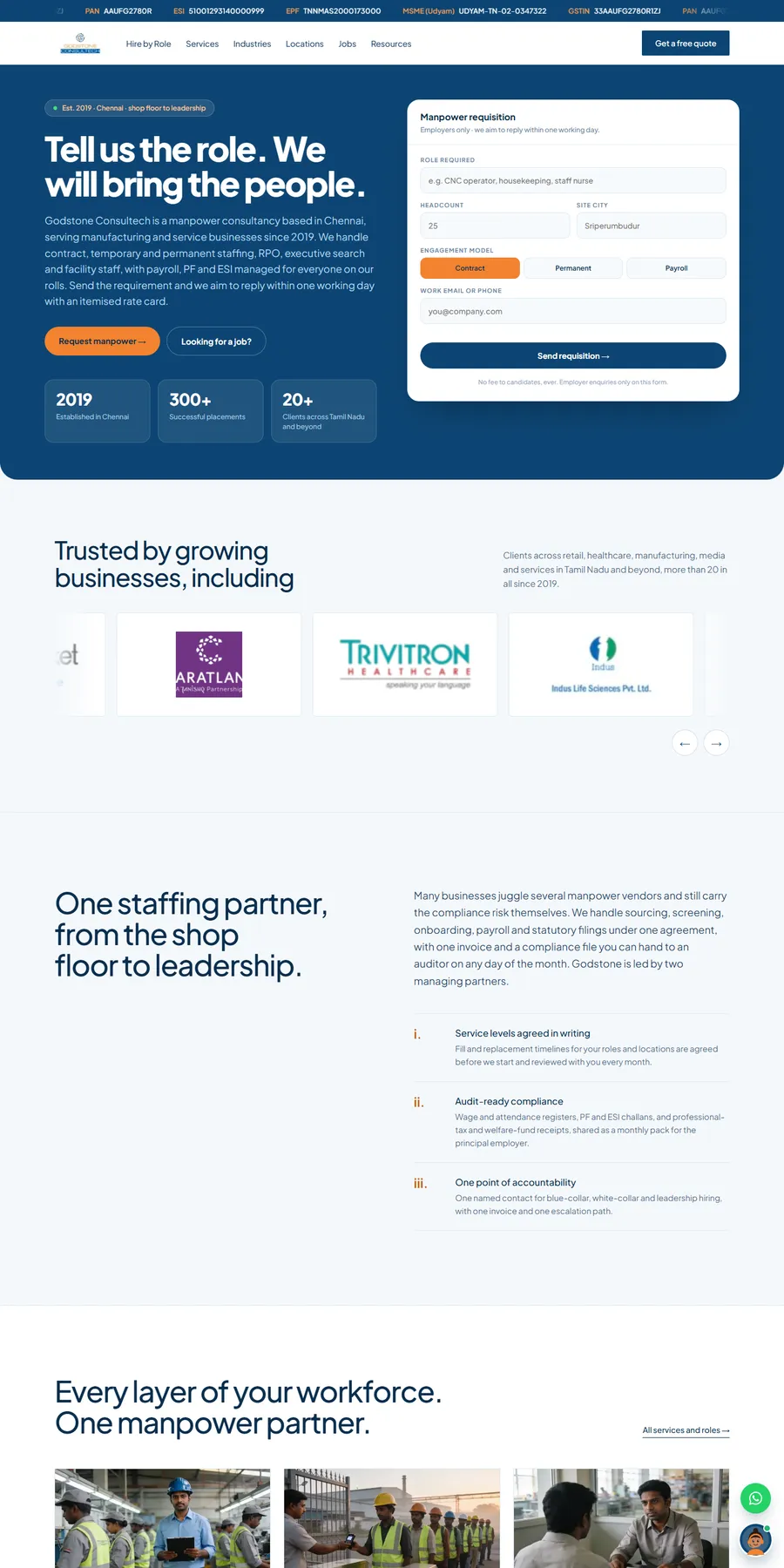
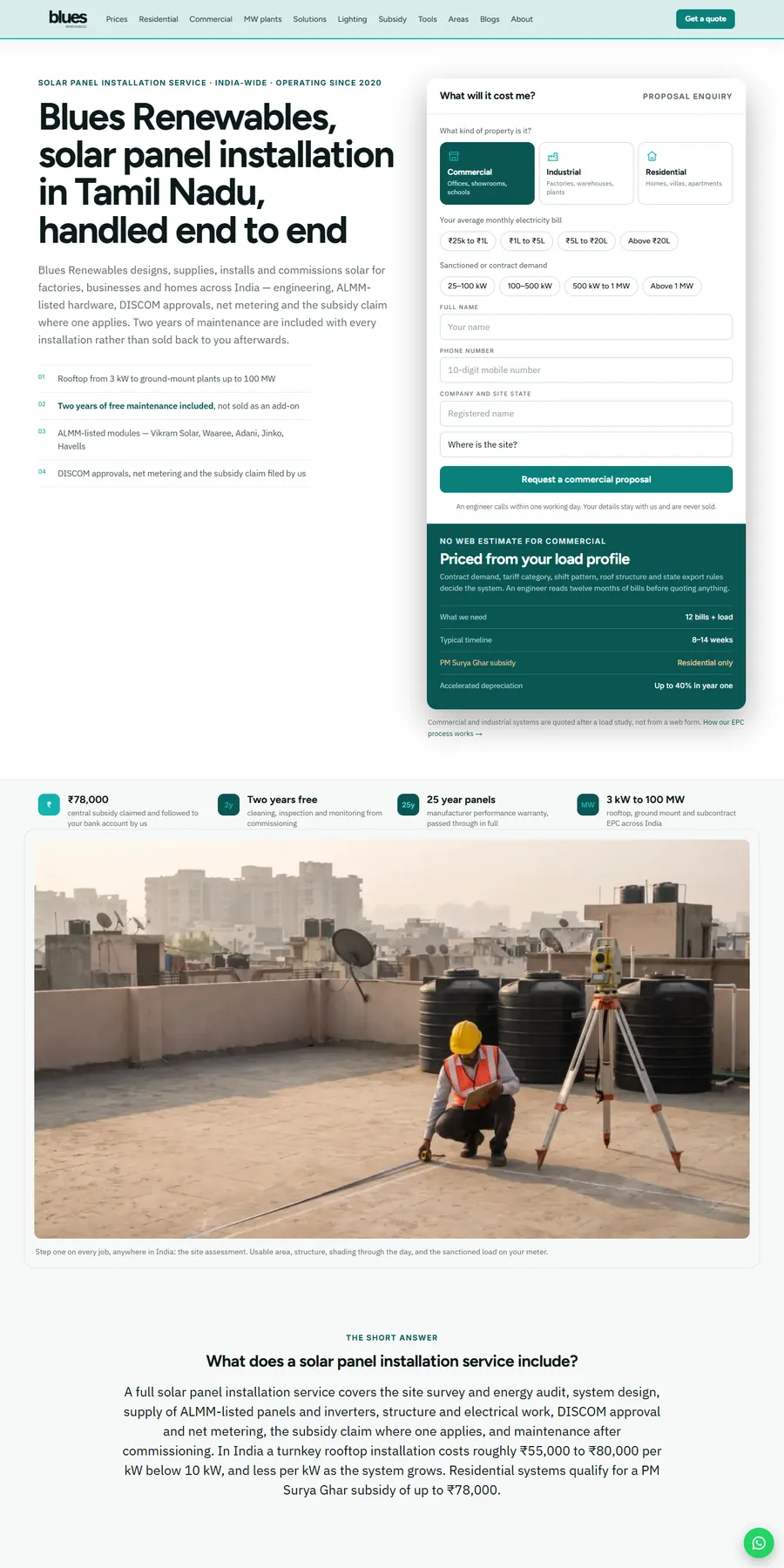
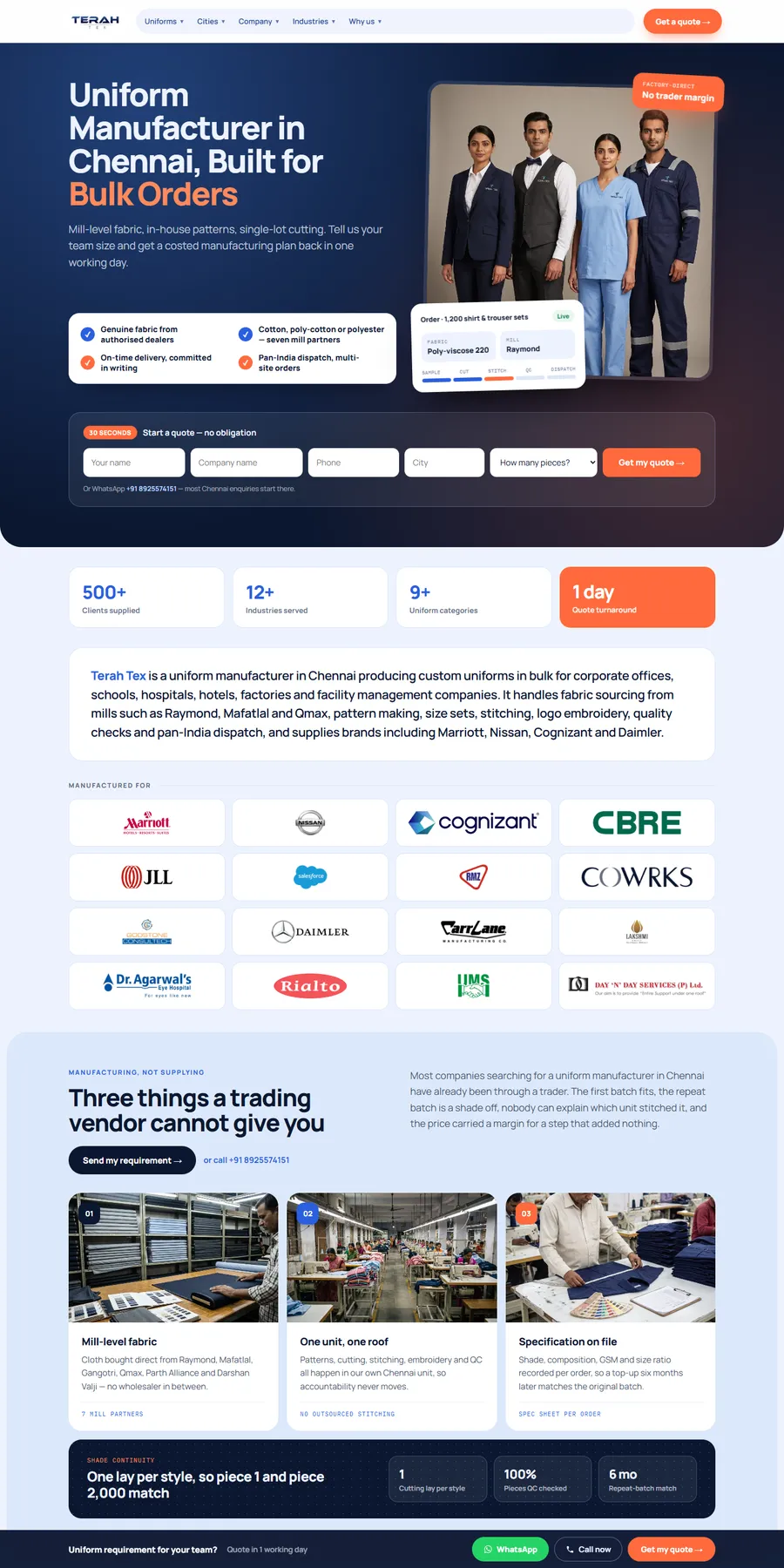
Godstone Consultech, a staffing and manpower firm in our portfolio, shows what we build for this trade: service pages for contract, temporary and permanent staffing, RPO and executive search, with lead forms for client requirements. Our measured numbers come from the same lead system on Blues Renewables, a local installer whose site went from no tracked leads to 7 to 10 enquiries a week, with Google clicks rising from 14 to 560 a fortnight in two months and every call and form tracked as a GA4 lead event. For an agency, its 129 local area guides become branch and city pages, and its tracked forms become client orders kept apart from applications. Terah Tex shows the two-step quote form we would use for a request talent form: it went from no website enquiries to about 5 bulk-order leads a week.

More websites we have designed and built

Process

How your staffing agency website project runs

Typical timeline: 4 to 8 weeks for most staffing sites; 8 to 12 weeks with many branches, industry pages or a custom ATS job feed. You see progress every week.

  1. Step 01 · Week 1

    Discovery and audit

    We audit your current site, competitors, and how you show up on Google and in AI answers, then agree on goals and a fixed quote.

  2. Step 02 · Weeks 2 to 3

    Strategy and design

    Sitemap, wireframes and full designs for your review. You approve everything before we build.

  3. Step 03 · Weeks 3 to 6

    Build and test

    Development, SEO setup, speed tuning, and testing across devices and browsers.

  4. Step 04 · Launch and beyond

    Launch and grow

    We launch, monitor, and improve based on real data. 30 days of free support included.

What shapes your quote

Scope, not hourly billing

Every project gets a fixed quote within 1 business day, agreed before work starts.

Get my fixed quote →
  • How many industry, role and branch pages you need
  • Which ATS feeds the job board, and how applications flow back into it
  • Request talent forms, routing by branch or desk and CRM connection
  • Whether we write the industry pages, recruiter bios and candidate guides
  • Spanish or other language job pages and applications
  • Moving off an old site or platform: job URLs, redirects, DNS and email records

Staffing agency website questions, answered

Straight answers to what owners ask us, and what they ask Google and AI assistants. Ask us anything else.

How much does a staffing agency website cost?

We quote one fixed price, agreed before work starts, based on the number of pages, features, integrations and content, including the ATS job feed. You get it within 1 business day of a free audit of your current site. There is no hourly billing and no monthly platform fee.

Can our job board pull jobs straight from our ATS?

Yes, for the major staffing ATS platforms through their API, feed or job board connector. Jobs appear as real pages on your site, update when you edit them in the ATS and come down when the order closes. Applications go back into the ATS with the source. We confirm what your ATS plan allows before we quote.

Will our jobs show up in Google's job search results?

We add JobPosting structured data to every job page, with pay range, location and expiry, which is what Google reads for its job results. Google decides what it shows, so no one can guarantee placement, but without the markup your own pages are not eligible at all.

Should clients and candidates use the same website?

Usually one site with two clear front doors works best, because both sides check the same brand. Each path gets its own pages, forms and tracking. A separate candidate site sometimes makes sense for a large travel nursing or IT contract brand; we go through the trade-offs on the audit call.

Do we have to post pay ranges on our job pages?

In a growing list of states and cities, yes, and Virginia, Maine and Connecticut added laws in 2026. We add a required pay range field to every job template and show it on the page and in the schema. Your counsel confirms which laws apply to your postings.

How long does a staffing agency website take, and who owns it?

Most take 4 to 8 weeks; sites with many branches, industry pages or a custom ATS feed take 8 to 12 weeks. You get a dated week-by-week plan and a written update every week. You own the code, design, content, domain and every account from day one.

Can you build pages for each branch and city we recruit in?

Yes, a page for each real branch with its phone, hours, recruiters and nearby jobs, matched to its Google Business Profile, and city pages only where you actually recruit and place. We do not publish thin city pages for places you do not serve.

We get more resumes than client orders from the site. Can you fix that?

Often the site speaks mostly to candidates. We give clients their own front door, industry pages written for hiring managers, a short request talent form and case studies, then track orders separately so you can see what changes. We do not guarantee order numbers.

Can candidates apply without a resume?

Yes, if your process allows it. For hourly roles we can offer a short form with name, phone, email and the job, and let recruiters collect a resume later. It lowers drop-off for people applying on a phone during a break.

How does our agency show up in ChatGPT and Google AI answers?

AI assistants lean on your website, Google profiles and reviews. We write your industries, roles, branches and screening steps as plain text, add Organization, LocalBusiness and JobPosting schema and make the site match your listings. No one can guarantee an AI mention, but a specific site gives them accurate facts.

Can you build Spanish pages for our job board and application?

Yes, as separate translated pages for the job board, application, how pay works and FAQ, with consent and privacy text in Spanish too. We route those applications to bilingual recruiters if you have them.

What makes you different from another staffing agency web design company?

Many staffing marketing agencies sell a site on their own platform with a monthly retainer, so the site and job board stay with them. We build a site you own outright around the ATS you already use, keep client orders and applications apart, add pay ranges and JobPosting schema, and put the terms in writing first: a fixed quote in 1 business day, a dated plan and no lock-in.
Get a free audit and a fixed quote for your agency's site

Four quick questions. You'll get a fixed quote and a free audit of your current site within 1 business day.

  • ✓ No obligation, no sales pressure
  • ✓ Fixed price, never hourly
  • ✓ Your details stay private

Prefer email? info@billionwebstudio.com

Step 1 of 4~60 seconds
What do you need?