Skip to content
Booking projects for next month. Free website audit with every quote.Claim yours →

Construction and manufacturingBooking projects for November

Wholesale Distributor Website Development Company for Online B2B Ordering

Your customers want to check stock, see their own price and reorder at 9 p.m. without waiting for a rep. New buyers want to find you when they search a part number. We build distributor sites with a searchable catalog, customer-specific pricing behind login, quick reorder and quote paths tied to your ERP, so orders stop arriving five different ways.

  • Built for wholesale distributors and industrial suppliers
  • Fixed quote in 1 business day
  • You own everything
yoursupply.com/catalogIndustrial MROsupply, 3 branchesLog in to orderTap to callReorder: 48 lines, net 30Plant account · via quick orderTracked as a leadSource: GoogleAI ASSISTANTWho stocks 316 stainless fittings nearHouston?Your Company: 316 SS fittings in stock, 3Houston branches, same-day.Source: your website
Illustration: a visit becomes a tracked lead

The short answer

What does a wholesale distributor website development company do?

A wholesale distributor website development company builds B2B websites that let your existing accounts order and pay online and let new buyers find you. For a distributor the site is two things at once: a public catalog that ranks for the products, brands and part numbers you stock, and a logged-in ordering portal where each customer sees its own price, its own approved products, stock by branch, order history, invoices and terms.

For an industrial, foodservice, building products or MRO distributor that means category and product pages with real specification attributes and manufacturer part numbers, search that understands part numbers and cross-references, quick order by SKU or spreadsheet upload, reorder from history, quote requests for large or special orders, an online credit application and resale certificate upload, branch pages with counter hours, and a line card. All of it has to stay in step with your ERP, or the website becomes another place for orders to go wrong.

Billion Web Studio is a wholesale distributor website development company that delivers this as one fixed-scope project: catalog, portal, quote and credit flows, ERP and payment integrations scoped during the audit, Organization and Product schema, and every order, quote request, credit application and call tracked in GA4. The B2B catalog and quote system behind it took two manufacturers we built for from no inquiries to about 10 and about 5 leads a week. You own the site, domain and accounts from day one, with no lock-in.

The market

What the numbers say about wholesale distributors and industrial suppliers online

Wholesale is a huge, fast-moving trade, and much of it already runs electronically through EDI and large accounts. The mid-size customer who still phones in orders is where most distributors have room to grow, and where competitors with a working portal take accounts. The figures below come from the Census Bureau, Gartner and 6sense.

How they choose

How trade buyers find and choose a wholesale distributor

A distributor's website serves two buyers. The existing account wants to reorder fast at its contract price; the new buyer is looking for a supplier who stocks the part, delivers to their area and will open an account. Here is how both move, and what your site has to do at each step.

  1. 1

    The search: a part number, a brand or a category

    A maintenance planner types a manufacturer part number, a buyer searches "316 stainless fittings Houston", a restaurant manager looks for a local produce distributor. Product and category pages with real attributes, part numbers and branch locations are what Google and AI assistants can match to those searches.

  2. 2

    The check: stock, delivery and terms

    New buyers want to know whether you carry the brand, whether it is in stock near them, how delivery and will-call work, and how to open an account. Branch pages, a line card, delivery areas and a clear "become a customer" path answer that without a phone call.

  3. 3

    The account: credit, tax and pricing

    A new account fills in a credit application, uploads a resale or exemption certificate and gets assigned a price list. When this happens on paper, it takes days; online, with the documents routed to credit and the ERP, the first order can follow the same week.

  4. 4

    The reorder: the real volume

    Most revenue is repeat orders. Logged-in customers need their own price, stock by branch, quick order by SKU, reorder from history, order status, invoices and pay online. On r/FoodService a restaurant buyer said they would never phone an order in when a portal exists.

  5. 5

    The exceptions: quotes, special orders and the rep

    Large jobs, project pricing and special orders still need a person. A quote request tied to the account and routed to inside sales keeps the rep involved where they add value, instead of retyping routine reorders.

The problem

Why most wholesale distributor websites lose trade accounts and orders

What we find again and again when we audit sites in this trade. None of it is about how the site looks.

Leak 01

Orders arrive five different ways

Reps take orders in person, some customers order on the website, others call or email PDFs. On r/CPGDistributors a distributor described nearly double-shipping an order a customer placed online and also through its rep, caught only by luck. A website that does not sync with the ERP adds a channel instead of fixing them.

Leak 02

Accounts leave for a competitor with a portal

On the same subreddit, a distributor lost a three-year wholesale account when the customer's new operations manager asked for online ordering, real-time inventory, order tracking and account history, and the distributor could not deliver them in the 60 days it was given.

Leak 03

Everyone sees the same price, or no price

Distributors sell at contract prices, price levels and customer-specific lists. A template store shows one price to everyone or hides everything behind "call for pricing". Small sellers on r/ecommerce describe being told by their platform that per-customer price lists need an enterprise plan.

Leak 04

The catalog cannot find a part number

Search that only matches product names, no manufacturer part numbers or cross-references, attributes stuck in PDFs, and product data copied from manufacturers word for word. Buyers searching a part number find another supplier, and search engines see the same text on hundreds of sites.

Leak 05

The rep is the only way to order

On r/FieldSalesHelp a distributor's rep described being the bottleneck for every order: when the rep is busy, customers cannot order. That caps growth at your reps' hours and pushes buyers toward whoever lets them order at night.

Leak 06

A portal nobody uses

On r/B2Bcommerce a distributor built a portal and half its accounts still email or phone orders. Portals fail when they are slower than a phone call: no saved lists, no reorder, wrong prices or stock that does not match the warehouse.

Our research

We checked 18 real wholesale distributor websites. Here is what we found.

On October 23, 2026 we opened the homepages of 18 wholesale distributors and industrial suppliers that rank in Google Maps in 10 US metros, the way a customer would on a phone, and ran a mobile Lighthouse test on each. Every number below comes from that check.

  • 68/100

    median mobile Lighthouse performance score (90 or more is good)

  • 5.9 s

    median time to show the main content on a phone (target: 2.5 seconds or less)

  • 3 MB

    median homepage download on a phone, before anyone scrolls

  • 13 of 18 took longer than 2.5 seconds to show their main content in a mobile Lighthouse test

  • 2 of 18 show a tap-to-call link on the first phone screen

  • 9 of 18 show a clear call, book or quote button on the first screen

  • 10 of 18 have a contact or quote form on the homepage

  • 2 of 18 let visitors book or schedule online

  • 1 of 18 describe the business to Google with business schema markup

  • 11 of 18 have Google Analytics or Tag Manager installed

  • None of 18 use call tracking

  • 4 of 18 show a copyright year of 2024 or older (of the sites that show one)

  • 8 of 18 have images with no alt text

  • 10 of 18 link to a privacy policy

  • 3 of 18 offer live chat or texting

What this means for your wholesale distributor website

The three biggest gaps in the sample. Each is fixable, and each is a reason a customer picks the next result instead of you.

See how your site compares →
  1. 1

    None of the 18 use call tracking. Calls are the main lead source in most local trades. Without call tracking you cannot see which marketing made the phone ring.

  2. 2

    Only 1 of 18 describe the business to Google with business schema markup. Schema tells Google and AI assistants exactly what you do, where and when. Without it they have to guess.

  3. 3

    Only 2 of 18 show a tap-to-call link on the first phone screen. Most of these searches happen on phones. A number that is not a tap-to-call link, or sits below the fold, costs calls.

How we checked: Google Maps results for “wholesale distributor” in Houston, Phoenix, Atlanta, Denver, Charlotte, Columbus, Tampa, Nashville, Kansas City, Sacramento; the two highest-ranked independent businesses per city (chains and directory listings left out). 20 homepages sampled, 18 loaded for our checker (the rest blocked automated visits), 18 scored by Lighthouse in mobile mode. Lighthouse is a lab test and varies run to run; it is not the same as Google's real-user Core Web Vitals. Businesses are not named. Checked October 23, 2026.

Generic vs built for you

Why a generic website fails wholesale distributors and industrial suppliers

A template is built to fit every business, so it fits yours badly. Here is what changes when the site is planned around how trade buyers actually buy.

Generic website compared with a website built for wholesale distributors and industrial suppliers
What you needGeneric template siteBuilt for wholesale distributors and industrial suppliers
CatalogProduct pages with manufacturer copy and a name searchCategory and product pages with specification attributes, manufacturer part numbers, cross-references, brand pages and search that matches part numbers
PricingOne public price, or "call for pricing"Customer-specific price lists, contract prices and price levels from your ERP after login, with optional public list prices
OrderingA retail shopping cartQuick order by SKU, spreadsheet upload, saved lists, reorder from history, multiple ship-to addresses, PO numbers and net terms
InventoryIn stock or out of stock, updated by handStock by branch synced from your ERP on a schedule you set, with will-call and delivery options
Account setup"Email us to open an account"Online credit application, resale or exemption certificate upload and approval routing to credit and the ERP
Large and special ordersA contact formA quote request tied to the account, with line items and file upload, routed to inside sales and your CRM
Branches and coverageOne address in the footerA page per branch with counter hours, delivery areas, staff contacts and Google Business Profile links
Tracking and ownershipPlatform reports you cannot connect to salesOrders, quotes, credit applications and calls by source in GA4 and your CRM, with site, domain and data in your name

Free self-check · 2 minutes

What your current wholesale distributor website is missing

Tick everything your site does today. Each box you cannot tick is a place where a ready-to-buy visitor leaves.

What you need

What every wholesale distributor website needs

The features that turn a wholesale distributor website from a brochure into the best salesperson you have. We build all of them.

  1. Must-have · 01

    A homepage that says what you stock and where you deliver

    Product categories, key brands, branches and delivery area on the first screen, with "Log in to order" and "Open an account" side by side. A buyer should know in five seconds whether you can supply them.

  2. Must-have · 02

    Category and product pages with real attributes

    Size, material, rating, pack quantity, manufacturer part number and cross-references as filterable attributes, product images, spec sheets and SDS as downloads beside the text, and unique copy on the categories that matter most.

  3. Must-have · 03

    Search that understands part numbers

    Search across your SKUs, manufacturer part numbers, customer part numbers and common misspellings, with filters by attribute and brand. For most buyers, search is the catalog.

  4. Must-have · 04

    Customer-specific pricing and catalogs

    After login, each account sees its own price list, contract items and approved products, pulled from your ERP. Public visitors see list prices or a "log in for price" prompt, as you decide.

  5. Must-have · 05

    Fast reordering

    Quick order by SKU, spreadsheet upload, saved lists for each location or job, reorder from history and order templates. If reordering online is slower than calling the rep, customers keep calling.

  6. Must-have · 06

    Account self-service

    Order status and tracking, invoices and statements, pay online through a hosted payment provider, multiple users with approval limits, ship-to addresses and PO numbers.

  7. Must-have · 07

    Online credit application and tax documents

    A credit application routed to your credit team, resale or exemption certificate upload with expiry reminders, and W-9 and terms downloads. States set their own certificate rules, so your tax lead decides which forms you accept.

  8. Must-have · 08

    Quote requests for large and special orders

    A quote form inside the account with line items, quantities, job name and file upload, routed to inside sales, so project pricing still gets a person and routine orders do not.

  9. Must-have · 09

    Branch, line card and supplier pages

    A page per branch with counter hours, delivery area and contacts, a line card of brands you carry, and a page for manufacturers who want you to distribute their line.

  10. Must-have · 10

    Punchout and EDI for large accounts

    Large buyers may order from their own procurement systems through punchout (cXML or OCI) or EDI. We scope how the website and portal sit alongside those channels so pricing and orders stay consistent.

  11. Must-have · 11

    Careers for drivers, warehouse and counter staff

    Open roles by branch, shifts, pay ranges where you choose, CDL requirements for drivers and a short mobile apply form kept apart from orders.

  12. Must-have · 12

    Schema, speed and a clean move

    Organization and Product schema matching the visible text, Core Web Vitals targets of LCP 2.5 seconds or less, INP 200 ms or less and CLS 0.1 or less on catalog pages, and a 301 redirect map that keeps every URL that already earns traffic.

What we build

The wholesale distributor website we would build for you

Here is the sitemap we start from for a regional distributor with several branches. Good wholesale website design starts from this list of pages and the ERP data behind them, not from a homepage layout. We cut or add categories, branches and portal features to match how your customers actually buy.

yourcompany.comHome · every section links here

Catalog

  • Category pages with filters
  • Product pages with attributes and spec sheets
  • Brands and line card
  • Part number and cross-reference search
  • New products and closeouts
  • Industries served

Ordering portal

  • Log in and account dashboard
  • Quick order and spreadsheet upload
  • Saved lists and reorder from history
  • Order status and tracking
  • Invoices, statements and pay online
  • Users, approvals and ship-to addresses

Become a customer

  • Open an account
  • Credit application
  • Resale and exemption certificates
  • Terms of sale and returns
  • Request a quote

Branches and service

  • Branch pages with counter hours
  • Delivery areas and will-call
  • Services: kitting, vendor managed inventory, repairs
  • Contact by department

Suppliers and company

  • Become a supplier
  • About and history
  • News and promotions
  • Careers by branch

Calls, bookings, leads

How we turn visitors into trade accounts and orders

Good website design for wholesalers is judged by orders that move online, new accounts that open without paperwork and quote requests that reach inside sales fast. This is how we build each path and track it.

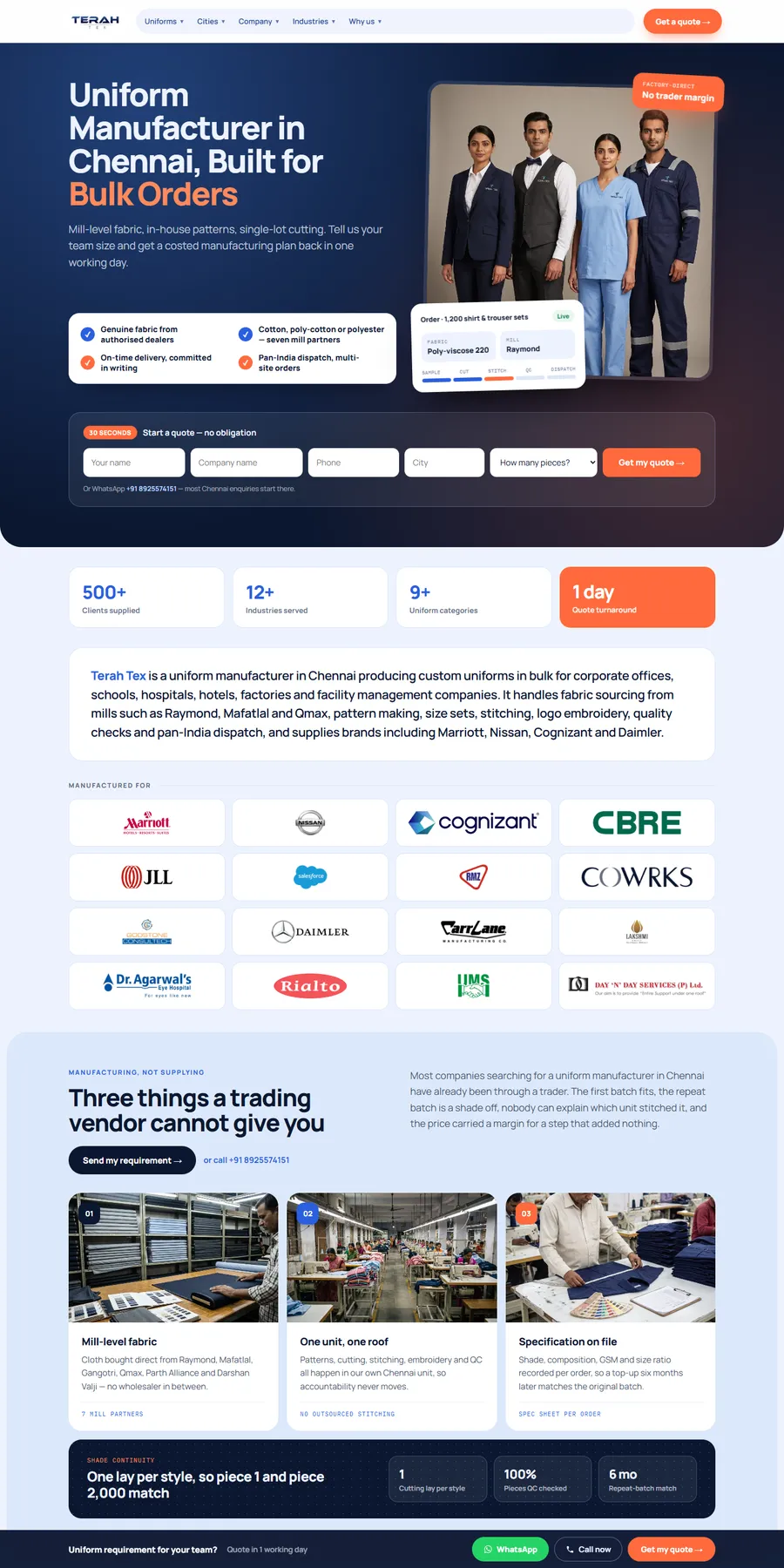
  • 01A become-a-customer pathA short first step (company, location, what you buy) then the credit application and certificate upload, routed to credit and sales. We used a two-step quote form for Terah Tex, a bulk uniform manufacturer that went from no website inquiries to about 5 bulk-order leads a week.
  • 02Quote requests with line itemsLogged-in and public quote forms with SKUs or descriptions, quantities, job name, need-by date and file upload, routed by branch or product line to inside sales and your CRM, with a stated reply time.
  • 03Online orders that land in the ERPOrders, PO numbers, ship-to and terms written to your ERP through its API or an integration tool, so there is one record per order. Where the ERP has no usable API, we scope a file or email-based handoff and say so in the quote.
  • 04Adoption built into launchAccount invitations with saved lists already loaded from order history, a short guide for buyers and a dashboard showing which accounts order online, so reps can move their regulars over one by one.
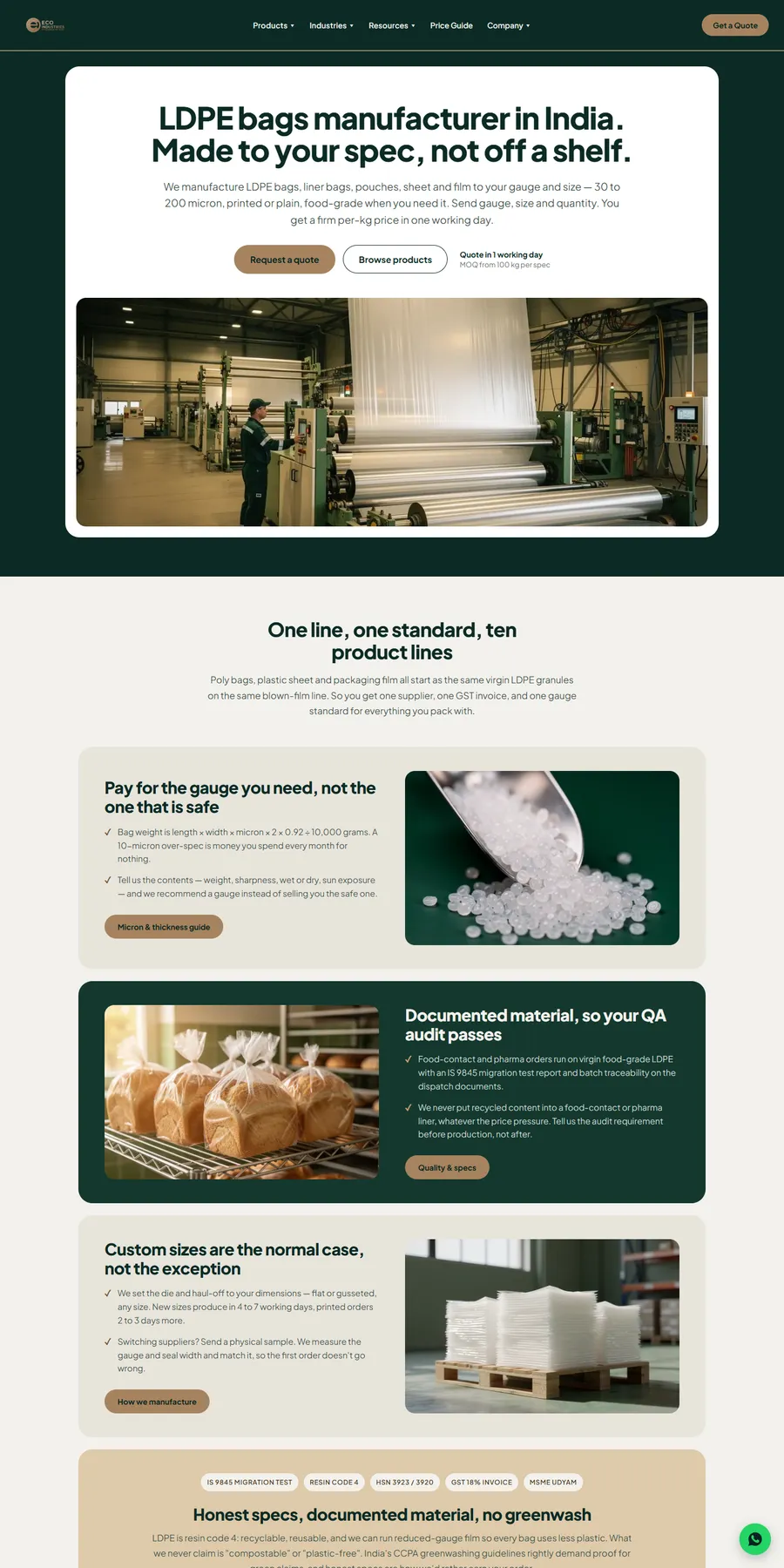
  • 05Category and branch landing pagesPages for the categories, brands and branches you want to grow, each with its own quote and account links. Eco Industries' industry and delivery pages did this job for a B2B catalog that went from no enquiries to about 10 leads a week.
  • 06Calls tracked by branchEach branch number tracked as its own conversion, so you can see which pages and searches produce counter and phone business as well as online orders.
  • 07A monthly report in plain numbersOnline orders and share of orders, new accounts, quote requests, credit applications and calls by source and branch. The same lead tracking setup records every form and call on the Blues Renewables site we built.

AI search

Buyers now ask AI assistants which supplier stocks a part near them, what a part cross-references to, or which distributors carry a brand in their region. Gartner's March 2026 survey found 45% of B2B buyers used AI during a recent purchase. Google says its AI Overviews and AI Mode need nothing extra beyond being indexed and eligible for a snippet, with important content in text. For a distributor, that means stock, brands, part numbers and branch locations written where machines can read them.

Questions your trade buyers ask AI assistants

  • Who stocks 316 stainless steel pipe fittings near Houston?
  • Which distributors carry this brand of motor in Ohio?
  • What is a cross-reference for this bearing part number?
  • Which foodservice distributors deliver to restaurants in my county?
  • How do I open a wholesale account with an electrical supply house?
  • Which packaging distributors sell stretch film by the pallet?
  • Products and attributes as text

    Part numbers, attributes, brands and pack quantities in HTML on each product page. An assistant cannot match a part number that only exists inside a PDF catalog.

  • Brand and category pages per branch area

    Pages for the brands and categories you want to sell, tied to the branches that stock them, so an assistant can answer "who carries this near me" with your name.

  • Unique descriptions

    Your own copy on key categories and products, with the application notes your counter staff give customers. Manufacturer copy shared by every distributor gives assistants no reason to name you.

  • Answers to account questions

    How to open an account, minimums, delivery areas and schedules, will-call hours, returns and terms, each answered in the first lines of its page.

  • Organization, LocalBusiness and Product schema

    Structured data for the company, each branch and key products that matches the visible page, so search engines and AI systems read the same facts a buyer sees.

  • One identity everywhere

    The same company name, branch addresses and phone numbers on your site, each Google Business Profile, supplier directories and manufacturer "where to buy" pages.

Compliance and trust

The rules a wholesale distributor website has to get right

A distributor's website handles tax documents, payments, product claims and, in some states, consumer warnings. We build the forms and pages so your team can apply its rules consistently. We do not certify compliance; your tax, credit and legal advisers set the rules.

Resale and exemption certificates

Each state sets its own rules for resale and exemption certificates. The Multistate Tax Commission says 36 states have indicated its Uniform Sales and Use Tax Resale Certificate can be used as a resale certificate, and tells sellers to confirm acceptance with each state. We build certificate upload, storage and expiry reminders, and your tax lead decides which forms you accept.

Card payments kept off your servers

Invoice payments and card orders run through a hosted payment provider, so card data never touches your website or ERP, which keeps your PCI DSS scope as small as possible. ACH and net terms follow your credit team's approval rules.

California Proposition 65 warnings online

If you sell consumer products into California, the safe harbor rule for internet purchases (27 CCR 25602(b)) allows the warning on the product display page, a clearly marked "WARNING" link on that page, or a prominent warning before the purchase is completed. We add a warning field per product so your compliance lead controls which items carry one.

Made in USA and product claims

The FTC says an unqualified Made in USA claim means all or virtually all made in the US, and that its standard covers websites, where flags can imply origin. Private label and distributor product pages show origin claims only where your supplier documents support them.

Testimonials and reviews

The FTC rule on consumer reviews and testimonials (16 CFR 465), in force since October 2024, bans fake or misrepresented reviews and testimonials. Customer quotes on the site are real, used with permission and attributed by role and industry when the company cannot be named.

Accessibility

The Justice Department says the ADA applies to the web content of businesses open to the public, which includes distributors with counters and public ordering. We build to WCAG 2.2 AA as standard practice: labeled forms and filters, keyboard navigation, color contrast and alt text. We do not label any site "ADA compliant".

We build with tools and patterns that support these rules and document what we set up. For legal advice on your own obligations, talk to your attorney.

Asked online

What wholesale distributors and industrial suppliers ask about websites, answered

We read what distributors and their customers ask each other on r/CPGDistributors, r/B2Bcommerce, r/FieldSalesHelp, r/smallbusiness, r/ecommerce, r/shopify and r/FoodService, in YouTube comments under videos about starting and running a distribution business, and in the WordPress.org support forum for a wholesale pricing plugin. The same problems come up: customers who want to order online, orders arriving through too many channels, platforms that cannot handle customer-specific pricing, and portals customers ignore. These are their questions, paraphrased, with factual answers.

Where owners talkr/CPGDistributorsr/B2Bcommercer/FieldSalesHelpr/smallbusinessr/ecommercer/shopifyr/FoodServiceYouTube comments on distribution business videosWordPress.org support forum for a WooCommerce wholesale pricing plugin

From r/CPGDistributors

“We lost a major account because we could not offer online ordering. How do we avoid that again?”

Our answer: The customer wanted online ordering, real-time inventory, order tracking and account history within 60 days. Start with the minimum that keeps accounts: login, customer-specific prices, stock by branch, quick reorder and order status, synced with your ERP. A portal of that scope is a weeks-long project, not a year, if the ERP has a usable API.

From r/CPGDistributors

“Orders come from reps, the website, phone and email PDFs. How do we stop the chaos?”

Our answer: The fix is one order record, not one channel. Online orders write to the ERP, reps enter orders in the same system, and customers see order status online so they stop calling to check. That is what prevents the double shipment the poster nearly made when a customer ordered online and through the rep.

From r/B2Bcommerce

“We built a B2B portal and half our accounts still email or call orders. Do buyers ever adopt self-service?”

Our answer: Replies said older and government buyers prefer phone, fax or email, and that real-time pricing, stock visibility and faster confirmations win them over, with a quote option for those who want a person. Load each account's saved lists from order history before inviting them, and let reps move their regulars over one at a time.

From r/FieldSalesHelp

“Every order has to go through me as the rep. Can customers order directly?”

Our answer: Yes, and replies agreed that tying ordering to one person caps the business at that person's hours. A portal with customer-specific prices and reorder lists lets routine orders come in at any hour, while the rep keeps quotes, new products and problem accounts.

From r/smallbusiness

“Our family wholesale business takes orders from WhatsApp broadcasts and re-keys them into QuickBooks. What should we use?”

Our answer: A logged-in catalog where customers see what is in stock and order directly, with orders passed into your accounting system instead of re-keyed. At your size the platform matters less than the sync and the pricing rules, so check both before you choose software.

From r/ecommerce

“We need each business customer to see only its approved products at its own price list. Is there a sensible way to do that?”

Our answer: Platforms often reserve per-customer catalogs and price lists for their top plans, which is the poster's problem. Before choosing, list your pricing rules (price levels, contract items, customer lists, quantity breaks) and confirm the platform or a custom build can pull them from your ERP. We scope this in the audit before we quote.

From r/shopify

“Can we run wholesale accounts, custom pricing and payment terms from the same store as our retail site?”

Our answer: It can work, and many sellers do it with a wholesale app or a separate B2B store. Keep wholesale behind login, with its own price lists, minimums, shipping options and net terms, and make sure orders from both channels land in one place for fulfillment and accounting.

From r/FoodService

“As restaurant buyers, do you order from distributors online or by phone?”

Our answer: The replies were short: online portal, and one buyer said they would never phone an order in. For a foodservice distributor, that makes order cutoff times, delivery days, substitutions and order history on the portal as important as the product catalog.

From YouTube comments on a video about starting a wholesale distribution business

“I want to run my wholesale distribution business online through my WooCommerce store. How do I do that?”

Our answer: WooCommerce can sell wholesale with plugins that add wholesale roles, price tiers, minimum quantities and hidden prices for the public. What matters more is the operations behind it: approving accounts before they see prices, collecting resale certificates, offering net terms for approved buyers, and passing orders and inventory to your accounting or ERP system so stock and invoices stay right.

From YouTube comments on a video about challenges distributors face

“We are launching our own product brand. How do we find distributors to carry it?”

Our answer: Distributors take on lines that fill a gap for customers they already serve and that come with sales support. Look for the distributors whose line cards list your category, check their "become a supplier" or vendor pages, and send what they ask for: margins, minimums, marketing support and product data. If you are the distributor, publish that page so good brands can find you.

From WordPress.org support forum for a WooCommerce wholesale pricing plugin

“One wholesale customer's order was charged retail prices while orders just before and after were correct. How do we stop that?”

Our answer: Plugin support said the usual cause is a product with no wholesale price set, and otherwise a plugin or theme conflict. The fix is process as much as software: make wholesale price a required field for every product, test orders while logged in as each customer type after every update, and have your ERP or order import flag any wholesale order priced at retail before it ships.

Questions are paraphrased from public posts and comments on Reddit, YouTube, forums and social media. We never quote anyone by name.

Others vs us

Wholesale website design options: Billion Web Studio vs an off-the-shelf B2B store template vs a typical distribution marketing agency

The three ways wholesale distributors and industrial suppliers usually get a website, side by side.

Wholesale website design options: Billion Web Studio vs an off-the-shelf B2B store template vs a typical distribution marketing agency
Billion Web StudioWebsite builder templateTypical industry agency
Who owns the site, domain and dataYou do, from day one, in your own accountsYou own the content; the store lives on the platformOften the agency or its platform, on a contract
Contract and pricingFixed quote in 1 business day, agreed before work starts, no lock-inMonthly subscription, with B2B features often on top plansMonthly retainer, often on a 12-month or longer contract
Timeline and plan4 to 8 weeks for a catalog site, 8 to 12 for a full portal, a dated week-by-week plan, and the next month of support free if we slip a dateAs fast as you can configure it yourselfVaries; ask for a dated plan in writing
Customer-specific pricingPrice lists, contract items and approved catalogs from your ERPDepends on plan and appsVaries; often scoped as a separate project
Catalog and searchAttributes, part numbers, cross-references and unique copy on key categoriesProduct names and manufacturer copyVaries
ERP integrationScoped in the audit and written into the fixed quoteApps or connectors you manageVaries; ask who maintains it
Account setupOnline credit application and certificate upload routed to creditCustomer sign-up formVaries
TrackingOnline orders, quote requests, credit applications and calls by source and branchStore sales reportsTheir dashboard, which may stay with them if you leave

Why Billion Web Studio

What we do better, and why it matters to you

  • Built around your ERP and pricing rules

    Most wholesale web design starts from a store theme. Ours starts from your price levels, contract items, branches and ERP, so the portal shows the right price and stock on day one.

  • A fixed quote in 1 business day, with a free audit

    We review your current site, catalog data, ordering channels, ERP and tracking, then send a written scope and a fixed price based on pages, features, integrations and content. No hourly billing.

  • A B2B catalog and quote system with measured results

    The catalog, industry pages and two-step quote form we built for Eco Industries and Terah Tex took both manufacturers from no inquiries to steady weekly leads. For a distributor we add login pricing, reorder and ERP sync on top.

  • Large structured catalogs are routine for us

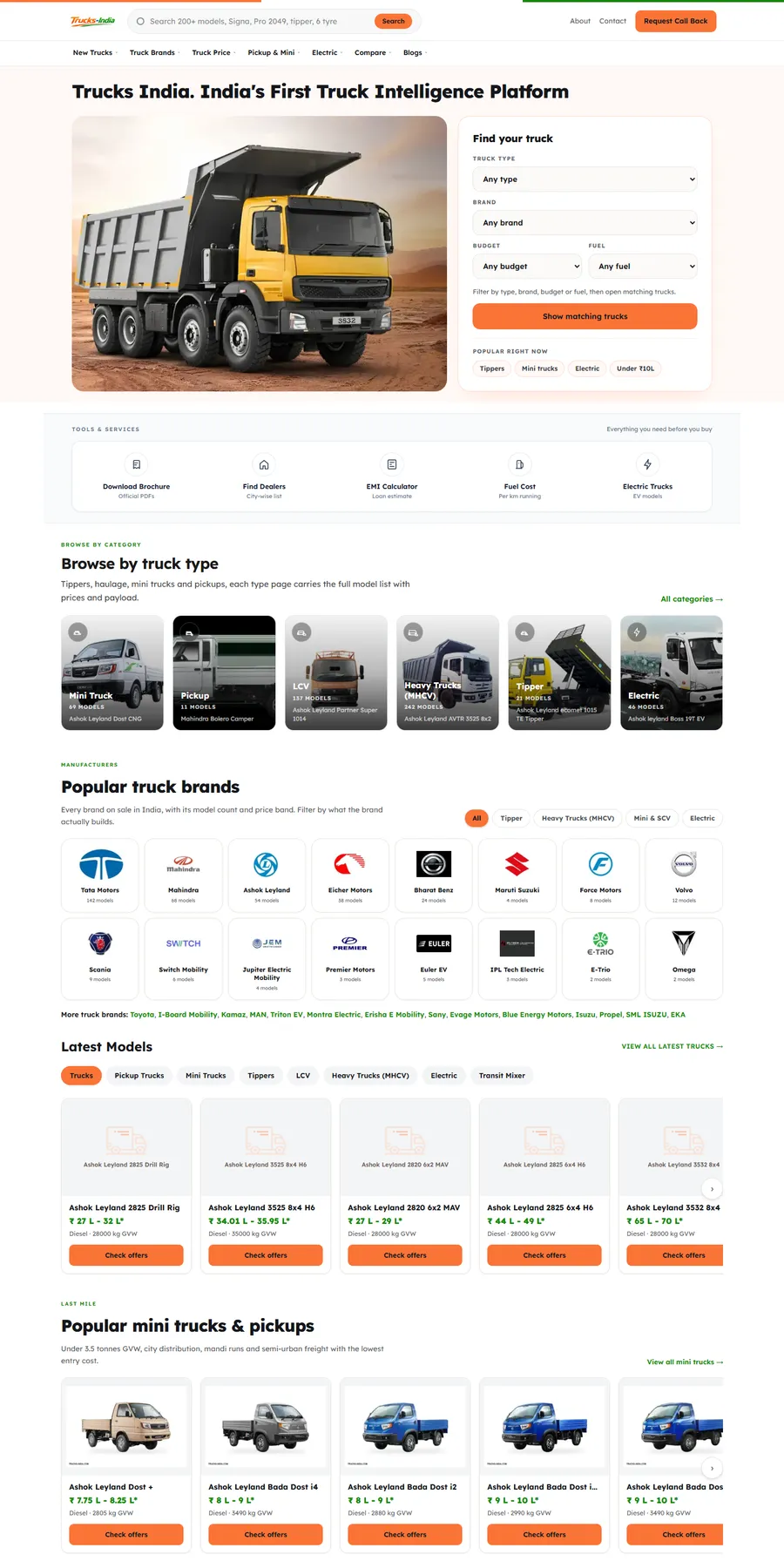
    Trucks India runs 497 truck models and 1,299 variant pages with comparison and price tools, built from structured data. A distributor catalog with attributes and filters is the same kind of build.

  • You own everything from day one

    Code, design, content, domain, hosting, analytics and integrations in your name, with an editable CMS and training. No lock-in.

  • A dated plan and a guarantee on it

    A week-by-week plan, weekly written updates and 30 days of free support after launch. If we slip a date because of us, the next month of support is free.

In writing, before we start

  • Fixed quote in 1 business day

    Scope, deliverables and price agreed in writing, with a free audit of your current site. No hourly billing.

  • Launch date in writing

    A dated week-by-week plan and a written update every week. If we slip because of us, the next month of support is free.

  • You own everything

    Code, design, content, domain and accounts are yours from day one. No 12-month contract, no rented site.

  • 30 days of support included

    We watch rankings, forms and call tracking after launch and fix anything that needs it.

Proof, not promises

Results from websites we have built

Our proof is measured B2B catalog work. Eco Industries, an LDPE packaging manufacturer, went from no enquiries to about 10 leads a week after we built a 44-page catalog, industry and delivery pages and technical buyer guides, and fixed 370 broken canonical references left by the old site. Terah Tex, a bulk uniform manufacturer, went from no website enquiries to about 5 bulk-order leads a week with 16 category pages, category and city pages across six metros and a two-step quote form. Trucks India shows the scale of structured catalog we build: 497 truck models, 1,299 variant pages and comparison, price and EMI tools. For a distributor, those become category and brand pages, branch pages, a become-a-customer flow and a quote path, with login pricing and reorder on top.

More websites we have designed and built

Process

How your wholesale distributor website project runs

Typical timeline: 4 to 8 weeks for a catalog site with quote and account requests; 8 to 12 weeks for a full ordering portal with ERP pricing and inventory sync. You see progress every week.

  1. Step 01 · Week 1

    Discovery and audit

    We audit your current site, competitors, and how you show up on Google and in AI answers, then agree on goals and a fixed quote.

  2. Step 02 · Weeks 2 to 3

    Strategy and design

    Sitemap, wireframes and full designs for your review. You approve everything before we build.

  3. Step 03 · Weeks 3 to 6

    Build and test

    Development, SEO setup, speed tuning, and testing across devices and browsers.

  4. Step 04 · Launch and beyond

    Launch and grow

    We launch, monitor, and improve based on real data. 30 days of free support included.

What shapes your quote

Scope, not hourly billing

Every project gets a fixed quote within 1 business day, agreed before work starts.

Get my fixed quote →
  • Catalog size and where product data lives (ERP, PIM or spreadsheets)
  • Pricing rules: price levels, contract items, customer lists and quantity breaks
  • ERP integration depth: pricing, inventory, orders, invoices and how often they sync
  • Account features: credit application, certificates, users and approvals, pay online
  • Moving from your current site: redirects, keeping pages that rank and setting up tracking first
  • Number of branches, punchout or EDI coexistence, and careers

Wholesale distributor website questions, answered

Straight answers to what owners ask us, and what they ask Google and AI assistants. Ask us anything else.

How much does a wholesale distributor website cost?

We quote one fixed price, agreed before work starts, based on pages, catalog size, features, ERP integrations and content. You get it within 1 business day of a free audit of your current site and systems. There is no hourly billing.

How long does it take to build a distributor website with online ordering?

A catalog site with quote and account requests takes 4 to 8 weeks. A full ordering portal with ERP pricing and inventory sync takes 8 to 12 weeks. You get a dated week-by-week plan before we start.

Can the website show each customer its own price?

Yes. After login, each account sees its own price list, contract items and approved products, pulled from your ERP. Public visitors see list prices or a log-in prompt, whichever you choose.

Will it connect to our ERP?

It depends on your ERP's API. We check it during the audit and write the integration into the fixed quote: pricing, inventory, orders, invoices and how often each syncs. Where an ERP has no usable API, we say so and scope a file or email-based handoff instead.

Do we need a custom portal or a platform like BigCommerce or Shopify?

A platform fits when your pricing rules and catalog fit its B2B features at a plan you accept. A custom portal fits when they do not. We decide this in the audit against your actual pricing rules, not the other way round.

How do we get customers to actually order online?

Make it faster than calling: saved lists from their order history, correct prices and stock, quick reorder and order status. Invite accounts with lists already loaded, give reps a dashboard of who orders online, and keep a quote path for orders that need a person.

Can new customers apply for credit and upload resale certificates online?

Yes. The credit application and certificate upload route to your credit team, with expiry reminders for certificates. Your tax lead decides which certificate forms you accept in each state.

Can we keep EDI and punchout for our large accounts?

Yes. Large buyers can keep ordering through EDI or punchout from their procurement systems. We scope how the website and portal sit alongside those channels so pricing and order records stay consistent.

Our product descriptions come from manufacturers. Is that a problem for SEO?

For the categories and products you most want to sell, yes: hundreds of distributors publish the same text. We keep manufacturer specs as attributes and write unique category copy and application notes where they matter most.

How do we show up in Google and in ChatGPT when buyers search for parts?

Google says its AI features need nothing extra beyond being indexed and eligible for a snippet, with important content in text. We put part numbers, attributes, brands and branches in text, add Organization, LocalBusiness and Product schema, and keep branch details consistent. No one can guarantee an AI mention.

Will a new website increase our sales?

We do not guarantee rankings or sales. A new site changes how many orders move online, how fast new accounts open and whether you can see where each order and quote came from. For two B2B manufacturers we built for, the sites went from no inquiries to about 10 and about 5 leads a week.

What should we ask a wholesale web design company before hiring one?

Ask how they handle customer-specific pricing, which ERPs they have connected and how the sync works, who maintains the integration, who owns the store data, domain and analytics, and whether the price is fixed.
Get your free wholesale distributor website proposal

Four quick questions. You'll get a fixed quote and a free audit of your current site within 1 business day.

  • ✓ No obligation, no sales pressure
  • ✓ Fixed price, never hourly
  • ✓ Your details stay private

Prefer email? info@billionwebstudio.com

Step 1 of 4~60 seconds
What do you need?