Booking projects for next month. Free website audit with every quote.Claim yours →
Professional servicesBooking projects for November
Commercial Real Estate Website Development Company for Brokerages and Investment Firms
A tenant rep searches for 12,000 square feet of flex space near the airport. An owner deciding who should list a strip center checks which firm has sold three like it. An investor wants the offering memorandum. All of them land on listing platforms first and then check your site. We build commercial real estate sites that hold your listings, closed deals, brokers and research on your own domain, and show which inquiries came from where.
Built for commercial real estate brokerages and investment firms
Fixed quote in 1 business day
You own everything
Illustration: a visit becomes a tracked lead
The short answer
What does a commercial real estate website development company do?
A commercial real estate website development company builds websites for commercial brokerages and investment firms that turn listing views, owner research and investor interest into tour requests, listing pitches and offering memorandum requests. The site has to present available properties clearly, prove the firm's track record by property type and submarket, introduce brokers with their deal history and keep confidential materials behind the right gate.
For a regional brokerage that means a property search synced from your listing database, a page per listing with flyer, photos, map and specs, a closed deals section by property type and submarket, broker pages with deal sheets and licenses, service pages for tenant rep, landlord rep and investment sales, dated submarket reports, and an offering memorandum request with a confidentiality agreement. Investment firms add strategy, team, track record within the rules and an investor portal login.
Billion Web Studio is a commercial real estate website development company that delivers this as one fixed-scope project: design, listings connected to the database or feed you already use, deal history, broker, service and research pages, Organization and RealEstateAgent schema, Core Web Vitals targets and GA4 tracking that separates tour requests, OM requests and listing inquiries by source. You own the site, the domain and every account from day one, with no lock-in.
The market
What the numbers say about commercial real estate brokerages and investment firms online
Commercial real estate is a large, relationship-driven market where buyers and tenants do much of their research before they ever call a broker. The figures below show the size of the market and how business buyers now shortlist firms, often with AI tools, before first contact.
5.9 million
commercial buildings in the US, in the latest released federal survey of commercial buildings (2018 data)
How investors and tenants find and choose a commercial real estate firm
Commercial clients come in four kinds: tenants looking for space, owners choosing a listing broker, buyers and investors looking for deals, and referral partners such as attorneys, lenders and accountants. Most of them build a shortlist before they call. Here is how each one checks a commercial firm and what your site has to show.
1
The search: space or a deal that fits
Tenants and buyers filter by property type, submarket, size, price and use on listing platforms and broker sites. Your site needs a property search that works on a phone, listing pages with specs, flyers and maps, and an easy tour or information request.
2
The shortlist: who knows this submarket?
Owners deciding who should list a building, and tenants choosing a tenant rep, look for proof: closed deals and leases by property type and area, dated submarket reports and brokers whose deal sheets match their need.
3
The broker check
Clients hire a person as much as a firm. Broker pages with photo, specialty, licenses, designations held, closed deals and direct contact answer the question before the meeting.
4
The confidential step: OMs and data rooms
Investment buyers request the offering memorandum. A click-through confidentiality agreement, tracked request and quick access to the data room show you run a professional process.
5
The repeat and referral
Commercial work repeats: a tenant renews, an owner sells the next property, an attorney refers a client. Research sign-ups and a clear record of past deals keep you in front of them between transactions.
The problem
Why most commercial real estate websites lose listing and tenant inquiries
What we find again and again when we audit sites in this trade. None of it is about how the site looks.
Leak 01
Your listings live on someone else's platform
Many firms rely on national listing platforms and keep a brochure site with a few stale listings, or none. Searchers and AI assistants find the platform, not you, and your own site cannot show the inventory that proves you are active.
Leak 02
No track record a client can see
"Over 1,000 transactions" with no detail. Owners and tenants want to see deals like theirs: property type, size, submarket and year. Without them, the firm with a deal list wins the pitch.
Leak 03
Broker bios with no deals
A headshot and a paragraph about hobbies. Clients want specialty, submarkets, licenses, designations held and closed deals. A broker page that reads like a deal sheet does the selling.
Leak 04
Research that is old or missing
A market report from two years ago tells an owner nobody is watching their submarket. Dated quarterly reports, even short ones, show current knowledge.
Leak 05
Confidential materials handled loosely
Offering memorandums emailed to anyone who asks, or posted as open PDFs. A proper confidentiality step protects sellers and shows buyers a serious process.
Leak 06
Investment firms marketing outside their exemption
Sponsors raising capital under Rule 506(b) cannot use general solicitation. Public deal pages, open webinars and social posts about a 506(b) offering can create problems; 506(c) allows advertising only with accredited investors and verification.
Our research
We checked 18 real commercial real estate websites. Here is what we found.
On October 23, 2026 we opened the homepages of 18 commercial real estate brokerages and investment firms that rank in Google Maps in 10 US metros, the way a customer would on a phone, and ran a mobile Lighthouse test on each. Every number below comes from that check.
63/100
median mobile Lighthouse performance score (90 or more is good)
7.6 s
median time to show the main content on a phone (target: 2.5 seconds or less)
2.4 MB
median homepage download on a phone, before anyone scrolls
17 of 17 took longer than 2.5 seconds to show their main content in a mobile Lighthouse test
6 of 18 show a tap-to-call link on the first phone screen
10 of 18 show a clear call, book or quote button on the first screen
10 of 18 have a contact or quote form on the homepage
6 of 18 let visitors book or schedule online
5 of 18 describe the business to Google with business schema markup
12 of 18 have Google Analytics or Tag Manager installed
1 of 18 use call tracking
2 of 18 show a copyright year of 2024 or older (of the sites that show one)
1 of 18 have images with no alt text
11 of 18 link to a privacy policy
5 of 18 offer live chat or texting
What this means for your commercial real estate website
The three biggest gaps in the sample. Each is fixable, and each is a reason a customer picks the next result instead of you.
17 of 17 took longer than 2.5 seconds to show their main content in a mobile Lighthouse test. Google counts 2.5 seconds or less as a good Largest Contentful Paint. Slow first screens lose visitors before they see your phone number.
2
Only 1 of 18 use call tracking. Calls are the main lead source in most local trades. Without call tracking you cannot see which marketing made the phone ring.
3
Only 5 of 18 describe the business to Google with business schema markup. Schema tells Google and AI assistants exactly what you do, where and when. Without it they have to guess.
How we checked: Google Maps results for “commercial real estate broker” in Houston, Phoenix, Atlanta, Denver, Charlotte, Columbus, Tampa, Nashville, Kansas City, Sacramento; the two highest-ranked independent businesses per city (chains and directory listings left out). 20 homepages sampled, 18 loaded for our checker (the rest blocked automated visits), 17 scored by Lighthouse in mobile mode. Lighthouse is a lab test and varies run to run; it is not the same as Google's real-user Core Web Vitals. Businesses are not named. Checked October 23, 2026.
Generic vs built for you
Why a generic website fails commercial real estate brokerages and investment firms
A template is built to fit every business, so it fits yours badly. Here is what changes when the site is planned around how investors and tenants actually buy.
Generic website compared with a website built for commercial real estate brokerages and investment firms
What you need
Generic template site
Built for commercial real estate brokerages and investment firms
Listings
✕A few PDFs or links out to a listing platform
✓Property search and listing pages on your domain, synced from your listing database or feed, with flyers, photos, maps and specs
Track record
✕"Over 1,000 transactions"
✓Closed deals and leases filterable by property type, submarket, size and year, with the client's permission where needed
Brokers
✕Headshots and short bios
✓Broker pages with specialty, submarkets, licenses, designations held, deal sheets and direct contact
Research
✕An old market report PDF
✓Dated submarket reports in text with charts, plus a sign-up for new reports
Offering memorandums
✕"Email us for the OM"
✓An OM request with click-through confidentiality agreement, tracked, and a link to the data room
Investment firms
✕Deal pages open to everyone
✓Public pages limited to the firm, strategy and team, with offering details gated to fit your Regulation D exemption
Services
✕One "Services" page
✓Pages for tenant rep, landlord rep, investment sales, property types and submarkets, each with matching deals
Knowing what works
✕A monthly count of form fills
✓GA4 events for tour requests, OM requests, listing inquiries, report sign-ups and calls by source
Free self-check · 2 minutes
What your current commercial real estate website is missing
Tick everything your site does today. Each box you cannot tick is a place where a ready-to-buy visitor leaves.
What you need
What every commercial real estate website needs
The features that turn a commercial real estate website from a brochure into the best salesperson you have. We build all of them.
Must-have · 01
Property search that works on a phone
Filters for property type, sale or lease, submarket, size and price, a map view and listing cards that load fast, synced from your listing database or feed.
Must-have · 02
Listing pages with everything a broker needs
Specs, photos, floor plans, site plans, flyer download, map, demographics or traffic counts where you have them, listing broker contact and a tour or information request.
Must-have · 03
Closed deals by type and submarket
A filterable record of sales and leases with property type, size, submarket and year, shown with client permission, so owners and tenants see deals like theirs.
Must-have · 04
Broker pages as deal sheets
Photo, specialty, submarkets, license number where your state requires it, designations actually held, closed deals and direct phone and email.
Must-have · 05
Service pages for how clients hire you
Tenant representation, landlord representation, investment sales, and property type pages such as industrial, office, retail, medical, land and multifamily, each linked to matching deals and brokers.
Must-have · 06
Dated submarket research
Quarterly or semiannual reports in text with charts, a last-updated date and a sign-up for new reports.
Must-have · 07
OM requests behind a confidentiality step
A click-through confidentiality agreement and request form for investment listings, tracked and routed to the listing team, with a link to the data room.
Must-have · 08
Investment firm pages within the rules
Firm, strategy, team and track record presented with your counsel's review, an investor portal login and offering details gated to match your Regulation D exemption.
Must-have · 09
License and firm disclosures
Firm name, responsible broker and license numbers where your state requires them, and the Texas IABS link on the homepage for Texas brokerages.
Must-have · 10
A CMS your team can update
Add a closed deal, publish a report or update a broker page without a developer, with listings updating from your feed on their own.
Must-have · 11
Fast pages and structured data
Core Web Vitals targets of LCP 2.5 seconds or less, INP 200 ms or less and CLS 0.1 or less on photo-heavy listing pages, plus Organization, RealEstateAgent and office markup.
What we build
The commercial real estate website we would build for you
Good commercial real estate website design starts with the sitemap. Here is the one we would start from for a regional brokerage with an investment sales team. A tenant rep boutique needs fewer listing pages; an investment firm swaps listings for strategy, track record and an investor portal.
yourcompany.comHome · every section links here
Properties
Property search (sale and lease)
Listing pages
Industrial and flex
Office and medical office
Retail and land
Investment offerings and OM requests
Services
Tenant representation
Landlord representation
Investment sales
Build-to-suit and development
Property management (if offered)
Track record
Closed deals and leases
Deals by property type
Deals by submarket
Client testimonials
Research
Submarket reports
Quarterly market updates
Research sign-up
People and firm
Broker pages
Teams and specialties
Licenses and disclosures
Careers and recruiting
Contact and offices
Investment firm (if needed)
Strategy and focus
Track record
Investor portal login
Accredited investor information
Calls, bookings, leads
How we turn visitors into listing and tenant inquiries
Good commercial real estate web design is judged by tour requests, OM requests and listing pitches won, not traffic. You should see where each came from. This is how we build those paths and track them.
01Tour and information requests on every listingA short form on each listing page with the property, the requester's company, size needs and timing, routed to the listing broker and tracked by page and source.
02OM requests with a confidentiality stepA click-through confidentiality agreement, contact details and buyer type, then data room access, each request tracked so you know who is reviewing a deal.
03Owner inquiries for listing pitchesA property valuation or broker opinion of value request for owners, tagged separately because each one can become a listing.
04Research sign-upsOwners, tenants and investors subscribe to submarket reports, building a list of future clients by property type and area.
05Tap to call and email brokersDirect broker phone and email on listing and broker pages, tracked by page, so you know which listings start conversations.
06A monthly report you can readTour requests, OM requests, owner inquiries, report sign-ups and calls by source and page, in plain numbers.
AI search
How commercial real estate brokerages and investment firms get recommended by ChatGPT, Gemini and Google AI
Tenants, owners and investors now ask ChatGPT, Google AI Mode and Perplexity which brokers handle a property type in a submarket and what the market is doing. 6sense found 94% of B2B buyers use large language models in their buying process, and Pew found people click a regular result on 8% of Google visits that show an AI summary, against 15% without one. Assistants can only repeat facts they can read, so your deals, brokers, submarkets and research need to be written plainly on your own site.
Questions your investors and tenants ask AI assistants
›Who are the best industrial brokers in north Austin?
›Commercial real estate firm that sells medical office buildings in Phoenix
›Tenant rep broker for 10,000 square feet of office in Nashville
›What is the industrial vacancy rate in the Inland Empire this quarter?
›Which brokerage sold the most retail centers in Tampa last year?
›Is this broker licensed in California?
Deals and specialties stated as text
Closed deals with property type, size, submarket and year, and broker specialties written on the page, not only in a PDF deal sheet.
Dated research in text
Submarket reports written in HTML with dates, so assistants and search engines can read and cite current figures you publish.
One identity across site, profiles and listings
The same firm and broker names, offices and contact details on your site, Google Business Profile, listing platforms and LinkedIn.
Structured data for firm, brokers and offices
Organization and RealEstateAgent markup for the firm and brokers, office locations and areas served, matching what the visitor sees.
Listings on your own domain
Current listings on your site give assistants proof of what you market and where, instead of leaving that record only on third-party platforms.
Compliance and trust
The rules a commercial real estate website has to get right
A commercial real estate site is broker advertising, and for investment firms it can be securities marketing. We build disclosures into the templates and flag state and securities specifics for your broker and counsel to confirm. We do not certify compliance.
Broker license and firm disclosures
California Regulation 2773 requires the license number and responsible broker's name on websites, and Texas requires a TREC Information About Brokerage Services link on the homepage of a brokerage's website. Rules vary by state, so the CMS sets license blocks per broker and office.
Regulation D and investment marketing
Under Rule 506(b) there can be no general solicitation or advertising to market the securities. Rule 506(c) allows general solicitation if all purchasers are accredited and the issuer takes reasonable steps to verify. Your website, webinars and email should match the exemption your counsel chose.
Confidential and client information
Closed deal details, client names and offering memorandums appear only with permission and behind confidentiality agreements where required. We build the gating; your team decides what is public.
Multifamily and fair housing
Advertising residential units, including multifamily listings marketed to renters, falls under the Fair Housing Act (24 CFR 100.75). Investment sales of multifamily properties to buyers are a different audience, but residential leasing pages need fair housing wording.
Reviews, texts and accessibility
The FTC rule on consumer reviews and testimonials bans fake reviews and sentiment-based rewards. Marketing texts need prior express written consent under the TCPA. The Justice Department says the ADA applies to business websites; we build to WCAG 2.2 AA as a target.
We build with tools and patterns that support these rules and document what we set up. For legal advice on your own obligations, talk to your attorney.
Asked online
What commercial real estate brokerages and investment firms ask about websites, answered
We read what commercial brokers, owners and investors ask on r/CommercialRealEstate and Quora, and the questions left under commercial real estate videos on YouTube. The themes repeat: how clients find a broker, whether listing platforms are enough, how to market listings and yourself, research, and licensing. These are their questions, paraphrased, with straight answers.
Where owners talkr/CommercialRealEstateQuoraYouTube comments on commercial real estate videos
From r/CommercialRealEstate
“I want to buy a retail space. How do you find the best commercial real estate brokers in your area?”
Our answer: Buyers and tenants usually start with brokers whose names appear on listings like the space they want, then check track record. That is where a firm website does its work: closed deals by property type and submarket, broker pages showing specialties and recent transactions, and a simple way to request a call. A buyer comparing three brokers will call the one whose record matches the deal.
From r/CommercialRealEstate
“Why do brokers market major commercial listings to the public online and with signs, when buyers are mostly professionals?”
Our answer: Public marketing widens the pool: users, smaller investors and tenants find space through listing sites, signs and search, and owners expect maximum exposure for their asset. It also markets the broker, since every listing tells owners which firm is active in that submarket. Your own site should carry those listings too, so the exposure builds your firm's record rather than only the platform's.
From YouTube comments on a commercial real estate interview
“In commercial real estate, is it who you know or who knows you?”
Our answer: Both, and the second part is where a website earns its keep. Owners and tenants who hear your name check you before they call. A site that lists your closed deals by property type and submarket, dated research and broker pages with specialties lets people who have never met you see why they should, and gives AI assistants and search engines specific facts to repeat.
From r/CommercialRealEstate
“What are good ways to market a commercial listing better?”
Our answer: Answers included sending marketing to your investor list, a broker blast and putting the property on Google Maps. Add a listing page on your own site with specs, photos, flyer, map and a tracked inquiry form, so every channel points to one place you control and you can see which channel produced each call. Do not create a Business Profile for a listing; Google's rules tie profiles to real businesses.
From r/CommercialRealEstate
“My commercial broker only sends me deals I can already find on the big listing sites. What should I expect from a broker?”
Our answer: Investors expect a broker to bring local knowledge, off-market or early opportunities and underwriting help, not just forwarded listings. Brokers can show that value publicly with dated submarket research, a closed deals record and an investor sign-up for new offerings, with confidential deals gated behind an agreement. Those are the pages that tell an investor you know more than the listing sites.
From YouTube comments on a commercial real estate interview
“I have a vacant retail building under contract with a tenant lined up on a NNN lease and need a cash buyer. How do I reach one?”
Our answer: Investment buyers look for a clear package: rent roll, lease terms, tenant information, property details and an offering memorandum behind a confidentiality agreement. Brokers market such deals through listing platforms, their buyer lists and their own site. A listing page with the key facts and a tracked OM request lets you see who is serious and follow up quickly.
From r/CommercialRealEstate
“Has anyone tried Google Ads as a commercial broker? I already get a lot of organic leads from my online presence.”
Our answer: The asker's experience shows the main point: an online presence with useful pages already brings inquiries. Paid search can add tenant and owner searches in your submarket, but only if the click lands on a specific page (available space of that type, or a page for owners thinking of selling) with call and inquiry tracking, so you can compare cost per conversation with what organic pages bring.
From r/CommercialRealEstate
“I have brokered for years by cold calling and now have a junior agent. How are other brokers marketing themselves?”
Our answer: Cold calling still works best with something to point to. Give each broker a page with specialties, submarkets and closed deals, publish short dated market notes, and send owners to a valuation or broker opinion of value request on the site. A junior agent's calls then end with a link that proves the firm's record, and every inquiry is tracked.
From Quora
“What is the best way for a new commercial real estate broker to get more clients?”
Our answer: New brokers usually pick a property type and submarket, call owners in it, and build credibility with each deal. A website speeds that up: a broker page that states the specialty, short dated market notes for the submarket, listings and any closed deals, and an owner inquiry form. Owners who get a cold call often look the broker up before calling back.
From r/CommercialRealEstate
“I own a commercial property and want to sell it myself. Where do I post it to reach buyers?”
Our answer: Owners selling directly can use commercial listing platforms, local broker networks and their own property page with photos, financials available on request and a contact form. Many owners still hire a broker for pricing and exposure. Brokerages win these owners with a clear page for owners considering a sale, recent comparable sales and a free broker opinion of value request.
From YouTube comments on a CRE market update video
“Where do people get the big brokerage research reports, and should a smaller firm publish its own?”
Our answer: Large brokerages publish quarterly market reports on their websites, often free with a sign-up. A regional firm can do the same at smaller scale: a dated quarterly note per submarket in plain text with a chart or two, a last-updated line and a sign-up for the next one. It shows current knowledge and builds a list of owners and tenants.
From YouTube comments on a CRE brokerage careers video
“Are the analysts at commercial brokerages licensed? How can they close deals without a license?”
Our answer: Licensing rules depend on the state: generally, activities like negotiating or arranging sales and leases for others require a real estate license, while analysts often support licensed brokers with research and underwriting. On a firm website, show license numbers for the people who hold them where your state requires, and describe support staff by their actual roles.
Questions are paraphrased from public posts and comments on Reddit, YouTube, forums and social media. We never quote anyone by name.
Others vs us
Commercial real estate website design options: Billion Web Studio vs a website builder template vs a typical CRE marketing agency
The three ways commercial real estate brokerages and investment firms usually get a website, side by side.
Commercial real estate website design options: Billion Web Studio vs a website builder template vs a typical CRE marketing agency
Billion Web Studio
Website builder template
Typical industry agency
Who owns the site, domain and content
You do, from day one, in your own accounts
You own the content; the site lives on the builder's platform
Often the agency, on a contract you lose the site with if you leave
Contract and pricing
Fixed quote in 1 business day, agreed before work starts, no lock-in
Monthly subscription, and you build it yourself
Monthly retainer or a large build plus hosting fees
Listings
Synced from your database or feed onto your own domain
Manual pages or links out to a platform
Often an embedded widget from a listing vendor
Track record and broker pages
Filterable deals and broker deal sheets
Whatever you write
Varies; often bios only
OM requests and investor pages
Confidentiality step, tracked requests, gating to fit Regulation D
Not included
Varies
Tracking by source
GA4 events for tours, OMs, owner inquiries and calls
Basic form counts
Their dashboard, which may stay with them if you leave
AI search and structured data
Deals and research in text, Organization and RealEstateAgent markup, Core Web Vitals targets
Up to you
Varies
After launch
30 days of free support, then optional care plans
Builder help docs
Changes billed or queued inside the retainer
Why Billion Web Studio
What we do better, and why it matters to you
A fixed quote in 1 business day, with a free audit
We review your current site: listings, deal history, broker pages, research, OM handling, disclosures and tracking. Then you get a written scope and one fixed price based on pages, features, integrations and content. No hourly billing.
Experience with large structured listing sites
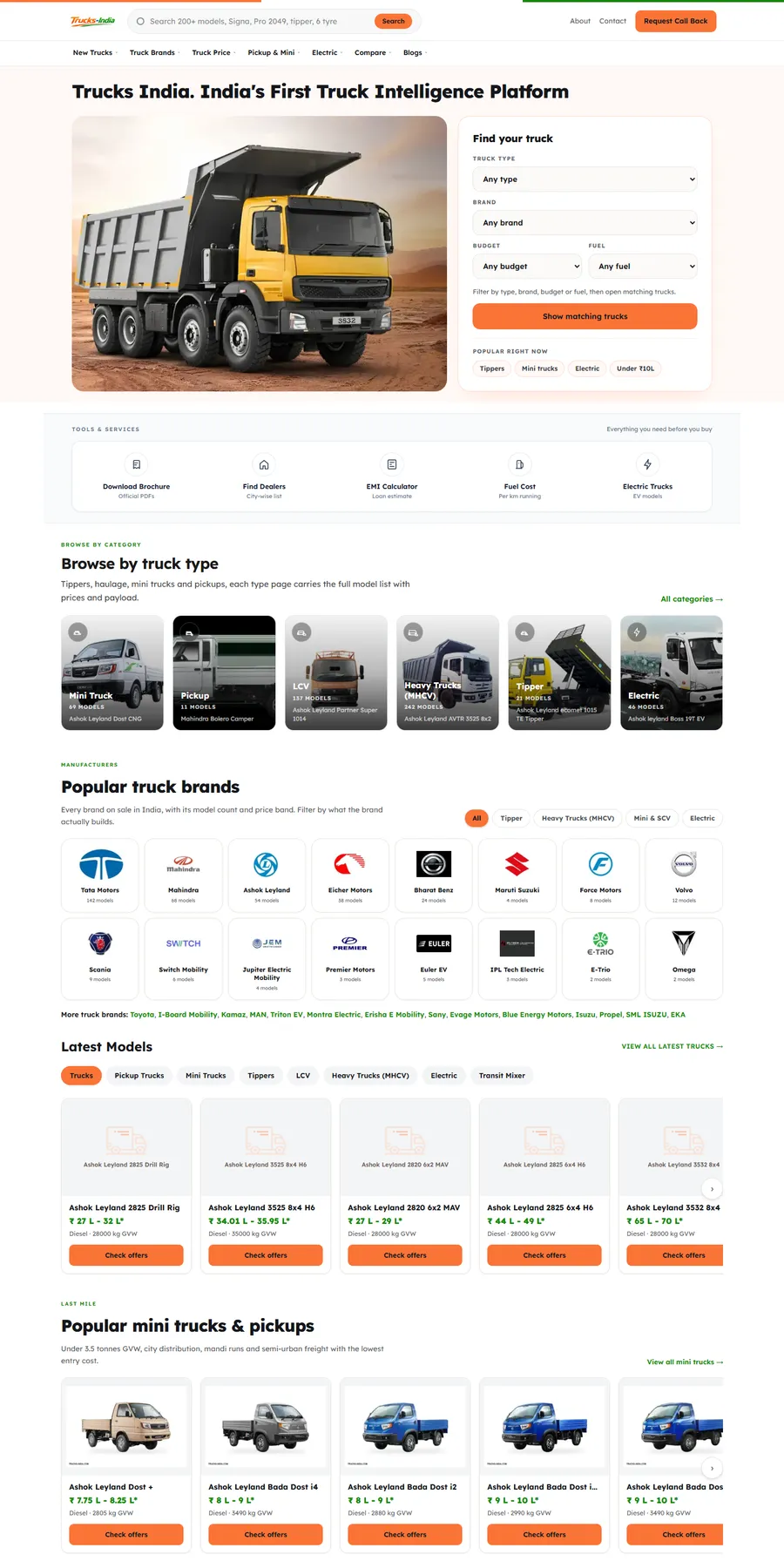
We built Trucks India with 497 models, 1,299 variant pages, filters, comparisons and calculators. A listing database with filters and detail pages is the same kind of work.
Track record front and center
Closed deals, broker deal sheets and dated research are planned from week one, because that is how owners and tenants choose a firm.
You own everything from day one
Code, design, content, domain, hosting and analytics in your name. If you change listing tools or stop working with us, the site and its history stay with you.
Disclosures and gating built in
License blocks per broker and state, confidentiality steps for OMs and investment pages gated to your exemption, flagged for your broker and counsel.
A dated plan and a guarantee on it
A week-by-week plan, weekly written updates and 30 days of free support after launch. If we slip a date because of us, the next month of support is free.
In writing, before we start
Fixed quote in 1 business day
Scope, deliverables and price agreed in writing, with a free audit of your current site. No hourly billing.
Launch date in writing
A dated week-by-week plan and a written update every week. If we slip because of us, the next month of support is free.
You own everything
Code, design, content, domain and accounts are yours from day one. No 12-month contract, no rented site.
30 days of support included
We watch rankings, forms and call tracking after launch and fix anything that needs it.
Proof, not promises
Results from websites we have built
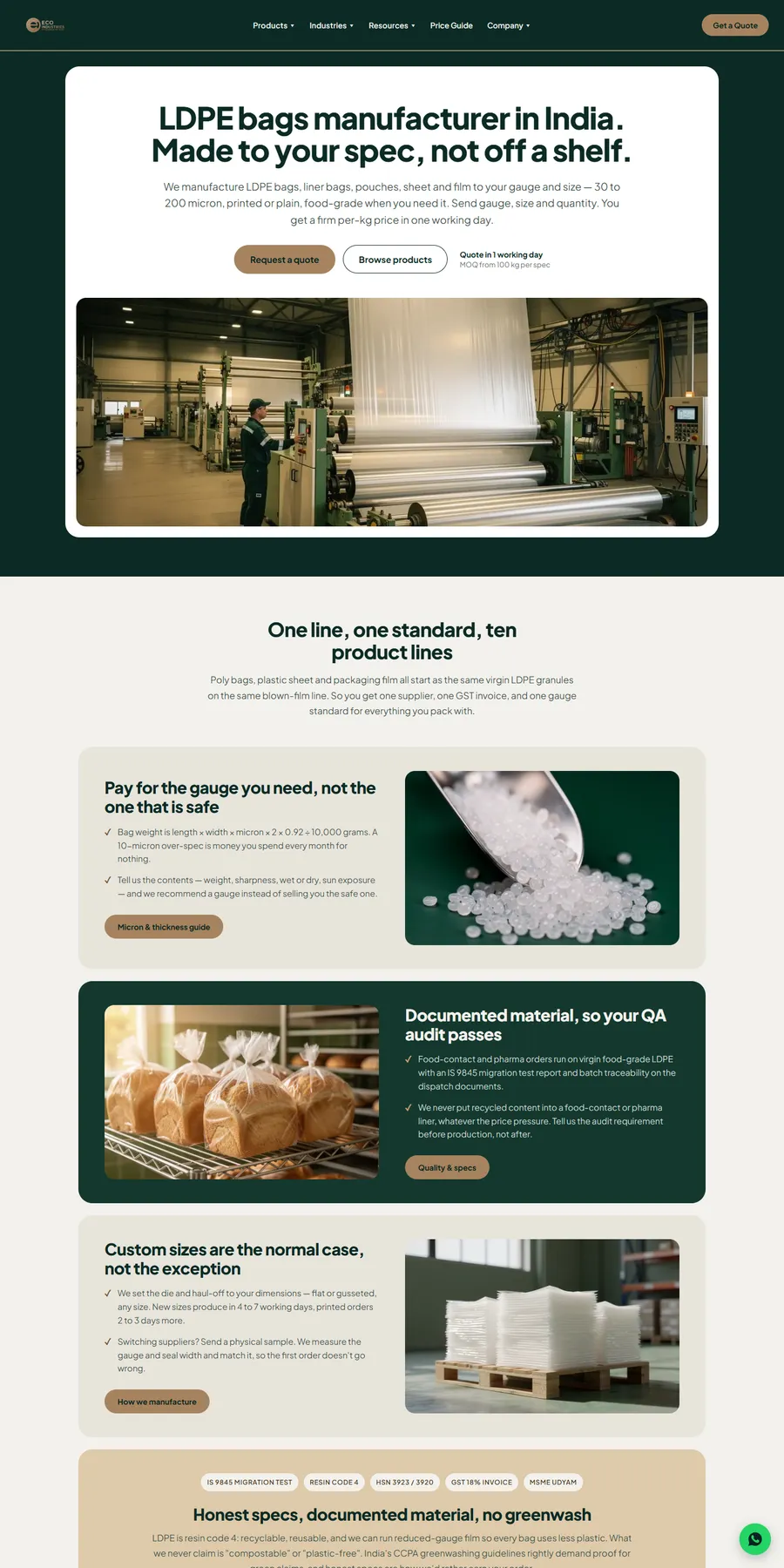
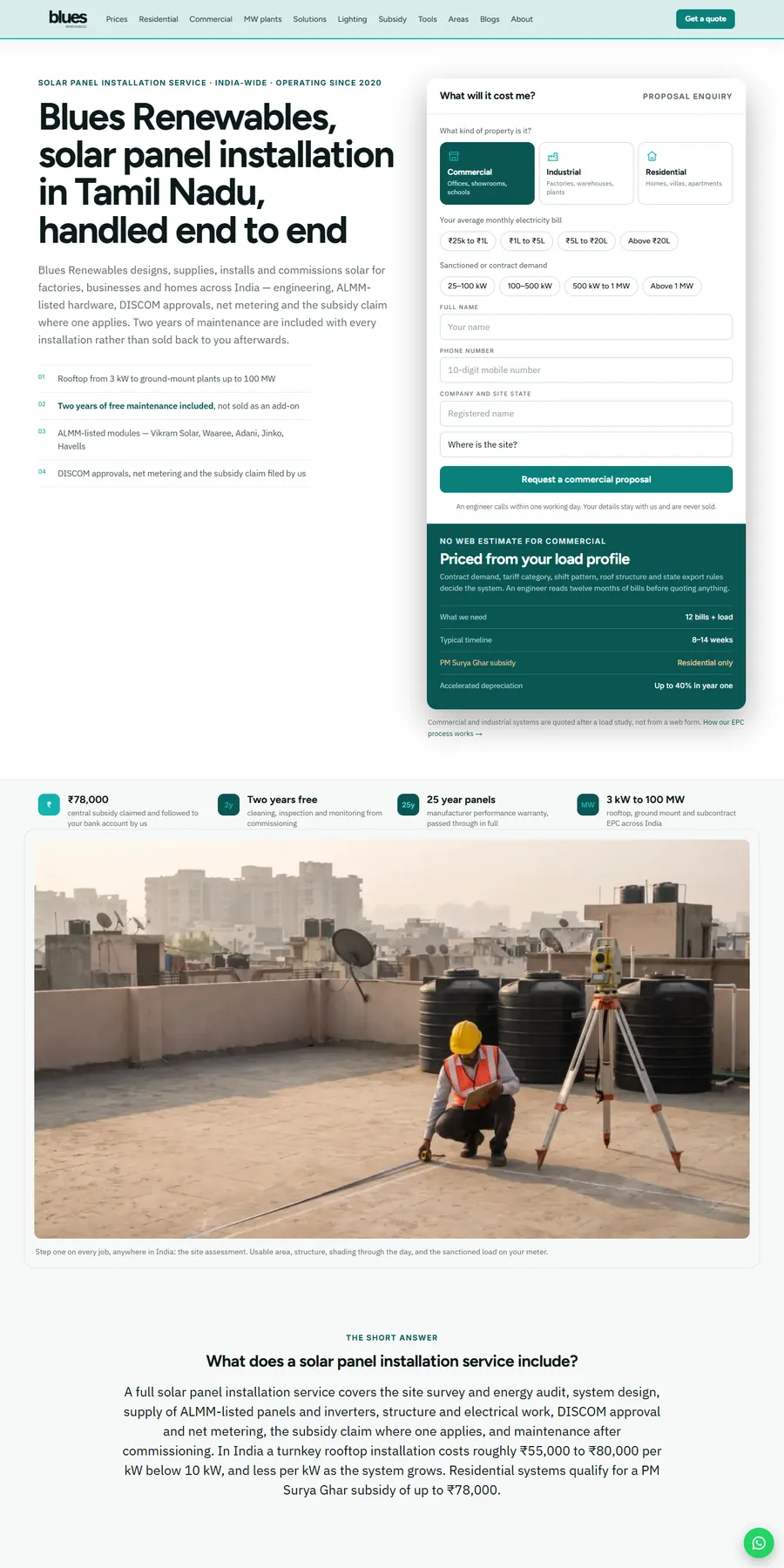
The closest proof is Trucks India, a commercial vehicle research platform: 497 truck models, 1,299 variant pages, comparisons and price, EMI and running cost tools, with 351 broken links fixed. Weekly Google clicks rose from 12 to 292 in five weeks and impressions from 321 to 49,755. A property database with filters, detail pages and comparisons is the same kind of build. Eco Industries shows a B2B site with a 44-page catalogue, technical buyer guides and industry pages that went from no enquiries to about 10 leads a week. Blues Renewables shows local area pages at scale (129 local guides) with every form and call tracked, the model for submarket pages.
How your commercial real estate website project runs
Typical timeline: 4 to 8 weeks for a boutique brokerage or investment firm; 8 to 12 weeks with listing integrations, many brokers or several offices. You see progress every week.
Step 01 · Week 1
Discovery and audit
We audit your current site, competitors, and how you show up on Google and in AI answers, then agree on goals and a fixed quote.
Step 02 · Weeks 2 to 3
Strategy and design
Sitemap, wireframes and full designs for your review. You approve everything before we build.
Step 03 · Weeks 3 to 6
Build and test
Development, SEO setup, speed tuning, and testing across devices and browsers.
Step 04 · Launch and beyond
Launch and grow
We launch, monitor, and improve based on real data. 30 days of free support included.
What shapes your quote
Scope, not hourly billing
Every project gets a fixed quote within 1 business day, agreed before work starts.
How listings reach the site: your database, a feed or manual entry
Number of brokers, offices, property type and submarket pages
Closed deal database and how much history we load
OM requests, confidentiality agreements and data room links
Investment firm pages and investor portal, with gating for your exemption
Research templates and whether we migrate past reports
Commercial real estate website questions, answered
Straight answers to what owners ask us, and what they ask Google and AI assistants. Ask us anything else.
How much does a commercial real estate website cost?
+
We quote one fixed price, agreed before work starts, based on the number of pages, features, integrations and content, including how listings reach the site. You get it within 1 business day of a free audit of your current site. There is no hourly billing.
How long does it take to build?
+
Most brokerage and investment firm sites take 4 to 8 weeks. Sites with listing integrations, many brokers or several offices take 8 to 12 weeks. You get a dated week-by-week plan before we start and a written update every week.
Can our listings sync to the site automatically?
+
Usually, yes, if your listing database or vendor offers a feed or API. If not, your team adds listings in the CMS. We confirm what your tools allow on the audit call before we quote.
Why have listings on our site if they are on the big listing platforms?
+
The platforms bring searchers; your site proves you are active, holds your full inventory and deal history in one place and captures inquiries you own. Many firms list on both and link back to their own listing pages.
How do we show closed deals without breaking client confidentiality?
+
Show what clients allow: property type, size, submarket and year are often enough, with names and prices only where permitted. The CMS lets you mark each deal public, anonymized or hidden.
Can we gate offering memorandums?
+
Yes. Buyers accept a click-through confidentiality agreement and give their details before they reach the OM or data room. Each request is tracked and routed to the listing team.
We raise capital from investors. What can our website say?
+
It depends on your exemption. Under Rule 506(b) there can be no general solicitation, so public pages usually stay at firm and strategy level. Rule 506(c) allows advertising if all purchasers are accredited and verified. Your securities counsel should review the site before launch.
Can brokers update their own pages and deals?
+
Yes. The site runs on an editable CMS with roles, and we train your team on a recorded call before launch. Brokers can update bios and deals; an admin approves changes.
What license information must the site show?
+
It depends on your state. California requires the license number and responsible broker on websites, and Texas requires an IABS link on the homepage. We build license blocks per broker and office and flag each for your broker to confirm.
How does our firm show up in Google and AI answers?
+
With deals, broker specialties and dated research written in text, one consistent identity across your site, profiles and listing platforms, and structured data for the firm and brokers. No one can guarantee a ranking or an AI mention, but a specific site gives them accurate facts.
What makes you different from another commercial real estate web design company?
+
We put the terms in writing first: a fixed quote in 1 business day, a dated plan, your ownership of everything and no lock-in. The build covers synced listings, deal history, broker deal sheets, dated research, OM gating and tracking by source, from a team that built a 1,299-variant vehicle database with filters and comparisons.